

DISTANT PLACES
Travel tips by Bremen sehenswert far from the Hanseatic City of Bremen
The "Green" Island of Corfu
From the sights of the capital, Kerkyra, to the Corfu Trail
Page 1 / 3
"We’re about to land in the water," a young woman remarks jokingly after glancing out the window. Her seatmate does not break the somewhat tense silence in the Airbus cabin, but a smile flickers across her face for a brief moment. This time, however, no "water landing" occurs; instead, the jet thunders at low altitude over the tiny Mouse Island (Pontikonissi) - beloved by the Austrian Empress Sisi - and the nearby, picturesque Monastery Island of Vlacherna.
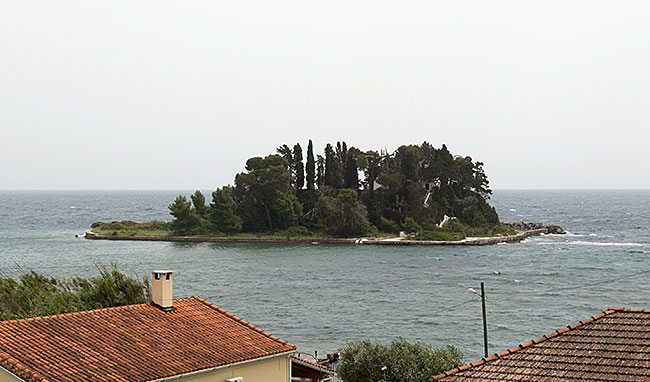
Even above Pontikonissi, the sun does not always shine
Then, the wheels screech as they touch down on the asphalt of the runway, which actually reaches right to the water's edge. This is different from many places in Greece, just as much as many things are said to be different about Corfu. Is that so? Let’s find out.
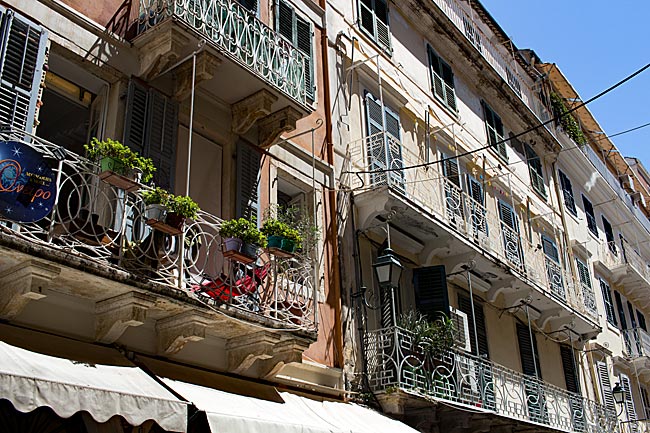
Venetian ambience in Kerkyra?
You can see this best in the neighboring capital, the second-largest of the Ionian Islands after Kefalos. The Greeks call not only the city but the island itself Kerkyra. According to legend, it was named after the nymph Gorgyra (also known as Kerkyra), who was brought to the island by the sea god Poseidon. A legend, indeed. In fact, the name appears in a modified form, "Korkyra," on written records as early as 1200 BC. The current name, Corfu, dates back to the Byzantine era. Once an independent island and later the first Roman province of modern Greece, it became part of the Eastern Roman (Byzantine) Empire after the fall of the Western Roman Empire in 395 AD. On a rocky promontory jutting into the sea, the Byzantines built a fortress in the early 6th century and named the city emerging from this core "Koryfo."
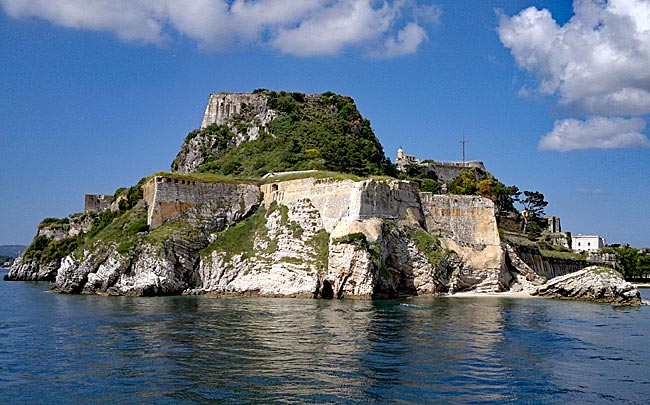
The Old Fortress in Kerkyra from the water
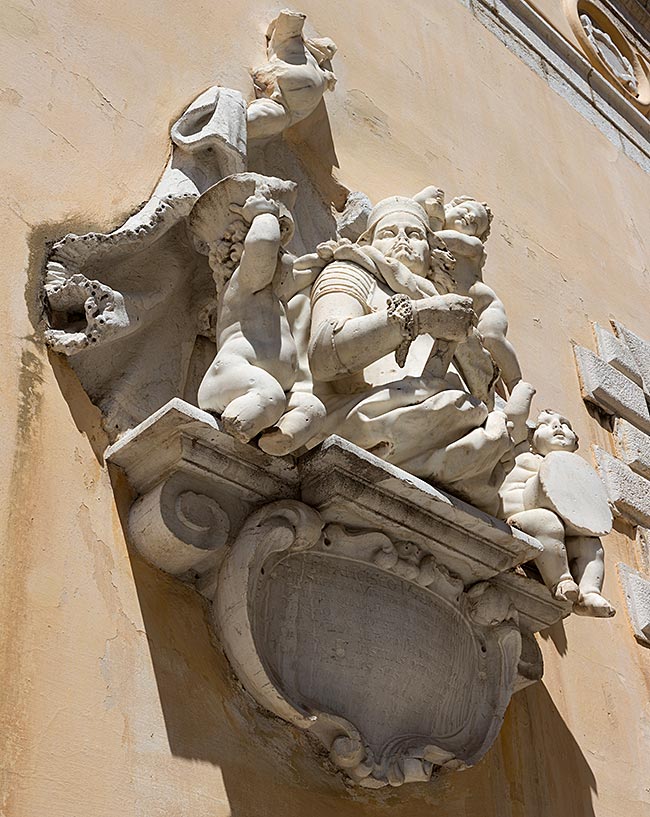
In the centuries that followed, the fortress was continually expanded and housed nearly the entire population of the island, about 3,000 people during the Middle Ages. Until the mid-14th century, the inhabitants of the island saw many masters come and go: Saracens, Normans, Franks; yet none influenced the architecture and culture of the island as lasting as the Venetians, whose feudal rule lasted until 1797. They knew how to defend their power; they expanded the fortress massively and separated it from the island by constructing a moat known as the Kontrafossa. The greatest threat came from the Ottomans, who attempted to capture Corfu several times. However, after a prolonged siege of the city by the Muslims, the Venetian army under the German Johann Matthias von der Schulenburg finally put an end to the threat in 1716. For his merits, a Baroque monument was erected for him in front of the Old Fortress.
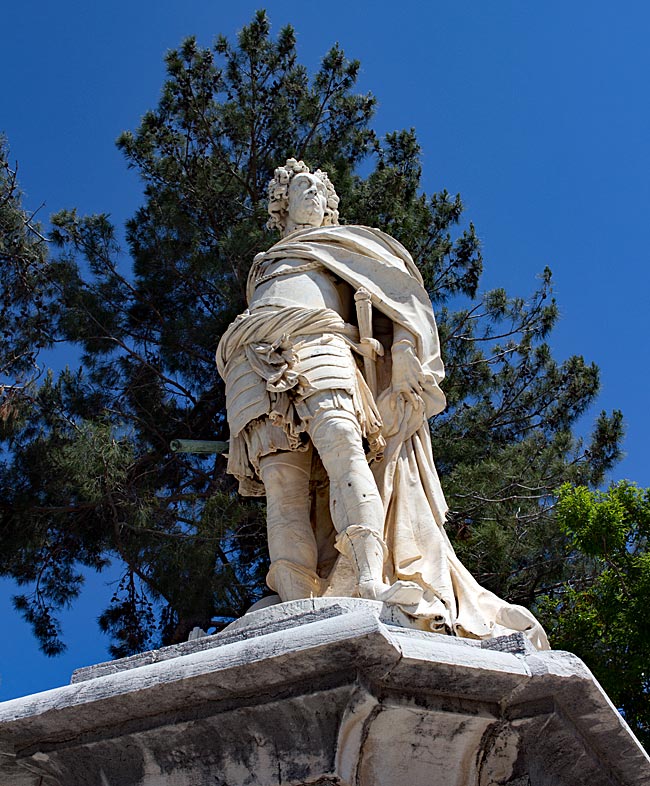
Johann Matthias von der Schulenburg
In 1815, Corfu became part of the United States of the Ionian Islands under British protection. During the period until 1864, when the island was finally annexed by Greece, the British created much of the modern infrastructure, including a dense network of roads - notable for Greek standards.
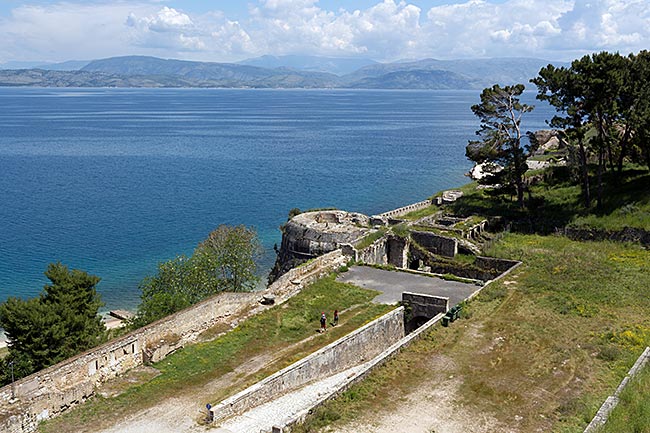
Today, the Old Fortress (Palaió Froúrio) is arguably the city's most important landmark, and the entrance fee is well spent; from the grounds, one enjoys a fantastic view over the city, the port facilities with their cruise ship piers, and the mainland coast on the opposite side.
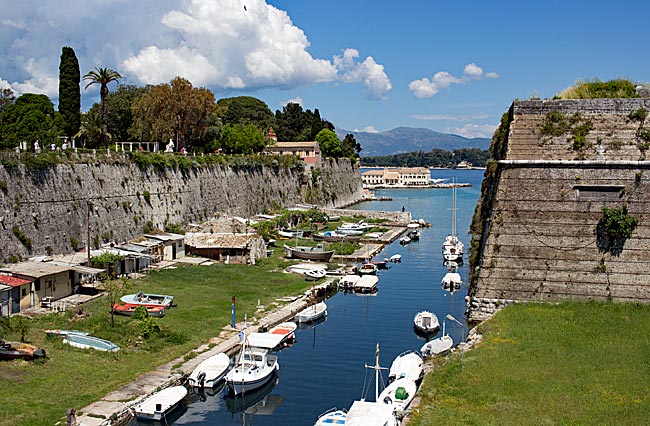
View of the moat in front of the Old Fortress
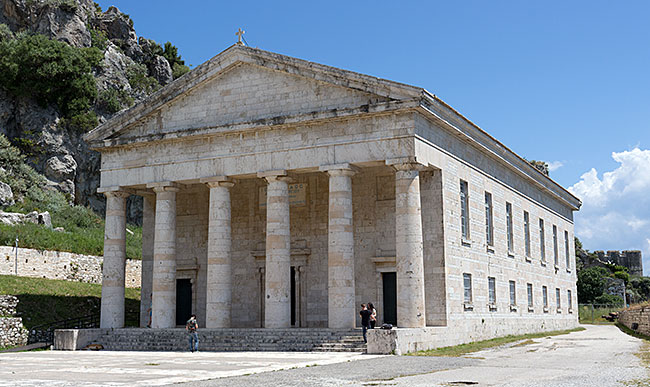
After crossing the bridge over the moat - where pleasure craft are moored today and small huts and sheds stand along the banks - an exhibition in a side room of the gatehouse from the Venetian era displays mosaics and wall paintings from early Christian times. Most of the structures still standing behind the massive fortress walls are remnants from the British period, such as former soldiers' barracks, the old hospital, and the Church of Agios Georgios, which resembles a Doric temple from the outside. Cannons from the 17th and 18th centuries scattered across the grounds give an impression of the caliber of weaponry used in emergencies at that time.
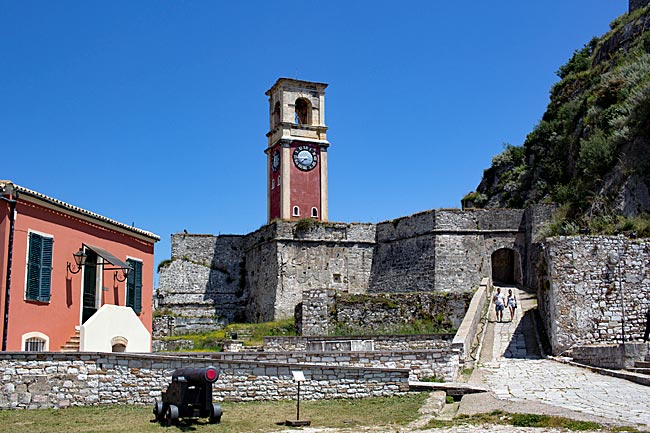
Inside the Old Fortress
The tallest structure in the fortress complex and the primary destination for most visitors is the Land Tower. Through corridors with worn paving and up flights of stairs, you reach a platform from which you can see not only the aforementioned panoramic view of the city but also the full scale of the old Venetian complex. The view reveals how small the city of Kerkyra was behind these walls in the Middle Ages compared to today.
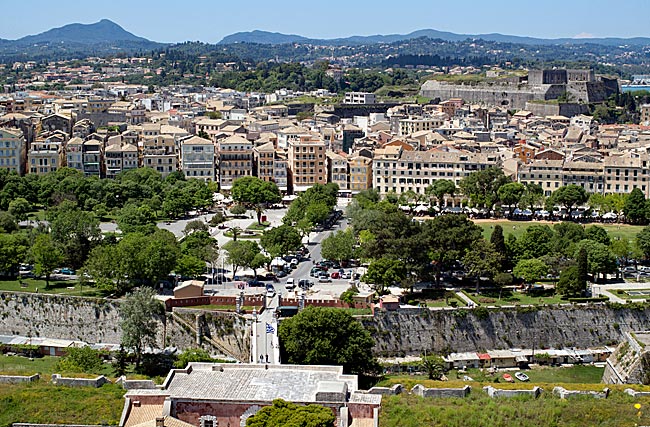
View from the Old Fortress of the Esplanade and the Old Town with the New Fortress
As your gaze wanders over the rooftops of the downtown houses, you realize that the Old Fortress was not the only bulwark for the defense of Kerkyra; just 450 meters in a straight line away, the intimidating New Fortress (Neo Froúrio) rises. After the siege by the Ottomans in 1576, the Venetians felt compelled to take further measures to protect the city and secure their power, leading them to construct the imposing fortress directly on the water at the current harbor until 1645.
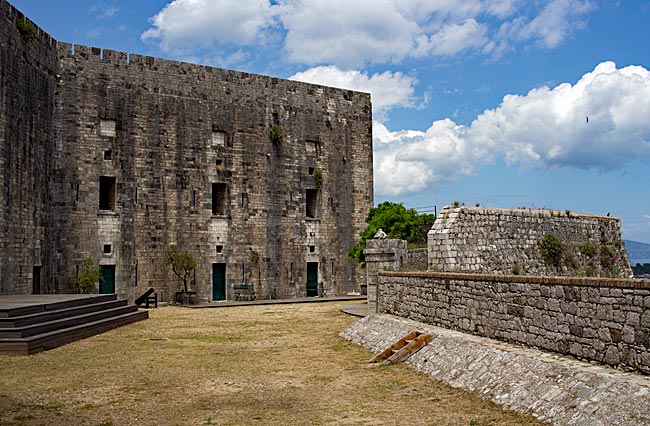
On the New Fortress
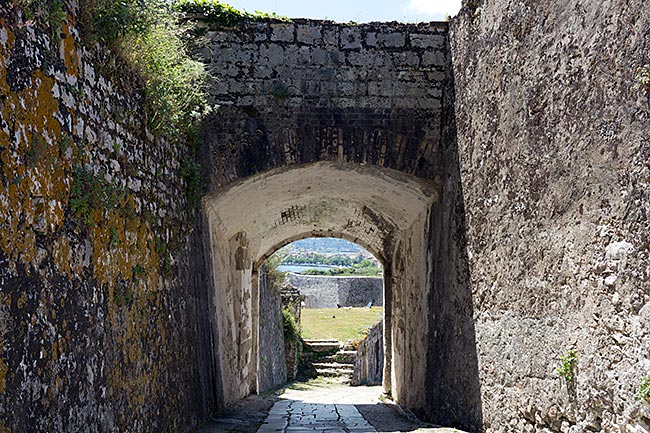
Once, the two fortresses were connected by a wall; the last remaining city gate is located quite inconspicuously as a passageway in a house at the edge of the pedestrian zone. The well-preserved defense system - which still bears the stone-carved winged lions, the symbol of the Republic of Venice, in several places - is now freely accessible, though it is not particularly spectacular. Most of the buildings are locked, so one can only walk through the open areas; however, even from the top level, there is a fantastic view over the town, the surroundings, and the Old Fortress.
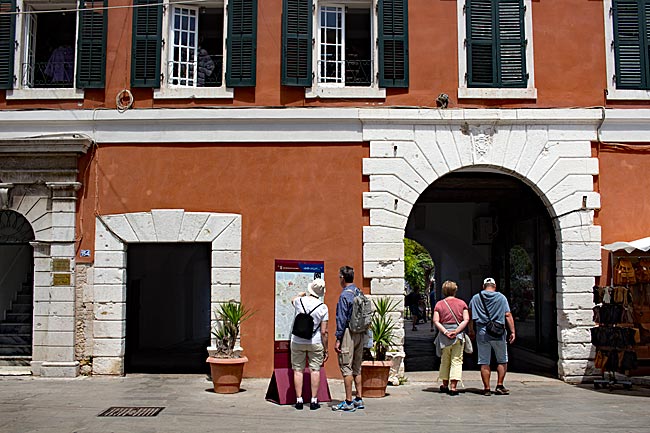
The last of the old city gates
Through the Old Town of Kerkyra
In front of the old town lies a wide green strip crisscrossed with roads and paths: the Esplanade (gr. Spianáda). It hasn't always been a park inviting people to linger on its many benches; rather, its creation was due to the evolution of military technology - specifically, the mass introduction and use of cannons in the 15th century. To create a clear field of fire, the Venetians ordered the demolition of the houses located here following an Ottoman attack in 1537 and used the space as a parade ground.
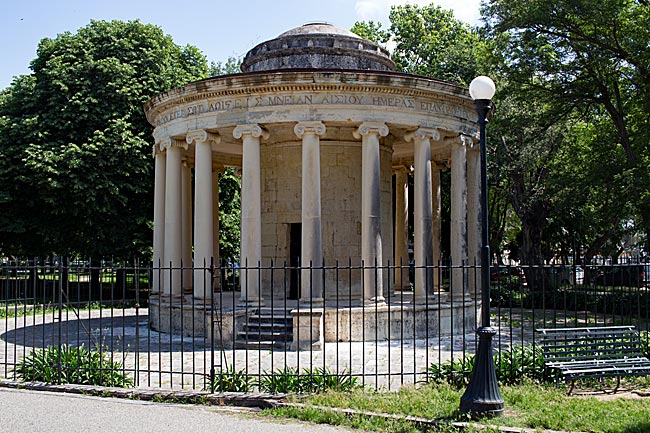
Rotunda on the Esplanade
It was only during the first half of the 19th century, under French and British rule respectively, that the area was transformed into a park with fountains, flower beds, trees, and hedges. At the center of the grounds stands the Ênosis Monument, which commemorates the union of the seven Ionian Islands with Greece in 1864.
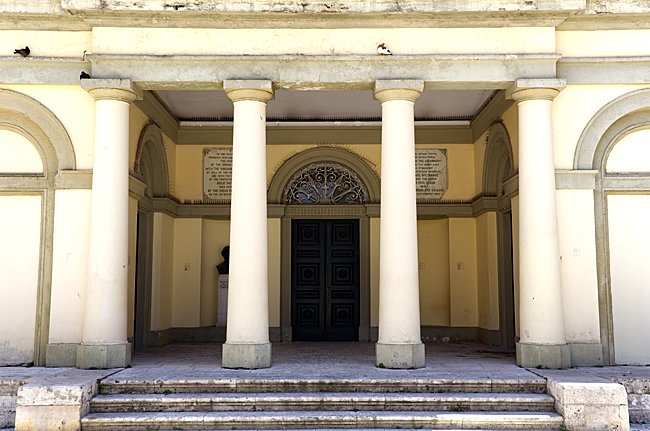
"In this building, formerly parliament house, the union of the Ionian Islands with the Kingdom of Greece by will of the Ionian people and with the consent of the protecting power Great Britain was voted by the Ionian parliament on the 23rd September 1863"
The shaded benches around the freestanding music pavilion - designed in the Belle Époque style - are often well-visited. The nearby Rotunda, built in honor of the first Lord High Commissioner of the Ionian Islands, Sir Thomas Maitland, is protected by an iron fence due to its dilapidated condition and can only be viewed from the outside.
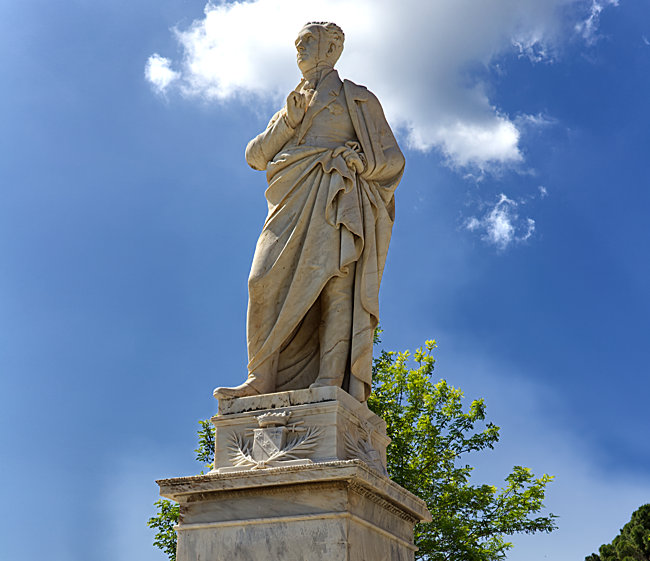
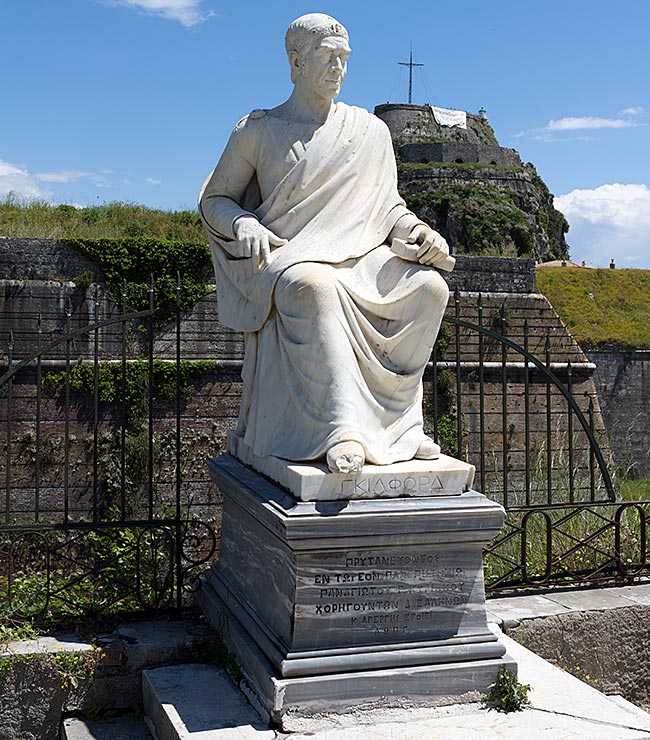
Ioannis Kapodistrias
A few meters away, the people of Corfu erected a monument to one of their own and the first Greek president after the War of Independence in 1829, Ioannis Kapodistrias, in front of the old building of the Ionian University (founded in 1824 by Frederick North, Earl of Guilford).
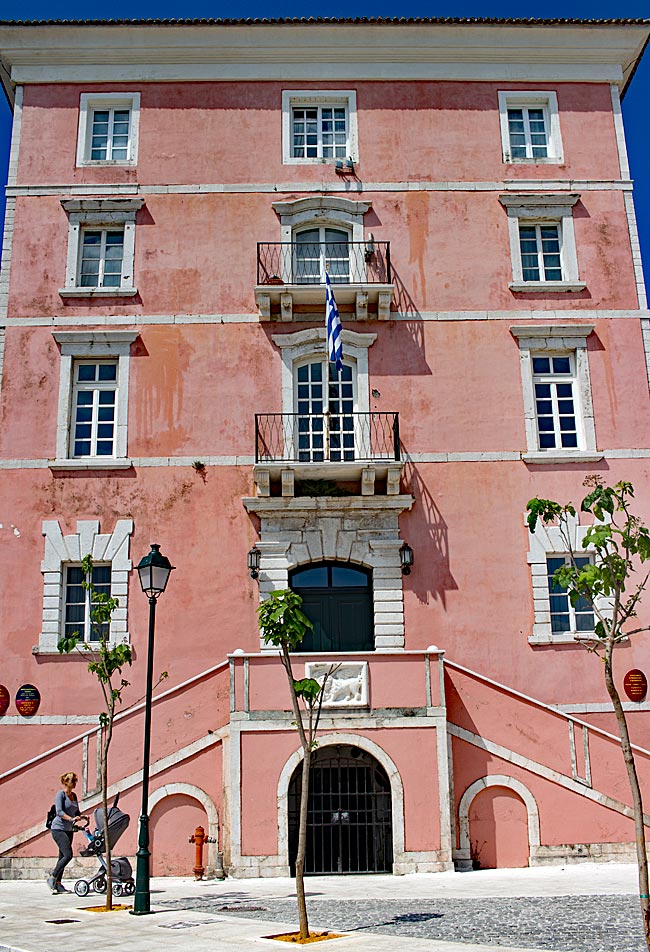
Ionian University Building; a relief with the Venetian lion is visible on the stairs.
Much more impressive is the building bordering the opposite side of the Esplanade: the Palace of St. George and Michael. In 1816, the British had the palace built by Maltese craftsmen using imported materials in a Neoclassical style featuring 20 Doric columns, a frieze by the local sculptor Pávlos Prosaléntis, and triumphal arches on both sides as a Governor’s Palace. The Lord High Commissioner who once resided here has long since moved out, as has the Greek royal family that occupied it later. Today, it houses the Asian Museum, which contains the largest collection of its kind in Greece with 10,000 objects.
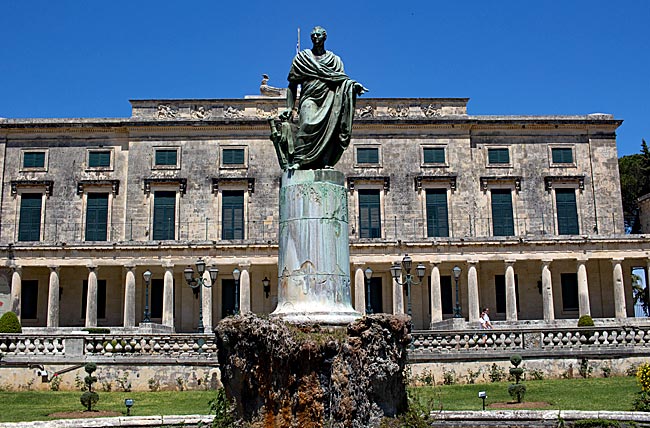
Palace of St. George and Michael
It isn't perfectly quiet around the Esplanade, partly because the coastal road along the square passes by the Old Fortress. However, this doesn't deter any of the guests at the cafes and restaurants on the opposite side, which border the Esplanade directly. For those who have a choice, it is a "pleasurable dilemma": which seats are best under the many sun-providing umbrellas, or under the arches of the Listón? A row of buildings constructed by the French in the early 19th century in a Neoclassical Empire style, the Listón offers an elegant alternative. In such a case, one can only decide by trying them all out.
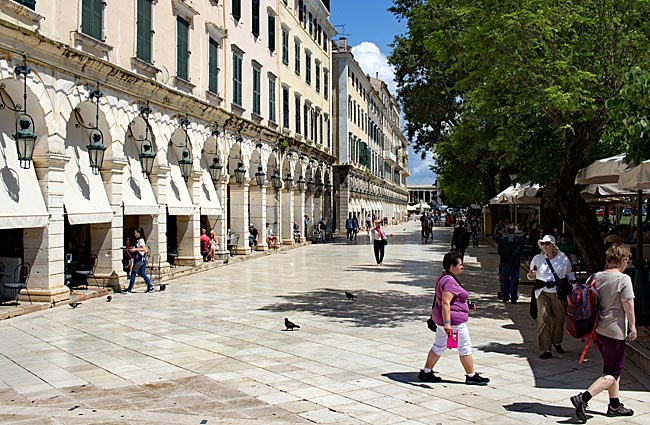
Listón
previous page
 next page
Map
More photos
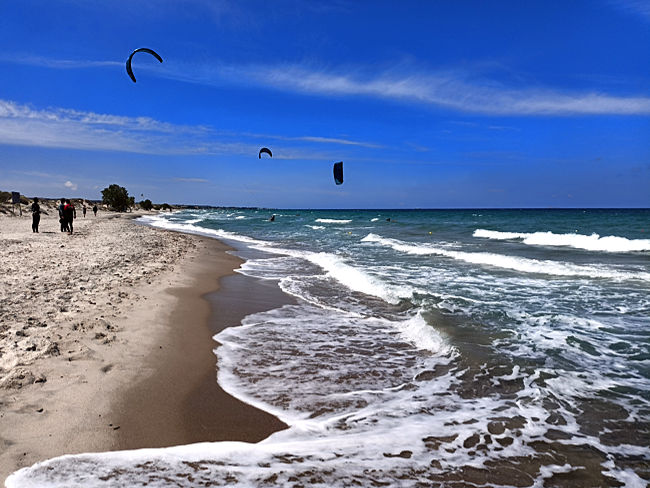
Kos - The Greek Dodecanese Island
A Travel Guide
Greece, the cradle of democracy. While some may think of great philosophers like Plato and Aristotle, or mathematicians such as Archimedes and Euclid; others might think of victorious generals like Alexander the Great, who founded Alexandria in present-day Egypt with its legendary library. Yet others may have sun, beach, Mediterranean flair, or the scent of thyme in mind when Greece is mentioned.
read more about Kos ...
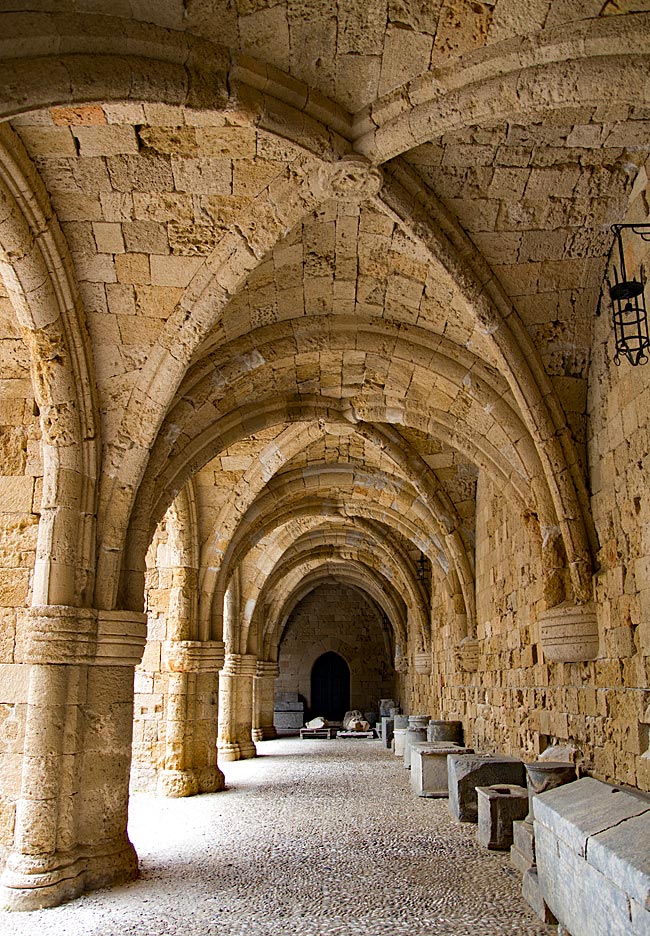
UNESCO World Heritage Site on Rhodes
A journey through the historic Old Town of Rhodes
Relics from various eras - ranging from antiquity to the period of Italian occupation - can be found almost everywhere on the island. Many have left their mark; in some places, they must be sought out, while in others, they appear in clustered, fascinating density and variety. Yet, nowhere else on the island are these traces as prominent as they are in the city of Rhodes. It is not for nothing that the historic Old Town was declared a UNESCO World Heritage site in 1988.
read more about Rhodes Old Town ...
Zakynthos
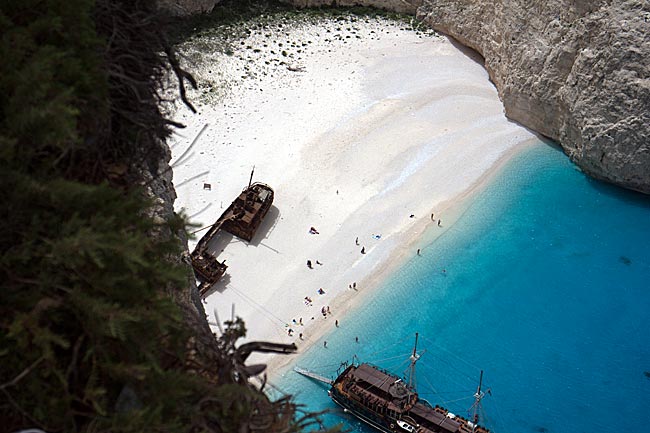
An island defined by the Caretta caretta
When searching for images of the 406 km² island online, one primarily encounters a very common recurring motif that has been captured from a similar angle by various photographers over the years: Navagio Bay on the northwestern coast. It's all junk, right? Well, that is a matter of perspective, and there are plenty of those during the season, whether they have a camera or not. The fact remains, however, that the rusting wreck of the motor vessel "Panagiotis" has become a landmark for Zakynthos.
read more about Zakynthos ...
Symi
An excursion to the Greek Dodecanese island off the Turkish coast
A visit to this sparsely populated rocky island of about 60 square kilometers, with its namesake picturesque harbor town, is part of the standard tour itinerary offered in many locations on the Greek island of Rhodes. From the main island, it takes ships approximately two hours to reach the port of the small island located 23 kilometers north of Rhodes off the Turkish coast, which has belonged to Greece since 1947. As more of the Greek coast recedes into the distance to the port side, the ship draws closer to the Turkish shore; this part of the southern Aegean essentially connects Europe and Western Asia.
read more about Symi ...