

DISTANT PLACES
Travel tips by Bremen sehenswert far from the Hanseatic City of Bremen
The "Green" Island of Corfu
From the sights of the capital, Kerkyra, to the Corfu Trail
Page 2 / 3
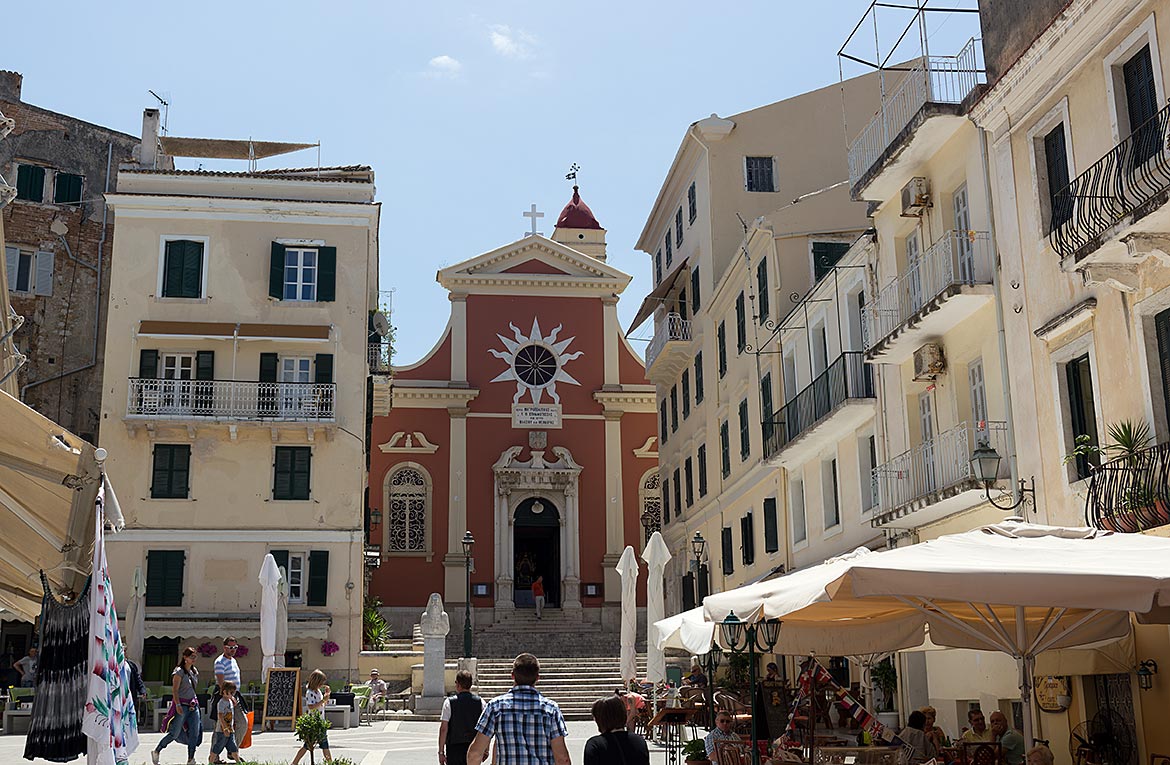
Beyond the Listón, the continuation of Odós Dousmáni, which cuts across the Esplanade at the level of the fortress, leads into the labyrinthine network of streets in the city center. It serves as the central axis and main shopping street through the heart of the town, initially a pedestrian zone, and then as G. Theodoki Street, passing by the City Theater and San Rocco Square with its bus station. Worth seeing at Platia Theodoki, next to the Catholic Cathedral of St. James and St. Christopher (San Giacomo) - originally built in the 17th century during Venetian times and reconstructed after WWII - is the current Town Hall (Dimarchion). This elegant building in the Venetian style was constructed between 1663 and 1691; it initially served as an aristocratic club, was used as a theater after a renovation in 1720, and was only converted into a town hall in 1903.
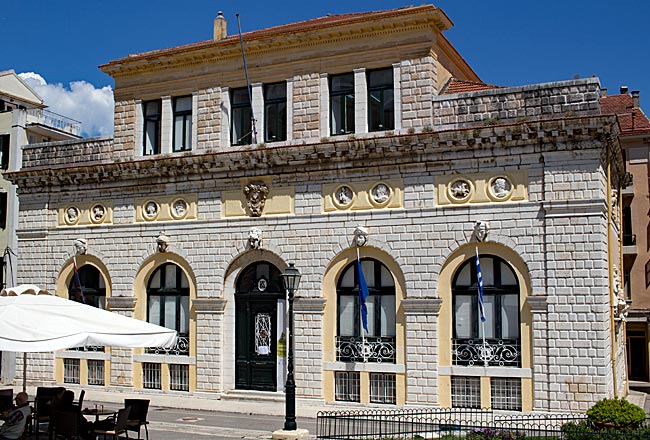
Dimarchion
The Platia, planted with palms, low hedges, and multi-colored bougainvillea, is occupied by cafés and restaurants with their tables, chairs, and sun umbrellas. Indeed, there is no shortage of culinary offerings for every palate in Kerkyra - whether in a quiet, hidden location or in the heart of the hustle and bustle. A beautiful view of the square, with its lush bloom during the warm season, can be seen from the nearby elevated former bishop's seat, where a branch of the Bank of Greece now operates.
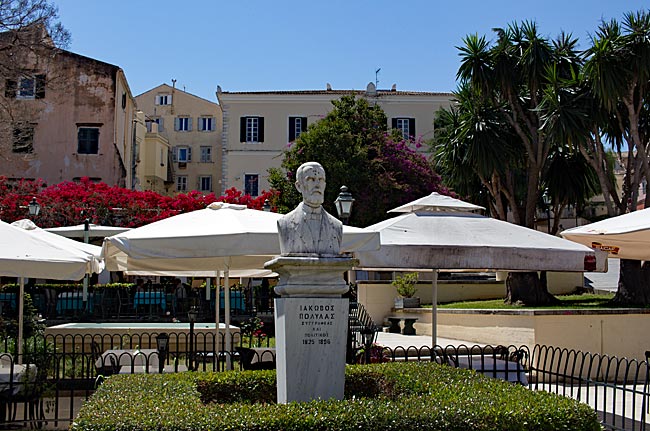
Platia in front of the Town Hall
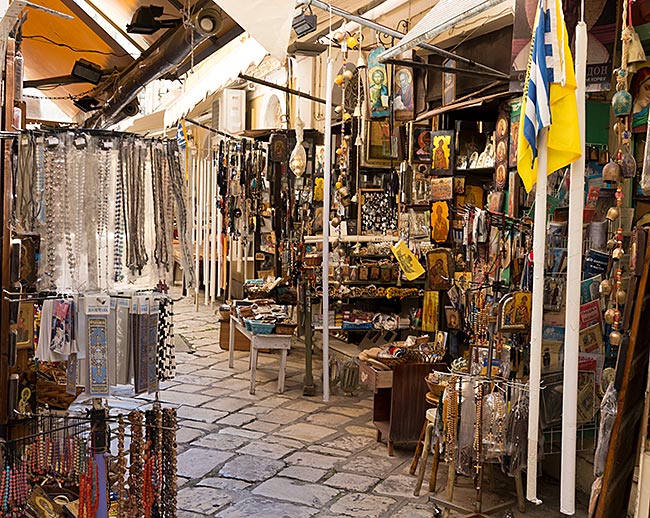
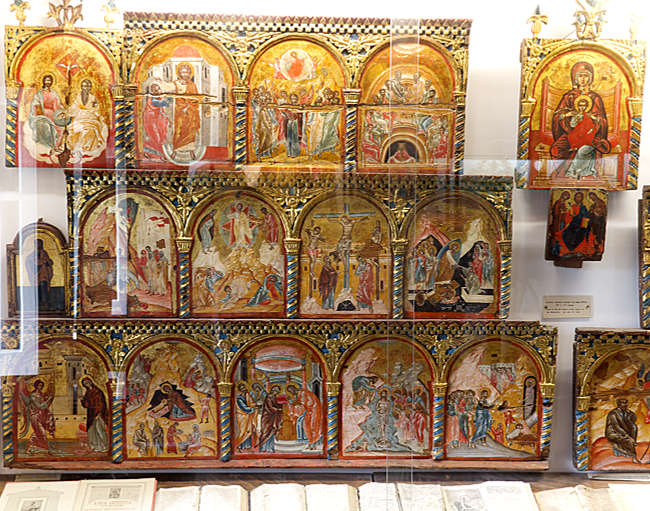
Not far from the town hall, the bell tower of the church of Saint Spyridon - consecrated in 1590 - rises prominently in a parallel alley. Agios Spiridon is the patron saint of the island. The Baroque paintings on the ceilings and walls of the interior broke with the old Byzantine tradition at that time; from today’s perspective, this may seem hardly revolutionary, as very few visitors would notice a difference. This modest sacred building is a destination for many believers because, in a room to the right of the marble iconostasis made in 1664, the mortal remains of the saint - who died around the year 350 - are kept in a sarcophagus made of ebony and embellished with silver. Yes, if indeed they are his; for they arrived on the island via winding paths three centuries later. So, is it faith or fact? Well, the work of the Italian silversmith alone is well worth a look. Photography inside is, as often happens, forbidden, but local traders right next to the church offer icons and more for those seeking authentic souvenirs. However, not everything that glitters is gold.
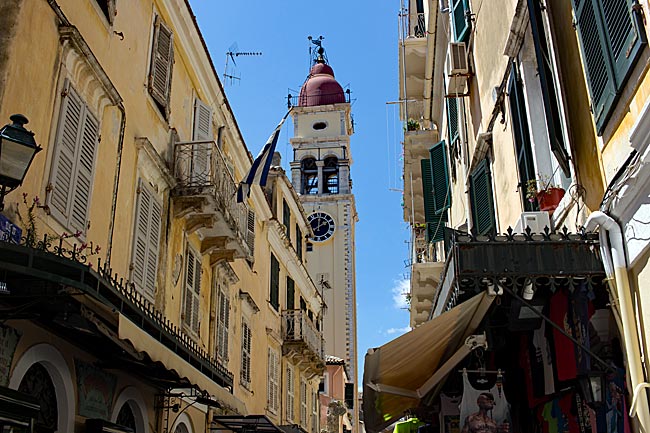
The bell tower of Agios Spiridon
Four times a year - on Palm Sunday, Maundy Thursday, August 11th, and the first Sunday of November - the bones of St. Spyridon (colloquially called "Spiro" by locals) are carried through the city in a large procession. These dates are not chosen at random; on August 11th, for instance, the final liberation from the Ottomans on that day in 1716 is remembered and celebrated.
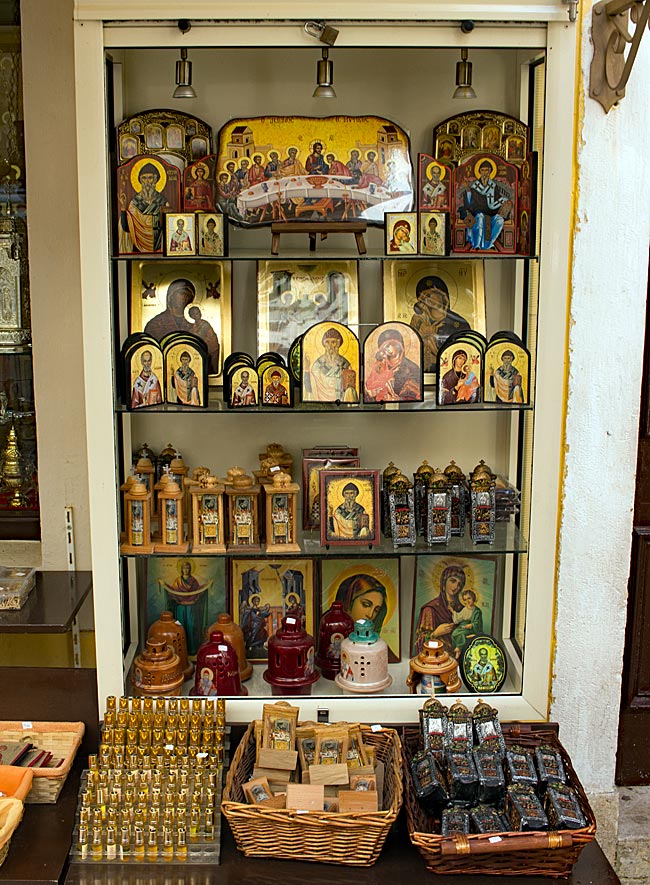
Icons on sale
Besides Agios Spiridon, there are many churches in Kerkyra, some half-ruined or deconsecrated, such as the ship-less Basilica of the 15th century, which has housed the Byzantine Museum since 1984, showcasing works from the 15th to 19th centuries. The sacred artworks were created by both local and foreign artists who initially worked in the Cretan School, but after the Ottoman conquest of Crete in the 17th century, they developed a new school of art on the Ionian Islands - one that was less Byzantine and more influenced by the West.
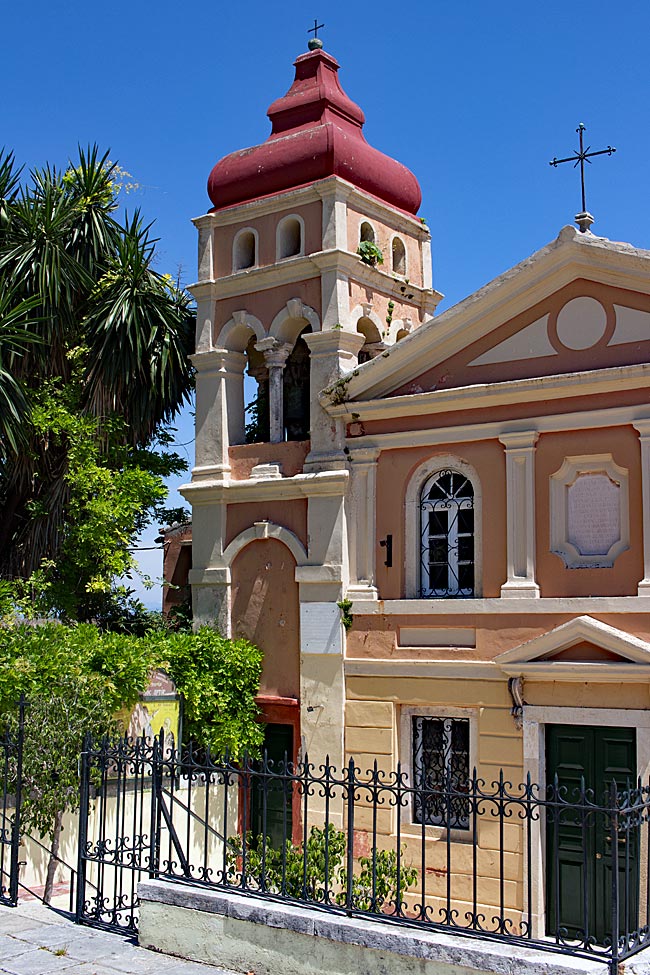
Small church on the Esplanade
The oldest church in the city is the Church of Jason and Sosipatres, built during the Byzantine era around 1000 AD. Located slightly outside the inner city toward the Analipsis peninsula, this area housed the first city of Corfu, Paleopolis, in antiquity. More centrally located is the Panagia Spiliotissa, known as the Metropolis at the harbor near the New Fortress. In this Orthodox cathedral, built in 1577, Byzantine Empress Theodora II found her final rest in a sarcophagus. The wife of Emperor Theophilos and regent for 13 years after his death in 843, she is considered a saint in the Orthodox Church because, by taking office, she reintroduced the veneration of icons and forbade their destruction. This decision influenced the appearance of Orthodox churches to this day.
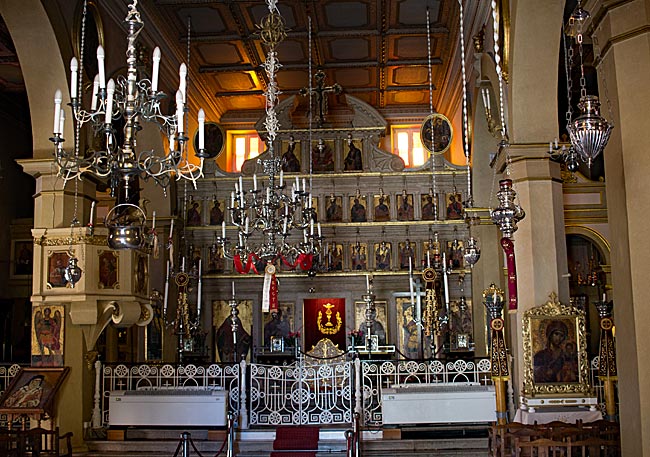
A view into Panagia Spiliotissa
A block further away, local residents pay homage to another notable figure. The nobleman and poet Dionysos Solomos was born in 1798 on the neighboring island of Zakynthos but died 59 years later on Corfu; he is now buried in the Solomos Museum. He only achieved widespread fame posthumously in 1865, when his 1823 poem "Hymn to Liberty" was set to music by the Corfu-born composer Nikolaos Mantzaros and became the national anthem of Greece (and a year later, also that of the Republic of Cyprus).
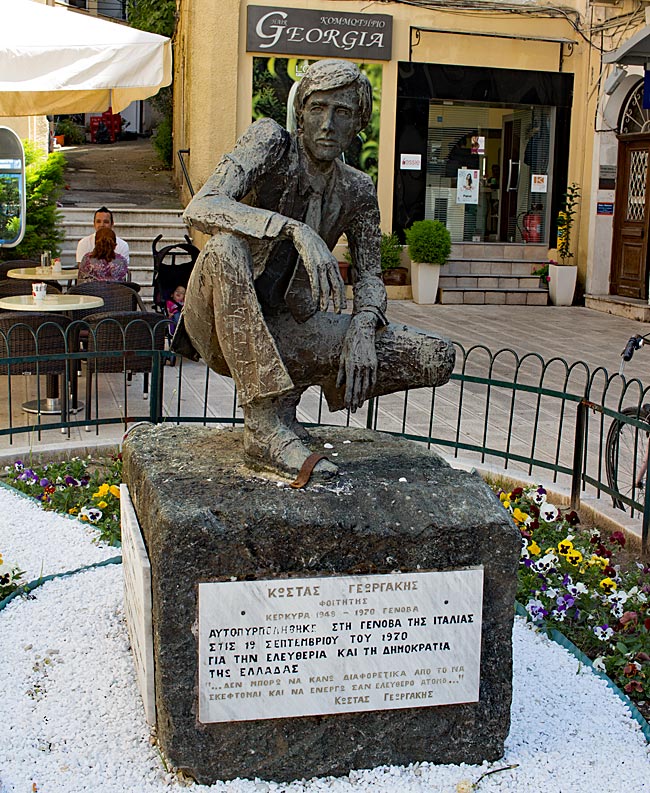
Memorial for student Costas Georgakis, who burned himself in Genoa in 1970 in protest against the military dictatorship in Greece for freedom and democracy
During a city tour, one can wander aimlessly or tick off sights with a map in hand, depending on personal taste. One can spend hours strolling through Kerkyra's polished main streets, browsing displays that range from exclusive and expensive to affordable, from extraordinary and stylish to kitsch; or one can feast on the wide variety of culinary offerings. And if desired, more "sights" can be found in the immediate city center than those mentioned here.
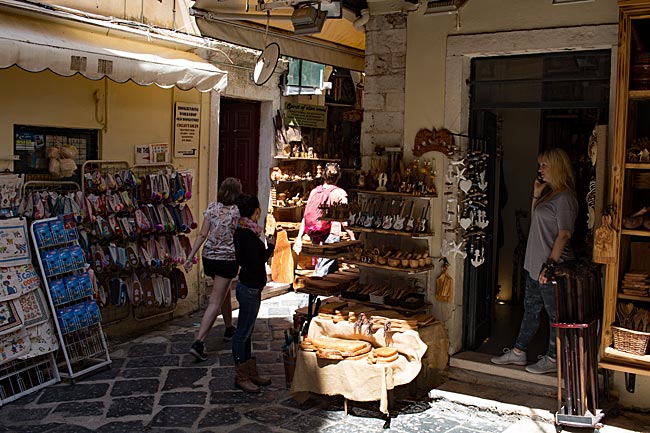
Business
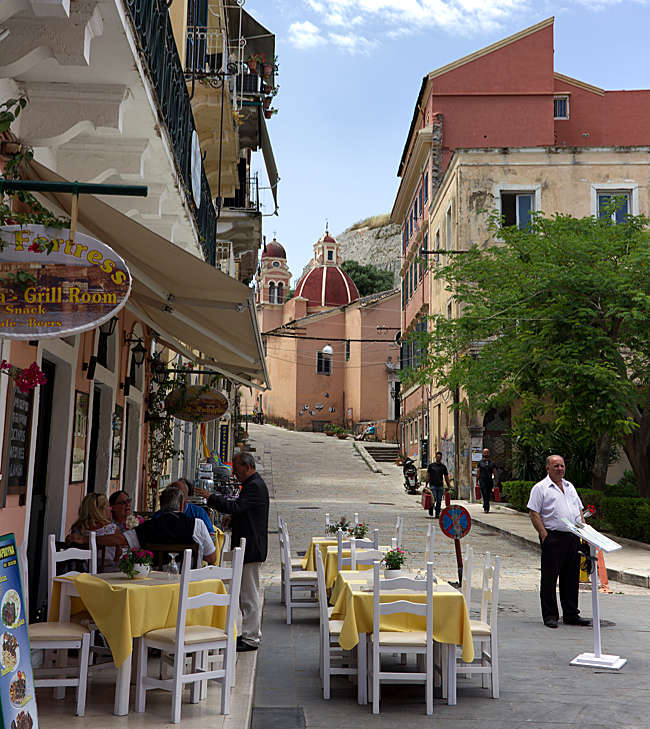
However, beyond all that, something else can be discovered, for instance on the hill known by the Venetians as Kambielo, surrounding the Metropolis. In this labyrinth of alleys - some barely wide enough for donkey carts or pedestrians - the island's capital reveals its original character, and one can almost catch a breath of old Venice through the neighborhood with its many stairs. As soon as you leave the main tourist trails and immerse yourself here, a sense of calm takes over, and life slows down significantly. Only a few people are moving quickly here, riding their scooters on the old cobblestones.
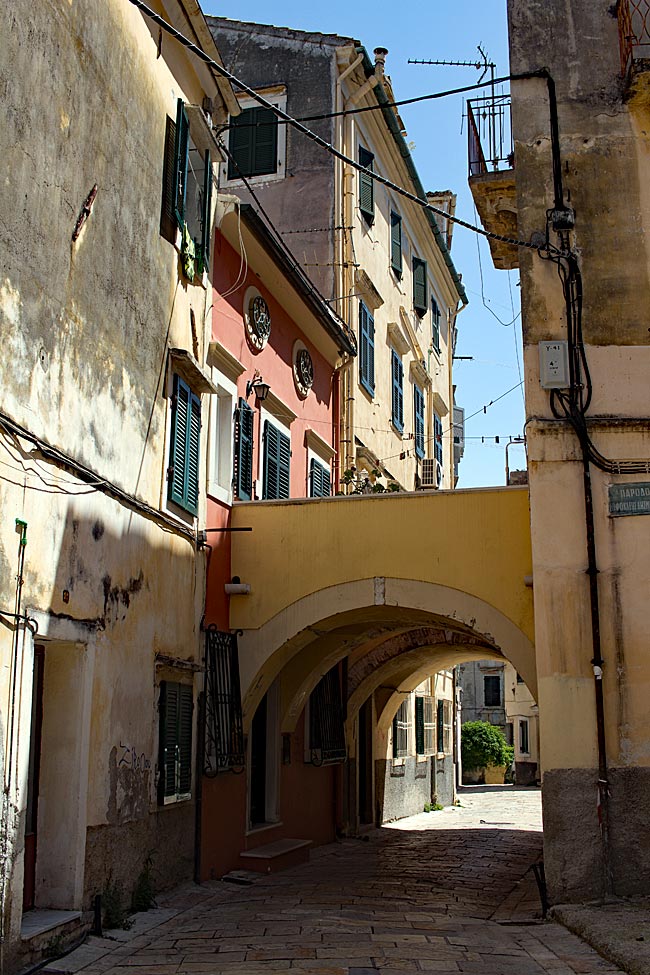
Beyond the polished streets
On many facades of the multi-story houses, paint peels and plaster crumbles; some shutters hang slightly crooked; electricity is handled somewhat unconventionally; and residents dry their laundry on lines strung from house to house. The windows of the nearly ground-level lower floors are often at head height, meaning one might peer into the apartments while passing by. And at certain times, sacks of trash pile up at collection points, stinking in the heat. This is where life happens.
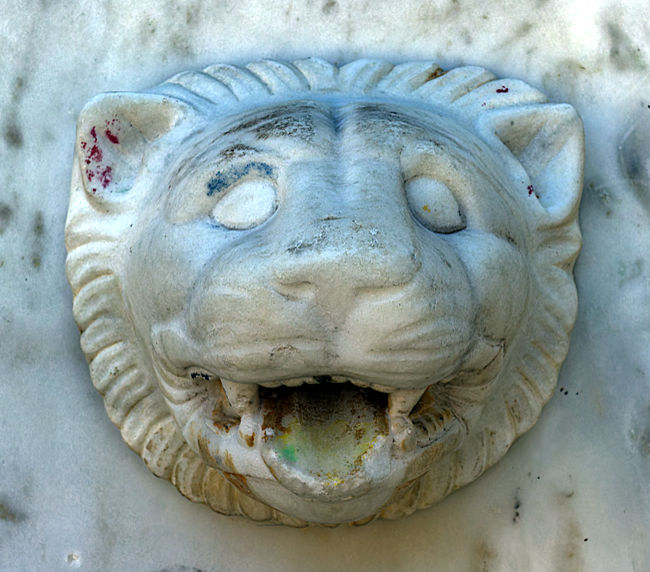
One of the most beautiful squares in the district is Platia Kremasti, featuring the Kremasti Fountain from 1699, donated by a wealthy patron. One of the surrounding buildings is the namesake church from the 16th century.
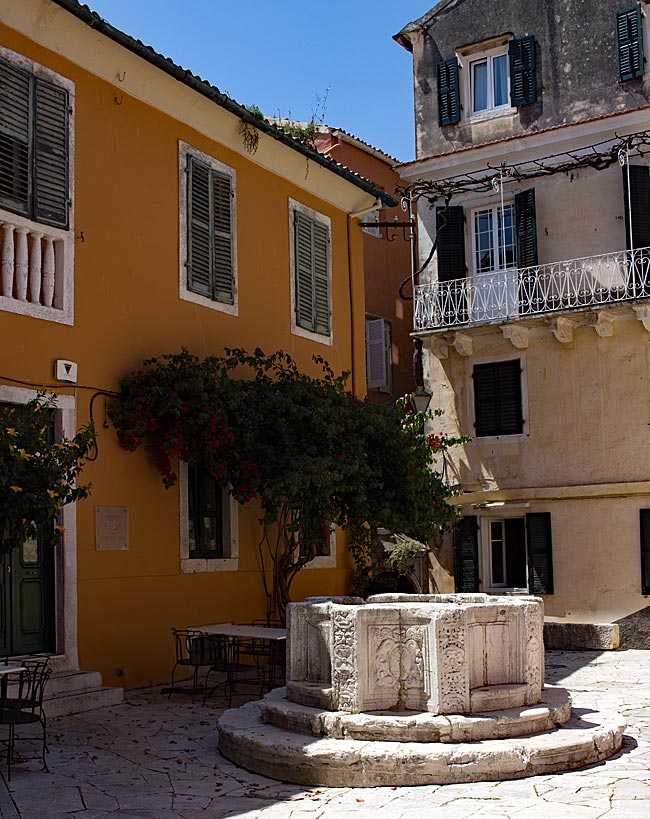
Platia Kremasti with fountain
Not just this neighborhood, but the entire old town of Corfu City has been listed as a UNESCO World Heritage site since 2007. And it is not only this largely unchanged neoclassical architecture since the mid-19th century that makes the island's capital - and Corfu itself - different from many other parts of Greece. This becomes most apparent when looking over the city from one of the two fortresses; here, one will not find the white-and-blue color combination often seen as typical on Greek Mediterranean islands. Instead, most houses are painted in shades of yellow and light brown. The Western influence is evident in both architecture and culture, rather than the Eastern influence experienced by much of Greece under Ottoman rule; the absence of mosques is merely one expression of this fact.
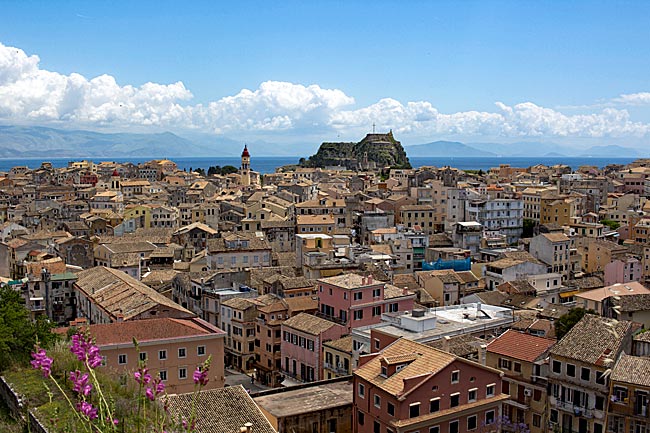
View from the New Fortress over the Old Town of Kerkyra, with the Old Fortress rising in the background and the mainland visible in the distance


Map
More photos
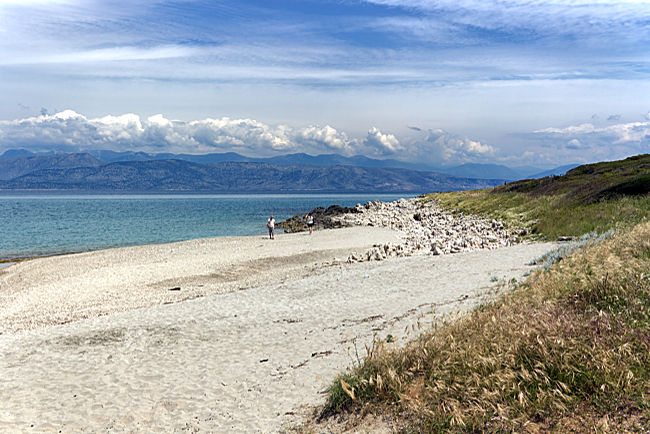
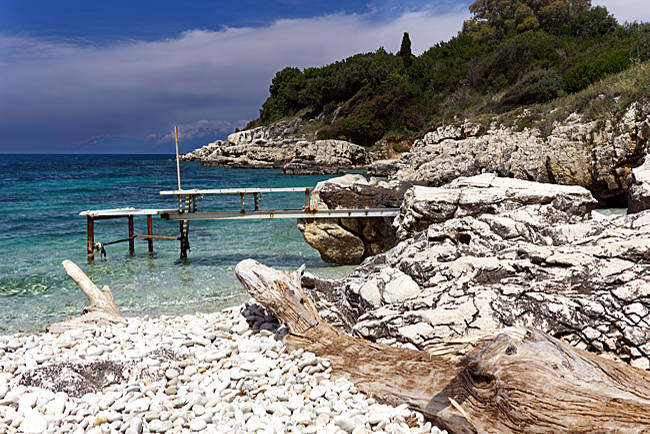
Kos - The Greek Dodecanese Island
A Travel Guide
Greece, the cradle of democracy. While some may think of great philosophers like Plato and Aristotle, or mathematicians such as Archimedes and Euclid; others might think of victorious generals like Alexander the Great, who founded Alexandria in present-day Egypt with its legendary library. Yet others may have sun, beach, Mediterranean flair, or the scent of thyme in mind when Greece is mentioned.
read more about Kos ...
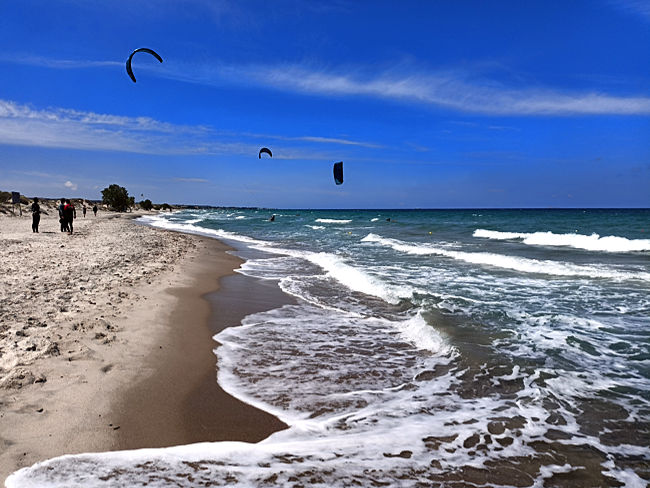
UNESCO World Heritage Site on Rhodes
A journey through the historic Old Town of Rhodes
Relics from various eras - ranging from antiquity to the period of Italian occupation - can be found almost everywhere on the island. Many have left their mark; in some places, they must be sought out, while in others, they appear in clustered, fascinating density and variety. Yet, nowhere else on the island are these traces as prominent as they are in the city of Rhodes. It is not for nothing that the historic Old Town was declared a UNESCO World Heritage site in 1988.
read more about Rhodes Old Town ...
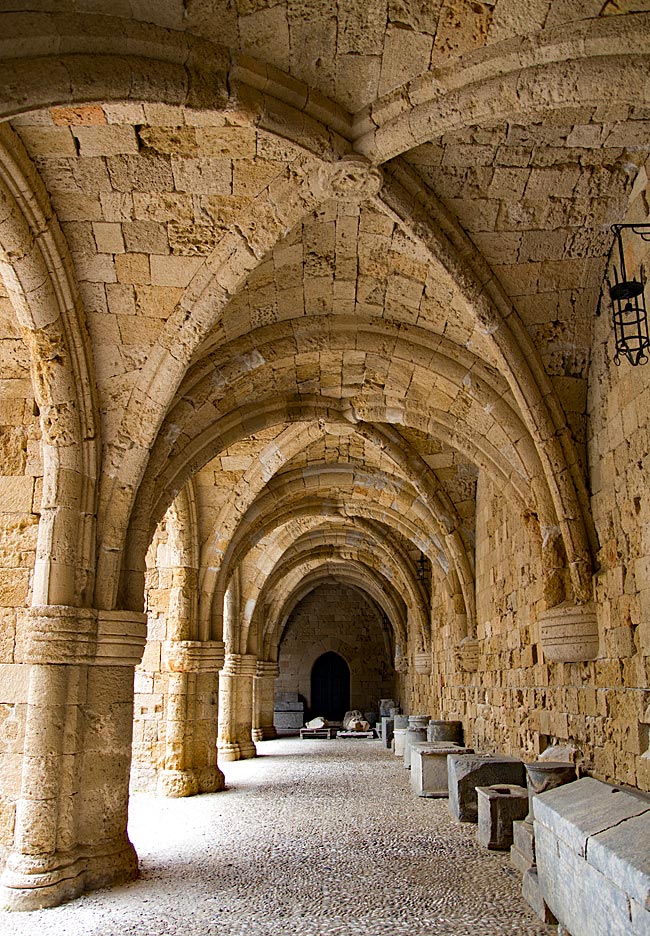
Zakynthos
An island defined by the Caretta caretta
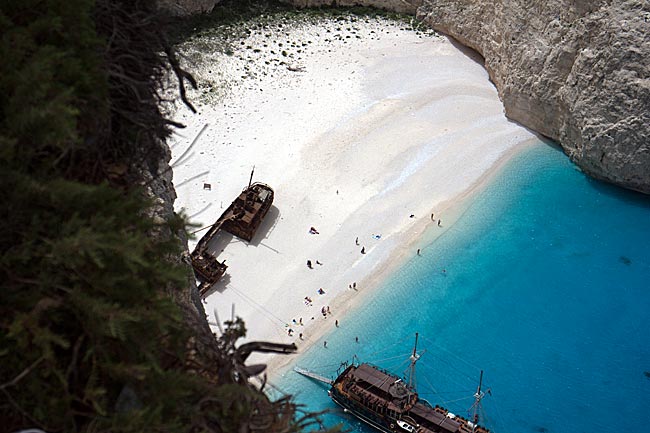
When searching for images of the 406 km² island online, one primarily encounters a very common recurring motif that has been captured from a similar angle by various photographers over the years: Navagio Bay on the northwestern coast. It's all junk, right? Well, that is a matter of perspective, and there are plenty of those during the season, whether they have a camera or not. The fact remains, however, that the rusting wreck of the motor vessel "Panagiotis" has become a landmark for Zakynthos.
read more about Zakynthos ...
Symi
An excursion to the Greek Dodecanese island off the Turkish coast
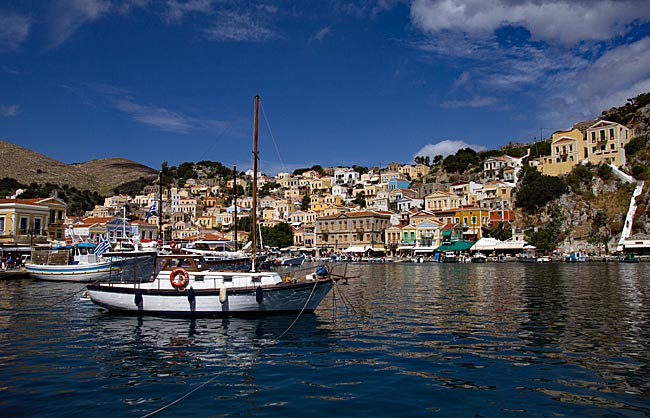
A visit to this sparsely populated rocky island of about 60 square kilometers, with its namesake picturesque harbor town, is part of the standard tour itinerary offered in many locations on the Greek island of Rhodes. From the main island, it takes ships approximately two hours to reach the port of the small island located 23 kilometers north of Rhodes off the Turkish coast, which has belonged to Greece since 1947. As more of the Greek coast recedes into the distance to the port side, the ship draws closer to the Turkish shore; this part of the southern Aegean essentially connects Europe and Western Asia.
read more about Symi ...