

DISTANT PLACES
Travel tips by Bremen sehenswert far from the Hanseatic City of Bremen
Hanseatic City of Rostock - A Travel Guide
Warnemünde
Page 1 / 3
Every city has neighborhoods that are magnetic to visitors and others that are less of a draw. Naturally, this applies to residents as well. Not everyone can afford to live in the polished properties of Warnemünde; in fact, if you can find any housing at all, many apartments have been converted into holiday rentals. This is a trend causing growing resentment among locals across many coastal towns in Germany and rightly so.
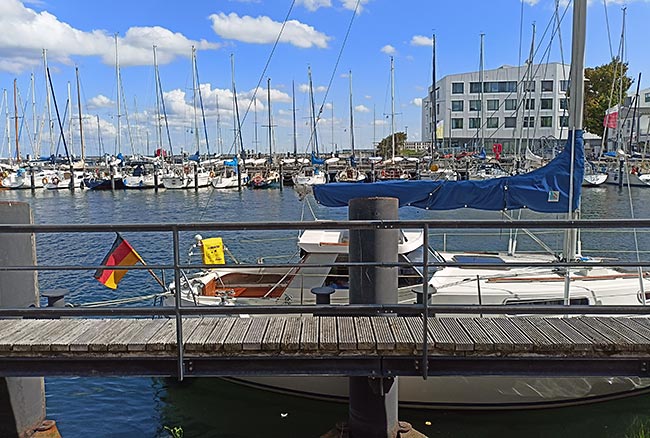
Leisure boats on the Alten Strom
Indeed, a steady stream of visitors flows through the streets and along the promenades of this town at the mouth of the Warnow. But what defines the appeal of this former fishing village today?
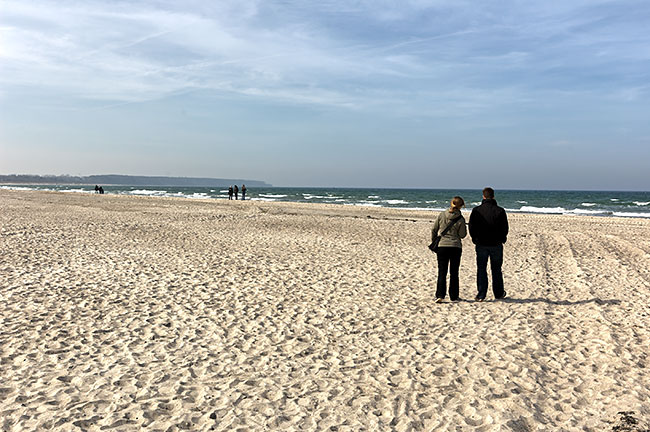
At the beach
Is it lying on the beach on hot summer days and jumping into the Baltic Sea for a cool dip? While that sounds like a perfect plan for a yearly vacation to most people, it is simply daily life for the people of Rostock. The S-Bahn takes only 21 minutes from the main station in the city center to the final stop in Warnemünde. And undoubtedly, the long, deep sandy beach is perfectly suited for an extended stay, supported by the infrastructure situated just behind it.
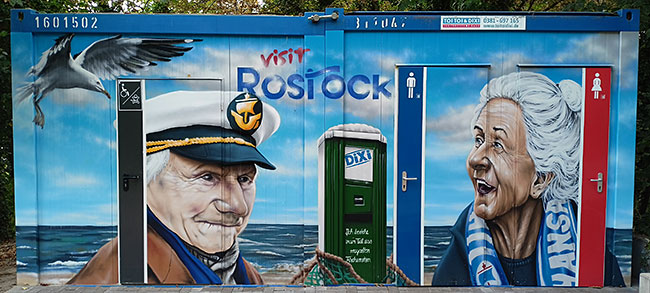
Even a toilet house can somehow be a work of art
But the beach isn't everything; a short walk from the centrally located station toward the town center reveals more. The view from the bridge over the "Alten Strom" (Old Stream) makes many visitors pause for a moment - snap of a souvenir photo included. Until 1903, the "Alten Strom," which was dredged and reinforced in 1423, was the only connection for shipping between the Baltic Sea and the Rostock harbor.
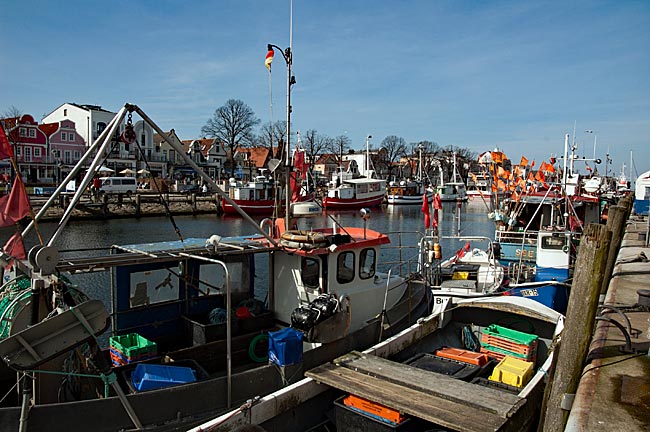
Harbor on the Old Stream (Alter Strom)
Today, sea vessels dock at the port facilities further east, while the "Alten Strom" between the bridge and the harbor entrance hosts a variety of craft: fishing cutters and boats, food trucks offering quick snacks to go, numerous excursion ships for harbor tours, as well as the coast guard vessel stationed there.
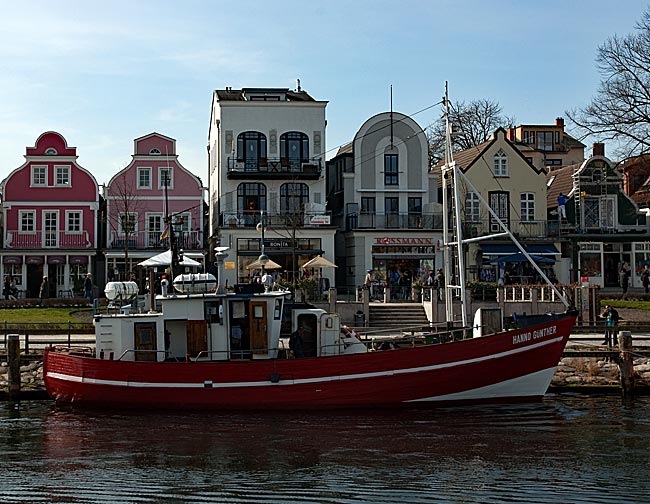
Promenade on the Old River
The charmingly restored captain's houses along the path above the quay are now home to cafés and restaurants with outdoor seating, allowing people to watch the lively scene in pleasant weather. Small shops and boutiques cater to customers of all budgets, and the scent of fried fish lingers in the air - not just on the days when the fish market takes place on the right bank of the stream.
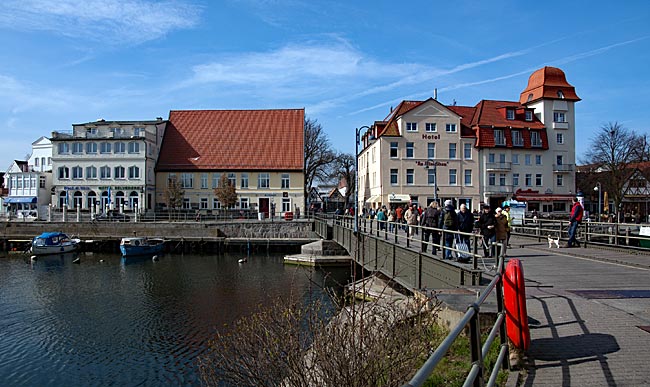
From the train station to the town, with the old Vogtei on the left
Once you cross the bridge, you stand at the left corner before Warnemünde's oldest house, a former Vogtei (administrative seat) built in 1609. "You can't tell its age," many might like to say about themselves. The Vogtei doesn't care; only an information board informs visitors of the long history of this outwardly modest building.
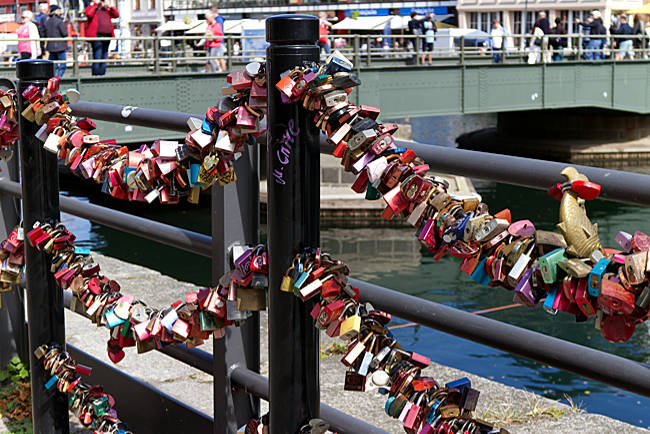
Numerous "love locks" attached to a railing next to the bridge - on the bridge itself, they have been just too heavy in the past. One wonders if all those couples are still together today
Those who resist the urge to follow the crowd into the town center or along the promenade and instead turn left gain a glimpse into the local history. Here, at Am Strom 53, lies the former studio of Edvard Munch. He lived and worked in his "Villa Munch" from June 1907 to March 1908 before moving to house number 30 after his landlord's death.
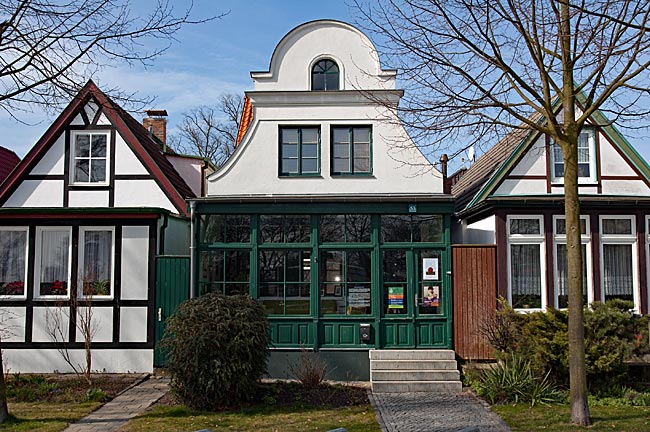
In this house at Am Strom 53, the Norwegian painter Edvard Munch worked and lived for a time. Today, exhibitions are held in the house operated by an association.
The Norwegian painter’s workshop is now a meeting place for artists and a venue for cultural events. An art path consisting of seven stations showcasing Munch's work leads interested visitors up the cliffs to the Wilhelmshöhe.
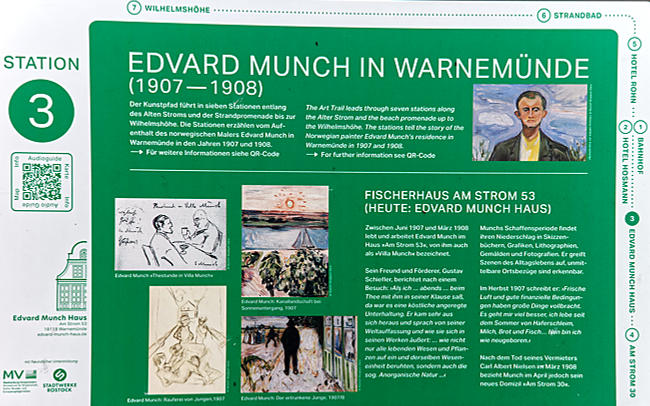
An art path consisting of seven stations showcasing Munch's work
The row of small houses and the rustic cobblestones continue into the branching Alexandrinenstraße. The Alexandrinenplatz at the entrance to the street was, according to the inscription on the pedestal of a bronze sculpture, "the southern border of the settlement until the 18th century."
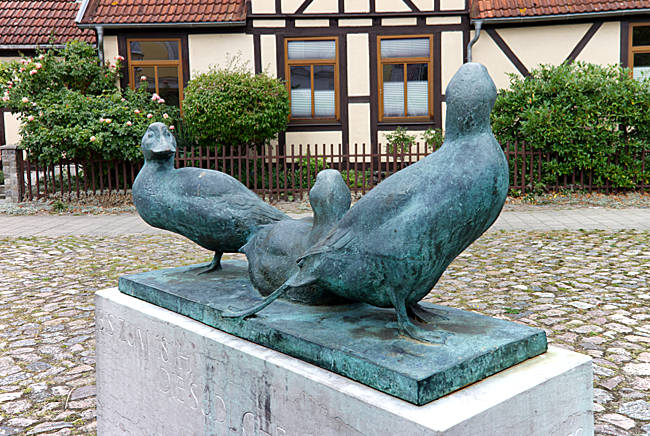
Bronze sculpture the three "Klaashahns" by sculptor Christian Wetzel from Banzkow
Three ducks as the subject for a metal artwork? One can also interpret it as a posthumous tribute to the migratory birds (in Low German: Hahns), which were likely caught in large numbers by fishermen and their wives around St. Nicholas Day (in Low German: Niklaastied) out of necessity, then sold at the market in the city of Rostock.
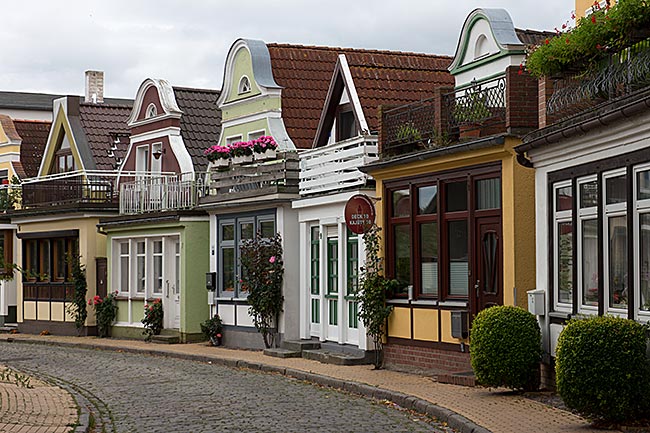
Houses from the 19th century in Alexandrinenstraße
As early as 1323, the lords of the nearby wealthy Hanseatic city purchased this small village, which was founded around 1200 at the Warnow mouth. It remained a relatively poor and small fishing village until the 19th century. At times, residents were mockingly dubbed "Klaashahns."
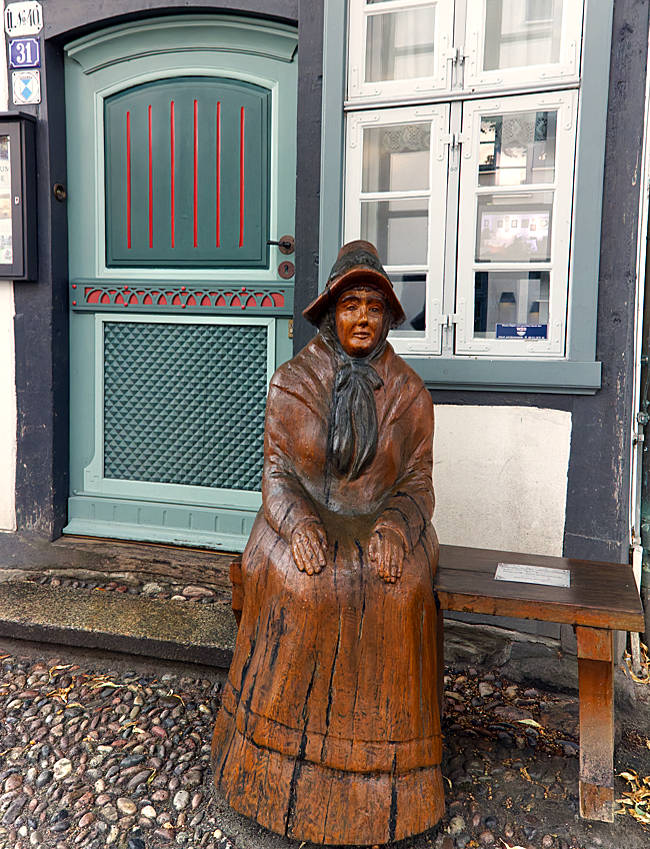
In front of the local history museum stands the sculpture "Die Warnemünderin," created in 2016/17 by Rostock woodcarver Harald Wroost from the timber of a 200-year-old oak tree from the Rostocker Heide
The narrow Alexandrinenstraße is lined with partially protected, restored houses mostly dating from the 18th or 19th centuries; some are built in half-timbered style. Since 1933, a local history museum has been housed in house number 31 at the end of the street.
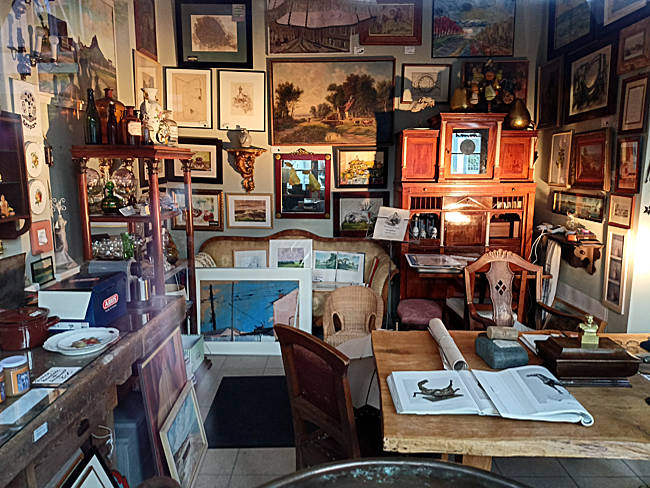
View through the window of a shop across from the local history museum
Old trees that occasionally break up the footpath add to the village-like atmosphere. Until the 19th century, Alexandrinenstraße was known as "Achterreeg" (Low German for "back row") and was one of only two streets in Warnemünde.
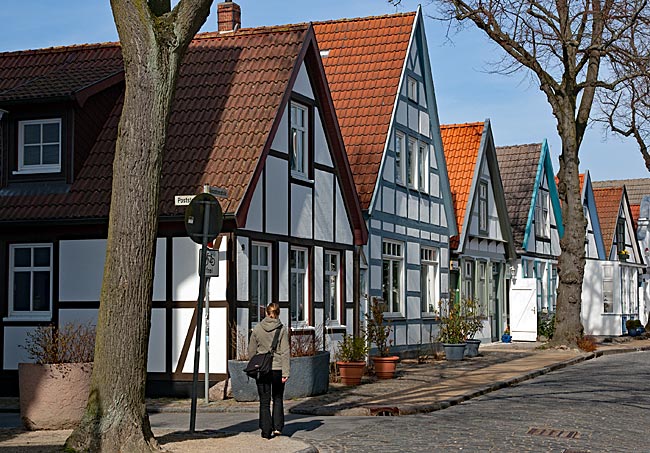
Restored timber-framed houses in Alexandrinenstraße
previous page
 next page
Read more about Rostock: The table of contents
Map
Rügen by the Baltic Sea
Active holiday featuring cycling and hiking
Enjoy an active holiday featuring cycling and hiking along the Baltic coast in Mönchgut on the island of Rügen. Long sandy beaches, rolling hills, and lush forests provide a varied and beautiful setting for your getaway. Often, the only thing breaking the peace is the distant whistle of the historic 'Rasender Roland' steam train. Despite its name (which suggests something "racing" or fast), it’s actually quite the opposite. A journey by train is simply part of the holiday experience.
read more about Rügen ...
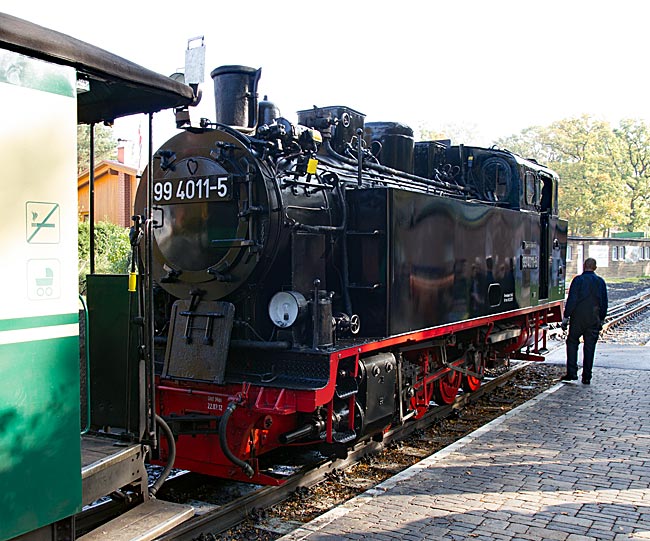
In the Probstei in late summer
Schönberger Strand and sea and more
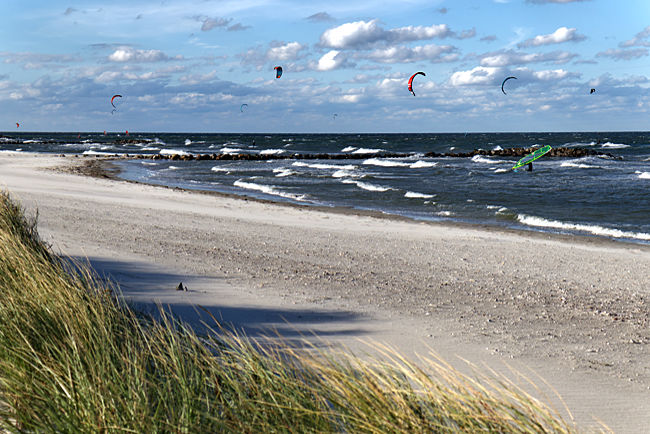
Can you walk or ride a bike from Brasilien (Brazil) to Kalifornien (California) in just a few minutes, always with a view of the water? No, not with your finger on the globe or map, but in person. You’ll have to forgo Copacabana and the Sunset Strip with the Angels in Los Angeles (Spanish for "The Angels"). Instead, you get Germany’s "True North" with all its bright sides. Of course, there are sometimes shadows here too, but they belong only on the margins of this story.
read more about Schönberger Strand ...
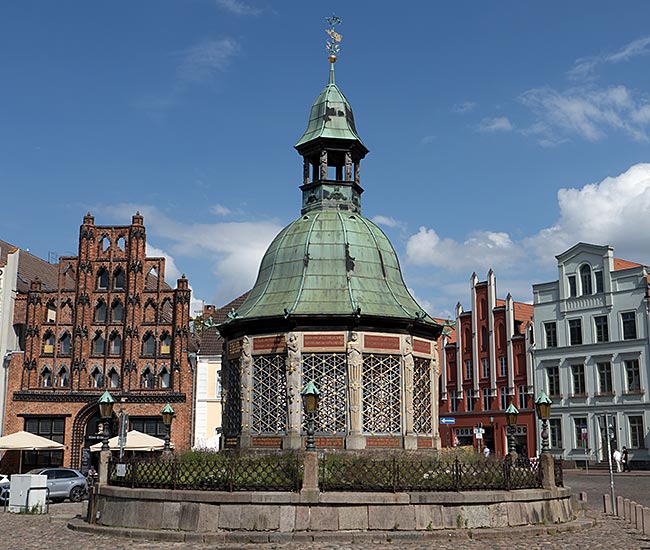
Wismar
The Hanseatic City on the Baltic Sea and its UNESCO World Heritage
The World Heritage House is a building with a stone front house and an attached timber-framed Kemladen on a foundation of loose fieldstones from a medieval predecessor building. This beautifully restored small building complex visually illustrates and provides information via text panels about the lives of past generations in the hall houses typical for Wismar, along with their outbuildings. Additionally, there is extensive information about the city’s history and numerous protected buildings in the old town - there are 1,754 in total, with 306 designated as individual monuments. In the old town, one is right in the middle of Wismar’s UNESCO World Heritage Site.
read more about Wismar ...
Crabs, dikes and the Wadden Sea
The North Sea spa town of Büsum
Once an island, Büsum was repeatedly threatened by the "Blanken Hans". When the greatest flood of the last century struck in 1962, Büsum was already long connected to the mainland - since 1585. Today, this town of around 5,000 residents, part of the Dithmarschen district, is one of the most important holiday destinations along Schleswig-Holstein's North Sea coast. Since 1985, the sea in front of Büsum has been protected as the Schleswig-Holstein Wadden Sea National Park, and since 2009, it has also been listed as a UNESCO World Heritage Site.
read more about Büsum ...
A stroll through Kiel
Sights in the fjord city and a visit to Laboe
A good starting point for exploring the city today, decades after the end of the war, is the centrally located main train station. On Sophienblatt, the main street running in front of the building, all major bus lines converge, and many sights can also be easily reached on foot during a multi-hour stroll.
read more about Kiel ...
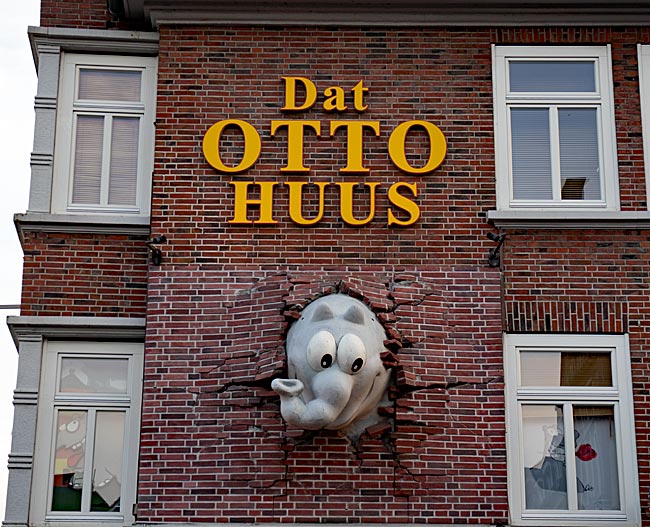
Emden in East Frisia
Where East Frisians make jokes and serious art thrives
What do Henri Nannen, the journalist and founder of the print magazine STERN, director Wolfgang Petersen (e.g., Das Boot), and comedians Karl Dall and Otto Waalkes have in common? They were all born in Emden. "The Men of the Emden" (a film) not necessarily, but that's a different story. And of course, women have also been born in this city of around 50,000 inhabitants, the largest in East Frisia, such as former boxing world champion Heidi Hartmann - naturally mentioned only as a representative of all others.
read more about Emden ...
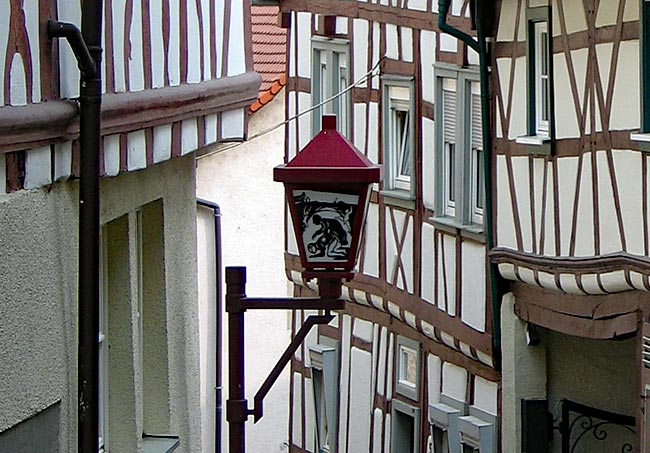
A short visit to the historic old town of Heppenheim
Half-timbering, a false dome, and legendary lanterns
The skyline of Frankfurt, Germany's financial capital with its office towers in the banking district, is still within sight when the train to Darmstadt and Bensheim pulls into the small station of Heppenheim. In 2010, the city was on everyone’s lips after native son Sebastian Vettel left all competition behind in his Red Bull car and became the youngest Formula 1 double world champion of all time. In 2011, he added another title to his collection, as did he in 2012 and finally in 2013 for a fourth time. However, we are not following in Vettel’s footsteps but rather those of history in the picturesque old town with its timber-framed houses.
read more about Heppenheim ...
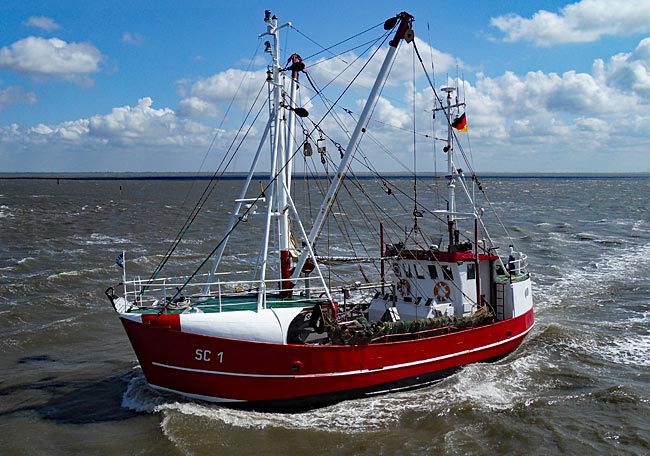
Norden-Norddeich in East Frisia
At the north Sea
At first glance, one might get the impression that this North Sea resort is merely a transfer station for vacationers heading in droves to the islands. Not only do several ferry docks dominate the harbor, but large parking lots and multi-story garages belonging to the Frisia shipping company right behind the dike offer hundreds of parking spaces for island visitors who don’t want or can’t take their cars with them - Juist is car-free after all. But beyond that, Norddeich reveals itself as a far less hectic and manageably small coastal resort. In this state-recognized North Sea spa, tourism has only been promoted since the second half of the last century, apparently with success, as more than 1 million overnight stays per year show.
read more about Norden-Norddeich ...