
 exploring Bremen & its surrounding areas
 You are here: accommodation
 Camping in Bremen
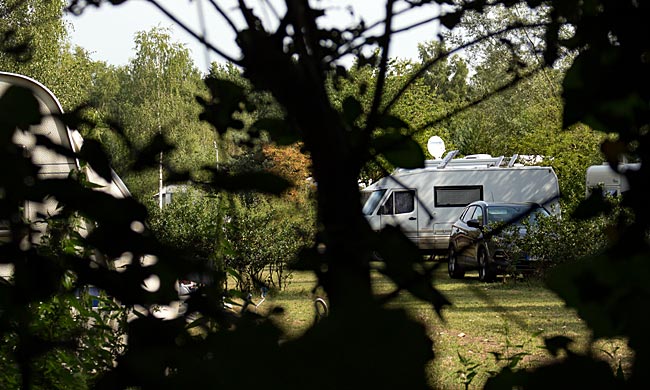
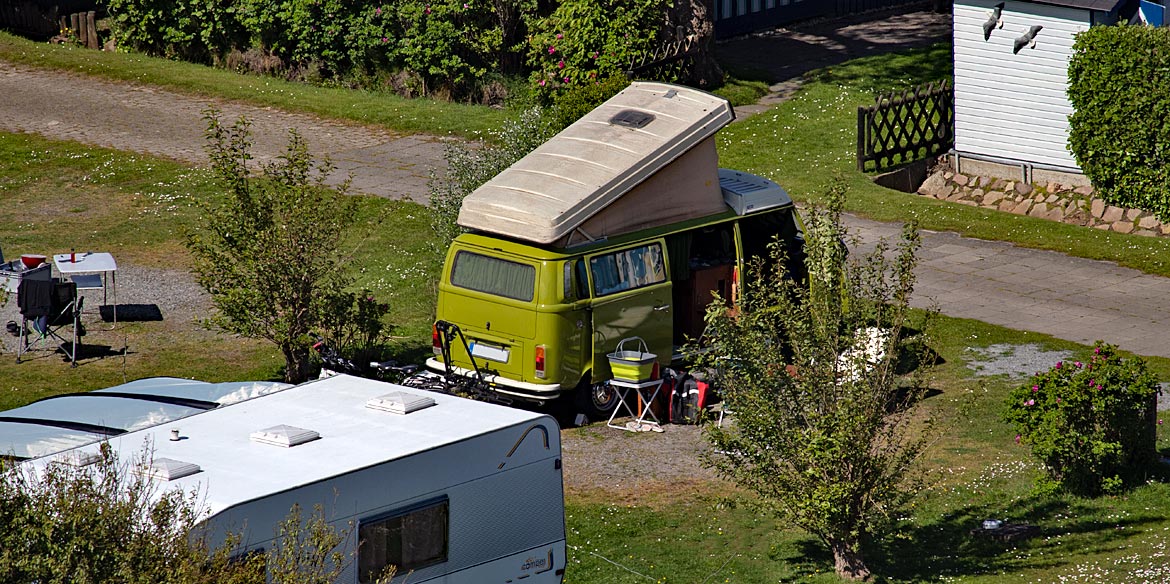
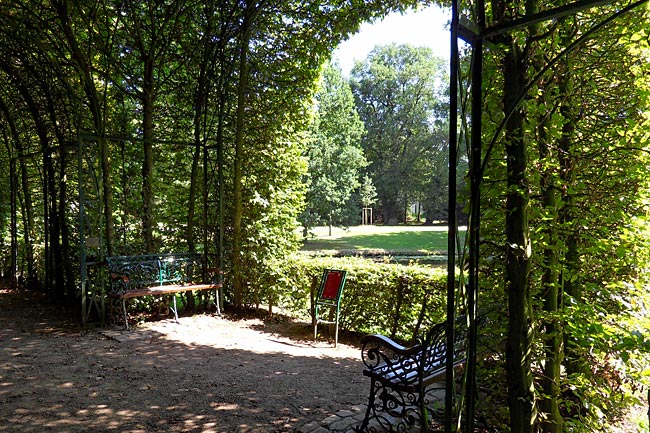
This is how it’s done right: plenty of greenery on the site with bushes and shrubs, and the green fence enclosing the area largely protects against curious glances from passersby at Stadtwaldsee.
For campers with motorhomes, caravans, or tents, Bremen offers HanseCamping, a 5-star site. The campsite with 153 pitches is conveniently located for both arrival and urban connections. It can be reached in less than 10 minutes from the "Überseestadt" and "Universität" exits of the A27 motorway without being overly disturbed by traffic noise afterward. For a visit to the city center, using public transport is recommended, especially since a bus stop is located directly at Hochschulring in front of the site. The most convenient route takes the Bus Line 28 toward Walle and transfers at the "Utbremer Ring" stop to Bus Line 27 toward Huckelriede. This way, you reach Bremen Hauptbahnhof (main station) in about 15-20 minutes and are just a few minutes later in the city center with its market square, Böttcherstraße, Schnoor district, or Schlachte by the Weser River.
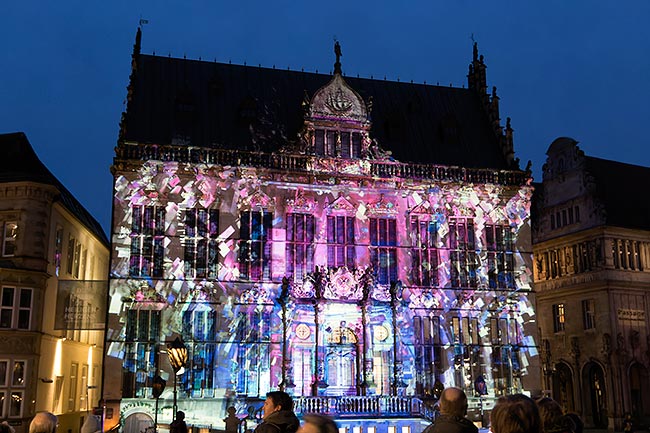
The Schütting (Merchant House) at the city center market square, used as a projection surface during 'Lichter der City' in 2023
Alternatively, you can take Bus Line 28 to the university and transfer there to Tram / Streetcar Line 6 toward the airport (more info at: www.bsag.de, Tip: buy tickets in advance, e.g., at a newsstand). Those who prefer an active approach can comfortably cover the approximately 6-kilometer distance by bicycle.
The campsite leaves hardly any wishes unfulfilled, as befits a site of this category. For those with specific requirements for a planned stay, it’s best to check the website or contact them directly.
Nearby shopping options with two supermarkets can be reached by taking Bus Line 28 toward Walle after five stops (Innsbrucker Str.) or in the opposite direction on the university campus. Both are also easily accessible by bike, as previously mentioned. For warm meals without cooking, a restaurant with an outdoor terrace by the lake is directly adjacent to the site, or the "Zum Platzhirsch" restaurant / café, just 5 minutes' walk away at Hochschulring / Kuhgrabenweg, which also has an outdoor terrace and a neighboring mini-golf course. Expanding the radius naturally increases the number of dining options.
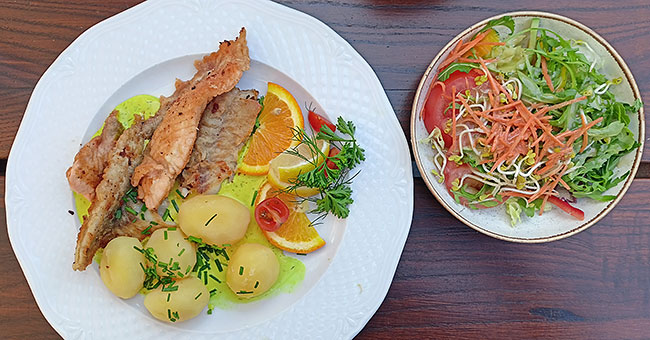
Hungry following your long journey? Pike-perch is served at Restaurant 'Zum Platzhirsch'
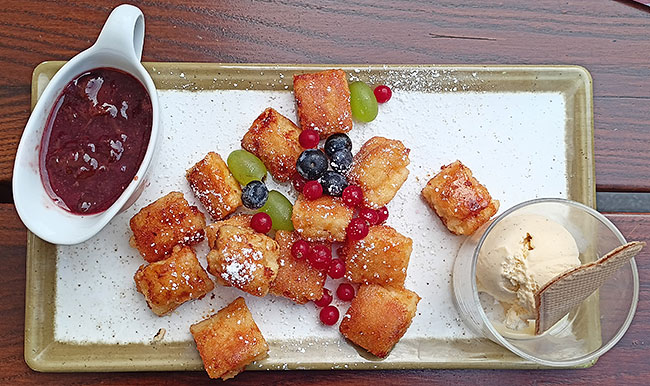
... followed perhaps by a sweet dessert
The campsite is located right next to one of the city’s largest lakes. The 282,000-square-meter body of water, which reaches a depth of 16.5 meters at its deepest point, was created in 1971/72 as a byproduct of construction work on the nearby A27 motorway and the university. Although the lake officially borders the extensive Stadtwald (city forest) on the opposite shore, many Bremen residents call it "Uni-See" due to its proximity to the university, which began operations in 1971. However, this popular swimming spot is far from a secret, during summer, the beaches and sunbathing areas are well-frequented. Thanks to a separate non-swimmer area, a secluded FKK (nudist) section screened by bushes, and an elongated swimmer area, there’s something for everyone. The DLRG (German Lifeguard Association) station keeps a watchful eye on the water activities.
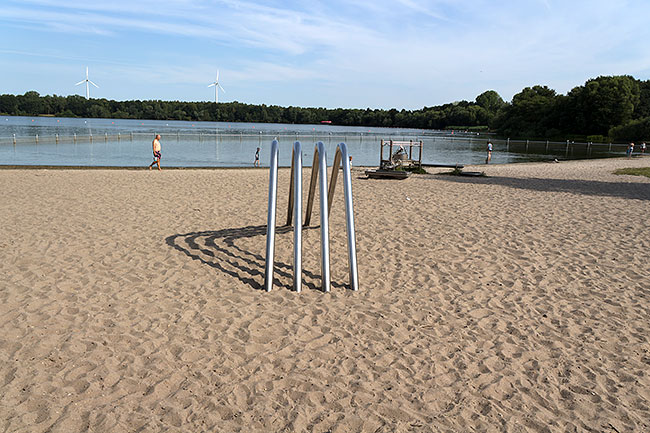
Beach, sunshine and water
And it’s not just swimmers out on the lake, in one section away from the beaches, surfers enter the water, and those who’ve always wanted to learn under expert guidance have the opportunity to do so at the local surf school, even without their own equipment. In another area of the shore, friends of the underwater world dive in. At Pits Tauchbasis (diving base), divers not only get fresh air and expert help but can also rent the entire setup. And for those who don’t yet know how to dive but have always wanted to take a course.
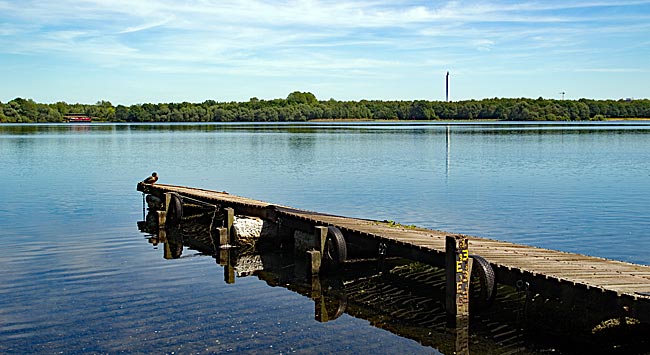
Plenty of water: view over the Stadtwaldsee, also known as Uni-See
For paddlers with their own boats, another opportunity for water activities near the campsite, though beyond Stadtwaldsee, exists via the Torfkanal (peat canal), where peat was historically shipped from the surrounding countryside to the city as fuel on characteristic peat barges. From there, you can paddle along the Kleine Wümme river through Blockland to Dammsiel. If your destination isn’t the restaurant / café with a garden for outdoor seating overlooking the Wümme, a lock connects the two waterways between April and October.
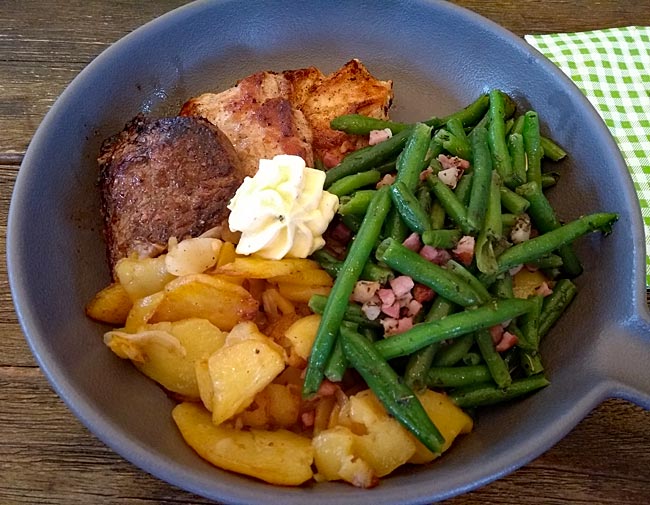
More rustic fare is found on the menu of the "Kuhsiel" restaurant with its large outdoor terrace. The selection is sufficient, and the food is good, supplemented by seasonal offerings like fresh chanterelles or North Sea crabs
Upstream, a good destination is Kuhsiel with a self-service lock that leads into Kuhgraben, bringing you back near HanseCamping. Of course, you can also cover the nearly U-shaped route in reverse, and if the boat is light enough, you can avoid locking at Dammsiel and Kuhsiel by simply carrying the vessel over the dike from one waterway to the next.
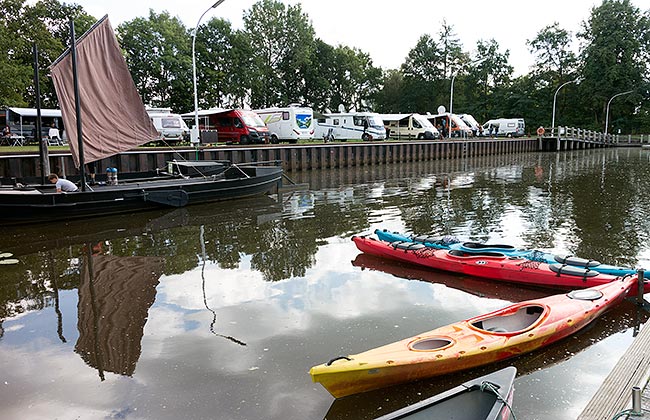
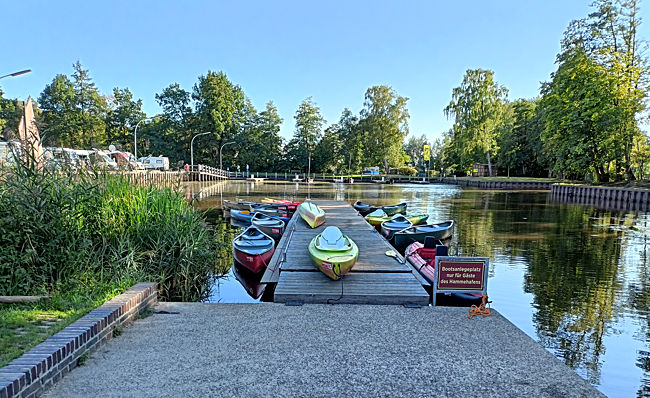
With enough time and physical strength, you can paddle to Hammehafen Worpswede (also called Neu-Helgoland). From there, you can book trips on peat barges, much like the ones at Torfhafen in Findorff in Bremen.
Directly behind Stadtwaldsee / Uni-See lies the Stadtwald (city forest) with a large playground, jogging track, and numerous hiking, cycling, and riding trails. Only separated by an embankment, which can be crossed via two tunnels, lies the even more expansive Bürgerpark. Through this central green lung of the Hanseatic city, you can walk from Stadtwaldsee to the train station or spend hours exploring on foot.
Motorhome pitch
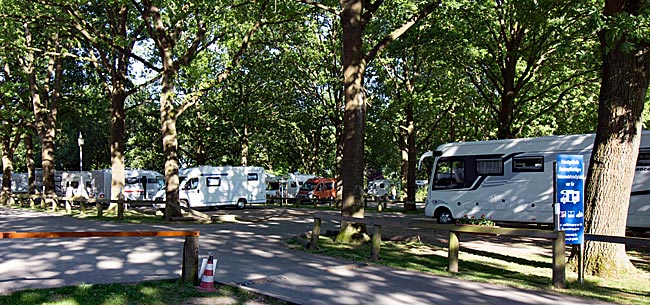
In summer, trees provide shade on the pitch, and for a spontaneous sunbathing session or swim, the Weser River and a small beach are within walking distance
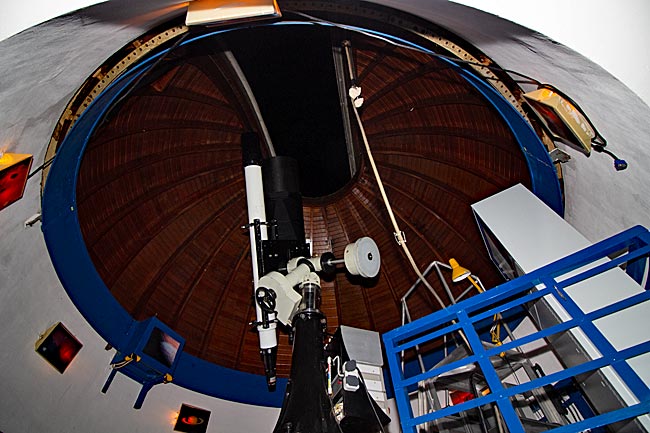
Alternatively to the campsite, there is a well-located pitch for motorhomes or campervans on Stadtwerder directly by the Weser. The Kuhhirten site with 50 pitches under trees offers everything necessary for a pleasant stay, including water supply and disposal, electricity, toilets, and showers. From here, the city center on the opposite bank of the Weser, just 1.5 kilometers away, past the observatory and planetarium, is quickly reachable by bicycle or even on foot. Even closer is Café Sand with a beach and the Sielwall ferry, which transports pedestrians and cyclists across the Weser during the season.
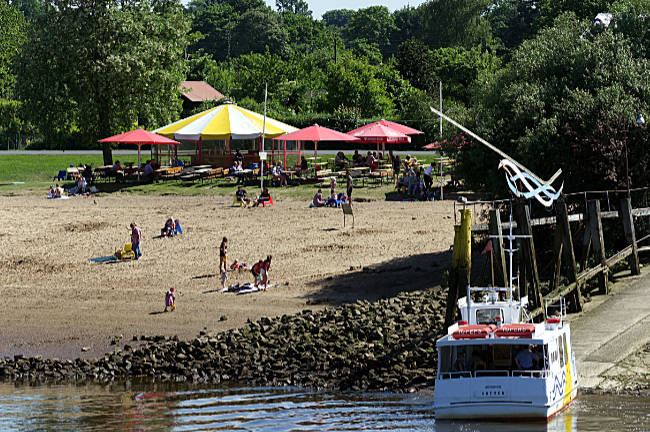
Café Sand with its beach
Stadtwerder itself is a green river peninsula stretching several kilometers to the Weser weir and slightly beyond. The area becomes a peninsula due to a Weser arm separated by a barrier that flows into Werdersee. The lake is part of the city’s flood protection concept, offers excellent swimming opportunities with its own DLRG station, and is less dangerous for children than the tide-dependent river. Those interested in water engineering should visit the aforementioned Weser weir. Along the path crossing the structure, you not only get very close to the bubbling water or can watch the locking of inland vessels and recreational boats but also reach a restaurant in Wehrschloss (weir castle), from whose terrace you have a good view of the weir and Weser.
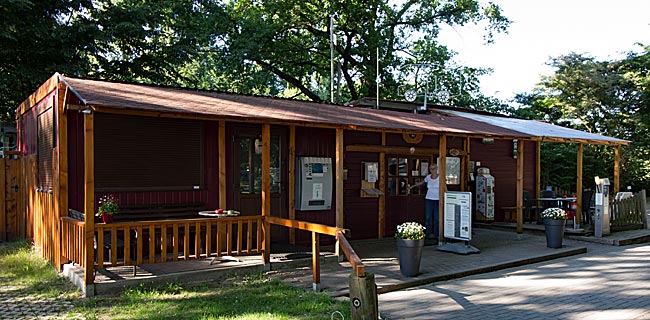
Registration and other essentials
previous page
 next page
Further information
Motorhome Parking Area at Kuhhirten
Kuhhirtenweg
28201 Bremen
Phone: +49 (0)173 9850092
Website: www.stellplatz-bremen.de
HanseCamping
Hochschulring 1
Horn-Lehe, Bremen
Phone: +49 (0)421 30746825
Fax: +49 (0)421 30746826
Website: www.hansecamping.de
Market Square
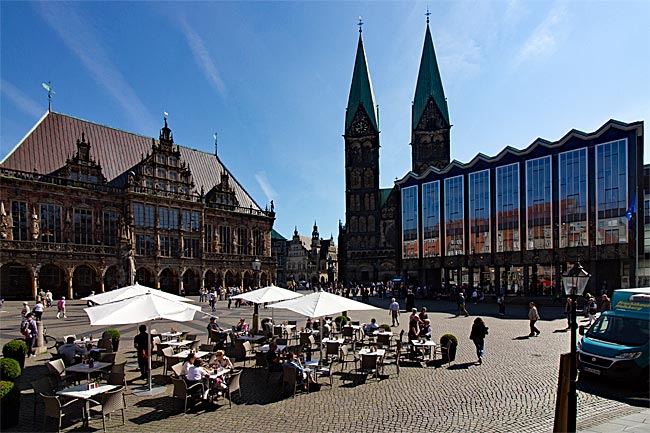
Once as in the present, market square is the political center of Bremen and today also a magnet for thousands of tourists, undoubtedly due to its unique architectural ambiance. Almost unobtrusively and plainly, the Bürgerschaft, the Bremen Parliament, stands next to the magnificent Old Town Hall.
read more ...
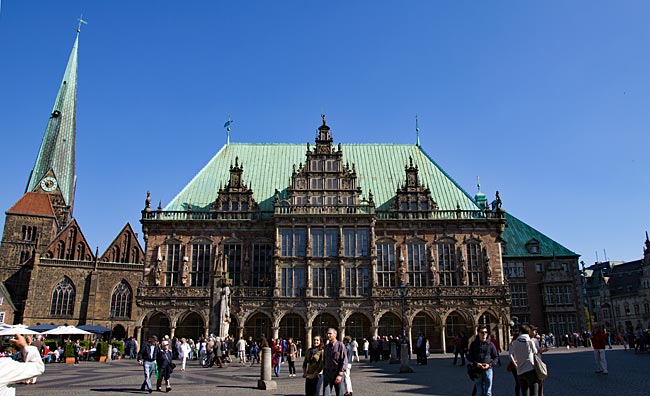
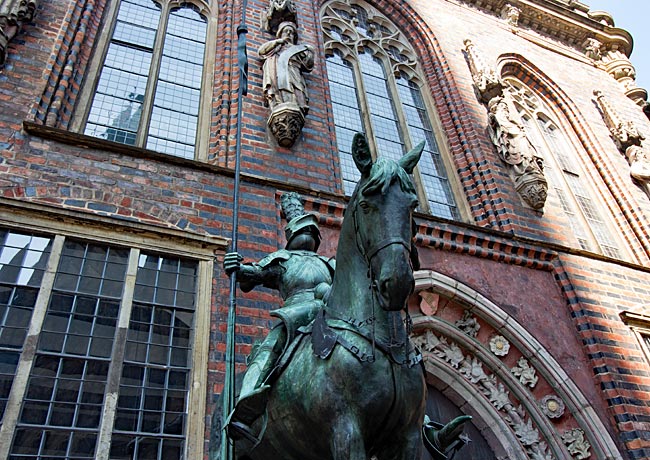
Town Hall
The original Old Town Hall on the market square was built between 1405 and 1412. Little remains today of this rather plain late Gothic brick building. The Renaissance façade that gives the UNESCO-protected structure its distinctive appearance was erected by Lüder von Bentheim between 1608 and 1614. Particularly above the arcades, it is lavishly adorned with various depictions from ancient mythology, which uniquely blend with Christian symbolism, Bremen city symbols, and other representations.
read more ...
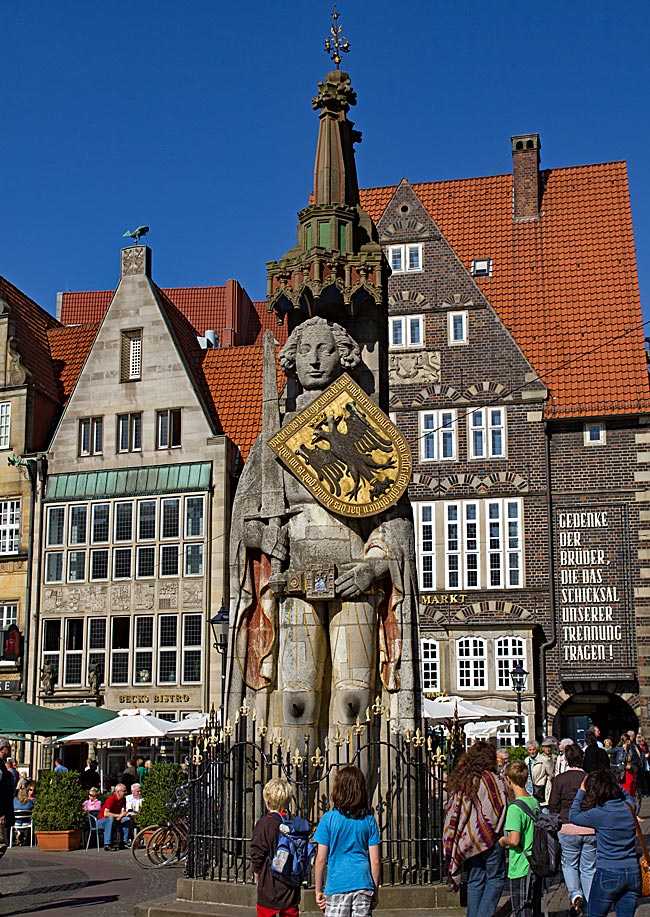
Roland statue
The Roland statue stands on the market square in front of the town hall and has been there since 1404. It is a 5.55-meter (10.21-meter total) tall sandstone figure of a knight with a drawn sword and shield in front of his chest. Like in many other European cities, the Roland in Bremen symbolizes the city's freedom, which historically stemmed from market rights and its own jurisdiction.
read more ...
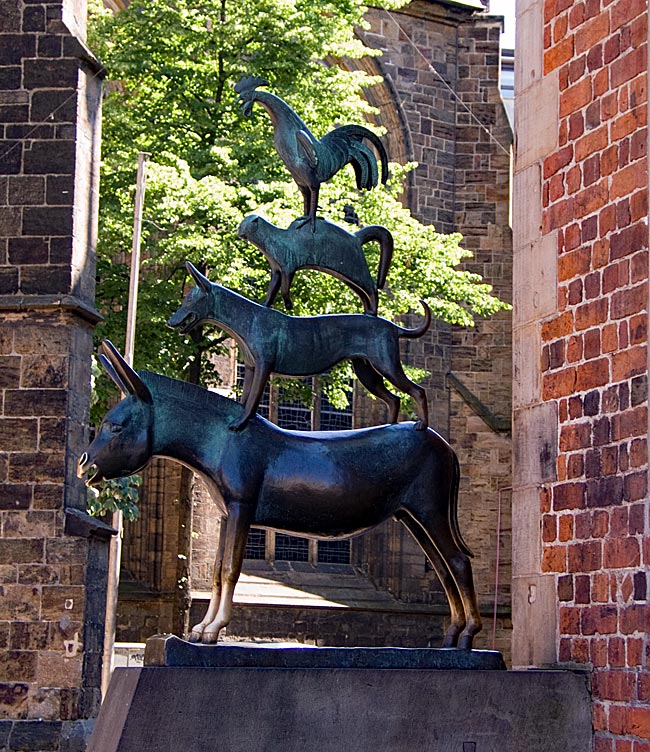
The Bremen Town Musicians
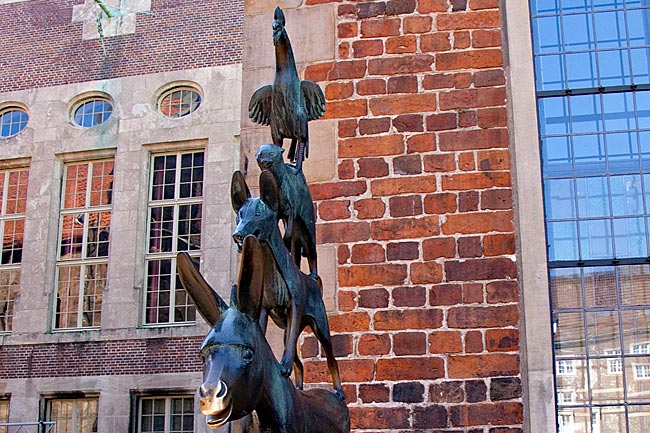
On the left broad side of the Old Town Hall, next to the entrance to the lower town hall hall, stand four bronze-cast heroes of a world-famous fairy tale - the Bremen Town Musicians. However, it remains a contentious point whether these mismatched four - donkey, dog, cat, and rooster - actually made it all the way to Bremen, as the fairy tale does not provide a clear answer on this matter. But perhaps that is not so important, for what truly matters is the message conveyed in the fairy tale.
read more ...
Böttcherstraße
Since at least 1931, the name Böttcherstraße is no longer primarily associated with the scent of wood and the sound of coopers' hammers, but rather with a very special, almost enclosed ensemble of buildings. Over a length of just over one hundred meters, museums, open artist workshops, specialty retailers offering upscale goods, dining establishments, and a hotel create a unique atmosphere between brick and sandstone structures that is unparalleled in Bremen.
read more ...
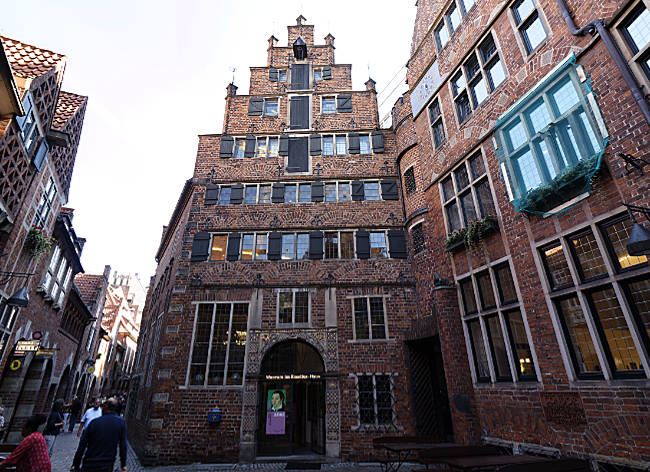
Schnoor
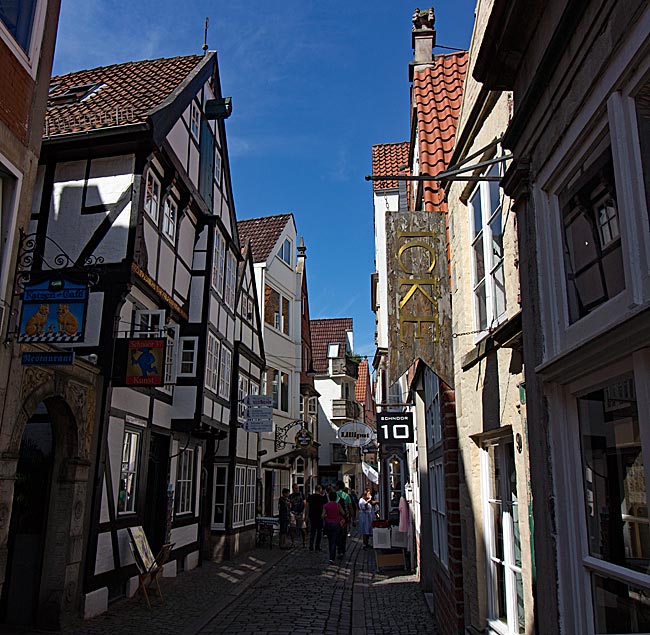
Bremen's oldest preserved neighborhood is the Schnoor. In earlier times, this area was primarily inhabited by fishermen and sailors, as it was here that the Balge - a tributary of the Weser - ran, and one of Bremen's first harbors was located. Many of the small houses date back to the 17th century or have been reconstructed based on historical models. The house at No. 15 in Schnoor Lane, built in 1402 on medieval foundations, is one of the oldest structures in the Schnoor, alongside the Packhaus (1401).
read more ...
Schlachte
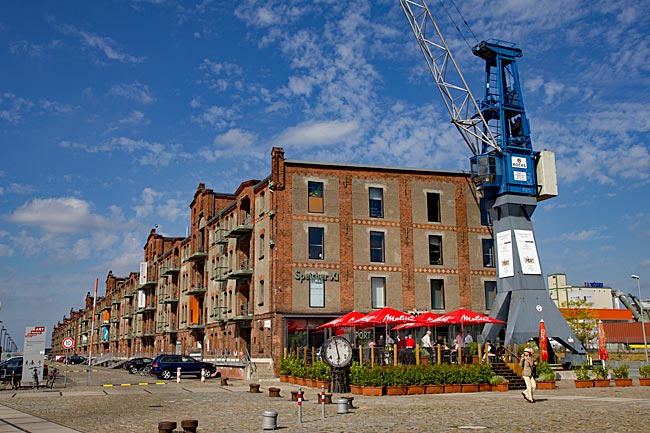
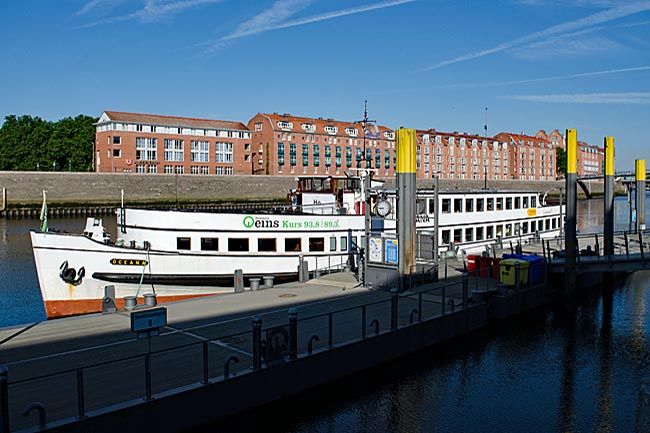
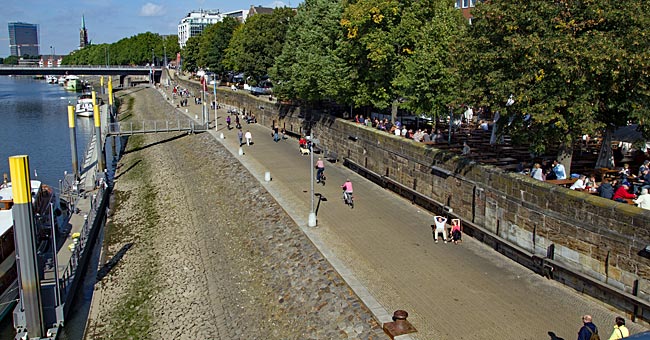
Between the Wilhelm-Kaisen Bridge and the Stephani Bridge, from the start of construction in 1993 to its grand opening on May 27, 2000, a promenade with a boulevard, ship docks, and numerous dining options was created for over €20 million (mostly EU-funded). This area, now lined with 60 trees and granite, offers something for every palate, where medieval harbor workers once toiled.
read more ...
Water-based activities in Bremen
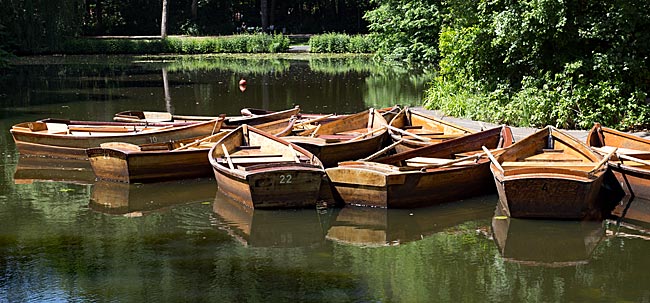
Given that Bremen is a city on a major river with numerous lakes, it makes sense to extend sports or other personal water-related activities from land to water. The most family-friendly activity on the wet element is certainly taking a rowboat ride along the canals of Bürgerpark.
read more ...
Stadtwald & Stadtwaldsee (urban forest & lake)
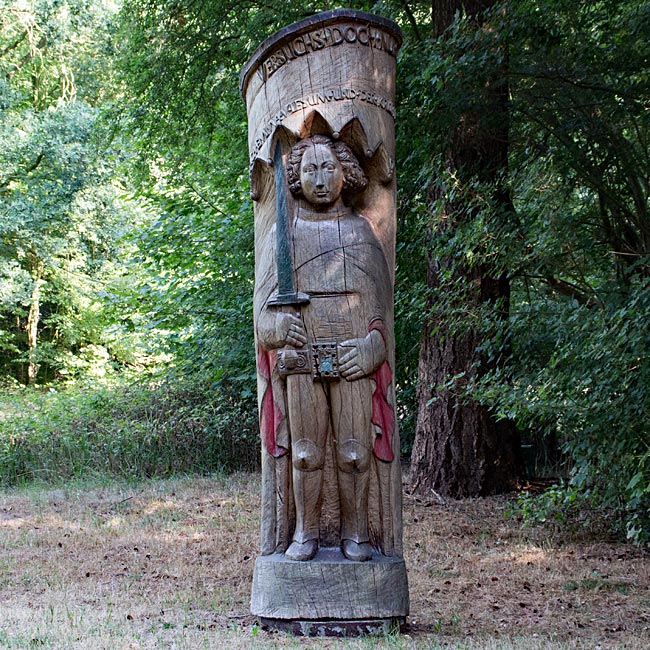
Stadtwald & Stadtwaldsee. The design of the Bürgerpark is attributed to Wilhelm Benque, who served as its director from 1866–1870 and again from 1877–1884. Carl Orth succeeded him in this role, and under his plans, construction of the Stadtwald began in 1907. The 66.5-hectare site north of the railway tracks had been donated to the Bürgerpark Association by the Bremen merchant Franz E. Schütte one year earlier.
read more ...
Neu-Helgoland (New Heligoland) / Hamme Harbor Worpswede
From April to October, the Hamme Harbor in Worpswede attracts many day visitors, weekend trippers, cyclists, and campers. The campsite operators run not only a bistro & beer garden with waterside seating but also rent out kayaks and canoes. Those who don’t want to paddle on the Hamme themselves can instead book an excursion trip aboard one of the Adolphsdorf Peat Boats. Food and drinks are also available just a few meters from the harbor at "Hamme Hütte Neu Helgoland." Tip: A great bike trip destination from Bremen!
read more ...