
 exploring Bremen & its surrounding areas
 You are here: attractions in the city center
 St. Peter's Cathedral (St. Petri Dom) 1/2
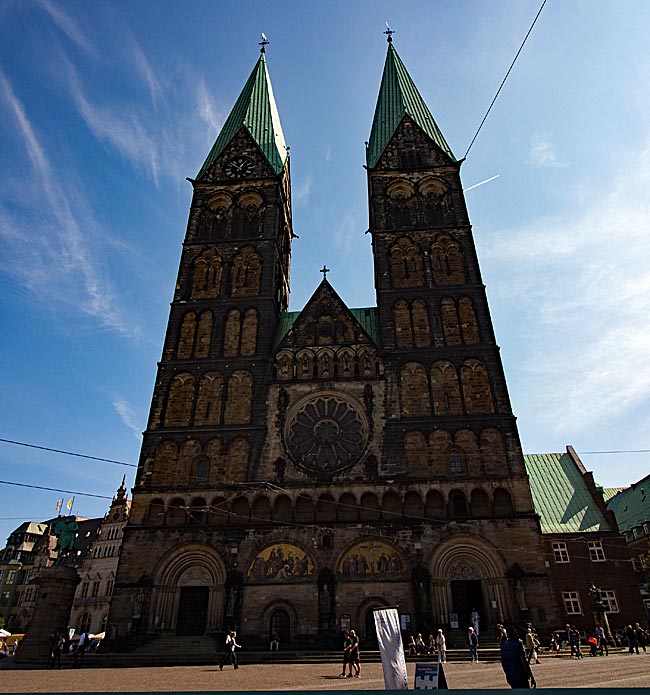
The facade of the cathedral. On the left in the image is a equestrian statue of Chancellor Otto von Bismarck
The history of the cathedral, Bremen's oldest church, begins with the Christianization of the region - originally settled by the Saxons - by Charlemagne in the 8th century. After subduing the Saxon tribes, Charlemagne appointed counts and bishops as representatives of the Frankish Empire and Christianity. Thus, Bremen became a bishopric. It is unclear exactly when the first cathedral was built on the highest elevation of what is known as the "Bremer Düne," (Bremen Dune) but it was likely destroyed by invading Vikings from Denmark in 858. The Romanesque structure begun in 1041 and completed with its two towers in the 13th century was later remodeled in the Gothic style during the 16th century.
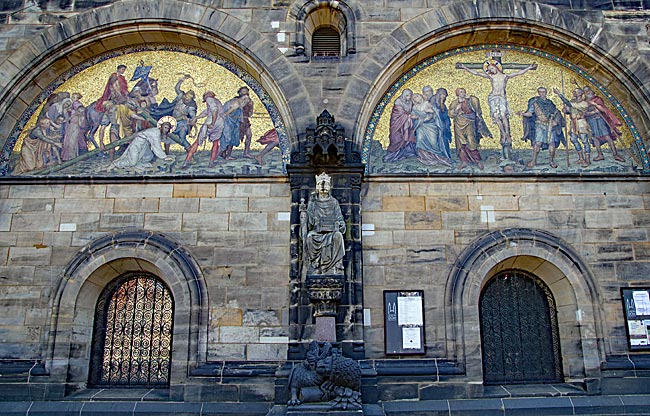
Close-up of the facade: The mosaics are a work from Venice based on designs by Hermann Schaper (1899-1901)
After a turbulent history involving changing ownership and damage, the cathedral finally took on its current appearance during a thirteen-year renovation that lasted until 1902. Since then, the once unevenly high towers - now measuring 99 meters with their pointed roofs - have been a widely visible landmark.
The Dom-Museum, founded in 1987, displays grave goods and textiles from between the 11th and 15th centuries, recovered in the 1970s from medieval bishops' graves during excavations in the central nave.
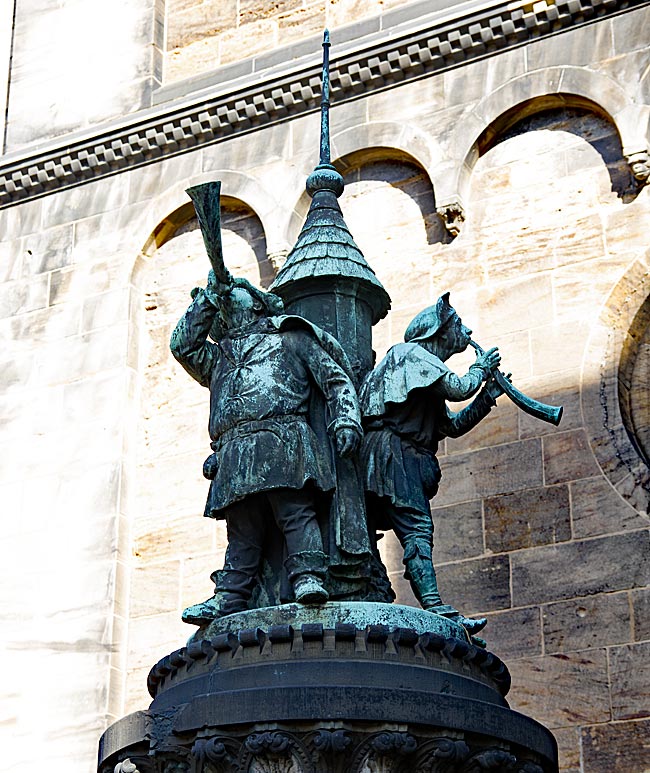
Tower trumpeters by Ernst Ehrhardt, 1908-1909, on a column next to the cathedral
A unique highlight is the so-called "Bleikeller" (Lead Cellar), which has been housed in an annex of the cathedral since 1984 instead of its original location in the east crypt. Visitors can see several mummified animals and six human mummies in open coffins, discovered in the east crypt in 1698. Initially, it was assumed that the lead once stored there - primarily used for roofing work on the cathedral - was responsible for preserving the bodies. However, this is not the case. Instead, the highly permeable subsoil caused rapid desiccation of the corpses until mummification occurred. The identities of these individuals remain unclear. One mummy, whose mouth appears open in a scream, was long believed to be a roofer who fell from the cathedral in the 15th century. However, an X-ray examination in 1985 revealed no bone fractures but did show a growth on the spine. Whether this individual was a soldier shot during the Thirty Years' War, as some speculate, remains uncertain. Open May-October; entrance via the "Glockengarten" (Bell Garden) next to the cathedral.
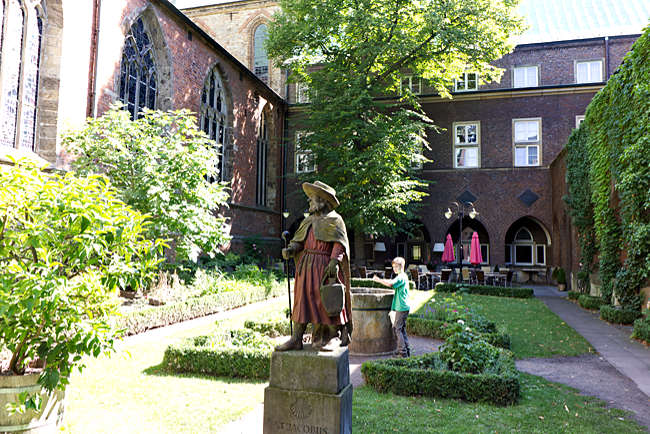
View of the Bible Garden near the Bleikeller, featuring James the Greater (Major) since 1980. The garden grows plants mentioned in the Bible and medieval monastic medicine
After visiting the Bleikeller, those seeking fresh air can find plenty of it at dizzying heights by climbing one of the towers, which also offers a beautiful view over the city. Open May-October.
The presence of a statue of James the Greater in the Bible Garden is no coincidence, as Bremen lies along a section of the extensive Jakobsweg network, specifically the Via Baltica. This hiking trail, also known as the Baltic-Westphalian Way, runs from Usedom through Rostock, Lübeck, Hamburg, and Bremen to Osnabrück in Westphalia.
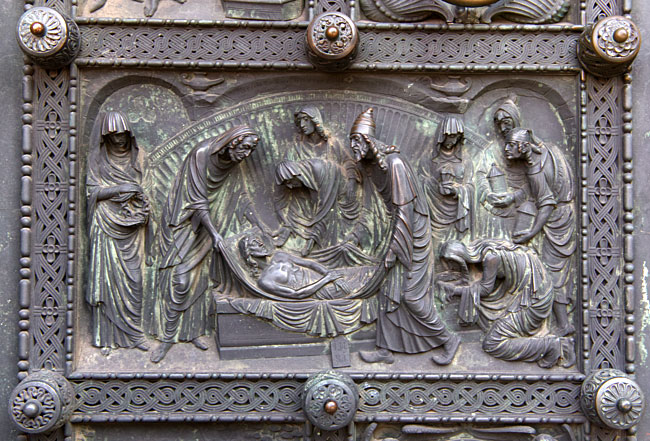
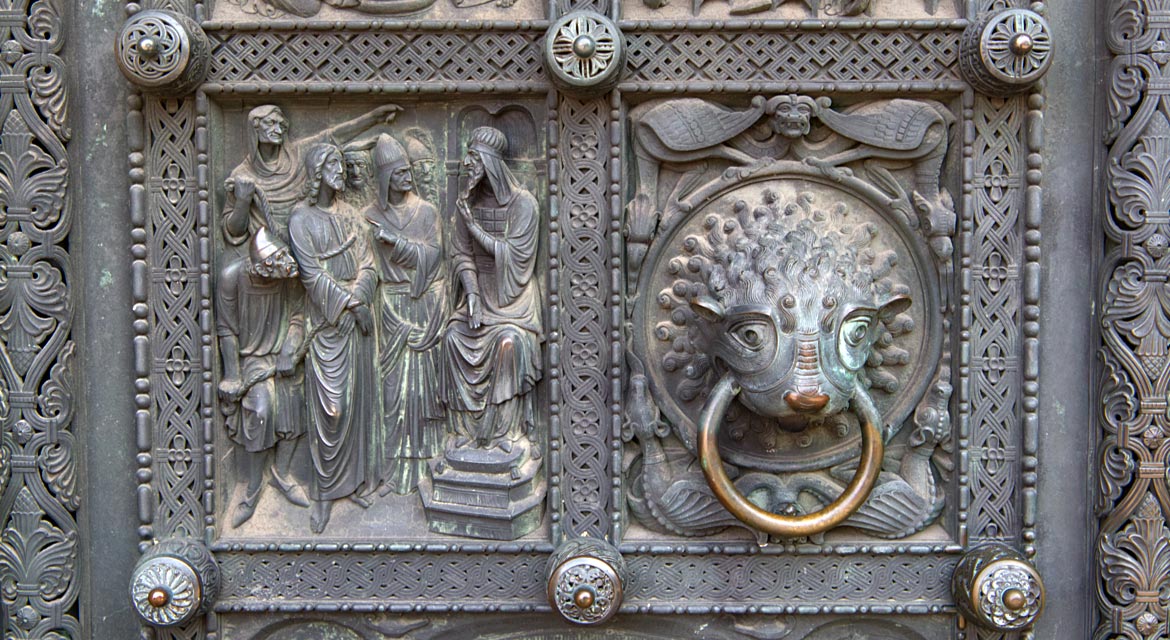
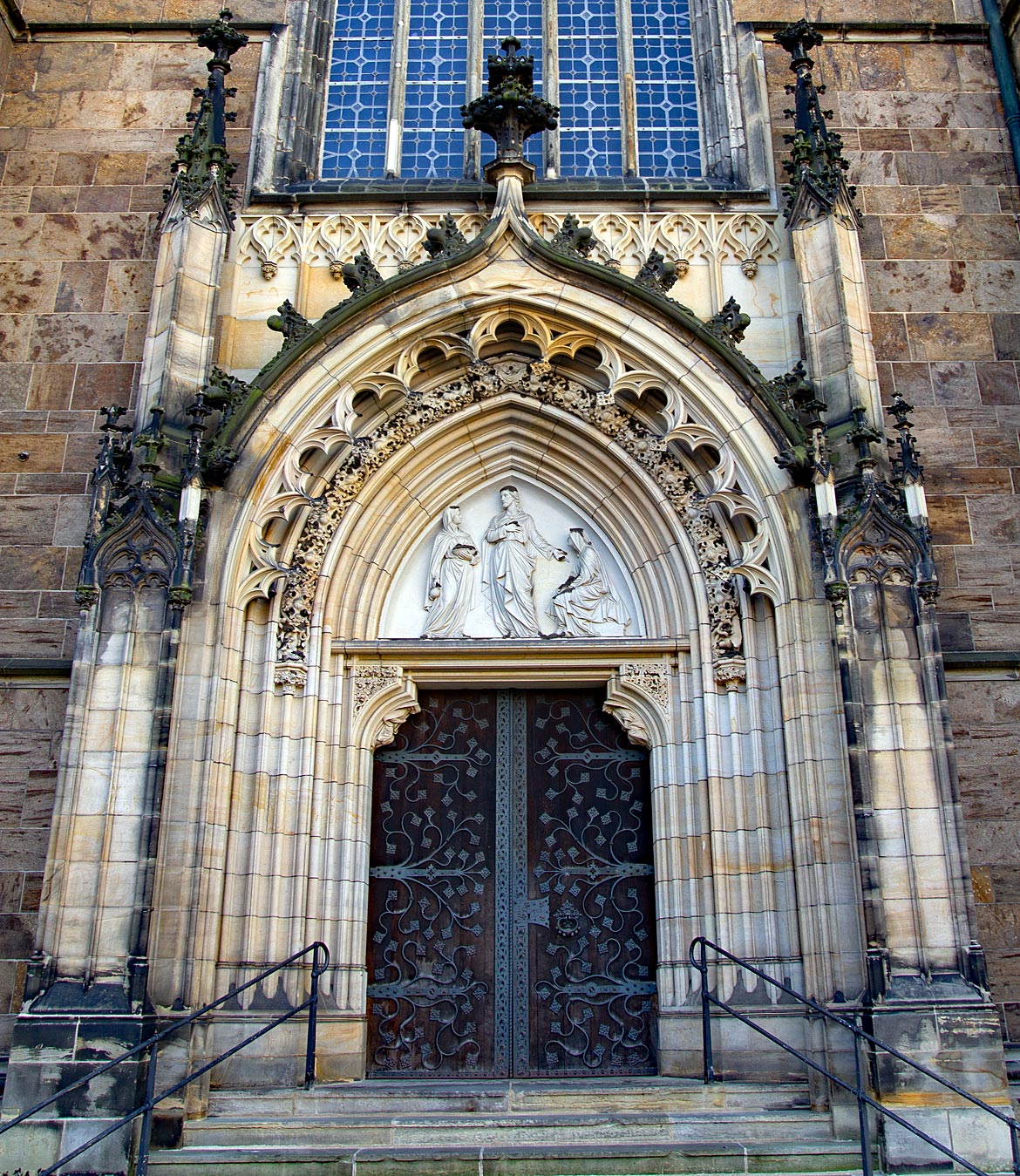
One of the biblical scenes from the Old Testament on the left cathedral door
Before entering the cathedral, it is worth examining the two doors, crafted in 1891 based on designs by Cologne artist Peter Fuchs. Both portal doors depict biblical scenes, the left from the Old Testament and the right from the New Testament. While this is not unusual for a church door, closer inspection reveals that some portrayals of Israelites and Jews within these scenes carry antisemitic elements, according to some critics. This reflects how widespread antisemitism was in past times, even in art, and Luther was not exempt from it. Of course, this cannot be used to justify antisemitic tendencies today.
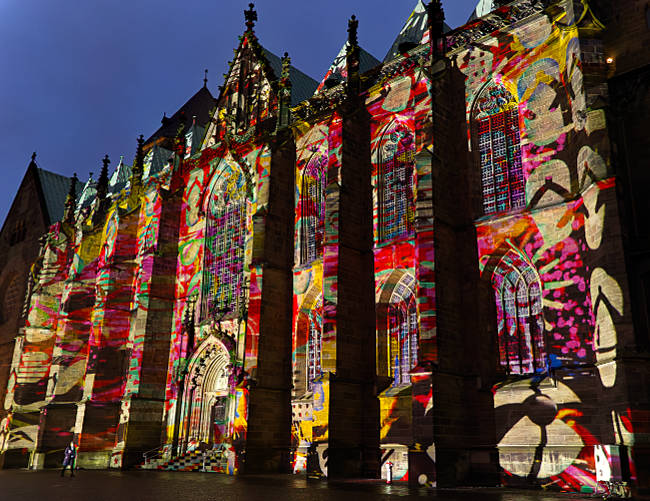
The cathedral can also be vibrant and colorful: A light display on the side facing Domshof during "Lichter der City" 2025, set to Vivaldi's "The Four Seasons".
previous page
 next page
Map
Further information
Domshof
In the shadow of the cathedral stretches the Domshof. Until 1803, the cathedral district - and thus the large square - belonged to the respective bishops, Sweden, and later the Electorate of Hanover, who ruled Bremen at times. The buildings, including townhouses, and the planting of numerous trees made the Domshof one of the most beautiful squares in the Hanseatic city during the 18th and 19th centuries.
read more ...
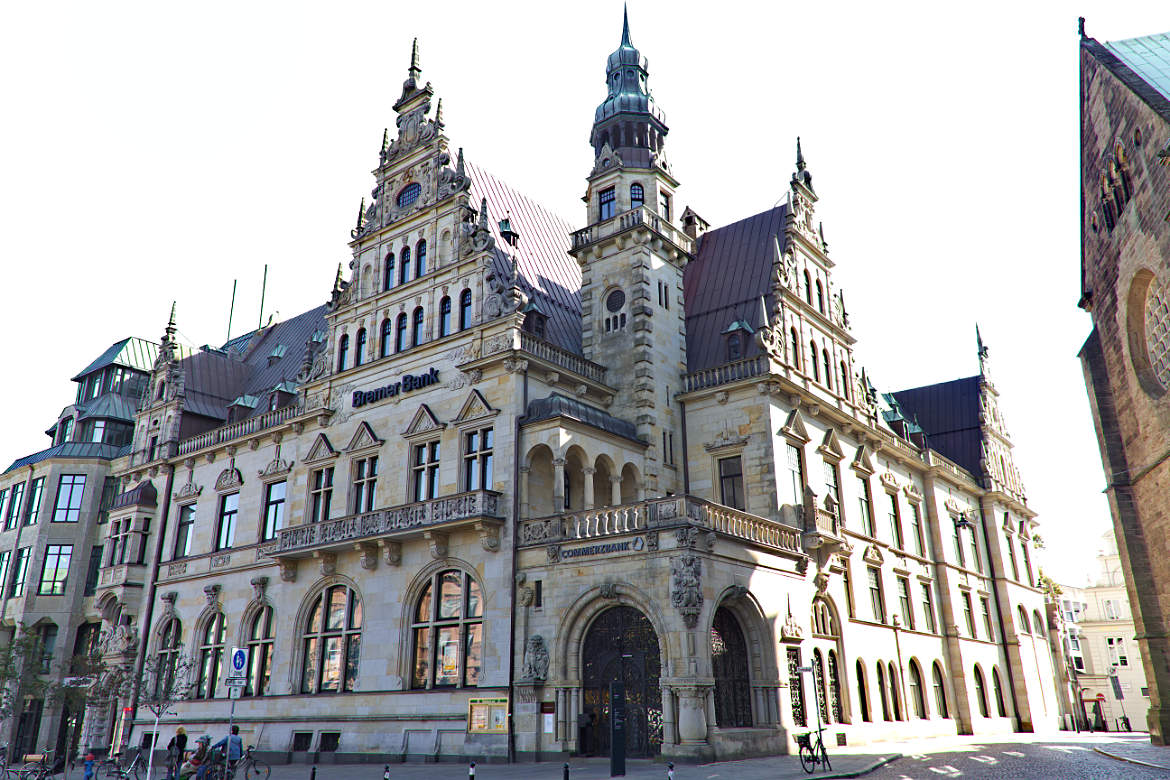
Domsheide
As the name suggests (in german), Domsheide is not far from the cathedral, just a stone's throw away. Passing by Börsenhof A, a historic business and office building constructed between 1861 and 1864 opposite the cathedral and renovated at the turn of the millennium, you quickly arrive at one of the most important public transportation hubs in the city center. Here, trams primarily operate in nearly all directions, including to the airport, Viertel district, central station, university, and Überseestadt.
read more ...
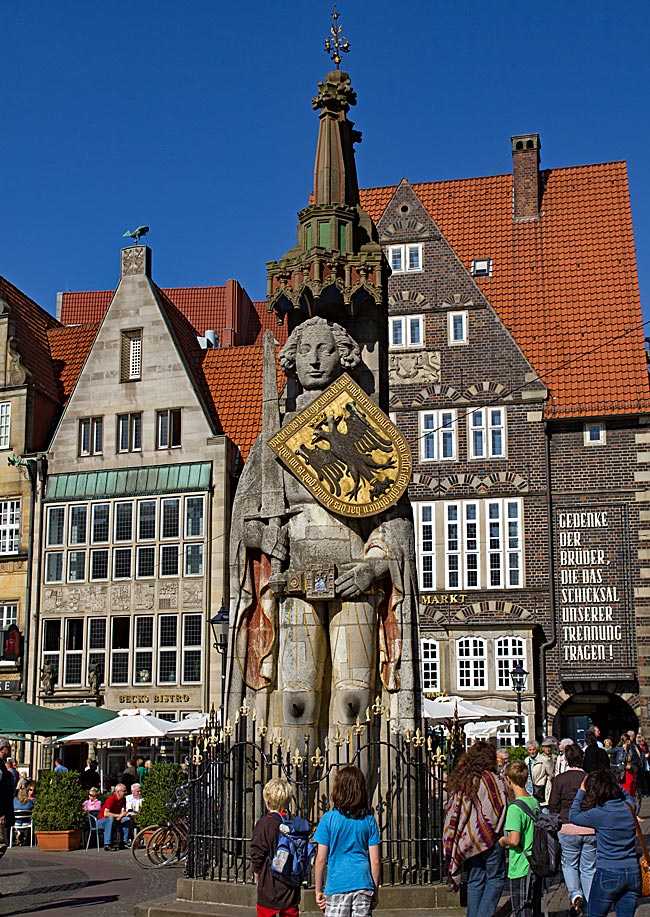
Roland statue
Since 1404, the Roland statue, a 5.55-meter-tall (10.21 meters total) sandstone knight with a drawn sword and shield on his chest, stands on the market square in front of the town hall. Like in numerous other European cities, Bremen's Roland also serves as a symbol of the city's freedom, which in earlier times stemmed from its market rights and independent jurisdiction.
read more ...
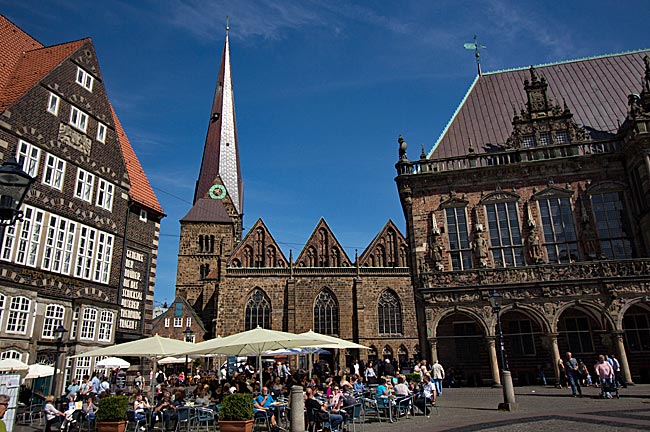
Market square
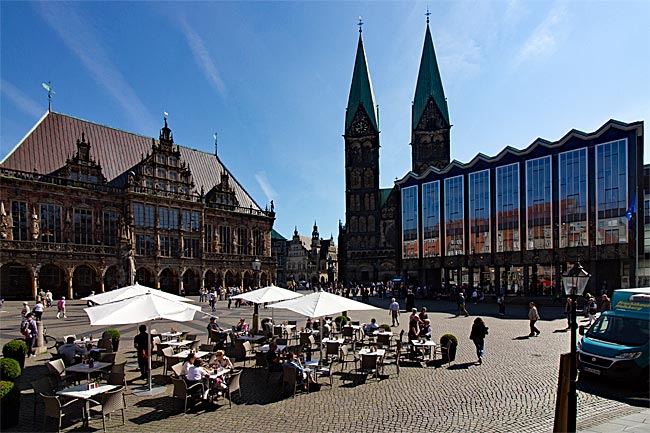
As it was in the past and as it is today, the market square is the political center of Bremen and also a major attraction for thousands of tourists, undoubtedly due to its unique architectural atmosphere. Almost unobtrusive and plain in appearance, the Bürgerschaft (Bremen's parliament) stands next to the magnificent Old Town Hall.
read more ...
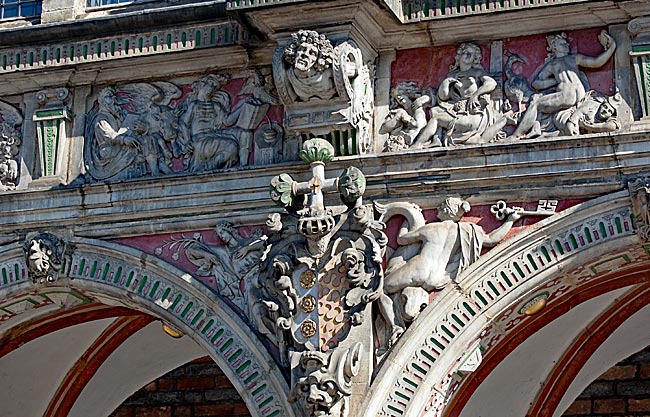
Town Hall
The original Old Town Hall on market square was built between 1405 and 1412. Little of this originally rather plain late Gothic brick structure remains today. The Renaissance façade, which gives the UNESCO-protected building its distinctive appearance, was constructed between 1608 and 1614 by Lüder von Bentheim. Above the arcades in particular, it is lavishly adorned with various depictions from ancient mythology, blending uniquely with Christian symbolism, Bremen city symbols, and other representations.
read more ...
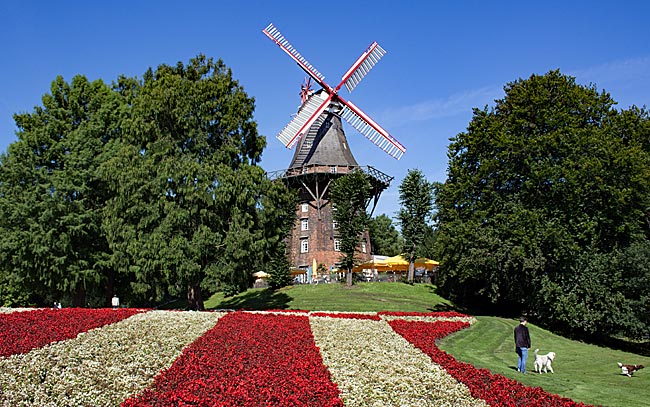
Wallanlagen
Almost entirely surrounding the Old Town, a zigzagging park landscape with a moat stretches out. These are the last visible remnants of the fortifications that once encircled the Old Town and parts of the New Town until the early 19th century. The transformation into a garden landscape began in 1802 with the first section between the Weser River and Herdentor Gate.
read more ...
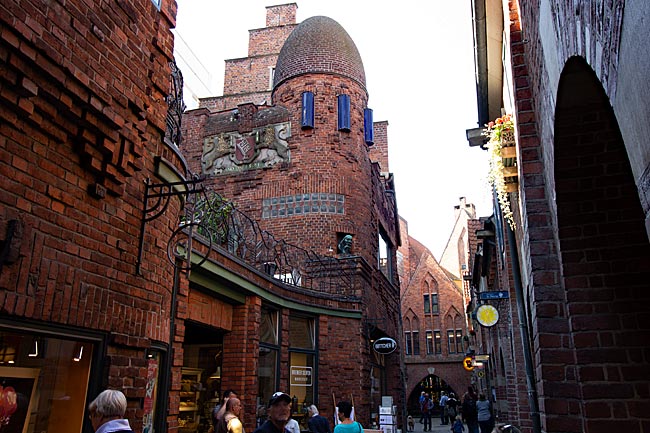
Böttcherstraße
Since at least 1931, the name Böttcherstraße is no longer primarily associated with the scent of wood and the sound of coopers' hammers, but rather with a very special, almost enclosed ensemble of buildings. Over a length of just over one hundred meters, museums, open artist workshops, specialty retailers offering upscale goods, dining establishments, and a hotel create a unique atmosphere between brick and sandstone structures that is unparalleled in Bremen.
read more ...