
 exploring Bremen & its surrounding areas
 You are here: worth seeing in Bremerhaven
 German Emigration Center Bremerhaven (Deutsches Auswandererhaus®)
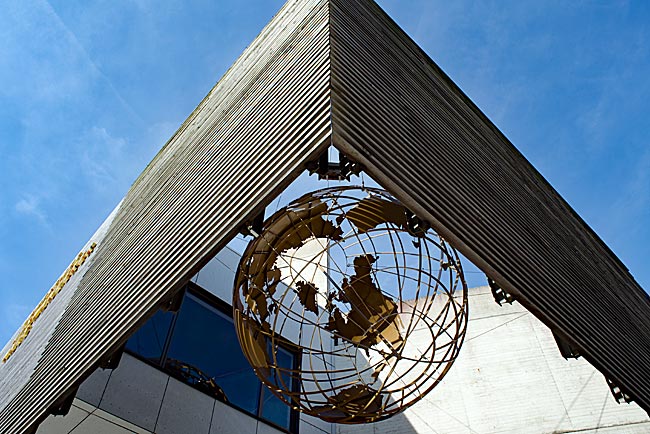
Globe above the entrance of the German Emigration Center
There are sentences that remain in memory. So too is the statement made by Chancellor Merkel on August 31, 2015: "We can do this." She was referring to the acceptance of the expected 800,000 refugees for that year, primarily from the war-torn country of Syria. For the economy of one of the richest countries in the world, the statement is correct, but the practical handling proved suboptimal from an administrative perspective in many places.
Racism, which unfortunately has openly surfaced and still surfaces in Germany, is not the way forward. For integration to be successful, both sides must make efforts. The refugee wave of 2015 was not the first and will not be the last to reach Germany. In the sometimes heated debate, it is often forgotten that Germans themselves have frequently become refugees due to war, persecution, or economic hardship in the past and were taken in and thus saved by people elsewhere.
Opened in 2005, the German Emigration Center presents on approximately 3,500 square meters of exhibition space the history of emigration - primarily to America - in five epochs between 1830 and 1974. A total of 7.2 million people left the country from Bremerhaven to find a new home and establish a new existence beyond the oceans. Although Bremerhaven was then the largest emigration port on the European mainland coast, for many in Germany, the journey also began in Hamburg or Cuxhaven.
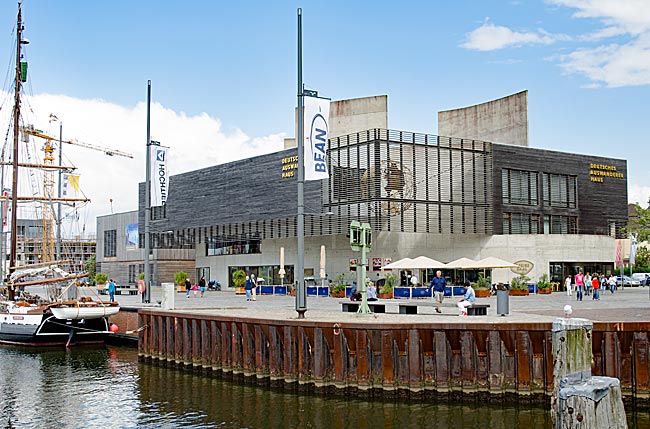
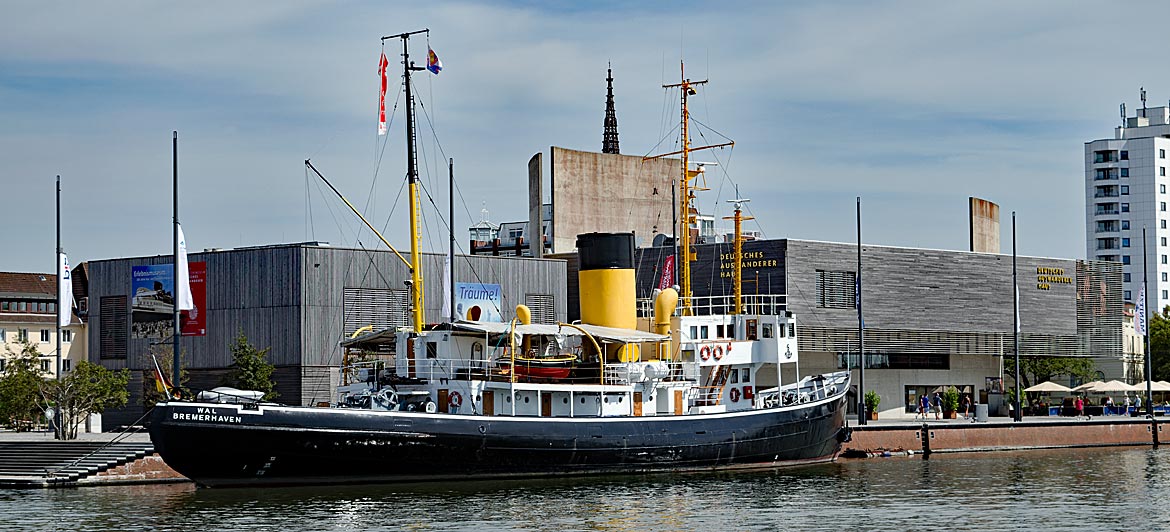
View of the German Emigration Center
From the third-class waiting room, a staircase leads directly to the quay, where people with their luggage await departure. Crates of supplies and coal for the boilers are also waiting to find their place on board. On board the North German Lloyd's fast steamer, which set sail on its maiden voyage from Bremerhaven to New York in 1888, there was room for 928 passengers: 600 in the intermediate deck and 104 in second class. In the museum’s staging, an original replica of the ship’s side - 8 meters high and 32 meters wide - must suffice behind a strip of water to convey the dimensions. The moment just before farewell.
But who boarded these ships and why? Over 150 years of emigration saw millions leave Europe. "No land, no work, no rights" - these were people who saw no economic prospects for themselves in a German Empire that did not yet exist as a nation-state before 1871. Wars, persecution for political or religious reasons also drove people onto ships heading toward an uncertain future. Before boarding via the gangway, visitors can read and listen to personal stories of individual emigrants.
On board, screens between stacks of luggage show excerpts from original film documents depicting the loading and departure of the 1924-launched fast steamer "Columbus" of the North German Lloyd (NDL). In a series of cabins further along the tour, it becomes clear how much emigrants suffered during earlier crossings and even feared for their lives. Until the 1840s, these were sailing ships on the dangerous Atlantic crossing, many no longer than 30 meters. Up to 100 people crammed below deck in a space with all their belongings, five per bunk, human odors from perspiration and waste spread quickly, as did diseases and pests.
From 1870 onward, nearly all ships on the route were steam-powered and made of iron. With the beginning of steel production in 1890, ships became even larger and faster thanks to advancements in propulsion technology with twin screws. But not only that, the journey became more pleasant and luxurious for passengers, at least those in first and second class. Images show opulently Rococo-style salons, swimming pools below deck, and dance events on deck.
Although emigration from Europe also occurred on a larger scale to Australia, Canada, and South America, as the exhibition shows, its focus remains on immigration to the United States, culminating in the staging of arrival at Ellis Island and finally Grand Central Terminal in New York City.
Were these all success stories like that of the dishwasher who became a millionaire? No, the documentation shows that establishing a new existence in the new homeland was difficult at different times and often involved hard work.
The 150 years of emigration are contrasted by 300 years of immigration, which forms the second half of the tour. Döner, pizza, cheese, pasta, or even potatoes - who in our daily lives questions who brought cultural enrichment into the country that we have so readily adopted?
Visitors to the German Emigration Center gain an intense sense of what it means to emigrate and leave much behind or immigrate into a culture initially foreign to oneself, while carrying one’s own with them. Tolerance, acceptance, but also rules and a unifying common language are needed to overcome prejudices and fears. It is the many photos of real people and their real fates abroad or even here that can be read in the exhibition or heard through headphones, as well as the people who speak in films at the Roxy cinema, that make what is depicted so vivid and emotionally tangible and ultimately show how emigration and immigration have functioned successfully across centuries in many parts of the world.
For this emotionally gripping staging with a historically sound background, the museum received the European Museum Award in 2007.
As mentioned earlier, immigration also played a role in the exhibition. Since mid-2021, this topic has been given more space in a newly opened second annex.
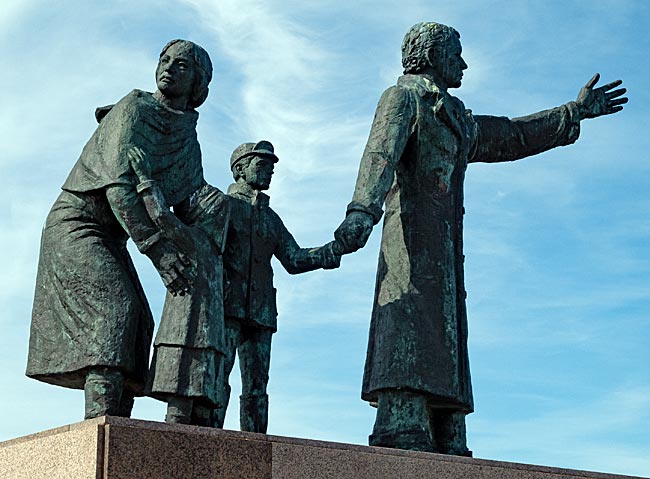
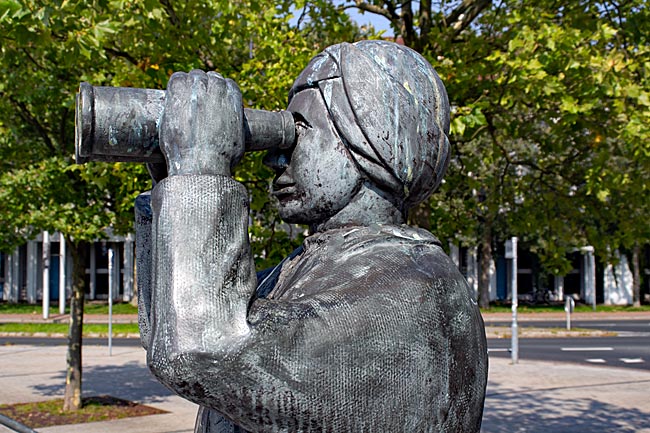
The monument for German emigrants to America, erected in 1986 by the German-American Memorial Association (Philadelphia, USA), stands on Willy-Brandt-Platz between Zoo am Meer and Außenweser, next to the landing stage for Heligoland trips.
Note: We would have liked to show you photos from the Emigration Museum as well, but no images are permitted for public or commercial use.
previous page
 next page
Map
Further information
German Emigration Center
Columbusstraße 65
27568 Bremerhaven
Phone: +49 (0) 471 90 22 0 – 0
Open:
March - October: Daily 10 AM - 6 PM, November - February: Daily 10 AM - 5 PM
Email: info@dah-bremerhaven.de
dah-bremerhaven.de
Bremerhaven - Zoo am Meer (Zoo by the Sea)
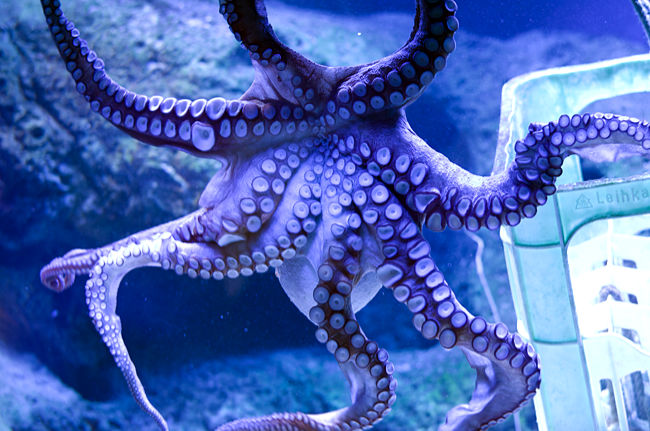
In addition to the 19th-century harbor facilities, the Zoo am Meer is the oldest attraction on the site between the Weser River and the pedestrian zone. It opened in 1928 under the name "Tiergrotten." The enclosures house polar bears, seals, penguins, various bird species such as gannets and keas, reptiles like turtles, raccoons, Arctic foxes, pumas, monkeys, and others - almost 50 animal species in total.
read more ...
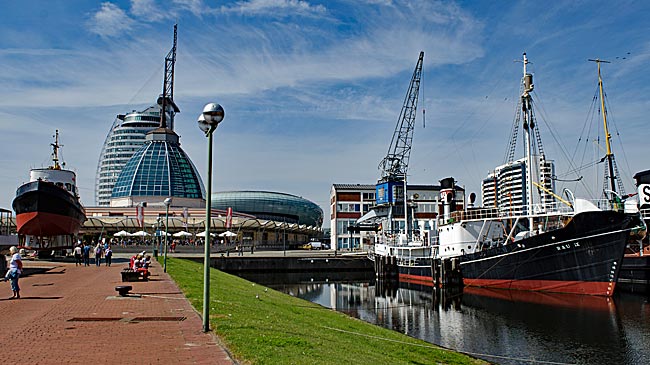
Bremerhaven Havenwelten
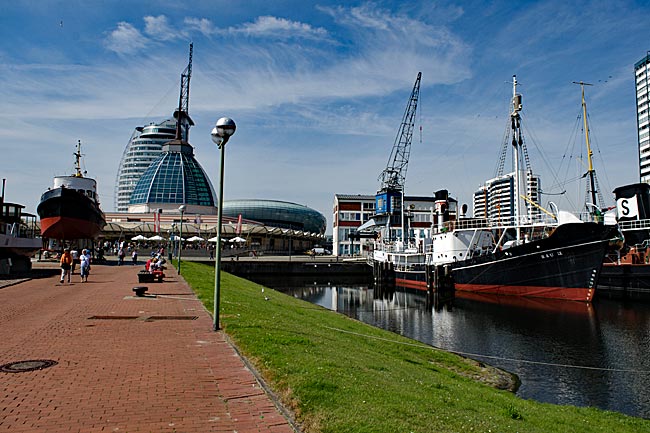
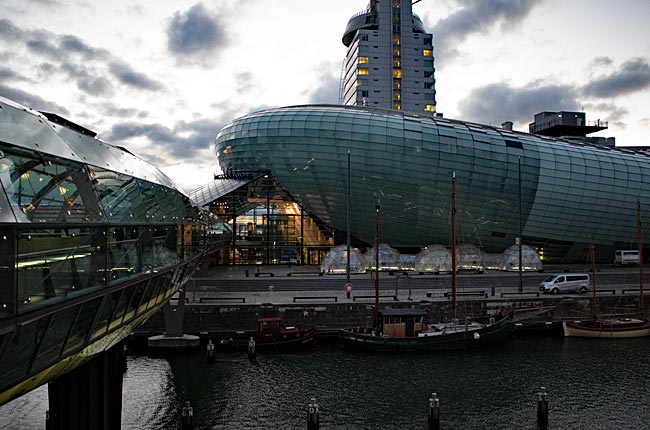
Since early 2008, Bremerhaven has not only had a new tallest building but also a new landmark in its Weser-side skyline with the ATLANTIC Hotel SAIL City, which rises 147 meters directly behind the Weserdeich. Architecturally, the structure perfectly embodies a maritime city - it stands like a powerful, rounded ship's superstructure. On the 20th floor, at a height of 77 meters, there is an observation deck (SAIL City) that is also accessible to non-guests.
read more ...
Klimahaus® Bremerhaven 8° Ost
In this futuristic building, visitors embark on a journey along the 8th meridian east, traveling around the globe through all climate zones. Across multiple levels, there is plenty to read, see, hear, and experience sensorially and tactilely about climate and its impact on local nature and human life. Visitors are not limited to being passive observers but are invited to actively engage with numerous exhibits.
read more ...
Bremerhaven - Überseehafen (Overseas Port)
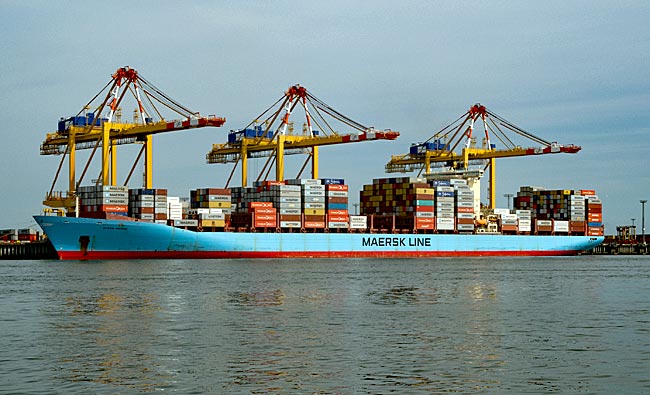
In addition to the Old Harbor (now the Museum Harbor), which was the first to be built, other ports were later added. Adjacent to the New Harbor lies Kaiserhafen I, the first in a series of additional harbor basins. Even a glance into this initial section of the expansive port area reveals a different world of maritime activity - one of large ships. And we will see even larger ones along the five-kilometer-long quay on the Weser.
read more ...
SAiL Bremerhaven
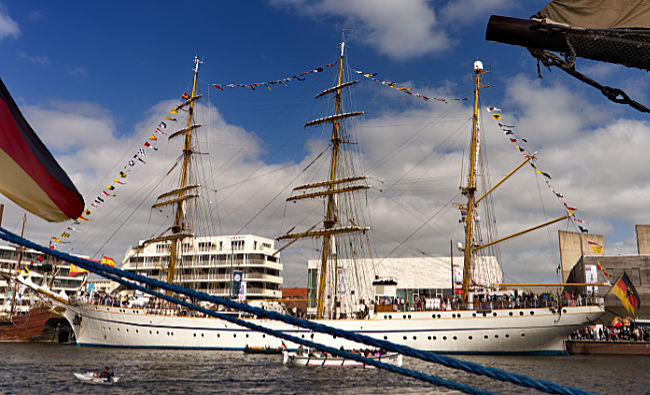
When SAiL Bremerhaven takes place, the port city becomes an even more international stage than it already is, both in terms of participants and visitors, who exceed ten million over the five days of the event. Unlike the usual focus on cargo ships at the container terminal and cruise ships at the cruise terminal, this time - true to its name - the spotlight shifts primarily to sailing ships. In total, 250 vessels were attracted or involved in the SAiL, which returned for the first time in ten years in 2025.
read more ...