
 exploring Bremen & its surrounding areas
 You are here: worth seeing in the surroundings
 Heligoland: the rock in the surf (2/2)
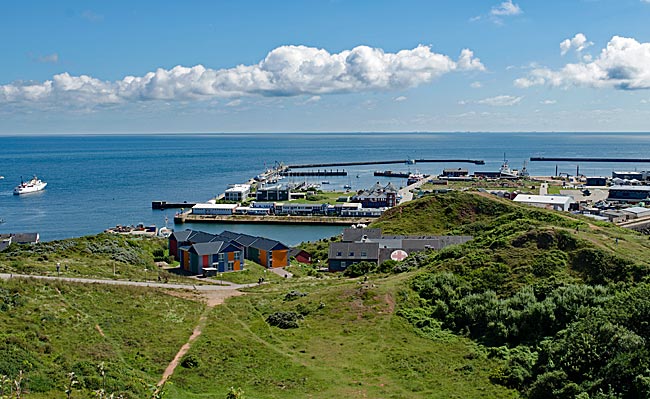
View of the South Harbor from the cliff path
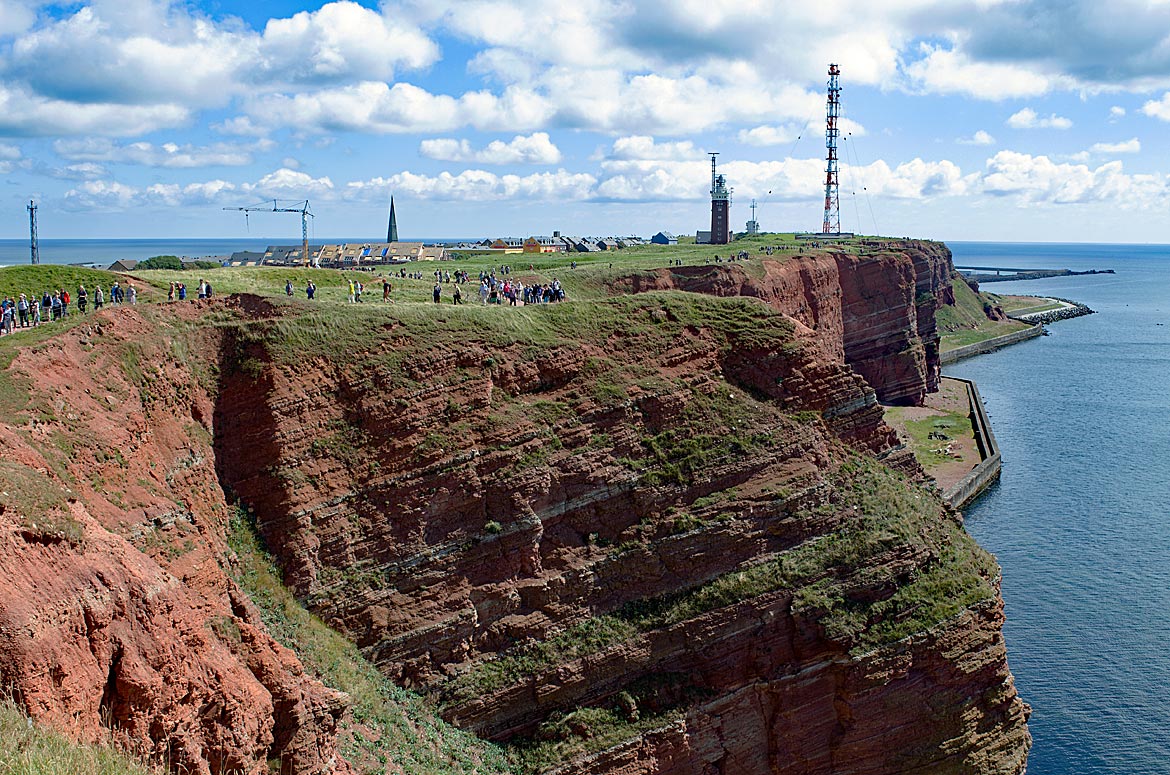
At the end of the stairs in the Upper Town, if you follow the path to the left, you will arrive at what is arguably the most spectacular route on Heligoland - the Wai langs Klef, or the cliff path (Klippenrandweg). Initially, you still have a view from above of the South Harbor, but after another ascent, the name of this roughly three-kilometer-long path becomes clear: it runs along the upper edge of the cliffs, right at the precipice.
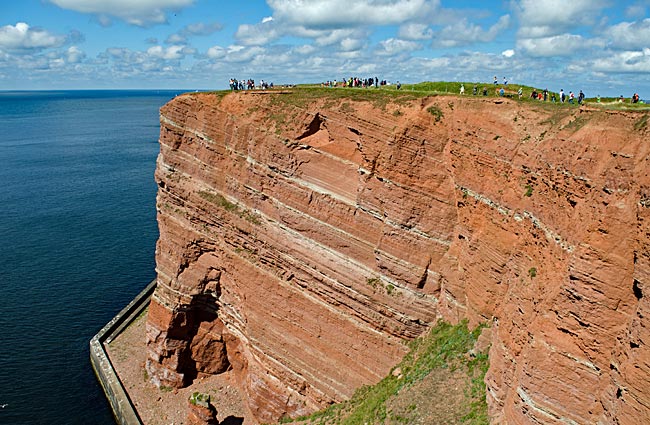
On the cliff path
The steep coastline rises up to about 50 meters, shaped by erosion. Water and wind continue to gnaw persistently at the Gatts and Hörns - the bays and rock outcrops - made of red sandstone. If you're visiting the island as a day tripper, you won't be alone on this section of the path, which winds back and forth in a zigzag pattern. The specially set-up viewing platforms offer a welcome opportunity to step aside, pause, and enjoy the view in peace.

Gannet with offspring
However, "peace" is relative here, because alongside the landscape, thousands of seabirds are the real attraction along the cliff path. Around 10,000 pairs nest annually on the Lummenfelsen (guillemot rock), even in extremely steep slopes - including guillemots, black-legged kittiwakes, and gannets. There is constant coming and going, with lively communication among them. However, this only happens from spring onward; in winter, the rock lies abandoned.
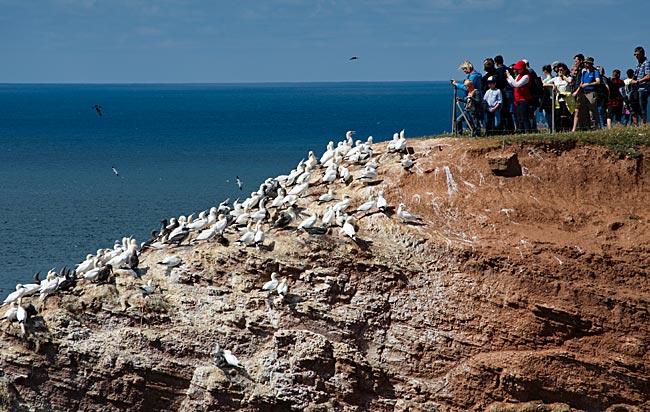
Encounters on the Lummenfelsen
Since the animals are used to seeing people, you can sometimes get quite close without actually getting too near, fences protect both the animals and humans here. However, gulls are not so easily deterred; after all, a passing human might drop a crumb or two of bread as a welcome treat.
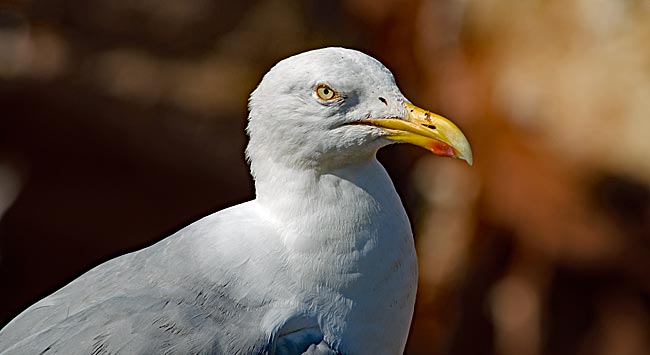
Seagull
A particularly spectacular event occurs every year at the end of June and beginning of July with the "Lummensprung" (guillemot jump), when young guillemots leap from the Lummenfelsen into the North Sea in the evening twilight.
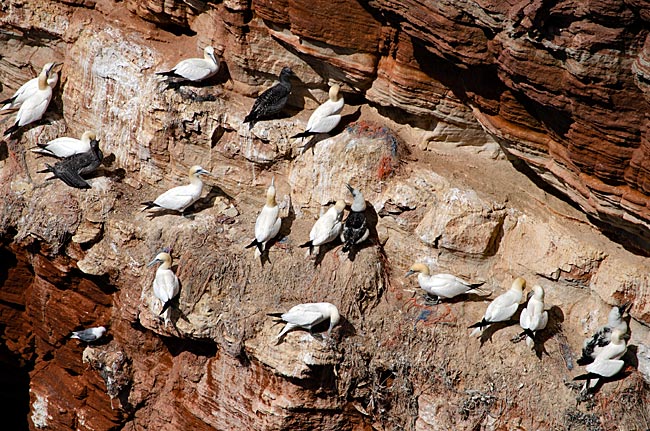
Crowded on the Lummenfelsen - even without guillemots
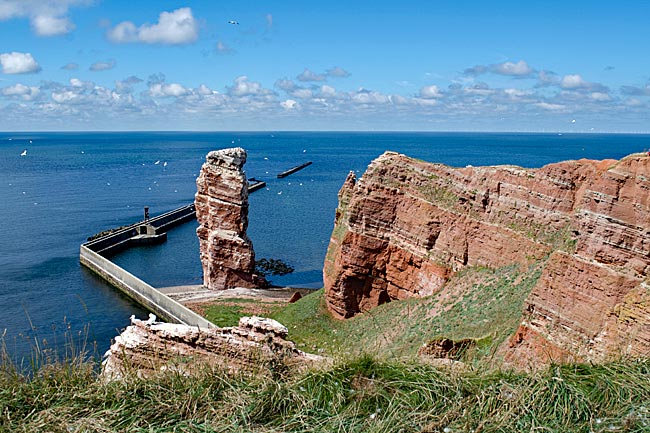
A short distance from the Lummenfelsen, at the northwest tip of Heligoland, you finally encounter the island's landmark: Lange Anna (Long Anna). This 47-meter-tall freestanding rock formation was still connected to the rest of the cliff until May 1860, when the natural bridge collapsed. Erosion not only created this former arch but continues to threaten the natural monument; in the past, the rock base had to be reinforced to prevent an imminent collapse. The breakwater behind it, like the airport on the dune, was built as part of the "Hummerschere" project.
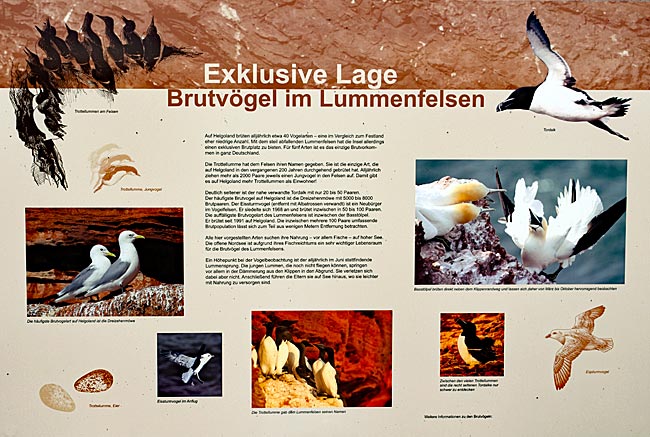
Information board at the Lummenfelsen
There is actually also a "Kurze Anna" (Short Anna), located right next door. In January 1976, a rock collapse from the main island created a second, smaller rock formation about 50 meters away - though you can't see it from the path.
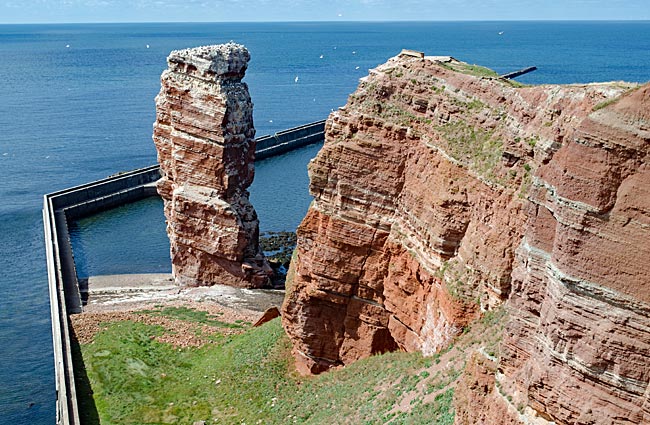
Lange Anna at the northwest tip of the island
From the island's tip, the cliff path, designed as a circular route, leads back to the Upper Town and then further down to the Lower Town. With luck, you might find a nice spot in one of the many restaurants or cafés. But you are guaranteed to find peace when the day visitors stream back to the landing bridge and the South Harbor, because that's when tranquility returns to Heligoland.
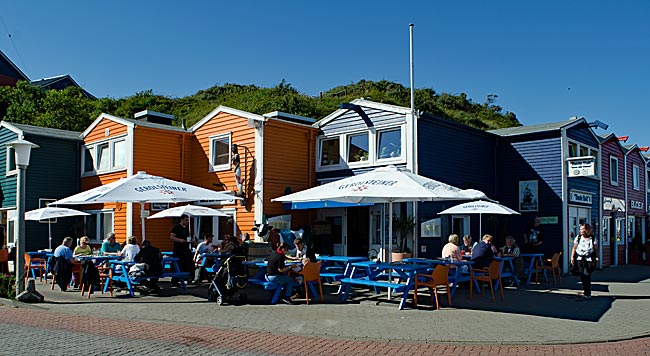
Another beautiful ppot: dining at the Hummerbuden (Lobster Huts)
previous page
 next page
Map
Further information
Heligoland Tourist Office
Lung Wai 28
27498 Deät Lun / Heligoland
Phone: +49 (0) 4725-8143-0 (Main)
Fax: +49 (0) 4725-8143-28
Email: info@helgoland.de
www.helgoland.de
Peak travel season: April - October
How to get there:
Airplanes fly from Heide/Büsum and Cuxhaven/Nordholz, www.flughafen-helgoland.de, www.fliegofd.de/inselfluege/helgoland-heidebuesum.html
A catamaran departs from Hamburg with stops in Wedel and Cuxhaven. www.helgoline.de
Ferries operate from Büsum, Bremerhaven, Cuxhaven, and Sylt. www.cassen-eils.de, /www.adler-eils.de, www.adler-schiffe.de/ab-sylt/helgoland.php
Stade - on the banks of the Schwinge River
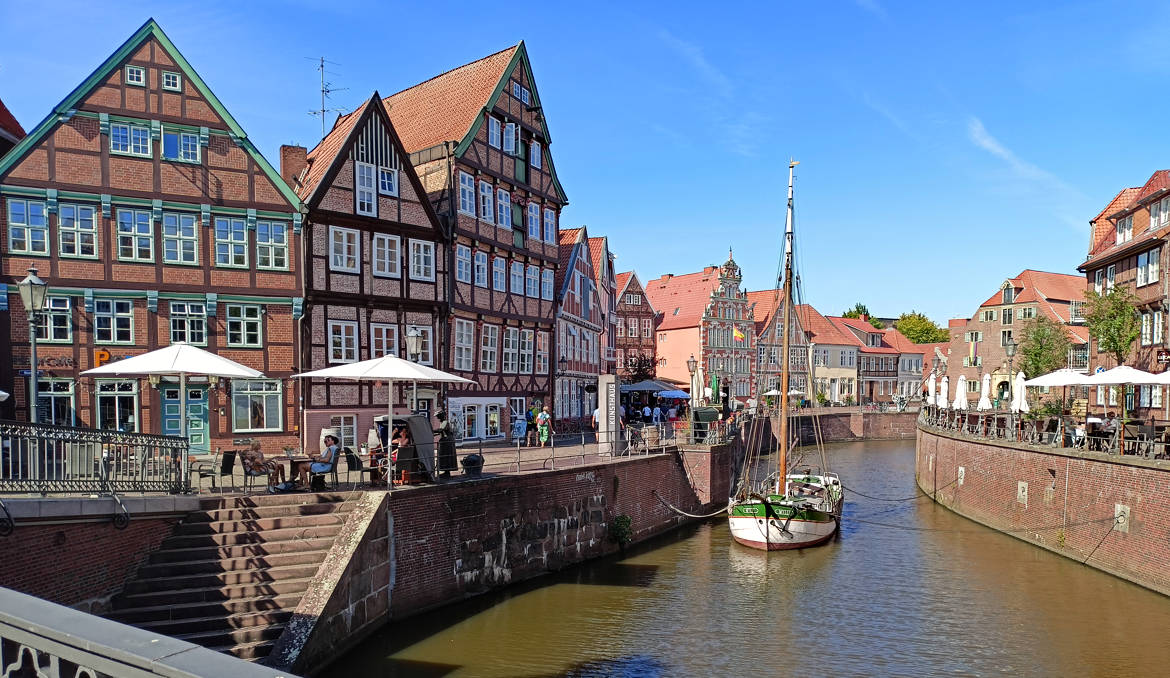
Do you know Stade? No? What a shame! Then feel free to read on if you'd like to learn about this smaller Hanseatic city on the Elbe, neighboring the much larger Elbe metropolis of Hamburg. As is often the case, the tourist's gaze doesn't fall on the entire city but rather focuses here on the historic city center and a bit of its surroundings. In our opinion, Stade is a beautiful and worthwhile destination for a short visit or even a few extra days.
read more ...
Bremerhaven in general
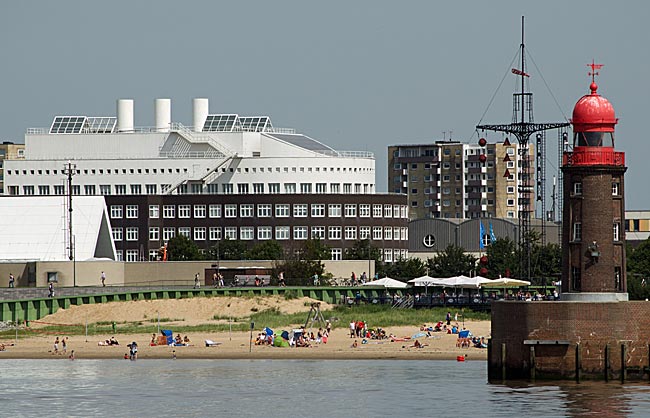
Bremerhaven was only founded in 1827. To secure Bremen's status as a port city amid the threat of the Weser - Bremens lifeline - silting up, Bremen acquired 342 acres (morgen) of land from the Kingdom of Hanover for 74,000 talers under then-mayor Johann Smidt. About 60 km downstream from Bremen, this land became home to the first urgently needed seaport built by Bremen: the so-called Old Harbor, completed by 1830.
read more ...
Bremerhaven - Zoo am Meer (Zoo by the Sea)
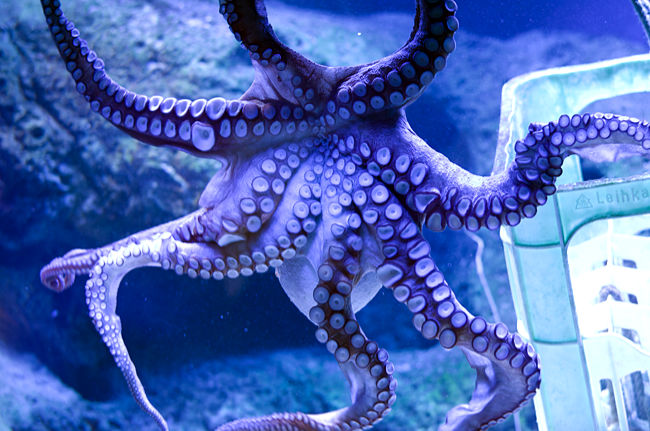
In addition to the 19th-century harbor facilities, the Zoo am Meer is the oldest attraction on the site between the Weser River and the pedestrian zone. It opened in 1928 under the name "Tiergrotten." The enclosures house polar bears, seals, penguins, various bird species such as gannets and keas, reptiles like turtles, raccoons, Arctic foxes, pumas, monkeys, and others - almost 50 animal species in total.
read more ...
Bremerhaven Havenwelten
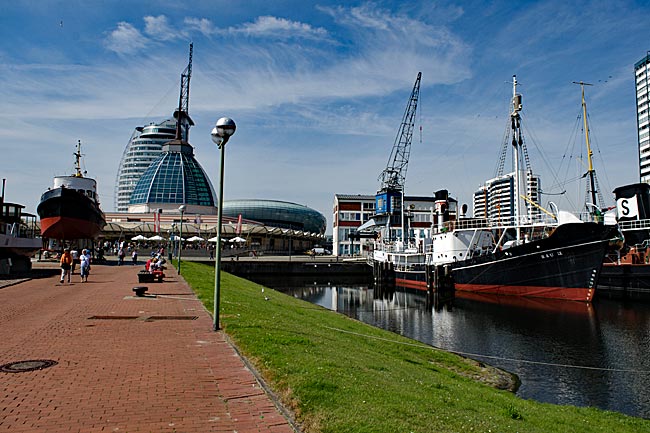
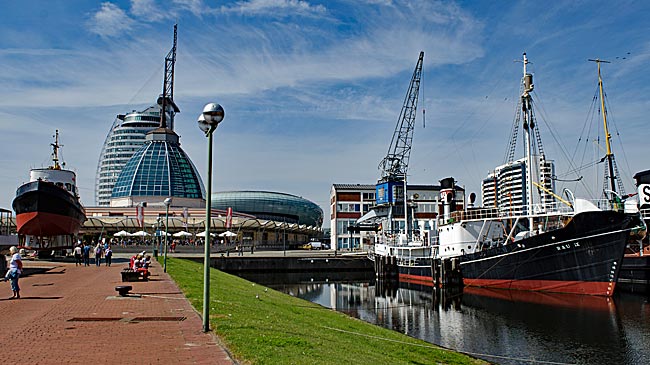
Since early 2008, Bremerhaven has not only had a new tallest building but also a new landmark in its Weser-side skyline with the ATLANTIC Hotel SAIL City, which rises 147 meters directly behind the Weserdeich. Architecturally, the structure perfectly embodies a maritime city - it stands like a powerful, rounded ship's superstructure. On the 20th floor, at a height of 77 meters, there is an observation deck (SAIL City) that is also accessible to non-guests.
read more ...
Cuxhaven - a day trip
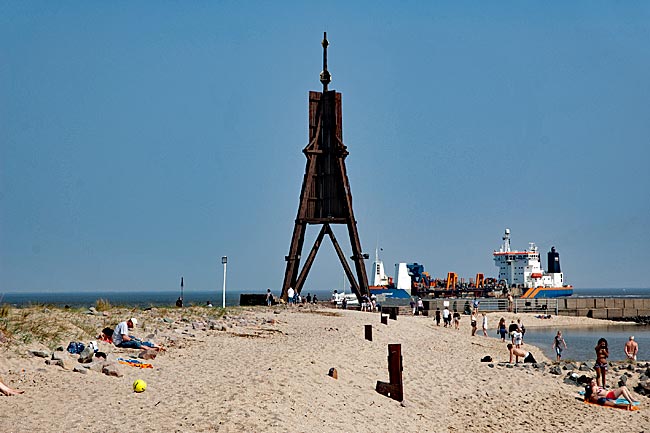
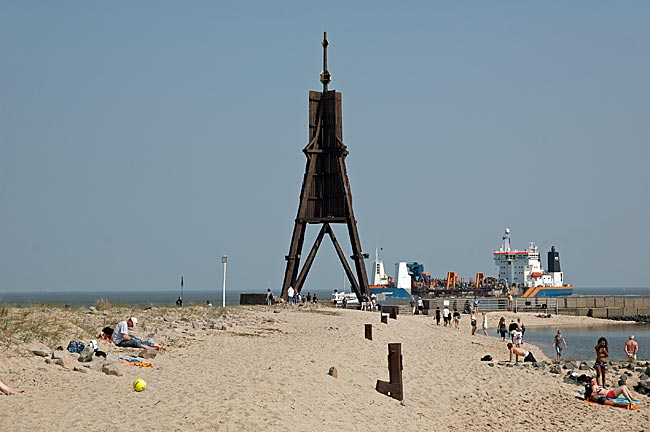
Many people from Bremen consider the seaside resorts of Cuxhaven to be "their home beach." The coastal city at the mouth of the Elbe is easily accessible from Bremen by car via the A27, which passes by Bremen and Bremerhaven before ending in Cuxhaven. By train, the journey takes a bit longer with a transfer in Bremerhaven. However, even in the off-season, Cuxhaven with its seaside resorts is a great destination for an outing - for example, by bicycle.
read more ...
The East Frisian Island Wangerooge
Among the inhabited East Frisian Islands, Wangerooge is the second smallest (7.94 km²) after Baltrum and car-free, making a stroll through town much more pleasant compared to other islands, especially since distances can easily be covered on foot. From the small train station, you're just a few steps away from the heart of the village, quickly finding yourself in front of the unmistakable Old Lighthouse, which now houses the island museum. From 1856 to 1969, this lighthouse served as a maritime navigation aid, guiding ships safely along their routes. Just how far its light could be seen becomes clear when you climb the 149 steps to the lantern room—from there, you can step out onto the surrounding gallery and enjoy a sweeping view of the island and the North Sea.
read more ...
Water-based activities in Bremen
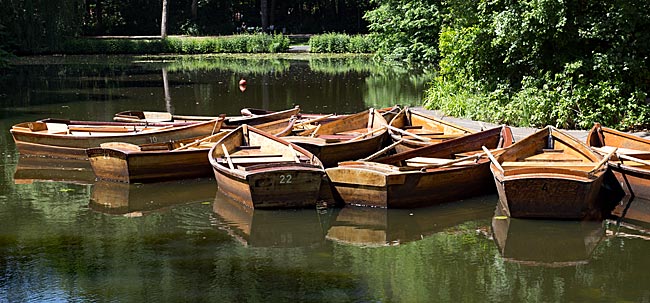
Given that Bremen is a city on a major river with numerous lakes, it makes sense to extend sports or other personal water-related activities from land to water. The most family-friendly activity on the wet element is certainly taking a rowboat ride along the canals of Bürgerpark.
read more ...