
 exploring Bremen & its surrounding areas
 You are here: attractions in the city center
 Roland - UNESCO World Heritage Site
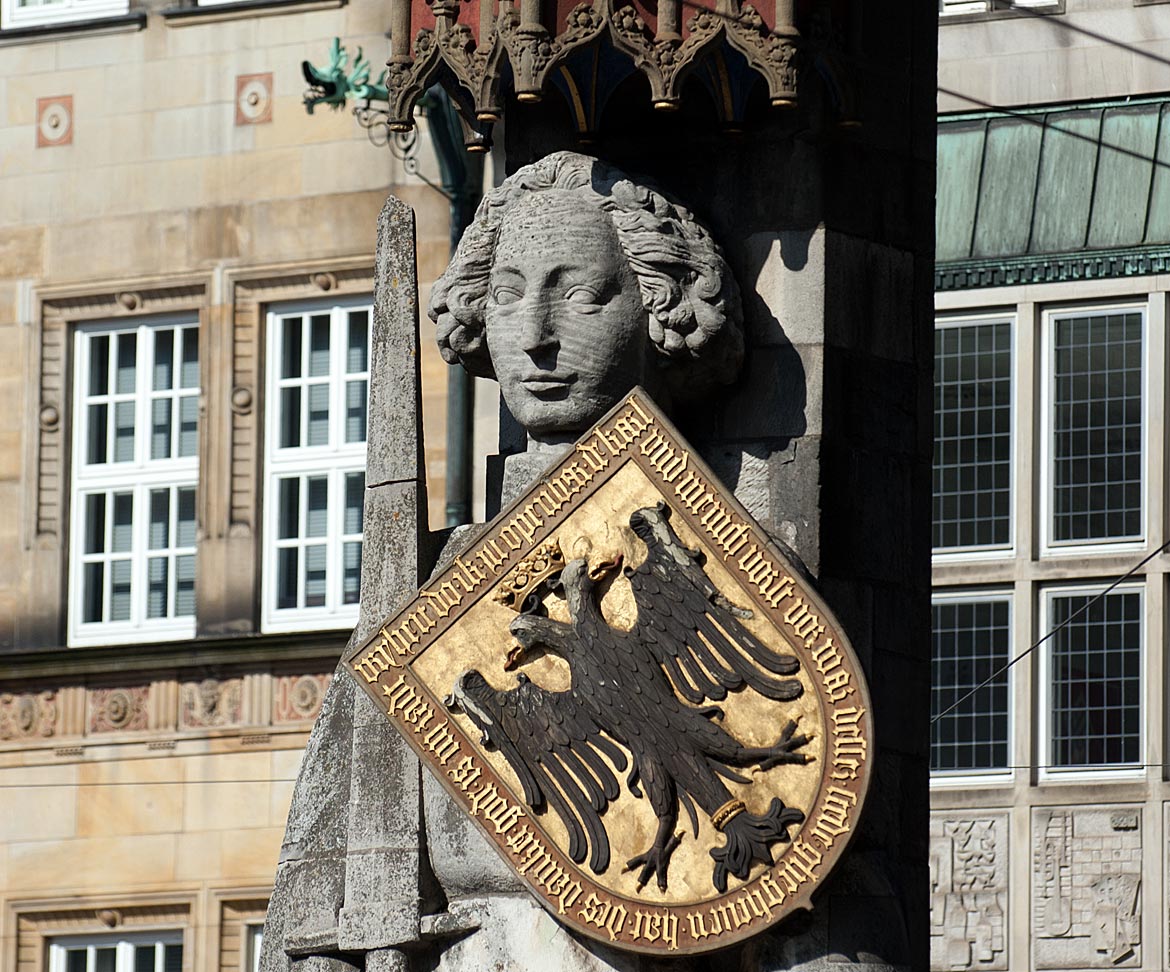
Since 1404, the Roland statue has stood on the market square in front of Bremen's town hall - a 5.55-meter-tall (10.21 meters including the pedestal) sandstone knight figure with a drawn sword symbolizing jurisdiction and a shield added 16 years later that appears somewhat out of place. Like numerous other statues across Europe, the Roland in Bremen represents the city’s freedom, which historically stemmed from market rights (symbolized by Roland's gloves) and its own judicial authority. These statues were typically placed near town halls for this reason.
The name "Roland" traces back to Hruotland (735–778), a Breton count who died in battle during Charlemagne’s campaign in present-day Spain. His heroic death is celebrated in the Old French epic The Song of Roland, composed between the late 11th and early 12th centuries, consisting of around 4,000 verses.
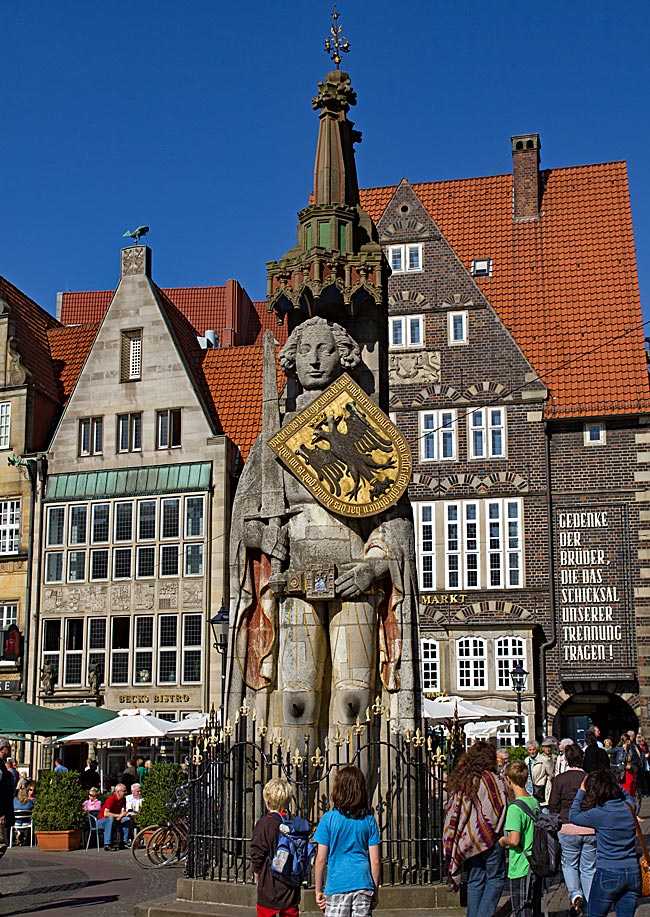
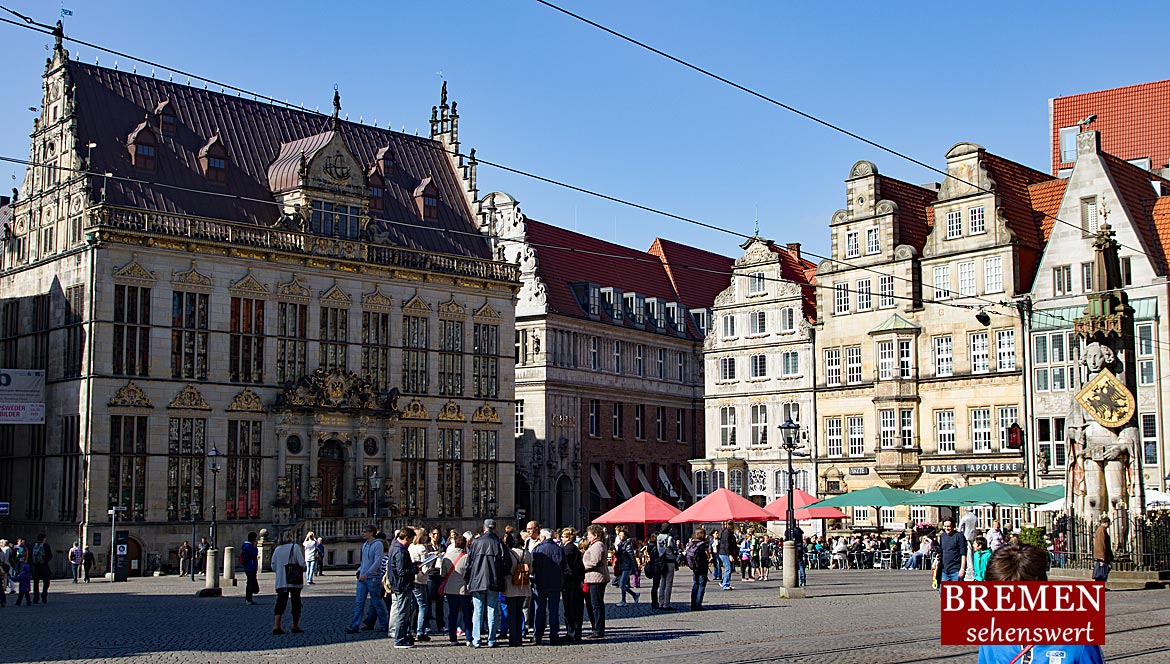
The Roland statue on the market square with citizens' houses in the background
The statue on Bremen’s market square is one of Europe’s oldest Roland figures. According to historical records, it replaced a wooden predecessor that burned down in 1366. Today, its stone successor is a popular photo subject in the Hanseatic city.
"I proclaim freedom to you, which Karl and other princes have truly granted this city." Whether Charlemagne actually made such a declaration - as inscribed on the giant’s shield - or whether this claim was as false as the documents presented at the time to prove Bremen’s freedom and imperial privileges remains uncertain. What is certain, however, is that the people of Bremen achieved their goal.
One could interpret Roland’s gaze as directed toward St. Peter’s Cathedral, where the ecclesiastical authority - the Archbishop - resided. Since the city council only recognized the Emperor’s authority (not the Church’s), conflict was inevitable. In the struggle for city freedom, the Archbishop ultimately lost. Did Roland witness this? Upon closer inspection, his gaze passes to the right of the cathedral, toward the location of the eastern city gate in the medieval wall - the present-day Ostertor.
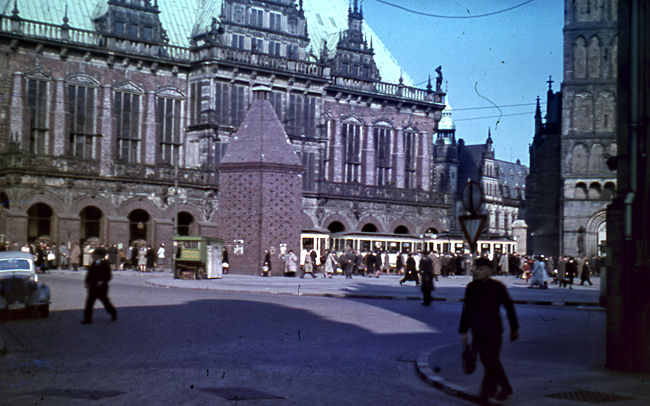
The Roland statue walled in during 1944 (archival image)
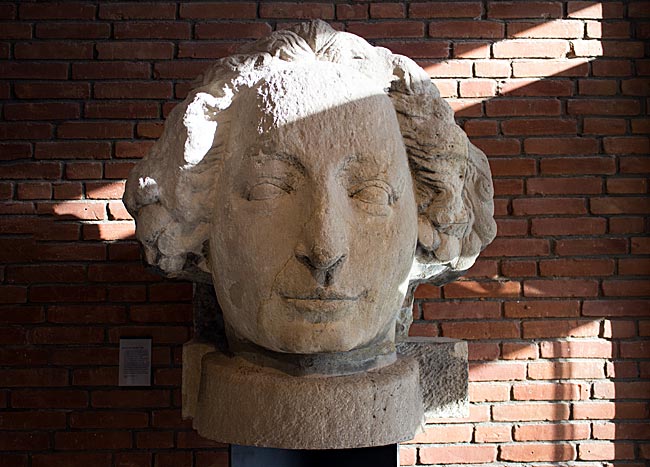
At the beginning of the 19th century, Bremen nearly lost its beloved statue when Napoleon considered acquiring it for the Louvre. The citizens convinced him that the Roland’s modest artistic value would not suit Paris’ grand museum. The importance of the Roland to Bremen is further evident in the protective measures taken during World War II - after centuries of preservation efforts. In 1939, the statue was disassembled and later re-erected behind a brick wall for protection. During dismantling, the original grille was removed; it was replaced with a new one only during a thorough restoration of this UNESCO World Heritage Site in 1983/84. The weathered original head was also replaced by a replica made of the same material. The original is now displayed in the entrance area of the Focke Museum in Riensberg, Schwachhausen.
Fun Fact: The distance between Roland’s kneecaps measures exactly 55 centimeters - the so-called Bremer Elle (ell). This medieval unit of measurement was used to calculate trade goods, allowing buyers to verify if merchants were cheating them when purchasing fabrics or other items.
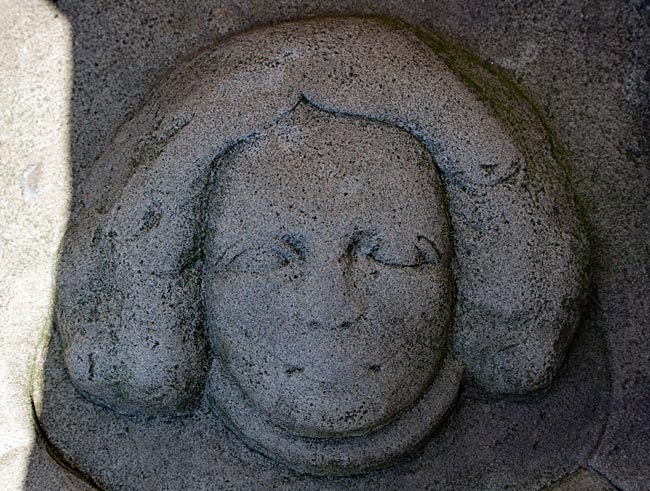
The cripple or not?
Anyone who steps up to the statue’s grille and looks down from the knees to the pedestal will notice a head or half-figure carved into the sandstone between Roland’s feet. Since at least the first half of the 19th century, this increasingly weathered face has been attributed - according to a legend by Bremen writer Friedrich Wagenfeld - to the cripple who supposedly granted the citizens the size of the Bürgerweide (a large open space). You can read more about this on our page about the Bremer Freimarkt, Germany’s oldest folk festival. However, Osvald Prepeliczay debunks this legend in his 2017 book The Secret at Roland’s Feet: A Journey Through Bremen’s History, citing a lack of chronological consistency. Instead, he suggests the figure represents a defeated Frisian chieftain. The Frisians settled along the North Sea coast and engaged in extensive maritime trade. To this day, East and North Frisia bear names referencing their settlements.
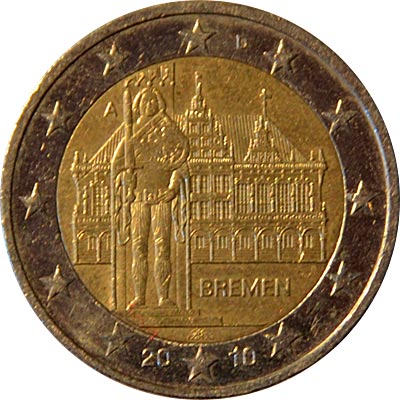
In 2004 - 600 years after its erection - the Roland (already a protected monument since 1973) and the town hall were honored with UNESCO World Heritage status. Both landmarks also appeared on a commemorative 2-euro coin in 2010.
previous page
 next page
Map
Market square
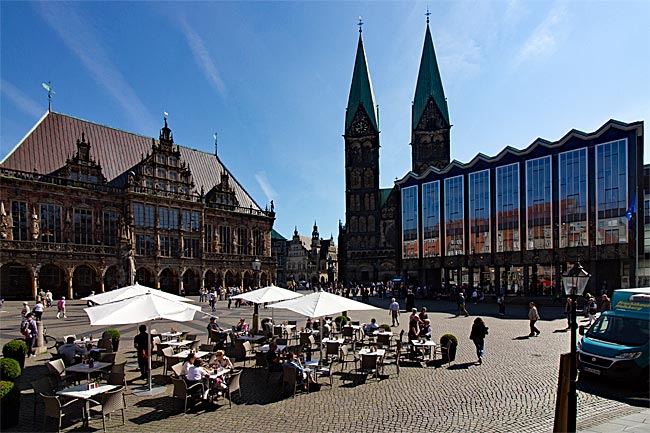
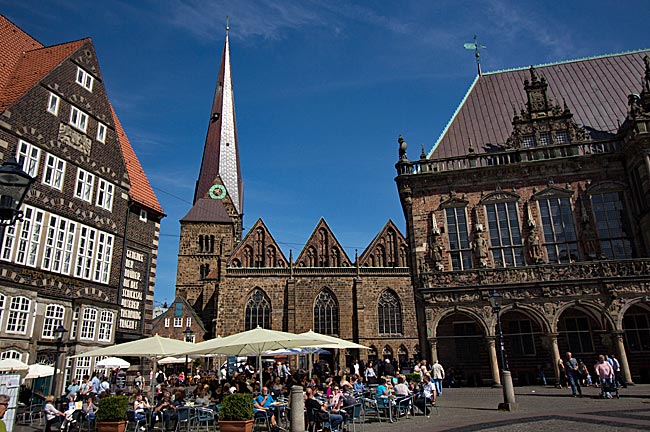
As it was in the past and as it is today, the market square is the political center of Bremen and also a major attraction for thousands of tourists, undoubtedly due to its unique architectural atmosphere. Almost unobtrusive and plain in appearance, the Bürgerschaft (Bremen's parliament) stands next to the magnificent Old Town Hall.
read more ...
Town Hall
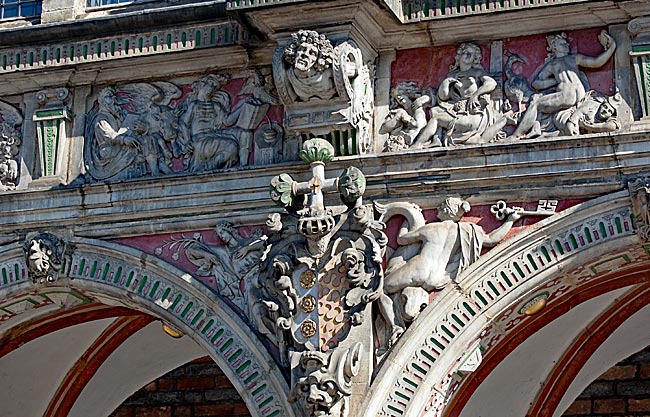
The original Old Town Hall on market square was built between 1405 and 1412. Little of this originally rather plain late Gothic brick structure remains today. The Renaissance façade, which gives the UNESCO-protected building its distinctive appearance, was constructed between 1608 and 1614 by Lüder von Bentheim. Above the arcades in particular, it is lavishly adorned with various depictions from ancient mythology, blending uniquely with Christian symbolism, Bremen city symbols, and other representations.
read more ...
Focke-Museum
Every city has its history, and in many cities, there is a museum that tells this story. In the Hanseatic city, it is the Focke Museum in the Riensberg district, where urban history is presented most vividly. The "Bremer State Museum of Art and Cultural History" was established in 1924 by merging two collections: the Gewerbemuseum, founded in 1884, and the Historisches Museum für bremische Altertümer (Historical Museum for Bremen Antiquities), founded six years later. The museum's founder, who passed away in 1922, also gave it his name.
read more ...
Freimarkt
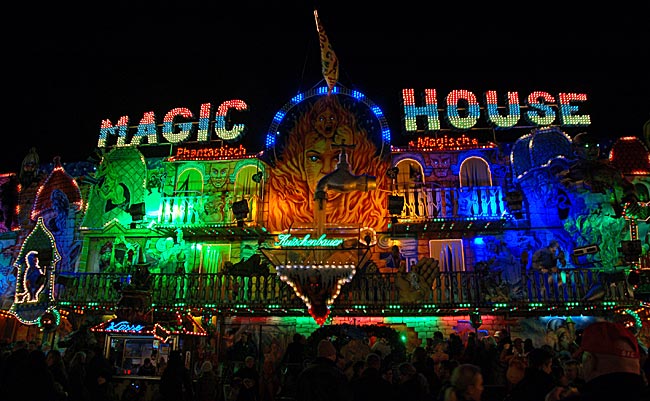
What some might simply call a fair or a large amusement park is, for others, an event of equal importance to Christmas. However, the fact remains that for most residents of Bremen, the Freimarkt is considered the "fifth season" and an unshakable Bremen tradition. This isn't surprising, as Bremers can look back on nearly a thousand years of history for their festival - and with that, the Freimarkt is Germany's oldest folk festival.
read more ...