
 exploring Bremen & its surrounding areas
 your are here: backgroundstories
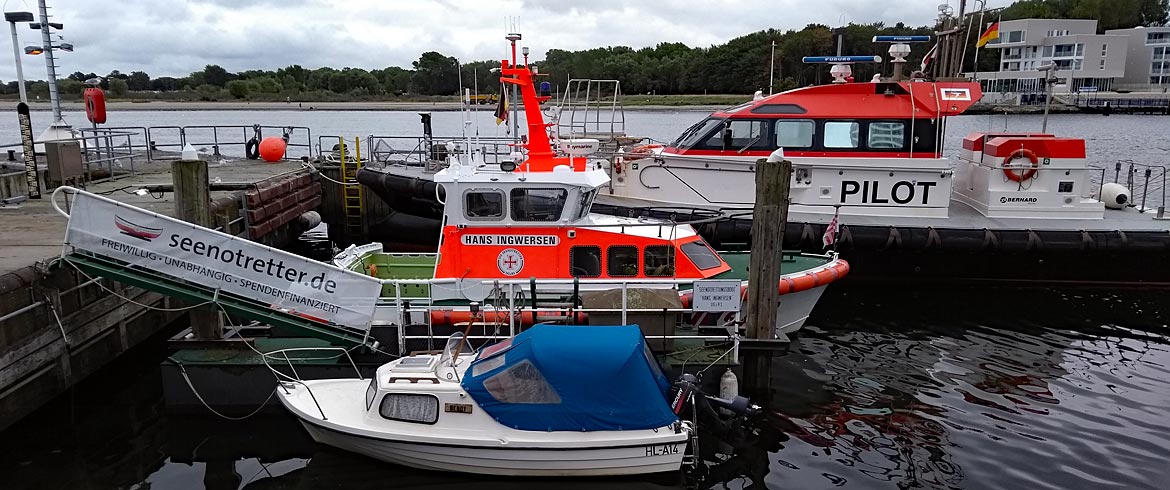
 DGzRS - German Maritime Search and Rescue Service
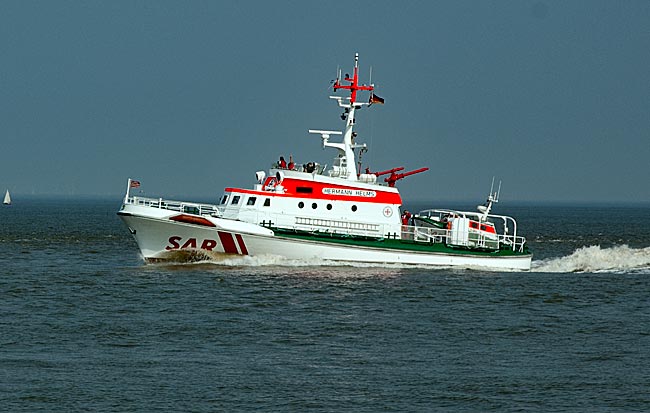
Maritime rescue cruiser "Hermann Helms" off Cuxhaven in 2011
There are many more or less clever sayings, such as: "Those who seek danger come to ruin." Had the Vikings, da Gama, or Columbus chosen to stay at home instead of embarking on their daring voyages across the world's oceans, history would undoubtedly be different. Whether for better or worse is debatable. Certainly, in pre-industrial times when sailing ships were indispensable, many sailors never returned from sea. Diseases, accidents, and pirate attacks often claimed lives just as storms turned many a sailor into a helpless plaything of the elements, sinking with crew and all. Rescue was only possible near land.
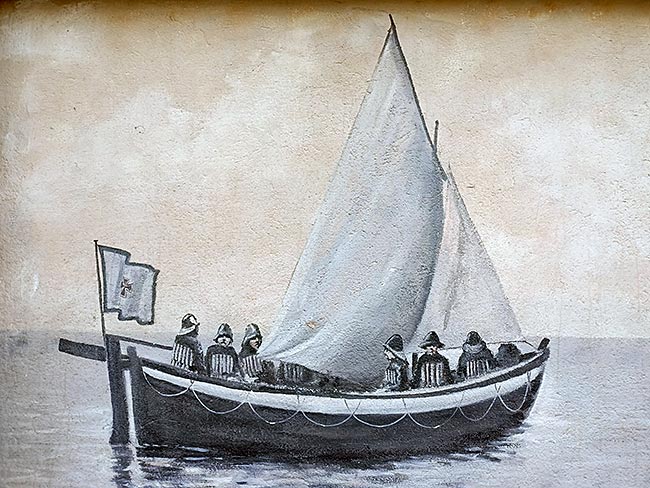
Wall painting by Hobrlant (May 2013), located opposite the Sea Rescue information point in Warnemünde
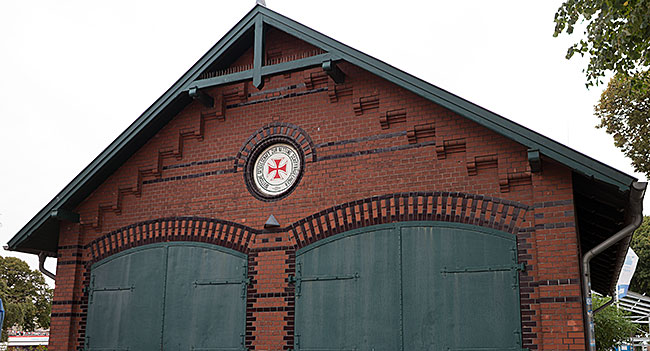
Restored historic Sea Rescue boat shed at the Alter Strom in Warnemünde
When ships collided, ran aground on sandbanks, or capsized in coastal waters, drifted helplessly on the waves, or people fell overboard, it was time for rescue teams who, even in adverse weather conditions, rowed out in smaller open boats to save lives - often putting themselves in grave danger. Scenes from the early days of maritime rescue.
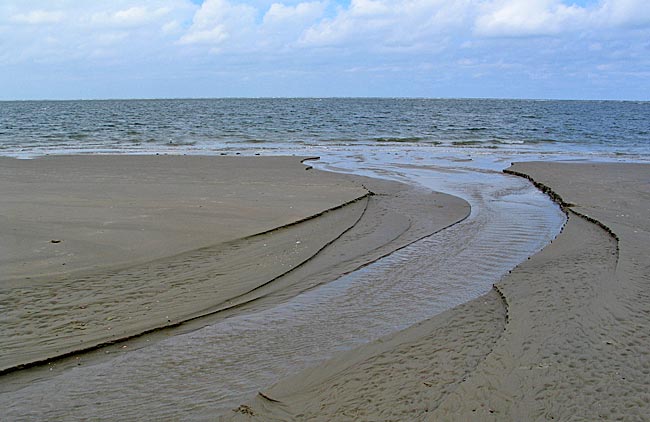
Priel at the North Sea coast. During high tide, water and sand can turn into a raging stream that cuts off waders from the nearby shore
Those who find themselves in distress today - whether cut off by the tide, a broken mast on their dinghy, an engine failure, someone falling overboard, or a sinking ship - have far better chances of being rescued even farther out at sea, thanks to modern technology and professionals who take care of them.
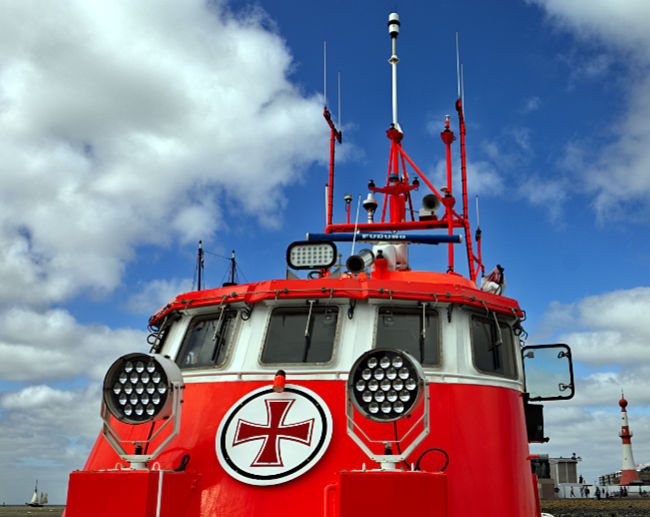
Sea Rescue Cruiser "Arkona" (commissioned 1992) with tender "Caspar" at the Alten Strom in Warnemünde
Along the German North and Baltic Sea coasts, these individuals are primarily the roughly 800 volunteers at sea and approximately 650 land-based volunteers of the DGzRS (Gesellschaft zur Rettung Schiffbrüchiger) - commonly known as 'The Sea Rescuers.' In the year 2020 alone, 357 people were rescued during 1,720 operations. Since its inception, the organization has provided assistance to more than 87,000 people. 'We head out when others come in!' (DGzRS)
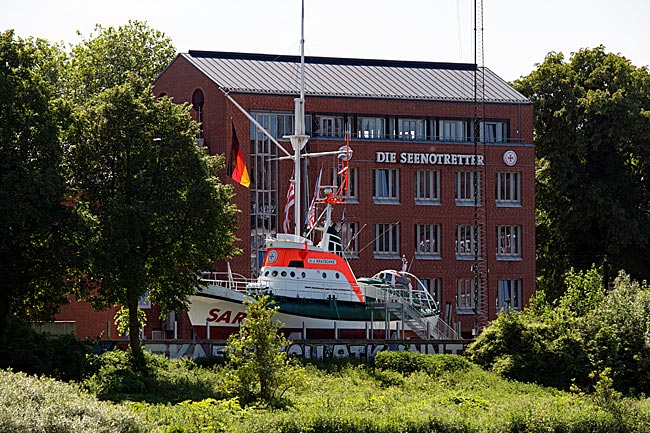
The headquarters of the German Maritime Search and Rescue Service at the Weser riverbank, with today's museum ship "H.-J. Kratschke," stationed on Sylt in the 1970s
Founded on May 29, 1865, in Kiel, the society has been headquartered in Bremen ever since. In addition to the previously mentioned rowboats, the stations were initially equipped with simple rocket apparatuses - used to shoot rescue lines onto stranded ships from the shore - and breeches buoys (a type of rescue device). Breeches buoys consist of a life ring with an attached pair of pants and a suspension system with pulleys that allows people to be rescued via cable cars over those same rescue lines. The first motorized boats were put into service almost 50 years after the DGzRS was founded, starting in 1911. With propulsion, the boats not only became faster but also expanded their range of operations.
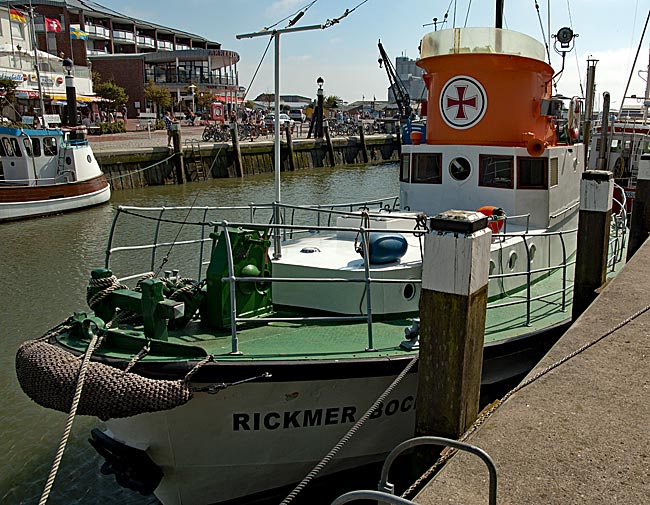
The maritime rescue cruiser "Hindenburg," commissioned in 1944 and later renamed "Rickmer Bock," seen here in Büsum harbor
With the christening of the maritime rescue cruiser "Theodor Heuss" in 1957, a completely new class of global maritime rescue cruisers was launched. These modern cruisers, measuring 23.2 meters in length, featured a newly designed propulsion system with a central engine and two outer engines totaling 1,750 horsepower. Additionally, the ships were each equipped with an agile daughter boat that could slide into the water via the stern. With their onboard firefighting systems, the crews of these cruisers could also extinguish fires in emergencies and use pumping systems to prevent damaged boats from sinking. The last of the maritime rescue cruisers built until 1960 was decommissioned in 1985.
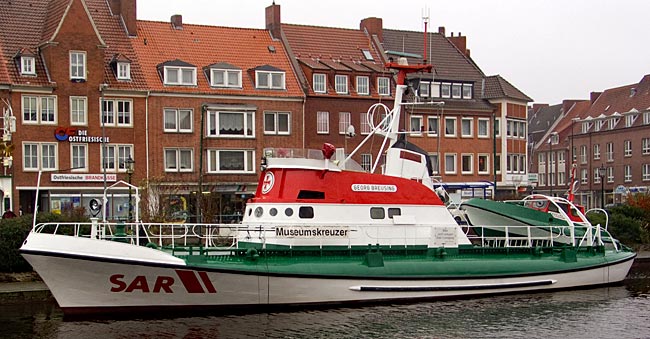
The 26-meter-class maritime rescue cruiser "Georg Breusing," built in 1963 at Abeking & Rasmussen in Lemwerder, was decommissioned in 1988 and now serves as a museum ship in Emden's harbor.
That the ships of the DGzRS became increasingly modern and adapted to operational conditions with each successive class is evident in the 23.1-meter maritime rescue cruisers that entered service in 1996. A novelty in the history of these rescue vessels was their enclosed superstructure, including a closed upper bridge, as well as gas protection capabilities. Additionally, the ships were designed to self-right if capsized. By adopting a delta hull design, they also deviated from the previously traditional rounder hull shape.
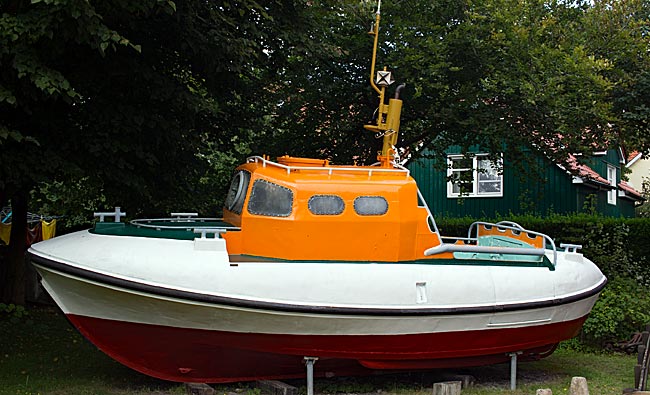
Former lifeboat "GESINA," built in 1971. This 7-meter-class boat was part of the DGzRS fleet until 1993 and is now a museum ship on Wangerooge.
Despite these technical advancements in equipment and crew expertise, lifeboat rescuers have still lost their lives during missions at sea, such as in a 1967 accident off Heligoland that claimed the entire crew of the "Adolph Bermpohl" - along with those they had previously rescued - as well as an incident near Borkum in 1995, where two men from the "Alfried Krupp" perished. In total, the DGzRS has lost 45 men to accidents throughout its history. A memorial stone on Heligoland's "Friedhof der Namenlosen" (Cemetery of the Nameless) honors the crew of the "Adolph Bermpohl."
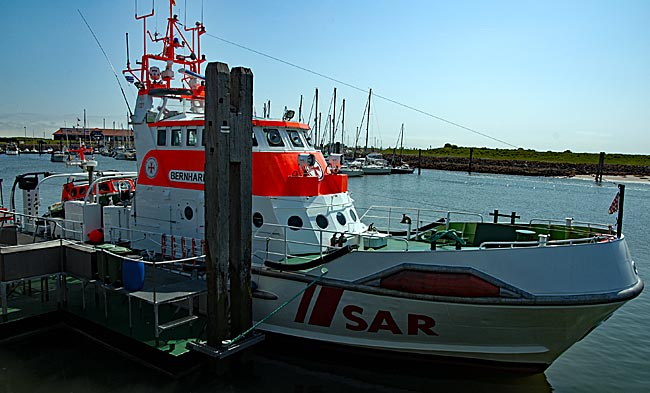
Maritime rescue cruiser "Bernhard Gruben" in Norderney harbor in 2010, now stationed in Hooksiel
Some of the society's ships bear the names of deceased crew members from their own ranks, such as the long-stationed maritime rescue cruisers "Bernhard Gruben" of the 23.1-meter class, named after the late captain (Vormann) of the "Alfried Krupp."
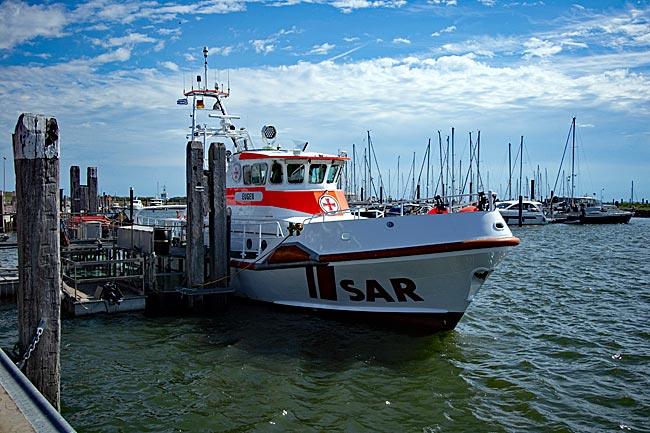
Maritime rescue cruiser "Eugen" in Norderney harbor in 2020; this 20-meter-class ship, along with its workboat "Hubertus," was launched in 2009.
Today, 43 lifeboats and 21 maritime rescue cruiserss fly the DGzRS flag. The largest measures 46 meters in length, has an engine power of 9,250 horsepower, and a maximum speed of 25 knots (46 km/h). One such ship, named "Berlin" with its daughter boat "Steppke," was christened in Bremen in 2016 and commissioned in 2017. The rescue ships are stationed at the North Sea and, since German reunification in 1990, also at the Baltic Sea across 55 locations, always ready for deployment.
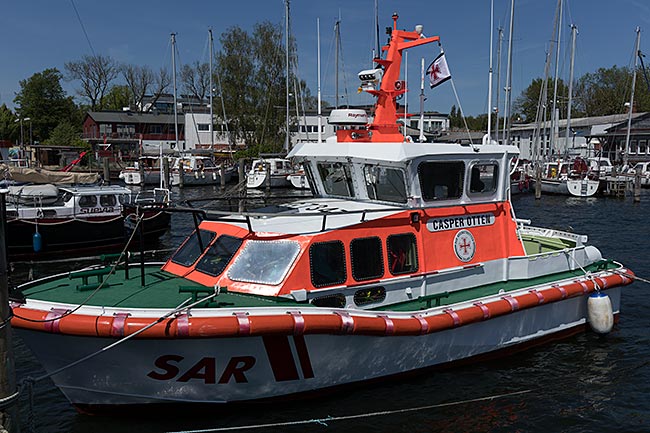
The rescue boat "Casper Otten" (2001) has been docked in Lauterbach on Rügen since 2017
In 2021, two new maritime rescue cruisers - "Nis Randers" (Darß) and "Felix Sand" (Grömitz) - along with a new lifeboat were added to the fleet. In exchange, the maritime rescue cruiser "Vormann Jantzen" embarked on its final voyage in early October. For 2025, the society reported assisting 3,389 people across 1,723 missions on the North and Baltic Seas.
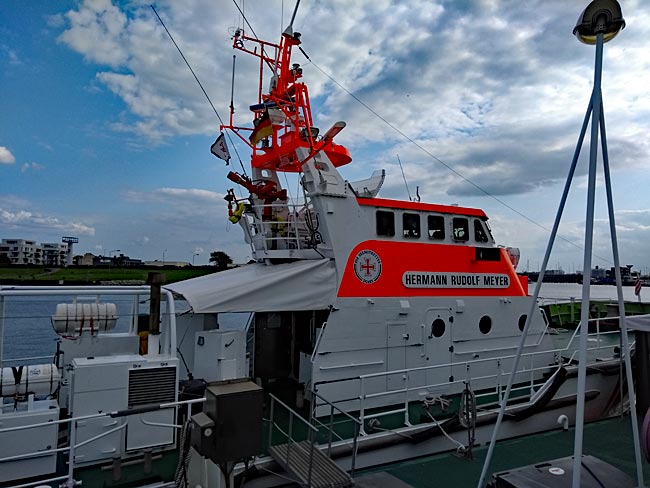
The DGzRS maritime rescue cruiser "Hermann Rudolf Meyer" in Bremerhaven at the Geeste River estuary in 2019
To prevent emergencies whenever possible, the society has compiled tips for those venturing onto the water on its website www.sicher-auf-see.de. This includes individuals heading toward Bremerhaven along the Weser, where the nearest cruiser is stationed. Interested parties can also arrange visits to inspect the maritime rescue cruisers - provided no emergency deployment is underway.
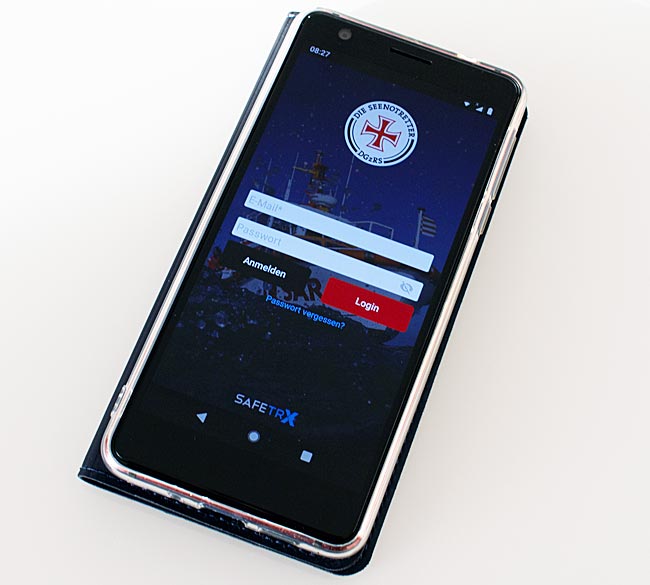
It's best to register before setting sail
Since 2017, water sports enthusiasts have been able to download the Safe Trx app onto their smartphones. This tool was developed by Ireland’s coast guard and has been successfully used in the Netherlands since 2013.
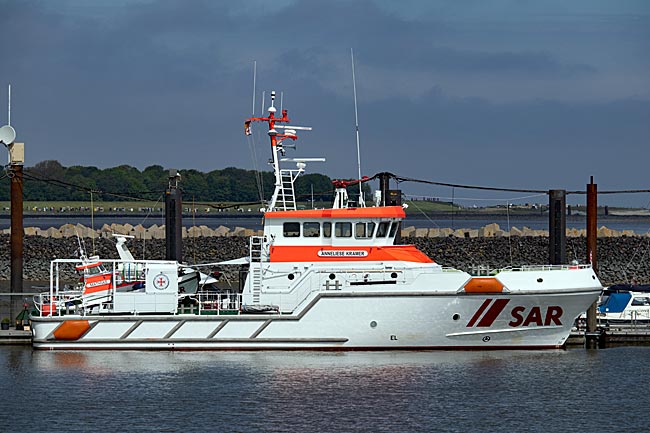
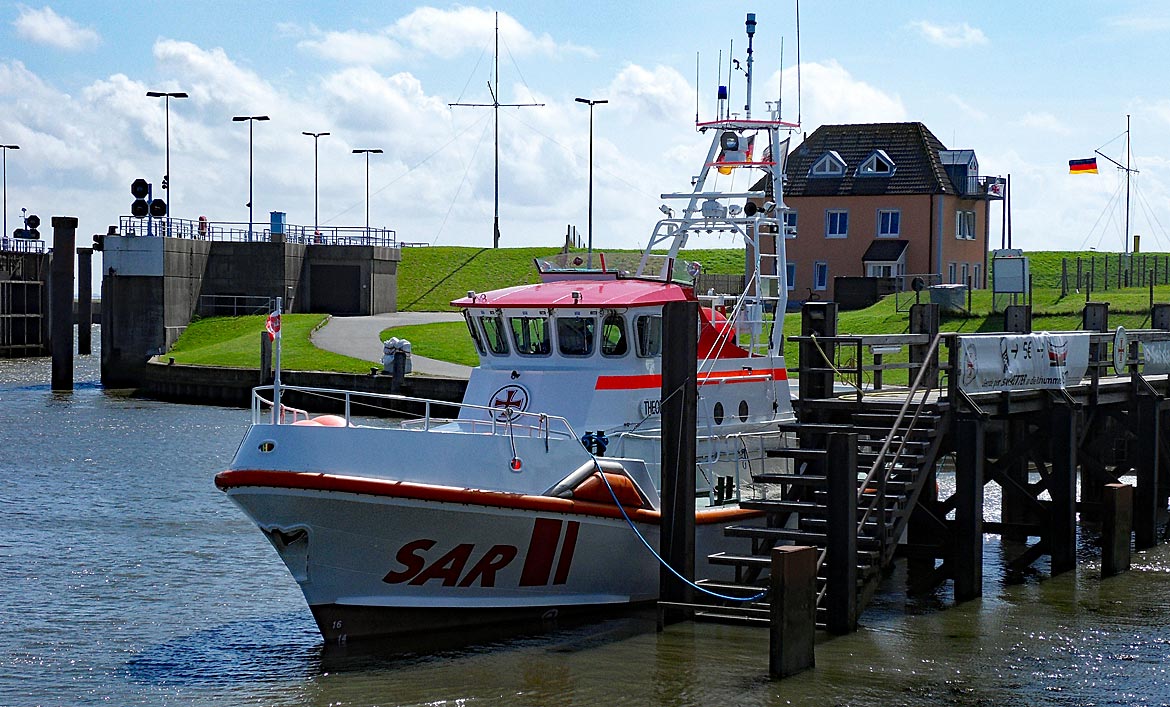
The DGzRS maritime rescue cruiser "Anneliese Kramer" with its daughter boat "Mathias" in Cuxhaven; this duo entered service in 2017
The DGzRS is entirely funded by donations and gratefully accepts contributions. Banking details can be found on the society’s website (listed in the sidebar), and donation boxes are available in many coastal shops, restaurants, and cafés.
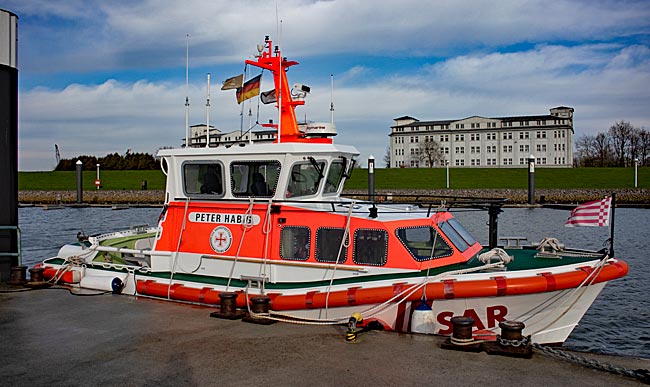
The 10.1-meter rescue boat "Peter Habig" was christened on May 18, 2019, in Wilhelmshaven
previous page
 next page
Further information
German Maritime Search and Rescue Service (DGzRS)
Werderstraße 2
28199 Bremen
Phone: +49 (0)421 53 707 - 0
Email: info@seenotretter.de
www.seenotretter.de
DGzRS App: SafeTrx
Georg Breusing Rescue Cruiser Support Association (Förderkreis Rettungskreuzer „Georg Breusing" e.V.)
www.georg-breusing.de
Cuxhaven - a day trip
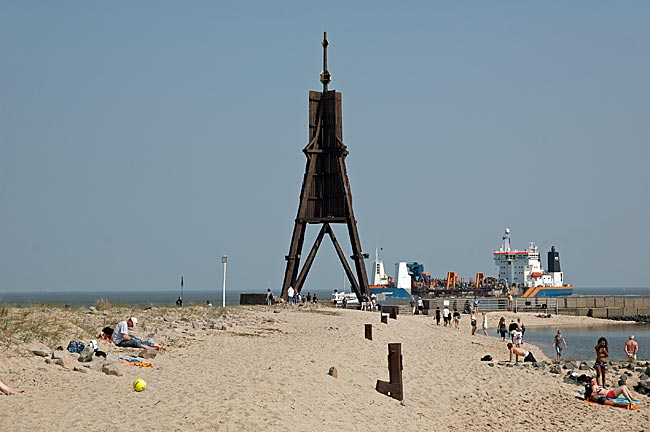
Many people from Bremen consider the seaside resorts of Cuxhaven to be "their home beach." The coastal city at the mouth of the Elbe is easily accessible from Bremen by car via the A27, which passes by Bremen and Bremerhaven before ending in Cuxhaven. By train, the journey takes a bit longer with a transfer in Bremerhaven. However, even in the off-season, Cuxhaven with its seaside resorts is a great destination for an outing - for example, by bicycle.
read more ...
Heligoland - a day trip
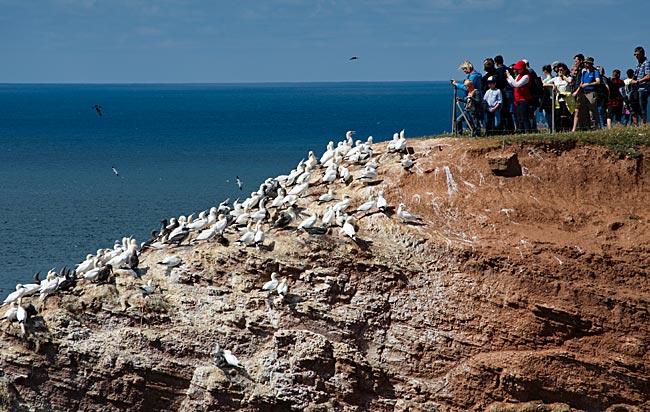
Germany's only supposed high-seas island is a destination for thousands of visitors each year, most of whom are day-trippers during the warmer months. And yes, admittedly, Heligoland isn't immediately in Bremen's surrounding area. However, it can be reached as a day trip from Bremerhaven and Cuxhaven - which is why we decided to visit.
read more ...
Bremerhaven Havenwelten
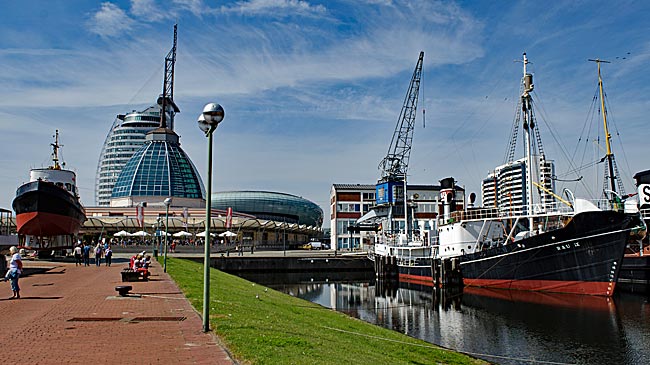
Since early 2008, Bremerhaven has not only had a new tallest building but also a new landmark in its Weser-side skyline with the ATLANTIC Hotel SAIL City, which rises 147 meters directly behind the Weserdeich. Architecturally, the structure perfectly embodies a maritime city - it stands like a powerful, rounded ship's superstructure. On the 20th floor, at a height of 77 meters, there is an observation deck (SAIL City) that is also accessible to non-guests.
read more ...
Bremerhaven - Schaufenster Fischereihafen (Fishery Harbor Showcase)
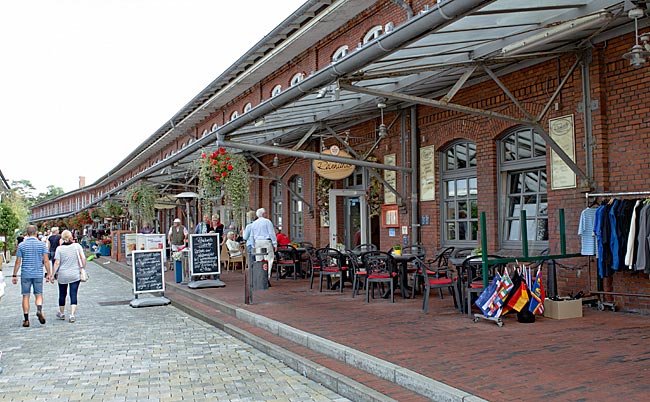
Away from the Havenwelten and older than both the Emigration Center and Klimahaus is the "Fishery Harbor Showcase." In fact, the Fishery Harbor was originally Geestemünde's deep-sea fishing harbor, built between 1891 and 1896. After a period of decline and decay - including partial demolitions - the idea emerged to transform the area into a maritime experience world. In 1990, efforts began to restore Fish Packing Hall IV, the oldest surviving hall, which had been slated for demolition just shortly before.
read more ...
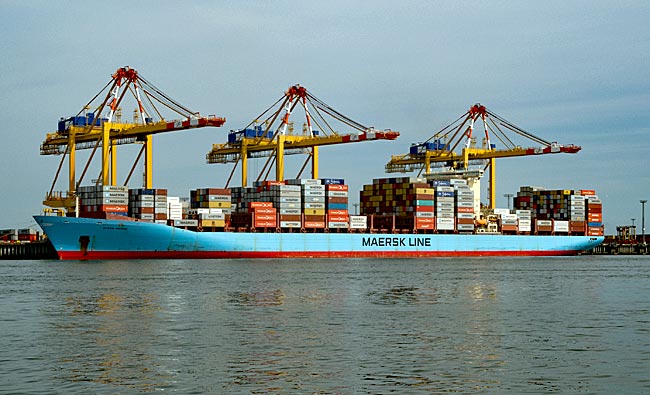
Bremerhaven - Überseehafen (Overseas Port)
In addition to the Old Harbor (now the Museum Harbor), which was the first to be built, other ports were later added. Adjacent to the New Harbor lies Kaiserhafen I, the first in a series of additional harbor basins. Even a glance into this initial section of the expansive port area reveals a different world of maritime activity - one of large ships. And we will see even larger ones along the five-kilometer-long quay on the Weser.
read more ...
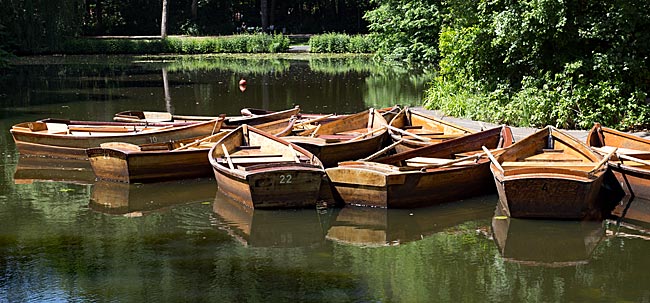
Water-based activities in Bremen
Given that Bremen is a city on a major river with numerous lakes, it makes sense to extend sports or other personal water-related activities from land to water. The most family-friendly activity on the wet element is certainly taking a rowboat ride along the canals of Bürgerpark.
read more ...
Round trip: from the city center to the Weser weir & back
Starting from Tiefer or Altenwall, the section of the Weser riverbank in front of Schnoor and diagonally opposite the DGzRS (German Maritime Search and Rescue Service), the Planetarium, and the Observatory on the other side of the river, a beautiful path for pedestrians and cyclists runs directly along the water upstream towards the Weser weir. After crossing the Weser weir, the return route takes you back via Stadtwerder.
read more ...
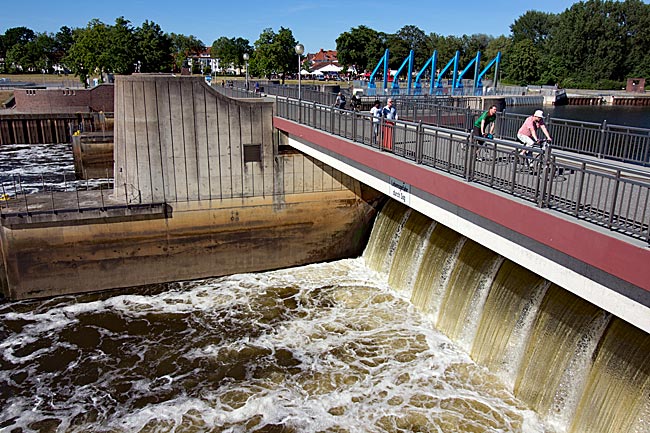
The Weser weir
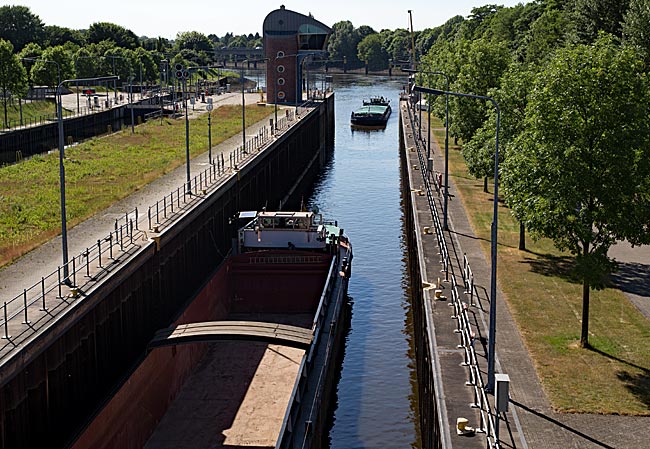
After the old Weser weir from 1911, one of seven weirs on the Weser, had become dilapidated, a newly built Weser weir was put into operation in 1993. To make navigation possible at all, the weirs are equipped with locks. In the chambers up to 225 meters long, inland vessels with a maximum width of 11.45 meters are locked through. The difference in water levels ranges between approximately three and a half and six and a half meters. As in the past, electricity is still generated by hydropower today. The weir is accessible to pedestrians and cyclists. There is something to see here.
read more ...
The East Frisian Island Wangerooge
Among the inhabited East Frisian Islands, Wangerooge is the second smallest (7.94 km²) after Baltrum and car-free, making a stroll through town much more pleasant compared to other islands, especially since distances can easily be covered on foot. From the small train station, you're just a few steps away from the heart of the village, quickly finding yourself in front of the unmistakable Old Lighthouse, which now houses the island museum. From 1856 to 1969, this lighthouse served as a maritime navigation aid, guiding ships safely along their routes. Just how far its light could be seen becomes clear when you climb the 149 steps to the lantern room—from there, you can step out onto the surrounding gallery and enjoy a sweeping view of the island and the North Sea.
read more ...
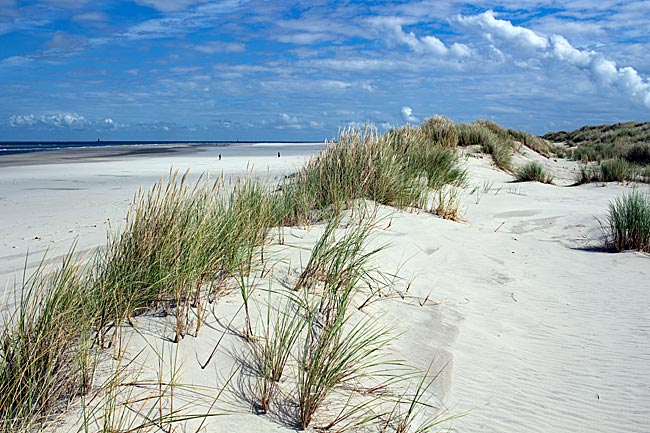
Brake & the River Island of Harriersand
As soon as the sun shines in spring and temperatures reach around 20 degrees, many Northern Germans are drawn to the North Sea coast for some water fun. The main thing is having a beach to lie on in the sun and sand for the kids to dig and build castles. That's why many people from Bremen also head north on warm weekends via the highway, packed with bags and picnic baskets ready for a day of beach vacation. But why travel far when the nearest beach is just around the corner - as a visit to Brake and Harriersand demonstrates.
read more ...
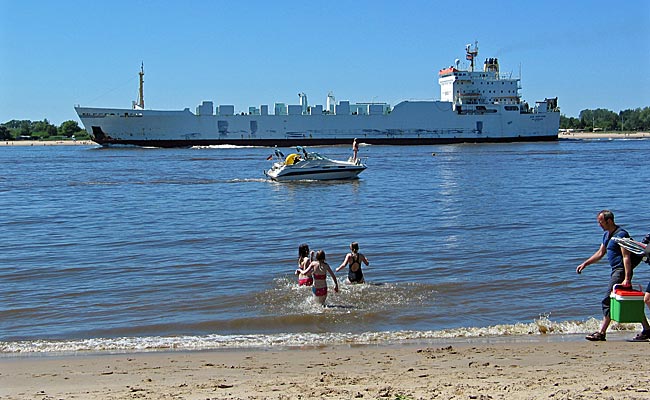
Vegesack
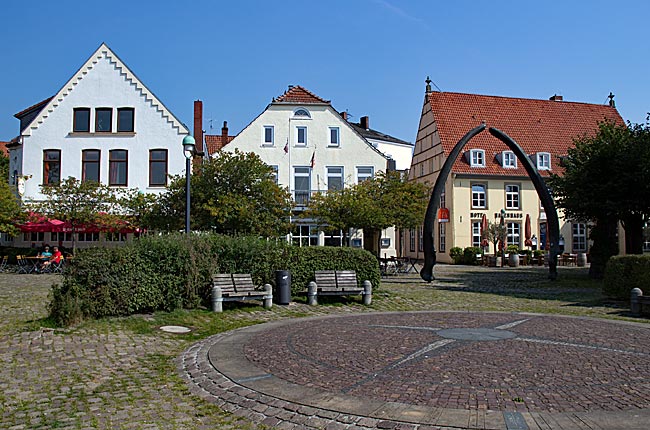
The most interesting area extends around the ferry terminal. From the seats of the nearby cafés and restaurants, you can almost watch the ferry operations. In front of the square stand the enormous lower jaws of a blue whale. Measuring 7.1 meters long, up to 1 meter wide, and weighing 1.2 tons, these bones belonged to a 26-meter-long animal that the port town received as a gift in 1961.
read more ...
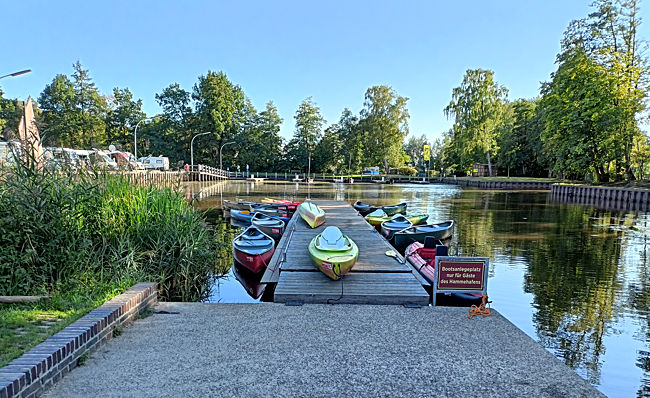
Neu-Helgoland (New Heligoland) / Hamme Harbor Worpswede
From April to October, the Hamme Harbor in Worpswede attracts many day visitors, weekend trippers, cyclists, and campers. The campsite operators run not only a bistro & beer garden with waterside seating but also rent out kayaks and canoes. Those who don’t want to paddle on the Hamme themselves can instead book an excursion trip aboard one of the Adolphsdorf Peat Boats. Food and drinks are also available just a few meters from the harbor at "Hamme Hütte Neu Helgoland." Tip: A great bike trip destination from Bremen!
read more ...
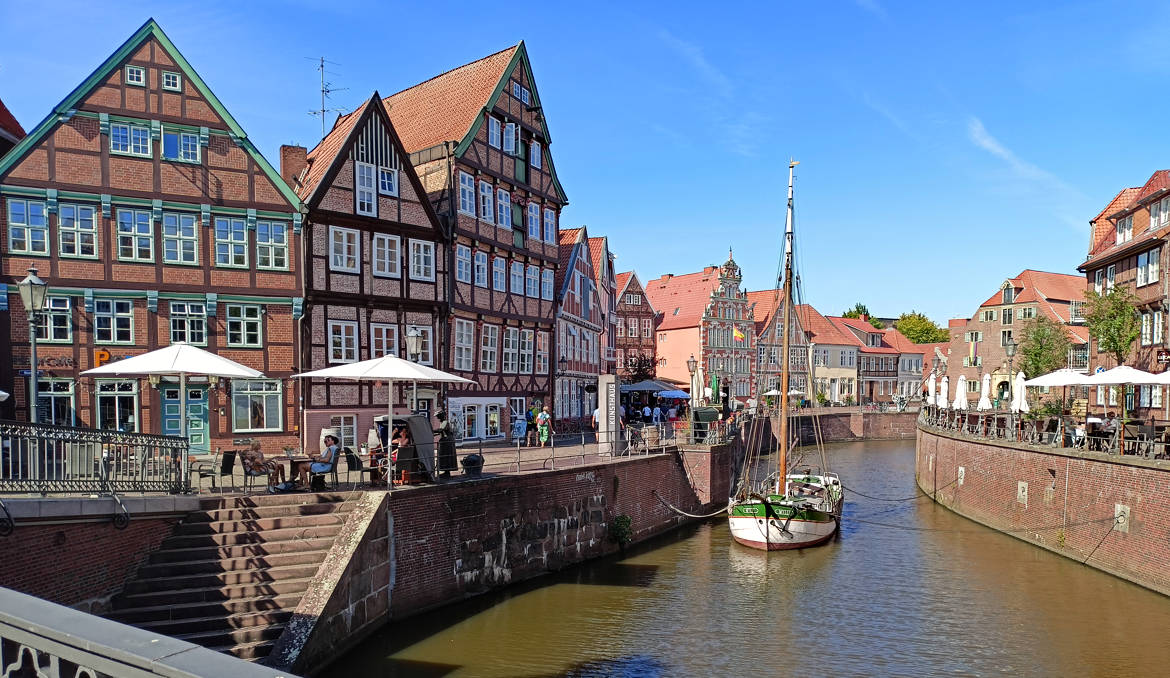
Stade - on the banks of the Schwinge River
Do you know Stade? No? What a shame! Then feel free to read on if you'd like to learn about this smaller Hanseatic city on the Elbe, neighboring the much larger Elbe metropolis of Hamburg. As is often the case, the tourist's gaze doesn't fall on the entire city but rather focuses here on the historic city center and a bit of its surroundings. In our opinion, Stade is a beautiful and worthwhile destination for a short visit or even a few extra days.
read more ...
Through Walle district to the industrial ports
The history of Walle began, like that of many other districts in Bremen, long ago as an independent village, more precisely, it started only as the seat of the Ministerial family von Walle. The first mention of the old village dates back to the year 1139. From this family came both farmers and citizens. Thus, with the settlement of more people, the family estate grew into a village around the manor. Walle was incorporated into the Hanseatic city in several steps, first between 1885 and 1902.
read more ...