
 exploring Bremen & its surrounding areas
 You are here: backgroundstories
 The Seven Lazy Ones (Sieben Faule)
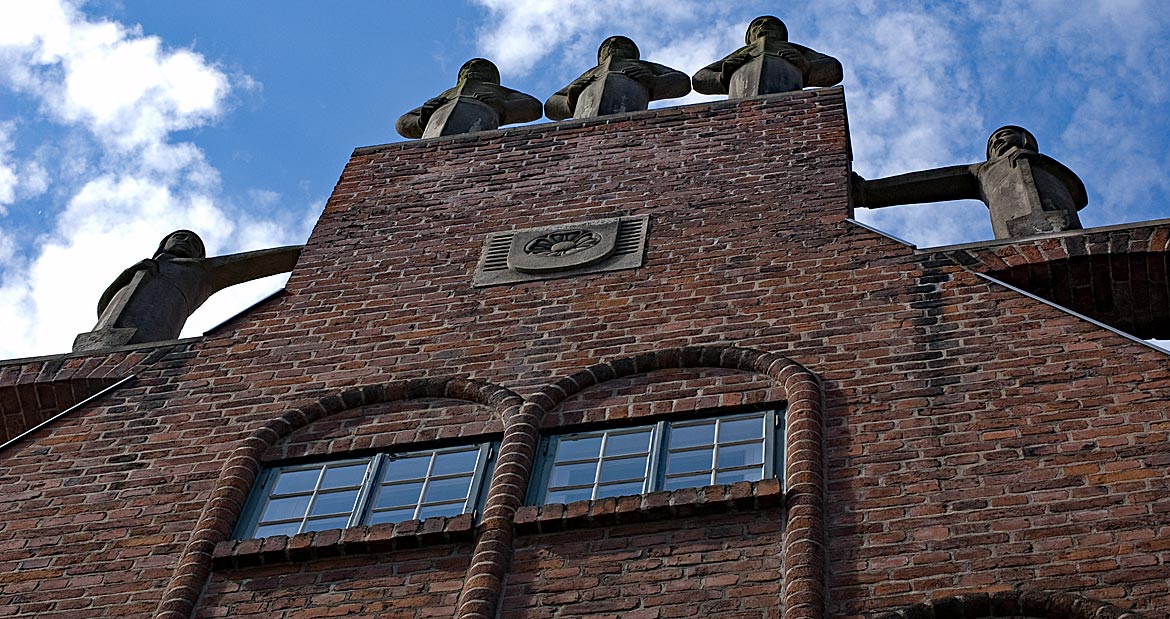
In addition to the Bremen Town Musicians, there is another, albeit far less well-known fairy tale whose setting is the Hanseatic city: "Die sieben Faulen" ("The Seven Lazy Ones") by the Bremen writer Friedrich Wagenfeld (1810-1846). Like the Bremen Town Musicians, the heroes of this story also have a monument in the city. In the Böttcherstraße, you encounter the supposedly lazy brothers at two locations. As upright figures created by Aloys Röhr, they adorn the gable of the former HAG House, which since its reconstruction in 1954 has been called the "House of the Seven Lazy Ones." The house stands to the right of the entrance to the Böttcherstraße when coming from the market square.
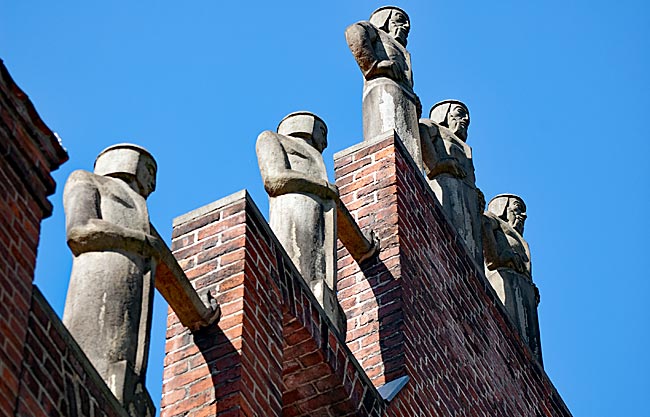
Haus der Sieben Faulen
And in the courtyard of the Paula-Becker Modersohn House, there is the "Seven Lazy Ones Fountain," created by Bernhard Hoetger in 1927. The Seven Lazy Ones made of terracotta are placed by Hoetger in niches distributed across the approximately five-meter-high structure made of red brick. The water-carrying part of the fountain is adorned with a bronze pipe featuring the Bremen Town Musicians as fountain figures.
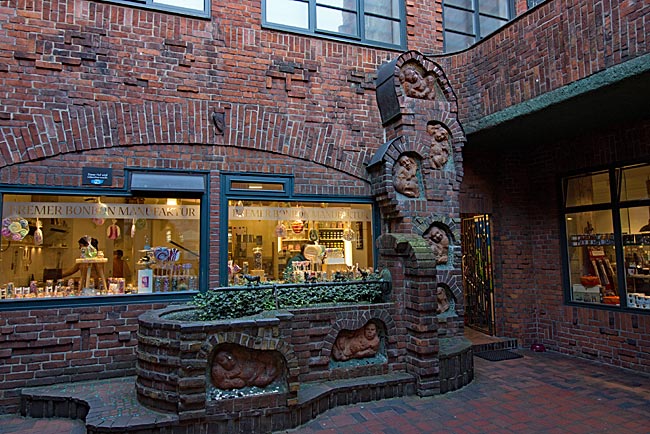
The Seven Lazy Ones Fountain in the courtyard of Böttcherstraße
Freely retold, the story goes like this:
Once upon a time, on the western side beyond the old city wall of Bremen, poor people had their land. The soil was sandy and marshy due to frequent flooding near the Weser River. People tried to make a living by growing cabbages and raising a few animals on the sparse grassland. A man also owned land there, which was large but mostly so wet that the hay harvest barely sufficed for one goat, and his cabbage harvest was always meager. Since the man and his wife had seven strong, tall sons, the milk from the single goat naturally fell far short of their needs. Instead of lending a hand, however, the sons preferred to spend their time idling and watching others work. When the aging father asked them to help with the work, they found this request ridiculous because he was not a role model for them. Despite their idleness, however, they had a hearty appetite that the industrious mother tried to satisfy. Among the neighbors, the family's offspring were well known and called "the seven lazy ones," but this did not particularly bother those so labeled.
But one day, their unemployment became too boring, and they decided - except for the youngest son - to leave and hire themselves out as laborers to the neighbors. They went from house to house, but everywhere they met only mockery: they were probably looking for another fool who would feed them without work done because their father's farm could no longer support them. So they returned unsuccessful and bitterly complained to their father, who now wanted to give them enough work. But the eldest son replied: "If you had provided us with employment before, we would not have fallen innocently under suspicion of laziness and could now make our fortune. You can manage the farm alone; we, however, really want to work, and since we are rejected everywhere here at home, we will go out into the wide world tomorrow." And despite the mother's tears and the father's advice to stay, the seven sons set off.
Years later, their return caused a stir in the village: "The seven lazy ones are back," it was said. But the men had brought various tools with them, and the very next day they energetically set to work on their father’s land. They dug a drainage ditch from the wet meadows to the Weser River, and once the ground was drained, they built a dike so that the river would no longer flood the land. The yield of clover and hay on the nutrient-rich soil was good, but people only said: "The old father was a diligent man; he confidently stepped into the water up to his knees and cut his meager grass, while his sons make everything easy for themselves - they still have no desire to work."
Even when they built a large house next to their modest father’s home in the fall, people saw comfort and laziness in it - meaning that they did not want to restrict themselves and be content with what was available. The house was followed by others as the sons married, and soon there were seven in a long row with an orchard and vegetable garden protected from wildlife by hedges. They paved the street so they would not have to walk through the muddy clay like everyone else during bad weather, and they planted linden trees along the roadside. "This is the street of the seven lazy ones," the neighbors said when a stranger, impressed by the sight, asked for the street name. The brothers' prosperity steadily grew, even though they only exerted half as much effort as their neighbors. They did not spend nights keeping rabbits away from their cabbages or gathering firewood in the nearby forest. They were only extremely busy, people thought, when it came to strengthening their laziness through something new.
Even in old age, long after their parents' deaths, they erected a beautiful fountain right in the middle of their street. But even here, the neighbors accused them of laziness, saying that the brothers and their wives were too proud and lazy to carry water from the Weser River in buckets as their father had done before and had only dug the well for that reason.
previous page
 next page
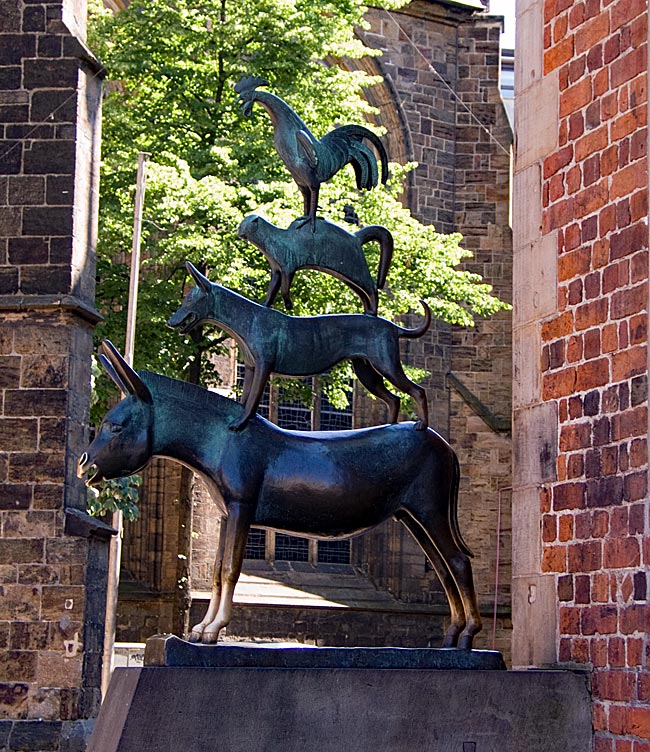
Bremen Town Musicians
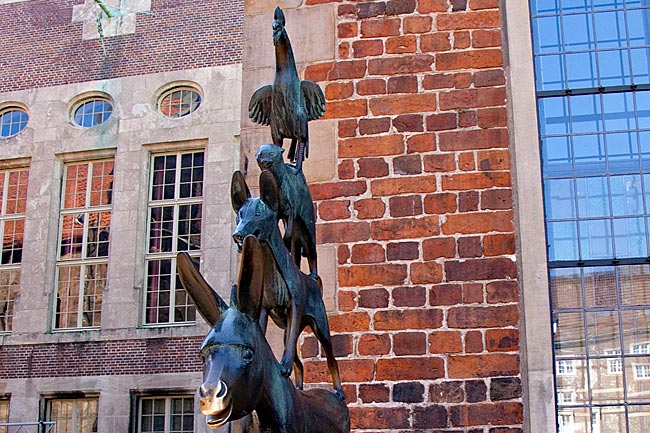
On the left side of the Old Town Hall, next to the entrance to the lower hall, stand four bronze-cast heroes of a world-famous fairy tale - the Bremen Town Musicians. However, it remains a contentious point whether these mismatched four - donkey, dog, cat, and rooster - actually made it to Bremen, as the fairy tale does not provide a clear answer on this matter. But perhaps that is not so important, for what truly matters is the message conveyed in the story.
read more ...
Böttcherstraße
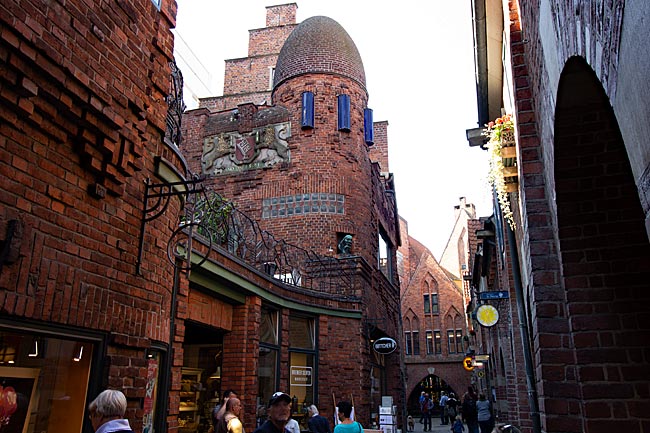
Since at least 1931, the name Böttcherstraße is no longer primarily associated with the scent of wood and the sound of coopers' hammers, but rather with a very special, almost enclosed ensemble of buildings. Over a length of just over one hundred meters, museums, open artist workshops, specialty retailers offering upscale goods, dining establishments, and a hotel create a unique atmosphere between brick and sandstone structures that is unparalleled in Bremen.
read more ...
The legend of the Bremer Gluckhenne
Bremen writer Friedrich Wagenfeld interpreted the legend of the "Bremer Gluckhenne" as a story of freedom and even went further to consider it as a founding myth of Bremen. In his brief creative period, Wagenfeld also wrote the tale of the "Seven Lazy Ones."
read more ...
Roland statue
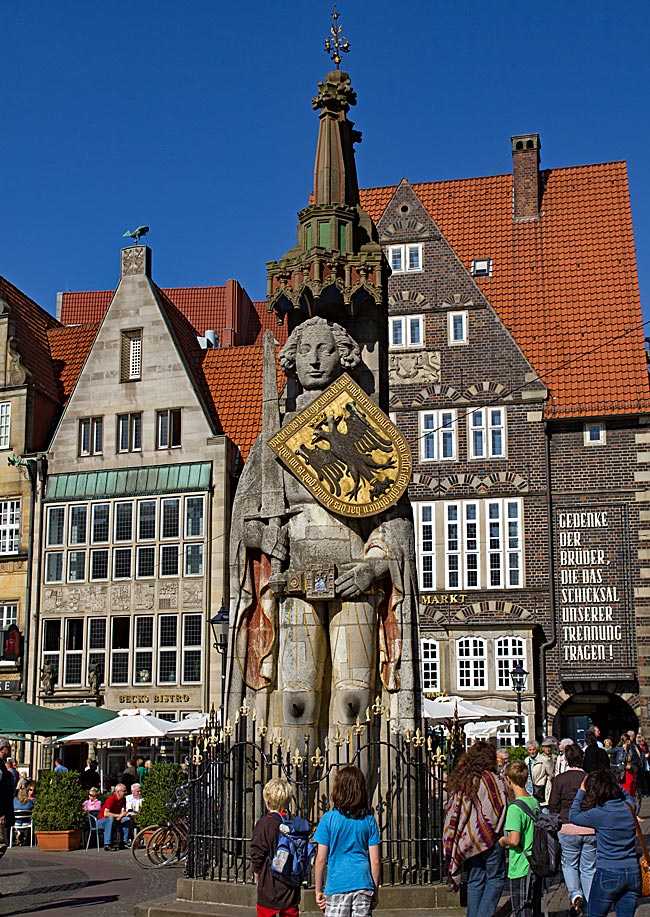
The Roland statue stands on the market square in front of the town hall and has been there since 1404. It is a 5.55-meter (10.21-meter total) tall sandstone figure of a knight with a drawn sword and shield in front of his chest. Like in many other European cities, the Roland in Bremen symbolizes the city's freedom, which historically stemmed from market rights and its own jurisdiction.
read more ...