
 exploring Bremen & its surrounding areas
 You are here: worth seeing in the surroundings
 Stade - on the banks of the Schwinge (1/6)
On the old fortifications
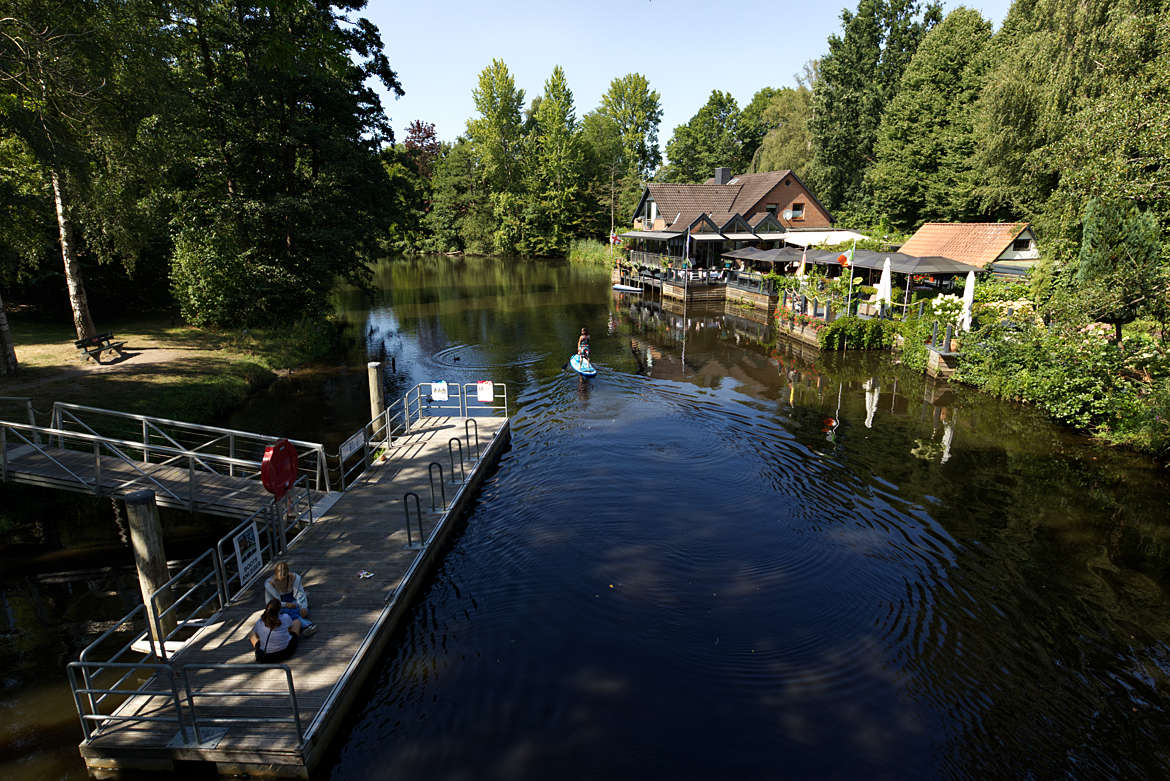
Today’s leisure mile on the water: the moat. Landing stages near the Hanse Bridge opposite Stader Bürgerpark, the former Adolf Ravelin, and meeting point
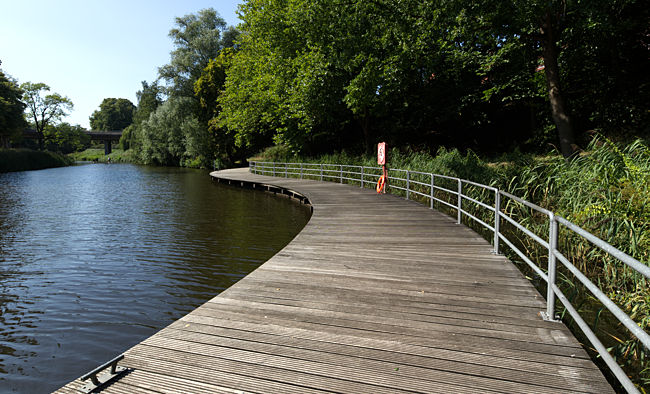
For a long time, it was considered sensible to dig a wide ditch around a castle or even an entire city for better protection against armed attackers if water was already present on-site. This is what happened in Stade on the Schwinge. To this day, the Schwinge and moat almost completely surround the old inner city. Here too, the watercourse runs partly in a curved shape to create space for bastions, such as the Georg or Königsmark Bastion. Under Swedish rule in particular, the fortifications were massively expanded between 1650 and 1712.
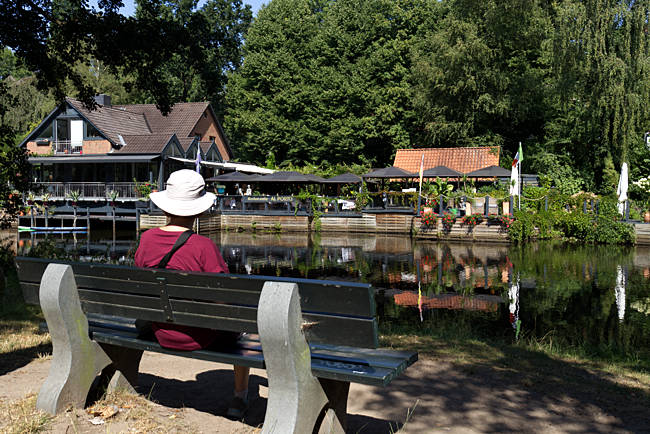
If there’s ever "war" in the kitchen of the Italian restaurant near Wohltmann Bridge due to stress, it’s not impossible that a pizza might occasionally "fly" over the moat. So be careful on the bench!
Around 150 years later, in 1867, the dismantling of the fortifications was approved by the now ruling Prussians. Advances in military technology had rendered such defensive structures obsolete. More than that, they hindered the spatial expansion of urban infrastructure - even in Stade. With the growing industrial revolution in the 19th century, there was an increasing need for space for factories, railway construction, and more.
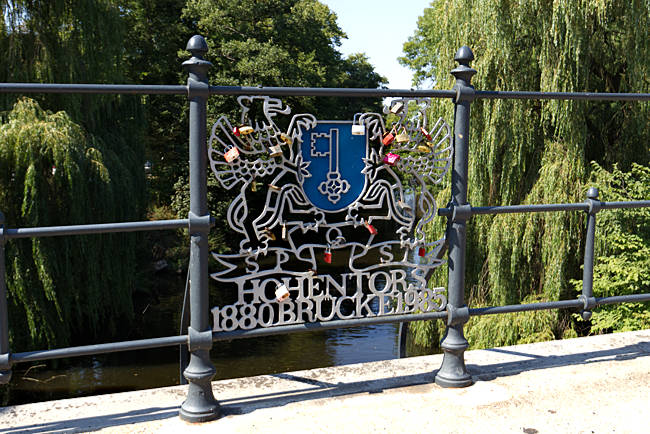
The city grew and expanded, so it needed sturdy bridges over the moat and Schwinge, such as the Hohentors Bridge built in 1880.
For example, the Stadthafen (city harbor) was created on part of the fortifications, and a section of the adjacent moat temporarily became the Holzhafen (timber harbor), where wood was also processed. Today, little remains of the fortifications, and the waterways are primarily used for leisure activities. And these can be just as sweaty as work in the harbor, because watersports are all the rage.
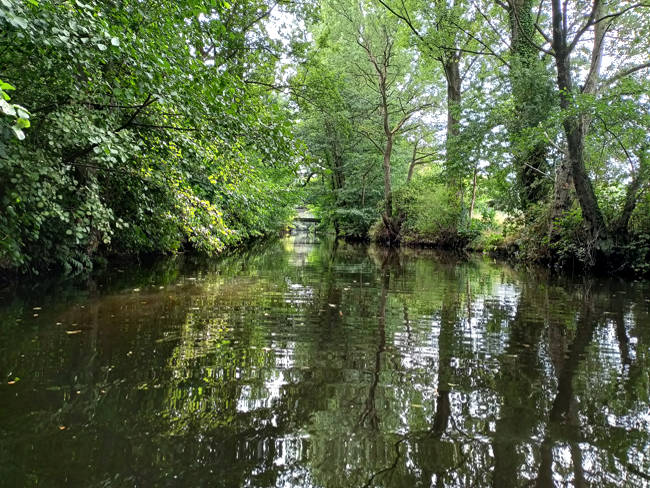
Pretty quiet and green: canoeing on the Schwinge out of the city
Not far from the Salztor (salt gate), even visitors to the city can rent kayaks, canoes, or SUP boards and circle the inner city by water or paddle many kilometers along the river from where the Schwinge and moat meet, heading out of town into the countryside.
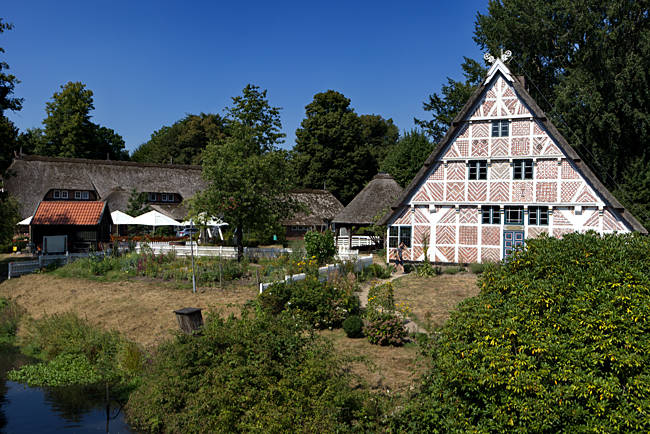
View from the Burggraben Bridge onto part of the Museum Island with the Geestbauernhaus (back left) and the Altländerhaus (front right)
Anyone who hasn’t been there on foot should take a trip to the island that was created between 1662 and 1664 through the expansion of Swedish fortifications in the moat. Previously, this area was known as the "Bürgerbleiche-Wiesen" (citizens' bleaching meadows). After the Swedes took control, bleaching linen for citizens ended, but at least the name "Bleicher-Ravelin" remained as a reminder. A ravelin refers to a fortified outpost in front of the main fortifications. Today, nothing remains of this either, nor of the military bathing facility that operated here from 1825 onward.
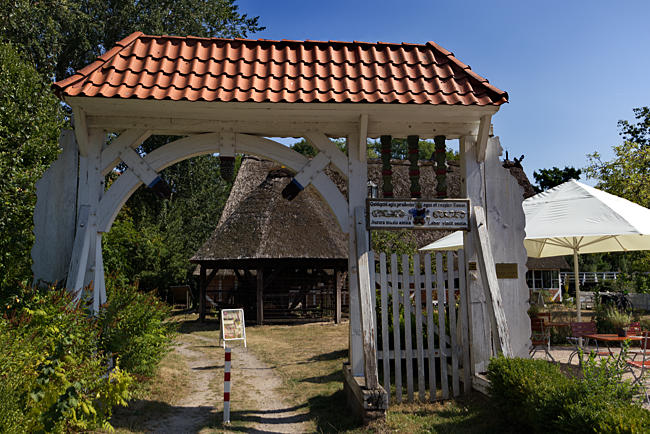
Altländer Prunkpforte (ornamental gate) with Pferdegöbel behind it (round building)
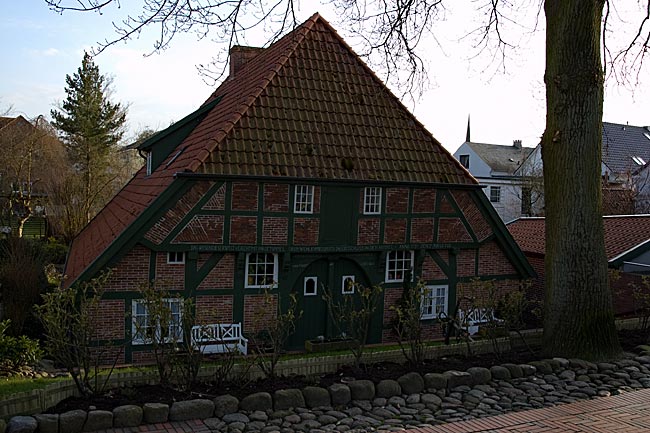
The small island was repurposed after the de-fortification in 1881 and redesigned starting in 1912. By 1914, the open-air museum had opened, featuring the large Geestbauernhaus from Varrel near Scheeßel, which is operated as a restaurant, and the Altländer House. After further expansion in the 1960s and 70s of the last century, Museum Island presents an ensemble of agricultural buildings such as a carriage house, a bakery, a grain mill, and an Altländer Prunkpforte from 1791, which was once the entrance gate to a large estate in the Alten Land - hence the name. Incidentally, the Alten Land between Stade and Hamburg is the largest fruit-growing region in Northern Europe, and during the blossoming of apples, pears, cherries, plums, or other stone fruits, it’s truly a beautiful sight. Perhaps a trip tip, for example by bike from a local rental shop or naturally with your own.
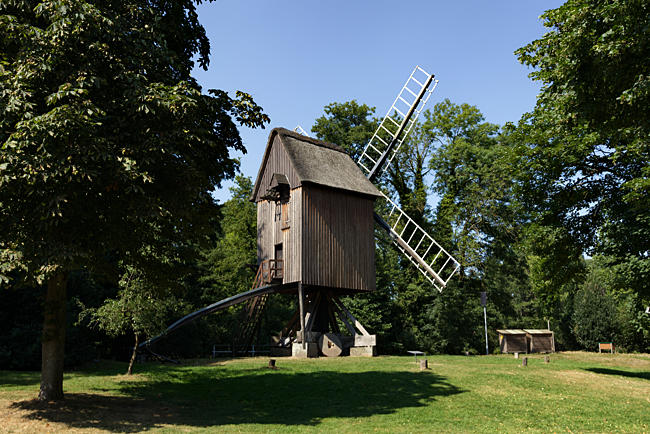
Bockwindmühle (post mill)
Also worth seeing is the post mill originally from Sehnde, which found its new home here in 1967. Compared to later Dutch-style mills, the sight is somewhat unusual - like a windowless house on stilts. The base serves to align the mill with the wind, and the millstone sits in the rectangular box above.
You can reach the island on foot via two bridges; those arriving by boat will also find a comfortable landing stage.
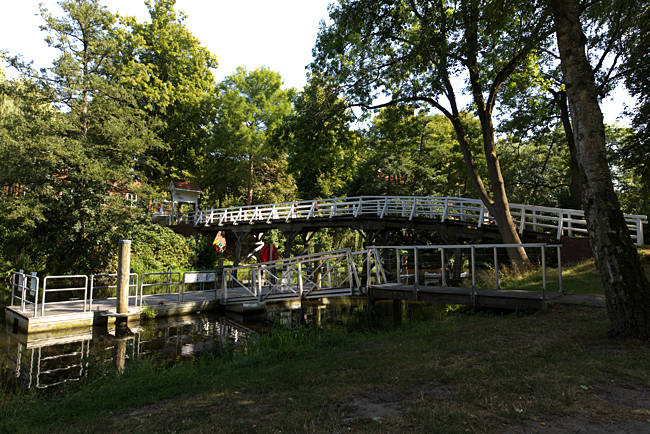
Next to the landing stage, the Wohltmann Bridge spans the moat. The namesake has made literary contributions, among others, to the history of Stade and was named an honorary citizen in 1964
In conclusion
You’ve made it this far? Read or skimmed through? Either way, thank you for your interest. In short, everyday life today often overlooks such things - we don’t want that here - but nonetheless, not everything has been said or written. Whoever, and that was the hook, takes a short or day trip to Stade, preferably from Bremen (after all, we’re at bremen-sehenswert.de), can definitely have a great time in this old Hanseatic city on the Schwinge. Those who spend several days here also have other worthwhile destinations like the Hanseatic city of Hamburg or Buxtehude, which are quickly reachable by public transport. The same applies to Cuxhaven with its seaside resorts at the mouth of the Elbe. Here, in addition to the harbor with the Alte Liebe (old love), there’s also sandy beaches and swimming opportunities. Have a great time.
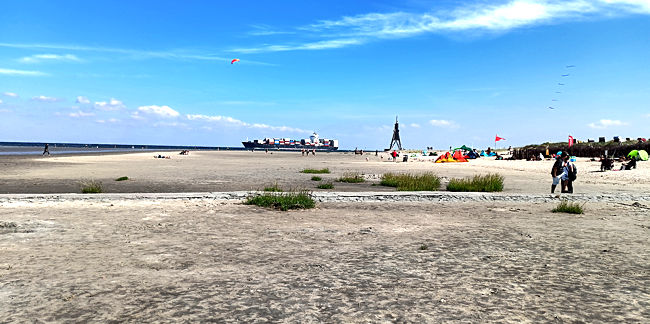
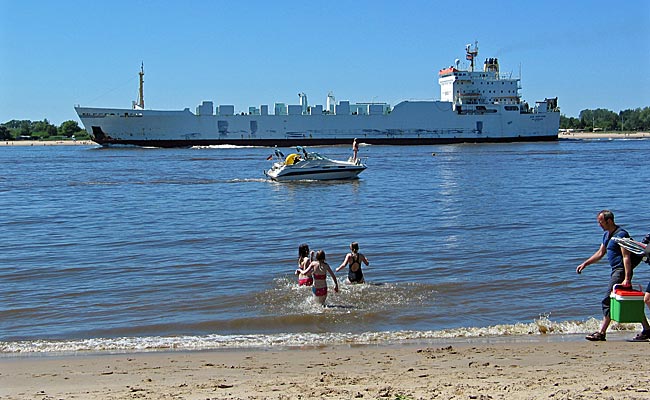
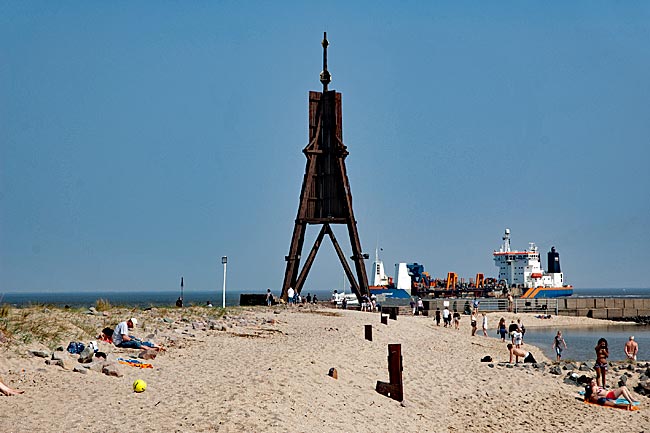
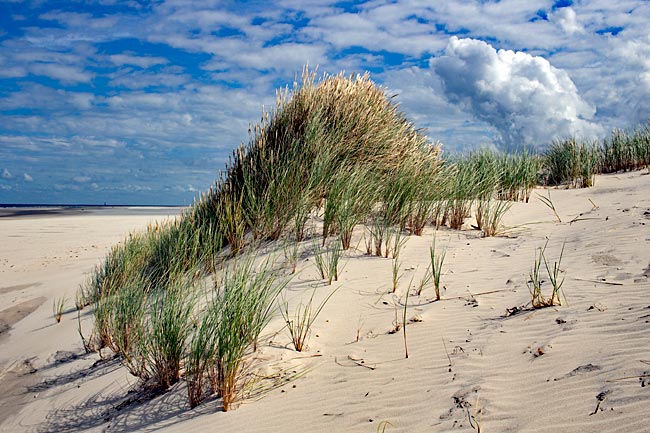
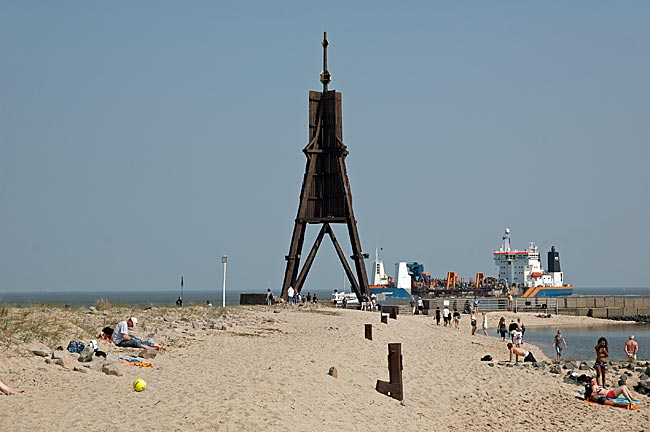
Beach or mudflats in Cuxhaven with the city’s landmark, the Kugelbake, in the background. The combination with maritime shipping is also exciting
previous page
 next page
Map
Further information
STADE Marketing and Tourism GmbH
Hansestraße 16
D-21682 Stade
Email: info@stade-tourismus.de
Website: www.stade-tourismus.de
Phone: +049 (0) 4141 77698-0
Tourist Information at the Harbor
Opening Hours: April to October: Mon–Fri 10 AM – 6 PM; Sat, Sun & Holidays 10 AM – 3 PM, November to March: Mon–Fri 10 AM – 5 PM, Sat 10 AM – 3 PM, Sun & Holidays closed
Schwedenspeicher
Wasser West 39
D-21682 Stade
Phone: +49 (0) 4141 79 773 0
Email: info@museen-stade.de
Website: www.museen-stade.de
Opening Hours: Tue–Fri 10 AM – 5 PM, Sat & Sun 10 AM – 6 PM
Kunsthaus
Wasser West 7
D-21682 Stade
Phone: +49 (0) 4141 79 773 20
Email: info@museen-stade.de
Website: www.museen-stade.de
Opening Hours: Tue, Thu, Fri 10 AM – 5 PM, Wed 10 AM – 7 PM, Sat & Sun 10 AM – 6 PM, closed during exhibition changes!
Verein Alter Hafen Stade e.V.
Phone: Gerd Becker +49 (0) 4141 4123255 or +49 (0)151 10974508
Email: becker1959@gmail.com
Website: www.greundiek.de
Kunstverein Stade e. V.
Website: www.kunstvereinstade.de
Heimatmuseum
Inselstraße 12
D-21682 Stade
Phone: +49 (0) 4141 79 773 40
Email:
info@museen-stade.de
Website:
www.museen-stade.de/heimatmuseum
Opening Hours: closed for renovation
SUP CLUB Stade: Rentals, courses, canoe, kayak, pedal boat, BBQ
Salztorswall 8
D-21682 Stade
Phone: +49 (0)1514 2898283
Arrival
The advantages of traveling by car from Bremen are limited. While there are several parking garages to park your vehicle near the city center, the train station is also just a five-minute walk from the city center. At the station, you need to change trains in Hamburg. The regional trains run more frequently, so you don't have to rely on specific connections. With a Niedersachsenticket (valid from 9 AM until 3 AM the next day), you can freely choose your connections for an entire day (round trip excluded IC and ICE). Buses and trams operated by Bremer Straßenbahn AG (BSAG) are also freely usable with the Niedersachsenticket.
Bremerhaven in general
Bremerhaven was only founded in 1827. To secure its status as a port city amid the threat of the Weser - Bremen's lifeline - silting up, Bremen purchased 342 acres of land at the mouth of the Weser from the Kingdom of Hanover for 74,000 talers under then-mayor Johann Smidt. About 60 kilometers downstream from Bremen, this became the site of the first urgently needed seaport built by Bremen, known as the Alter Hafen (Old Harbor), completed by 1830.
read more ...
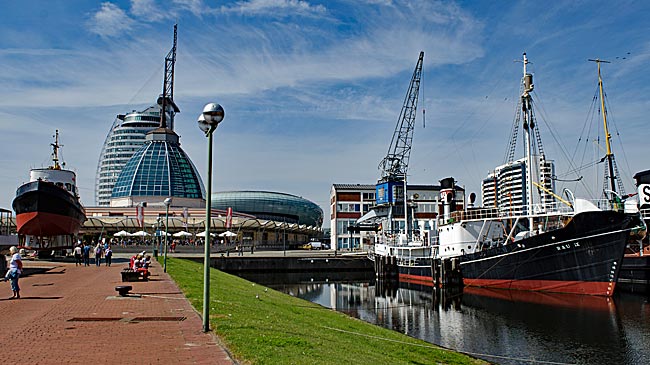
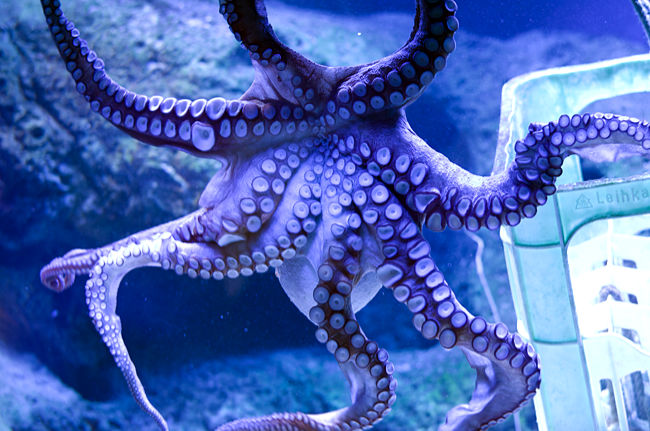
Bremerhaven - Zoo am Meer (Zoo by the Sea)
In addition to the 19th-century harbor facilities, the Zoo am Meer is the oldest attraction on the site between the Weser River and the pedestrian zone. It opened in 1928 under the name "Tiergrotten." The enclosures house polar bears, seals, penguins, various bird species such as gannets and keas, reptiles like turtles, raccoons, Arctic foxes, pumas, monkeys, and others - almost 50 animal species in total.
read more ...
Bremerhaven Havenwelten
Since early 2008, Bremerhaven has not only had a new tallest building but also a new landmark in its Weser-side skyline with the ATLANTIC Hotel SAIL City, which rises 147 meters directly behind the Weserdeich. Architecturally, the structure perfectly embodies a maritime city - it stands like a powerful, rounded ship's superstructure. On the 20th floor, at a height of 77 meters, there is an observation deck (SAIL City) that is also accessible to non-guests.
read more ...
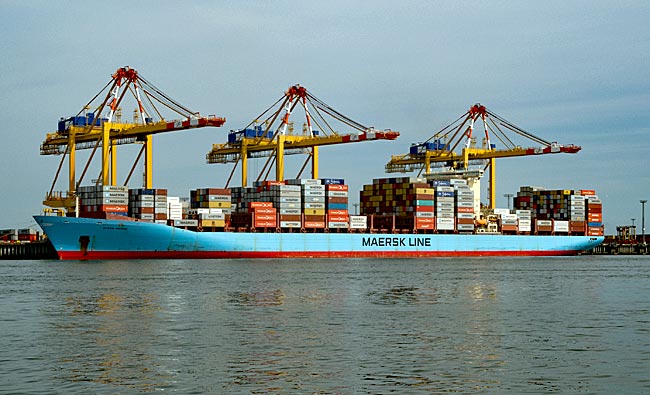
Bremerhaven - Überseehafen (Overseas Port)
In addition to the Old Harbor (now the Museum Harbor), which was the first to be built, other ports were later added. Adjacent to the New Harbor lies Kaiserhafen I, the first in a series of additional harbor basins. Even a glance into this initial section of the expansive port area reveals a different world of maritime activity - one of large ships. And we will see even larger ones along the five-kilometer-long quay on the Weser.
read more ...
Cuxhaven - a day trip
Many people from Bremen consider the seaside resorts of Cuxhaven to be "their home beach." The coastal city at the mouth of the Elbe is easily accessible from Bremen by car via the A27, which passes by Bremen and Bremerhaven before ending in Cuxhaven. By train, the journey takes a bit longer with a transfer in Bremerhaven. However, even in the off-season, Cuxhaven with its seaside resorts is a great destination for an outing - for example, by bicycle.
read more ...
Brake & the River Island of Harriersand
As soon as spring arrives and the temperatures reach around 20 degrees, many Northern Germans are drawn to the North Sea coast. The main attraction? A beach to lie in the sun and sand for children to dig and build castles. This also draws many people from Bremen to the highways heading north on warm weekends, equipped with bags packed and picnic baskets ready for a day of seaside relaxation. But why travel far when the nearest beach is just around the corner? A visit to Brake and Harriersand proves that.
read more ...