
 exploring Bremen & its surrounding areas
 You are here: worth seeing in the surroundings
 Wilhelmshaven, seaside city on the North Sea bay Jadebusen (1/4)
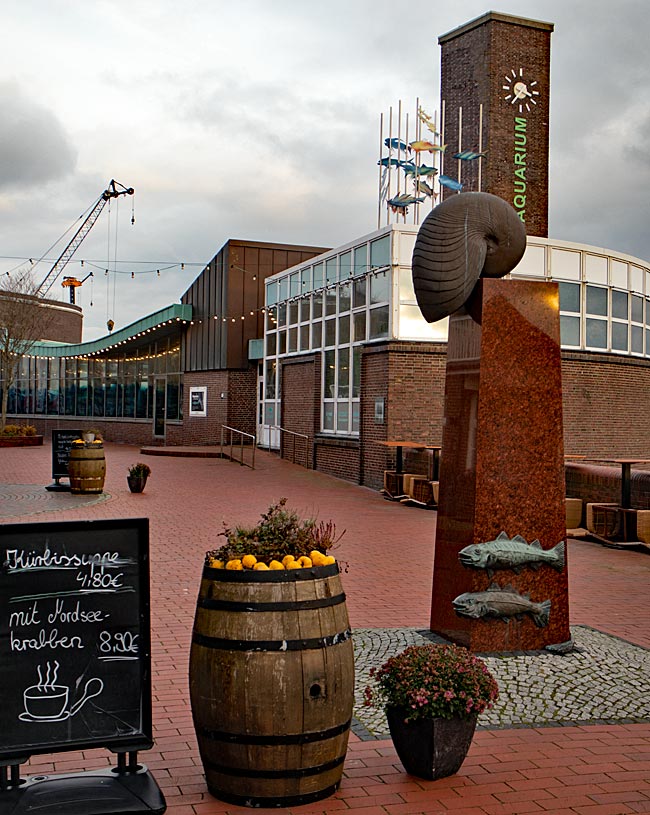
On the promenade at the south beach
The Lower Saxon city on the northwest coast of the Jadebusen, with its approximately 77,000 inhabitants, can be reached from Bremen by regional train in just under 90 minutes. The cheapest option is to travel with the Niedersachsenticket (without IC usage). By car, one route leads toward Oldenburg and from there via the Autobahn 29 directly to Wilhelmshaven.
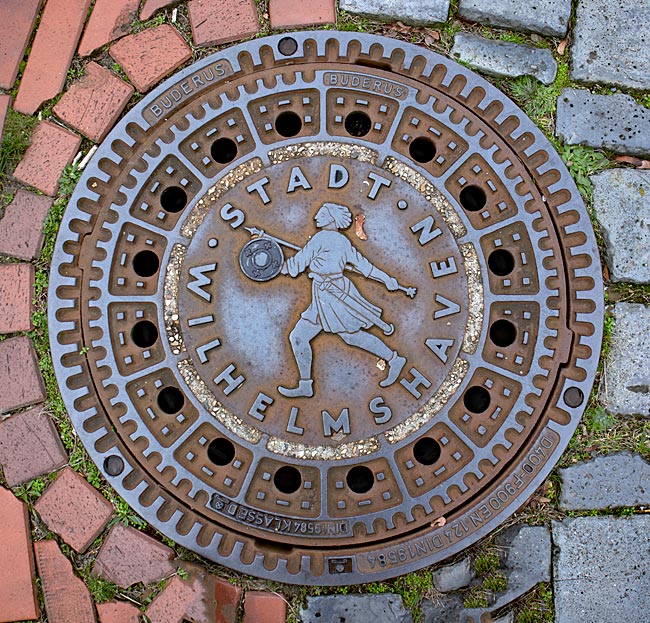
A secular manhole cover with the city coat of arms as a small attraction
The initially symbolic groundbreaking for today’s city took place on July 20, 1853, with signatures under the so-called „Jade Contract“. Prussia purchased an area of 314 hectares at the Jadebusen from the Grand Duchy of Oldenburg for 500,000 talers to establish a harbor. After the reordering of large parts of Europe at the „Vienna Congress“, which took place from September 18, 1814, to June 9, 1815, and after Napoleon Bonaparte’s defeat - thus ending France’s coalition wars on the continent that had lasted since 1792 - Prussia no longer had a harbor on the North Sea due to the loss of East Frisia.
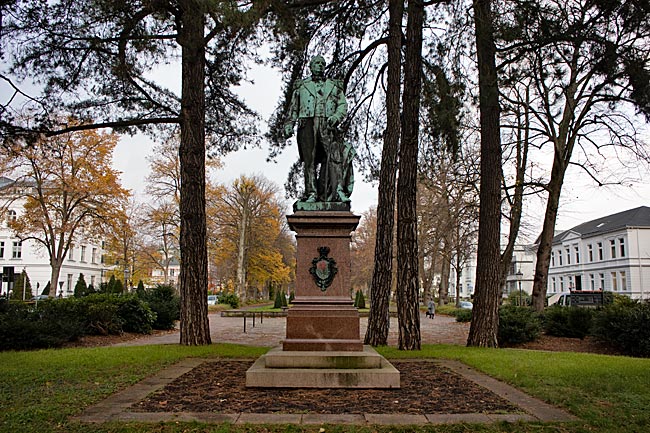
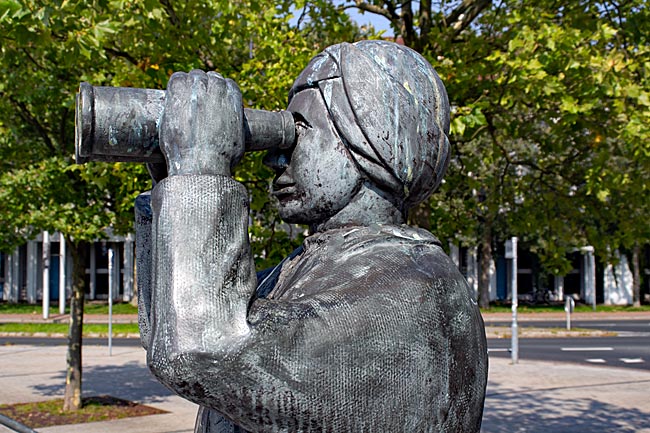
Prince Heinrich Wilhelm Adalbert von Preußen in naval uniform as a 3-meter-tall bronze statue at Adalbertplatz, which was originally laid out as a parade ground before being transformed into a green space. Of the neoclassical buildings on either side, only three remain. The pedestal sculpture, cast in 1882, was designed by the Berlin sculptor Karl Schuler.
Unlike the Bremeners, who sought to establish trade shipping with the acquisition of land and the construction of Bremerhaven, Prussia under King Friedrich Wilhelm IV. aimed for the harbor to become a naval base at the urging of Prince Heinrich Wilhelm Adalbert von Preußen, a cousin of the king. From the experience of the Schleswig-Holstein War (1848–1851) between the duchies of Schleswig and Holstein, most of the states of the German Confederation with Prussia on one side and Denmark on the other, it had been decided to build a fleet to represent its own interests at sea without relying on allies. The prince, appointed first admiral of the Prussian navy in 1854, was instrumental in realizing the base at the Jadebusen with access to the North Sea after officially taking over the acquired „Royal Prussian Jade Area“ as the king’s envoy on November 23 of the same year.The implementation followed the repeatedly modified plans of Privy Councilor Gotthilf Heinrich Ludwig Hagen.
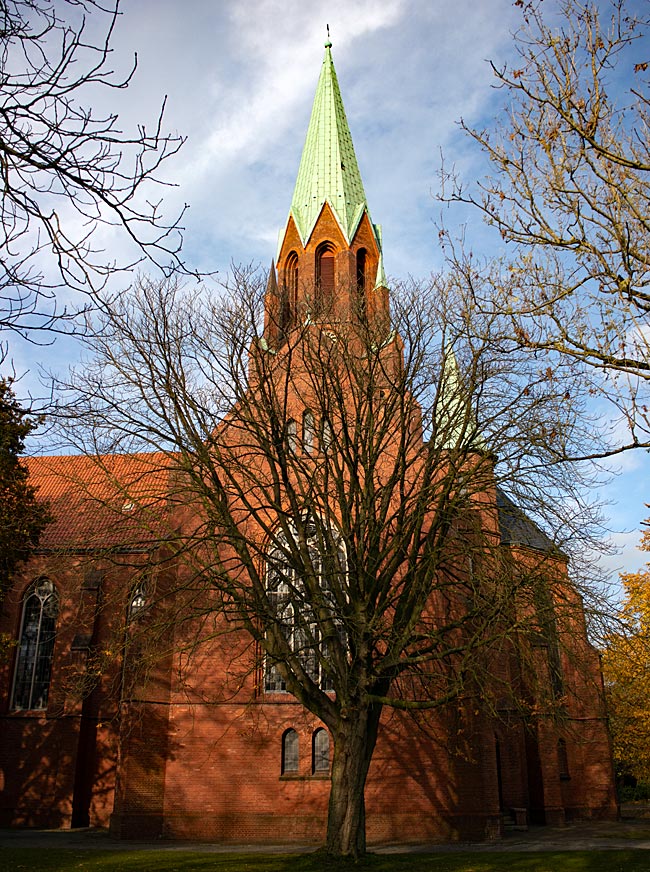
The former Elisabeth Church is now called Christ and Garrison Church
The name „Wilhelmshaven“ for the settlement that arose after 1856 was only granted in 1869. It first appeared on a deed that was embedded in the foundation of the Elisabeth Church. The „v“ in the name stems from Low German orthography but was already considered a misspelling in general use at the time (Hafen, not Haven in german; in english harbor, not haven). It was Prussian King Wilhelm Friedrich Ludwig von Preußen, who as Wilhelm I., the first German emperor from 1871 onward, ended the administrative dispute over spelling with an order. Bremerhaven and the coastal town of Cuxhaven also use a „v“ instead of an „f“ in their names.
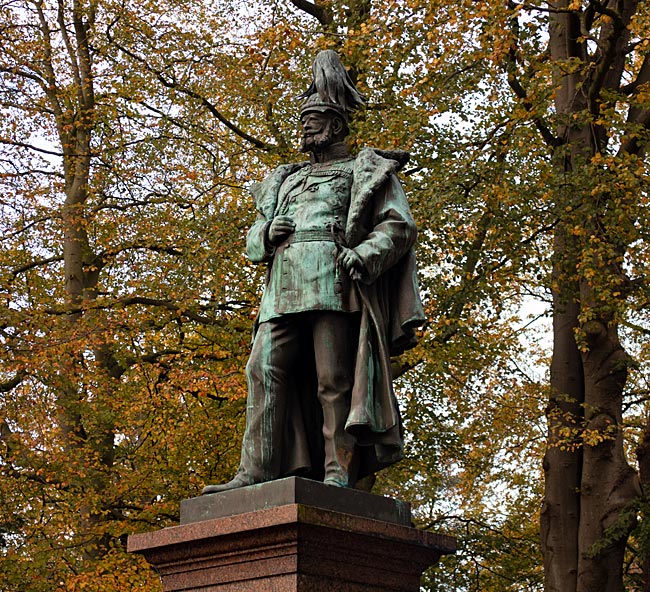
Emperor Wilhelm I., known as Wilhelm the Great, at Friedrich-Wilhelm-Platz opposite the church. The pedestal inscription reads: "On June 17, 1869, King Wilhelm came here, founded our city, and gave it his name." The bronze is a recast of the original from 1896, which had been melted down.
The Jade Contract stipulated that only people directly involved in establishing and later operating the harbor facilities could stay on the now-Prussian „Marine-Etablissement an der Jade“, essentially a military restricted area.This „state“ large-scale construction project and later the harbor and shipyard operations soon proved to be an economic factor from which people outside the delimited zone could benefit, enriching the lives of those in the exclave through trade and services. Soon, rapidly growing settlements arose around it, which within a few years coalesced into a city.
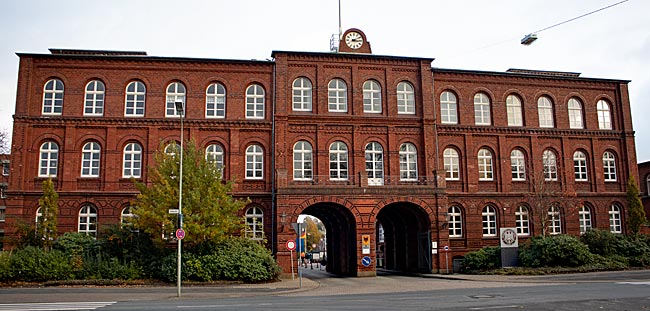
Former gate of the Imperial Shipyard, today entrance to the Arsenal of the Bundesmarine
After the Franco-Prussian War (1870–71), Prussia and the Grand Duchy joined the newly unified German Empire on January 1, 1871, ending the era of small states. The imperial constitution designated Wilhelmshaven on the North Sea and Kiel on the Baltic as imperial harbors.The shipyards in Kiel and Danzig became imperial shipyards after the king’s proclamation as emperor, and another was added with the one built in Wilhelmshaven in 1871. They nearly exclusively constructed ships for the Imperial Navy, which had great demand in the following decades.

Memorial plaque in the Christ and Garrison Church originally dedicated to the fallen of the German „Schutztruppe“ during the Herero uprising in present-day Namibia. Later, a Plexiglas plaque was added for the far greater number of victims among the nearly exterminated pastoral peoples.
From 1880 onward, the empire emerged as a colonial power on the world stage and challenged established colonial powers like England and France with its acquisitions in Africa and Asia.Conflicts were preprogrammed by the imperialistic expansion of the empire and not infrequently resolved through military means, as shown by the genocide in Namibia.
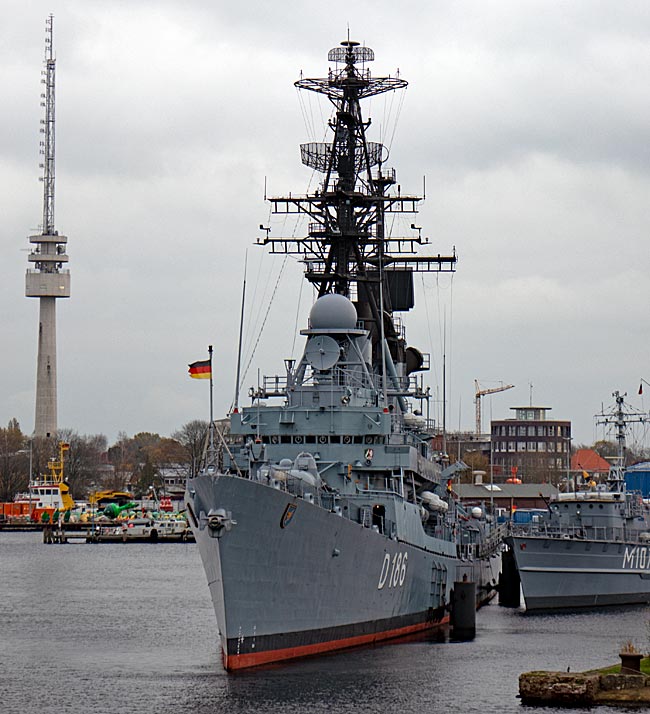
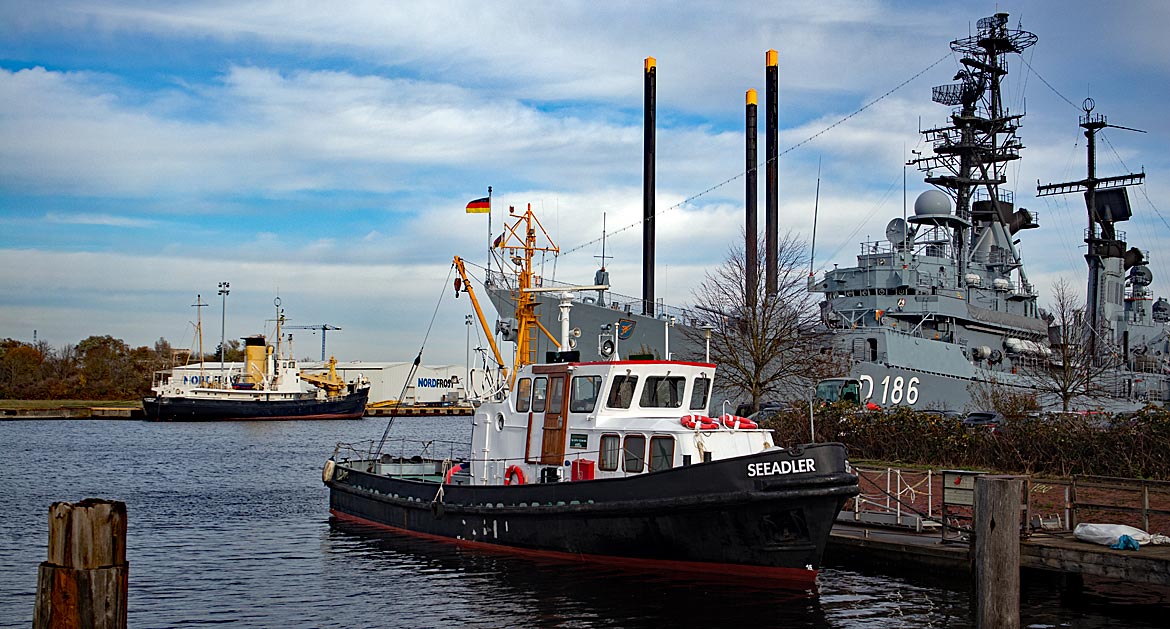
Clearly slimmer, faster, and more flexible than a battleship but still nearly 135 meters long: the destroyer „Mölders“. The Bundesmarine ship commissioned in 1969 was launched in US-American Maine in 1968 and decommissioned in 2003.Today, it is part of the German Naval Museum in Wilhelmshaven.
With the 1898 Fleet Act passed by the German government, which provided for the construction of a series of new ships for the battle fleet over six years, and the amendment to the law in 1900, which doubled the number, an unprecedented arms race between the empire and Great Britain began. On Prussian side, the country’s naval supremacy was seen as a threat - and perhaps driven by megalomania - was meant to be curbed. At the imperial shipyard in Wilhelmshaven alone, more than 30 ships were built from 1871 to 1918, including numerous line ships, such as the first battleship of the Imperial Navy, the „SMS Nassau“, completed in 1909. With the commissioning of the „HMS Dreadnought“ in 1906, the British Royal Navy had previously raised the bar for large combat ships significantly. Larger, better armored, and with a shift to uniform large-caliber guns providing greater firepower, they became nearly monstrous floating fortresses. The Britons, initially little deterred by German efforts, launched after the so-called „Naval Scare“ in 1909 a shipbuilding program that the Germans could not match. The costs for new constructions were exorbitant on both sides and partly covered by special taxes.
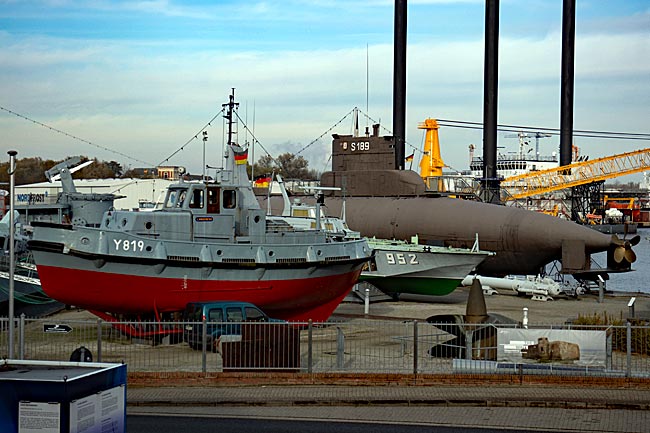
In total, the Imperial Navy deployed 374 submarines in World War I. They sank 100 warships and 6,394 merchant vessels, including the passenger steamer „RMS Lusitania“, which regularly sailed between Liverpool and New York. 1,198 people, including 128 US-Americans, died on May 7, 1915. After the Germans resumed unrestricted submarine warfare on February 1, 1917, the USA declared war on Germany. This submarine of class 205 in the maritime museum was laid down in Kiel in 1965 and required over two years to build.
previous page
 next page
Map
Further information
Tourist Information
Ebertstraße 110
26382 Wilhelmshaven
Phone: +49 (0) 4421 913000
Open: Monday – Friday 10 AM – 6 PM, Saturday 10 AM – 4 PM
Email: tourist-info@wilhelmshaven-touristik.de
www.wilhelmshaven-touristik.de
Stiftung Deutsches Marinemuseum
Südstrand 125
26382 Wilhelmshaven
Phone: +49 (0) 4421 400840
Open: April 1 – October 31 daily 10 AM – 6 PM, November 1 – March 31 daily 10 AM – 5 PM, Closed December 24
Email: info@marinemuseum.de
www.marinemuseum.de
UNESCO World Heritage Wadden Sea Visitor Center
Südstrand 110 b
26382 Wilhelmshaven
Phone: +49 (0) 4421 910733
Open: January – March: Tuesday – Sunday 10 AM – 5 PM, April – June: Daily 10 AM – 5 PM, July – August: Daily 10 AM – 6 PM, September – October: Daily 10 AM – 5 PM, November – December: Tuesday – Sunday 10 AM – 5 PM
Closed: December 23–25, 31
Email: info@wattenmeer-besucherzentrum.de
www.wattenmeer-besucherzentrum.de
Küstenmuseum Wilhelmshaven
Weserstraße 58
26382 Wilhelmshaven
Phone: +49 (0) 4421 400940
Open: February – November: Tuesday – Sunday 11 AM – 5 PM
Closed in December
www.kuestenmuseum.de
Kunsthalle Wilhelmshaven
Adalbertstraße 28
26382 Wilhelmshaven
Phone: +49 (0) 4421 41448
Open: Tuesday 2 PM – 8 PM, Wednesday – Sunday 11 AM – 5 PM
Closed: Monday, December 24–26, 31, January 1
Email: kunsthalle@wilhelmshaven-touristik.de
www.kunsthalle-wilhelmshaven.de
Kulturzentrum Pumpwerk
Banter Deich 1a
26382 Wilhelmshaven
Email: pumpwerk@wilhelmshaven-touristik.de
www.pumpwerk.de
Aquarium Wilhelmshaven Bullermeck GmbH
Südstrand 123
26382 Wilhelmshaven
Phone: +49 (0) 4421 5066444
Open: Daily 10 AM – 6 PM
Closed: Christmas Eve
Email: info@aquarium-wilhelmshaven.de
www.aquarium-wilhelmshaven.de
Dangast
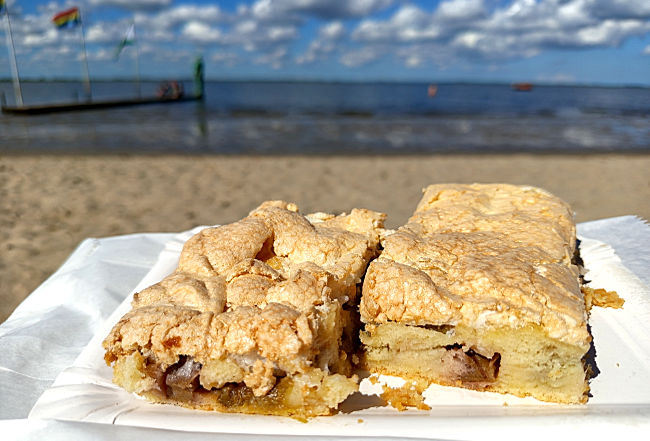
Dangast is located on the Jadebusen, a 190 km² sea bay at the North Sea created by storm surges. The town, which belongs to Varel, is a popular holiday and excursion destination. Campers will find two campsites right by the water here, and cyclists have excellent conditions for tours in the surrounding area. The rhubarb cake in the picture is a classic with a rich tradition at the old spa house, which has been run by a family business for several generations.
read more ...
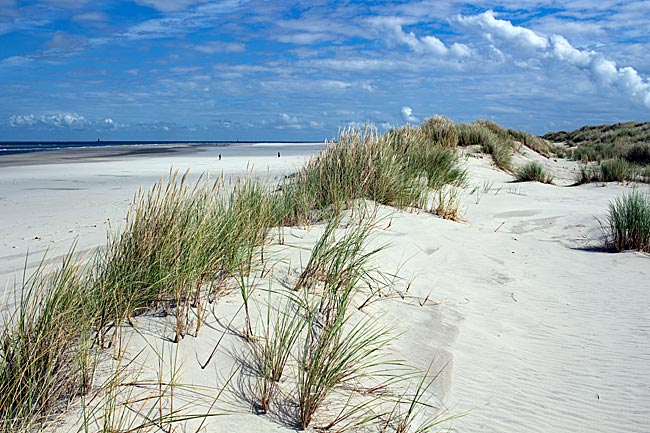
The East Frisian Island Wangerooge
Among the inhabited East Frisian Islands, Wangerooge is the second smallest (7.94 km²) after Baltrum and car-free, making a stroll through town much more pleasant compared to other islands, especially since distances can easily be covered on foot. From the small train station, you're just a few steps away from the heart of the village, quickly finding yourself in front of the unmistakable Old Lighthouse, which now houses the island museum. From 1856 to 1969, this lighthouse served as a maritime navigation aid, guiding ships safely along their routes. Just how far its light could be seen becomes clear when you climb the 149 steps to the lantern room—from there, you can step out onto the surrounding gallery and enjoy a sweeping view of the island and the North Sea.
read more ...
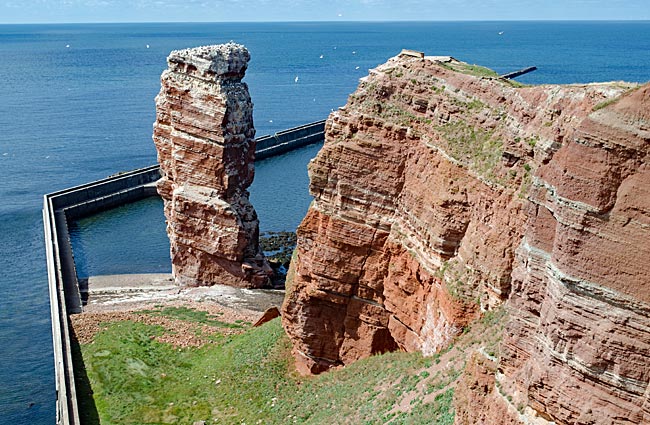
Heligoland - a day trip
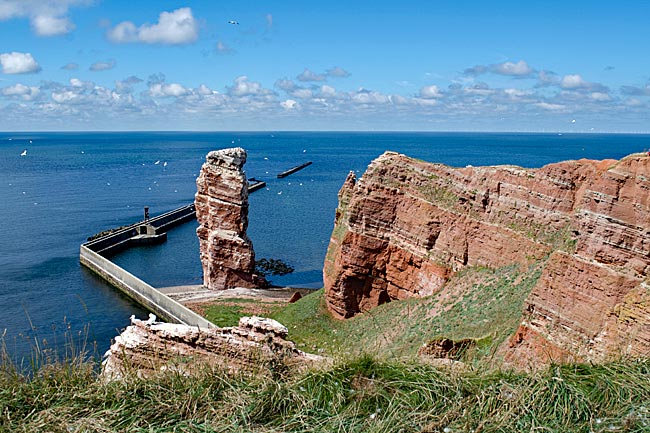
Germany's only supposed high-seas island is a destination for thousands of visitors each year, most of whom are day-trippers during the warmer months. And yes, admittedly, Heligoland isn't immediately in Bremen's surrounding area. However, it can be reached as a day trip from Bremerhaven and Cuxhaven - which is why we decided to visit.
read more ...
Bremerhaven in general
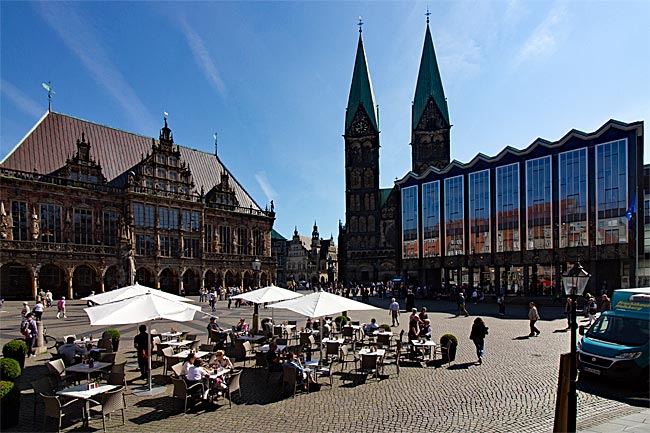
Bremerhaven was only founded in 1827. To secure its status as a port city amid the threat of the Weser - Bremen's lifeline - silting up, Bremen purchased 342 acres of land at the mouth of the Weser from the Kingdom of Hanover for 74,000 talers under then-mayor Johann Smidt. About 60 kilometers downstream from Bremen, this became the site of the first urgently needed seaport built by Bremen, known as the Alter Hafen (Old Harbor), completed by 1830.
read more ...
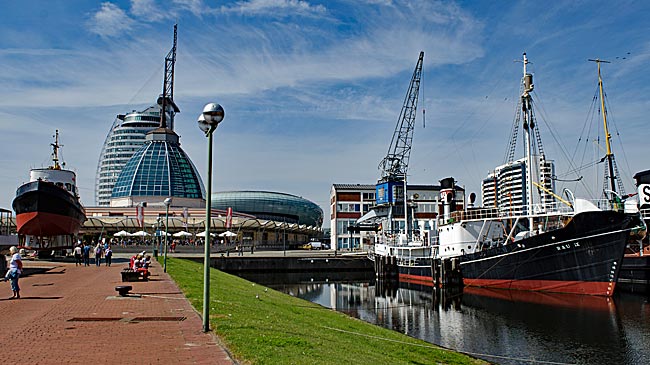
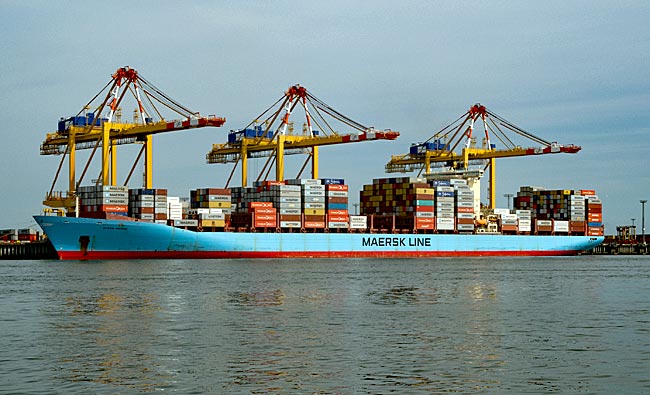
Bremerhaven - Überseehafen (Overseas Port)
In addition to the Old Harbor (now the Museum Harbor), which was the first to be built, other ports were later added. Adjacent to the New Harbor lies Kaiserhafen I, the first in a series of additional harbor basins. Even a glance into this initial section of the expansive port area reveals a different world of maritime activity - one of large ships. And we will see even larger ones along the five-kilometer-long quay on the Weser.
read more ...
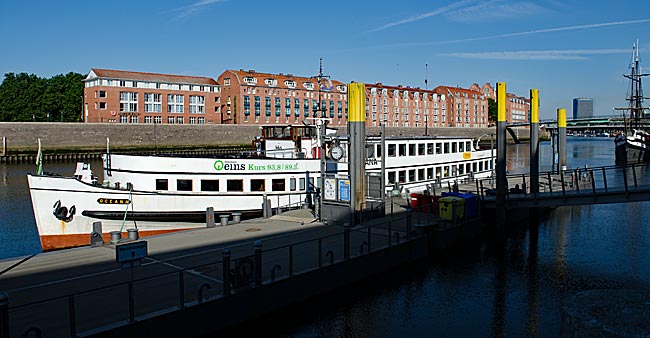
Weser cruise from Bremen to Bremerhaven
Of course, you can take a car for a visit to Bremerhaven from Bremen or board the regional train at the main station. However, with suitable weather and enough time, it is more interesting to cover the route on the Weser by ship. The shipping company "Hal över" operates the connection from May to September. The ship departs from the Martinianleger near the city center along the Schlachte. Those who wish can even take their bicycle with them; additionally, you can pre-book a breakfast onboard.
read more ...
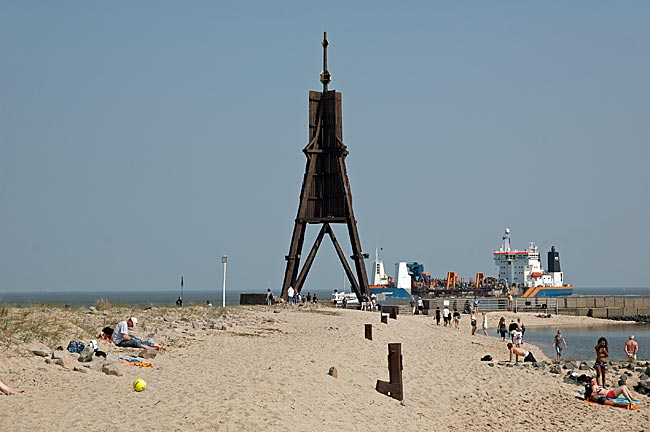
Cuxhaven - a day trip
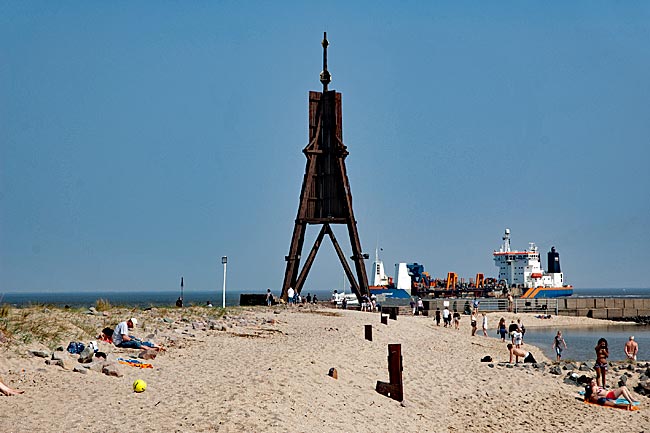
Many people from Bremen consider the seaside resorts of Cuxhaven to be "their home beach." The coastal city at the mouth of the Elbe is easily accessible from Bremen by car via the A27, which passes by Bremen and Bremerhaven before ending in Cuxhaven. By train, the journey takes a bit longer with a transfer in Bremerhaven. However, even in the off-season, Cuxhaven with its seaside resorts is a great destination for an outing - for example, by bicycle.
read more ...
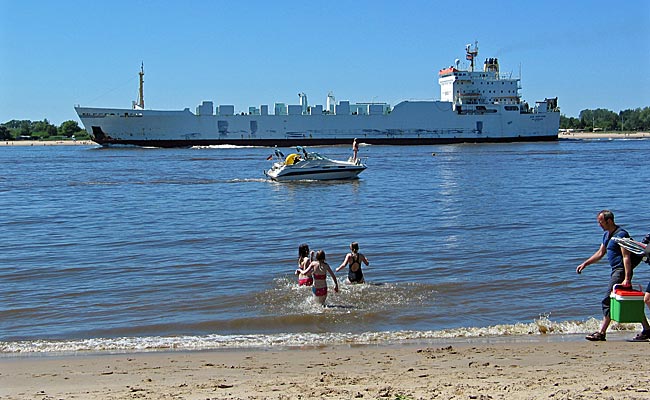
Brake & the River Island of Harriersand
As soon as spring arrives and the temperatures reach around 20 degrees, many Northern Germans are drawn to the North Sea coast. The main attraction? A beach to lie in the sun and sand for children to dig and build castles. This also draws many people from Bremen to the highways heading north on warm weekends, equipped with bags packed and picnic baskets ready for a day of seaside relaxation. But why travel far when the nearest beach is just around the corner? A visit to Brake and Harriersand proves that.
read more ...
Oldenburg
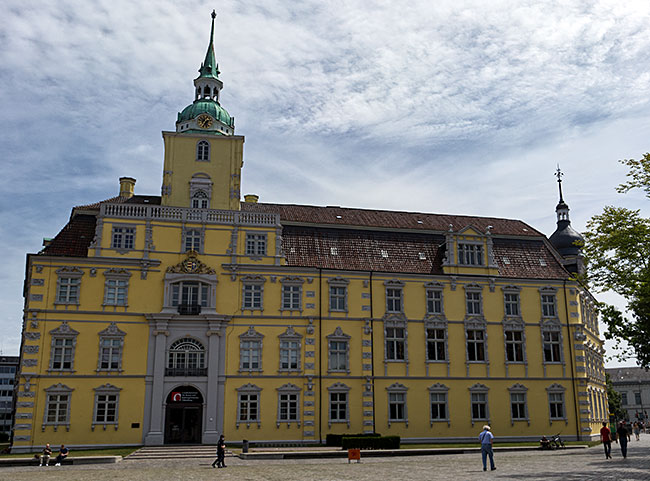
The third-largest city in Lower Saxony today was once the seat and capital of ruling counts, dukes, and grand dukes, later a Free State and state capital. Remnants of the time when nobles ruled the city include the palace and numerous primarily neoclassical buildings in the city center. But even beyond that, there is much to discover in the expansive, largely car-free inner city. And again and again, one comes across water during a stroll, such as the Old City Harbor.
read more ...