
 exploring Bremen & its surrounding areas
 You are here: tours through the city
 Cycling through Woltmershausen to Lankenauer Höft (1/2)
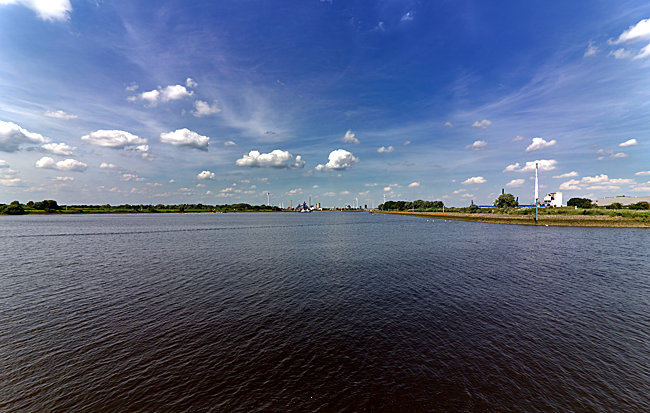
A view across wide waters at the harbor entrance to the Neustädter Hafen near Lankenauer Höft
A truly maritime bike tour leads from the Stephani Bridge to the almost entirely water-surrounded Lankenauer Höft. Whether coming from the Neustadt district or from the Stephani district on the opposite Weser bank, you pass by the heavily trafficked bridge - or more precisely, next to the adjacent railway bridge - „De Liefde“. The current three-masted ship with its dark red hull was built in 1941 at Winschoter Diep in Martenshoek in the Netherlands near Groningen for a shipping company based in Zaandam as a timber freighter.
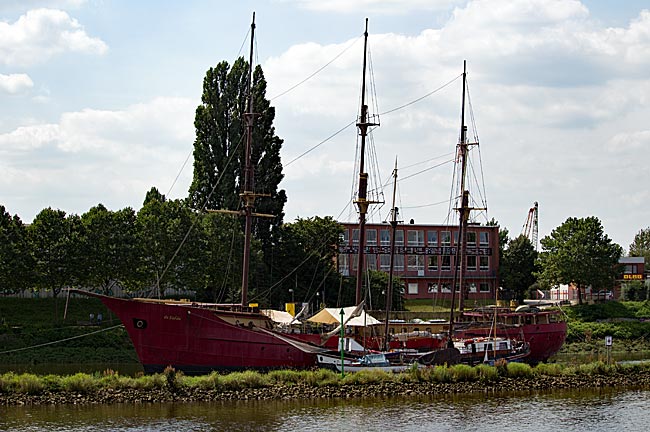
Across from Überseestadt: „De Liefde“
However, it wasn’t until ten years after the war that the ship finally carried wood as cargo in its holds - after nearly sinking. In fact, the vessel had a turbulent history under various names, narrowly escaping scrapping before Eduard van der Velden purchased it, transferred it from Zoutkamp to Bremen, and moored it in 2003 at the former berth of the „Schulschiff Deutschland“, which now lies in the New Harbor in Bremerhaven.
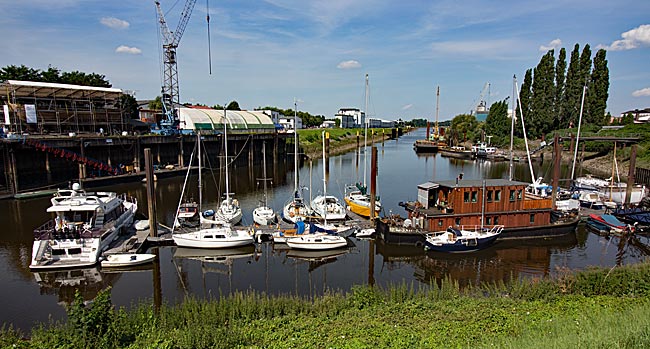
View into Hohentorshafen with mooring spots for sports boats. On the left side of the image stands the Kogge replica, scaffolded and covered, on dry land
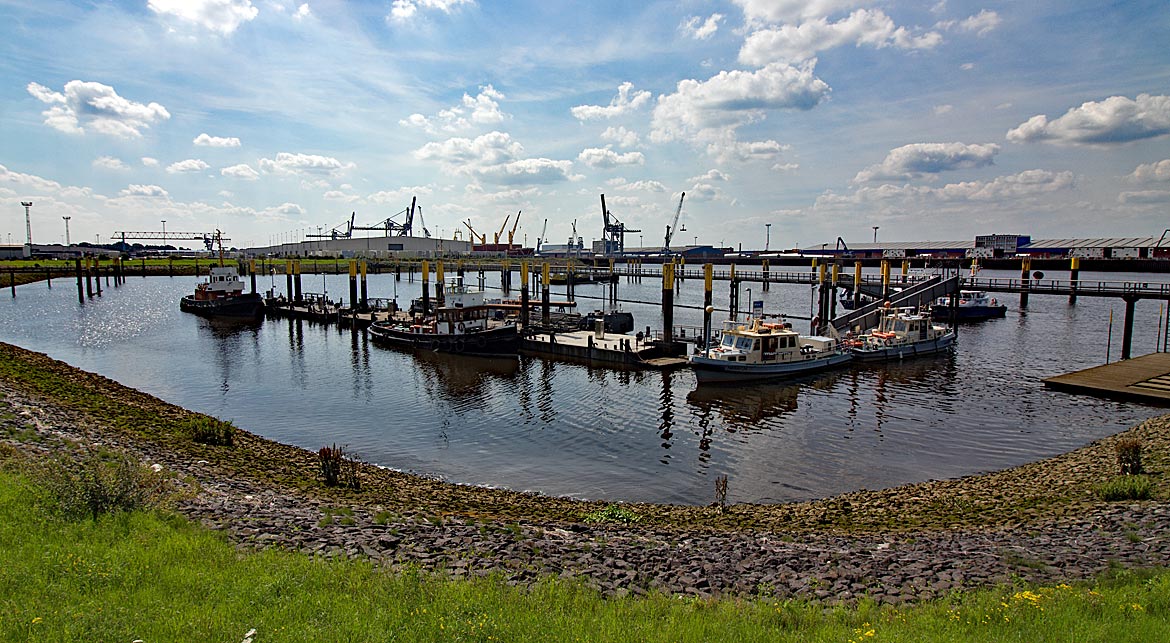
Behind „De Liefde“‘s mooring extends the Hohentorshafen, home to numerous businesses, including the boatyard Maleika. At the far end of this elongated harbor basin, Maleika offers, among other things, water moorings for sports boats. Unlike around 100 years ago, however, no ships are built here anymore - only repaired, such as in 2017 when the first rescue cruiser of the German Maritime Search and Rescue Service (DGzRS) based in Bremen underwent restoration. In the early 1950s, this boat - which had originally been commissioned in 1931 as a motor rescue boat named „Konsul Kleyenstüber“ - was extensively converted into a rescue cruiser and renamed „Bremen“. After being decommissioned in 1965, the cruiser was modified again and used, among other things, as a tugboat. The goal of the shipyard visit: restoring its original condition from the early 1950s - a challenging task. The „Bremen“ is already a protected museum ship operated by volunteers; its mooring spot is in Vegesack’s harbor.
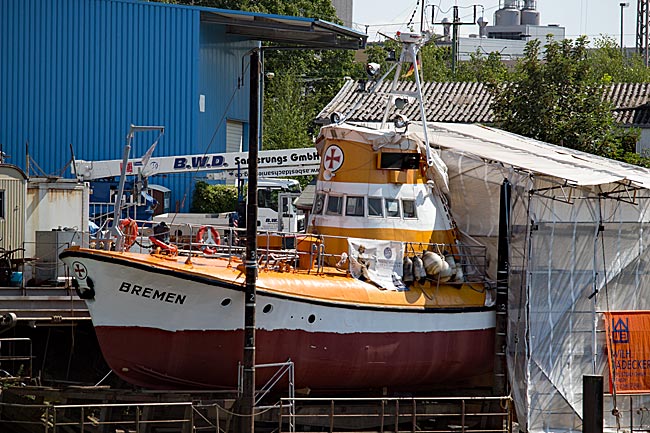
Museum ship in dry dock: the rescue cruiser "Bremen"
In this part of Hohentorshafen, the wreck of the Kogge replica also lay on dry land for many years. In 1962, well-preserved remains of a Hanseatic cog were discovered during dredging work in the Weser. These served as the original model for the replica, which was completed just in time for the Schlachte opening in 2000 and moored there for fourteen years until a defective sea valve caused it to run aground. The meticulously restored wooden ship finally returned to the Weser’s waters on March 20, 2021, and is expected to resume its mooring at the Schlachte after further expansion in a few months.
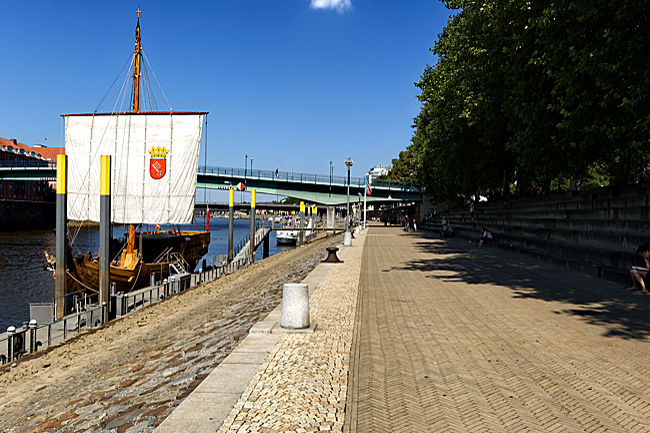
The Schlachte with the Kogge replica
Further along, the street „Am Hohentorshafen“ transitions into „Ladestraße“, marking the shift from Neustadt district into the Woltmershausen district - often simply called „Pusdorf“ by older Bremen residents. Farmers settled this area along the Weser as early as prehistoric times. Whether the name Pusdorf derives from a farmer named Poos (whose name in Low German means something like „to blow“) or whether the wind here blew more fiercely than elsewhere, contributing to its naming, remains uncertain. What is certain is that Woltmershausen was first mentioned in documents in 1244 and neighboring Rablinghausen in 1250; both became part of the Hanseatic city in 1902.
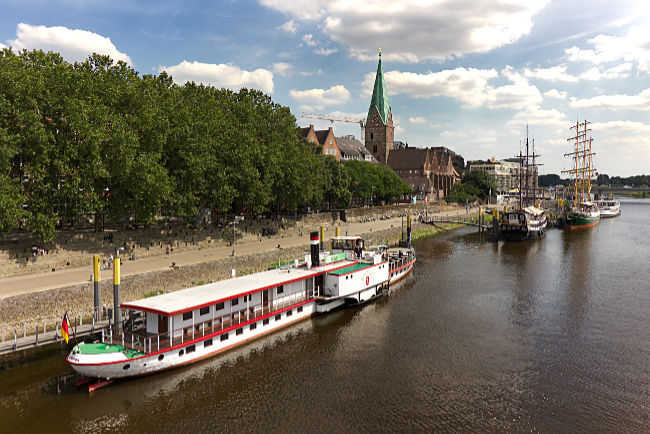
A part of the Schlachte
However, even some Bremen residents are unfamiliar with Woltmershausen, as the district seems somewhat cut off from Neustadt and the rest of the city. One reason for this lies in past construction measures. For example, the heavily trafficked „Oldenburger Straße“ leading to Delmenhorst and Oldenburg passes by the district, effectively separating it from the rest of the city. The railway line running parallel to this main road is also frequently used, necessitating a tunnel that acts as the main gateway into the district - a true bottleneck during peak hours. Additionally, the construction of Neustädter Harbor beginning in the early 1960s turned Woltmershausen and adjacent Rablinghausen into a cul-de-sac ending in water, with no further fixed connection to other residential areas of Bremen.
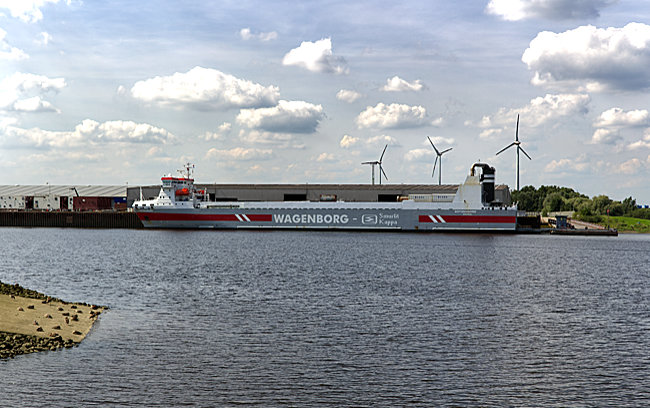
A cargo ship in the Neustadt harbor, where shipping traffic has however declined
Caution is advised when cycling along the cobblestone Ladestraße, as heavy traffic from agile forklifts and large trucks - some from other European countries - dominates during business hours. Where Ladestraße ends, you transition onto Westerdeich, perhaps one of the district’s most beautiful streets, offering at least a view of the Weser from higher floors.
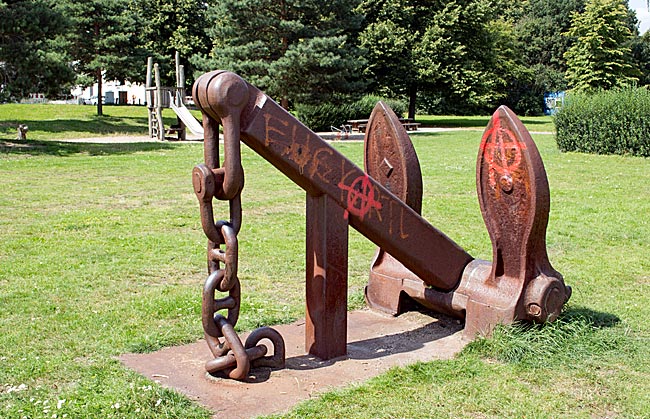
Anchor in "Play and Water Garden Woltmershausen"
After a short stretch on this too-narrow street, it is worth turning into "Play and Water Garden Woltmershausen“ to temporarily leave behind roads with car traffic. The park has existed as a park-like facility since the 1950s when the Weser was straightened and its shore reinforced with water construction stones. However, its current size and design only became possible in 2003 after demolishing no-longer-needed structures on the site, such as the potato bunker that had been vacant and dilapidated since New Year’s Day 1999. In 2006, following extensive planning and construction work, the garden was inaugurated. Alongside a sand play area and numerous play structures - especially for younger children - the garden also features facilities for sports like ball games and skating. Given its direct proximity to the Weser, it made sense to create water access across the rocky shore reinforcement. Thus, a concrete staircase with steps of varying widths invites visitors to linger and splash in the water (though swimming is prohibited here). Weser water also feeds a small artificial stream on the green space.
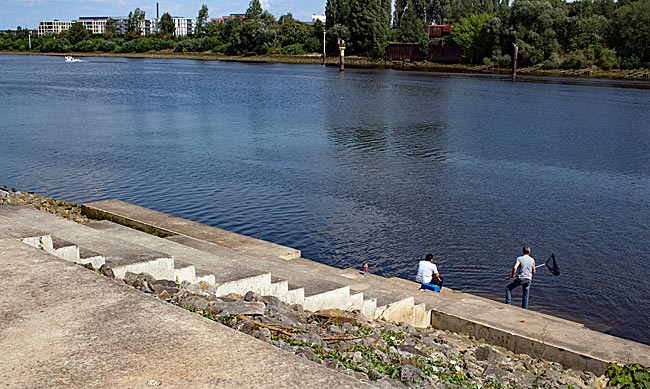
A staircase into the Weser
previous page
 next page
Map
Stephani district
The Stephani district forms the western end of Bremen's Old Town and is considered the birthplace of the city, making it one of its oldest districts. As early as 1050, Archbishop Adalbert I founded a priory in honor of Saint Stephen. The priory, located on a dune, was called Steffensberg (mons sancti Stephani) in German translation. Adalbert's episcopal successors established a parish and built the first church in what was then also known as Steffensstadt (Stephen’s City).
read more ...
Vegesack
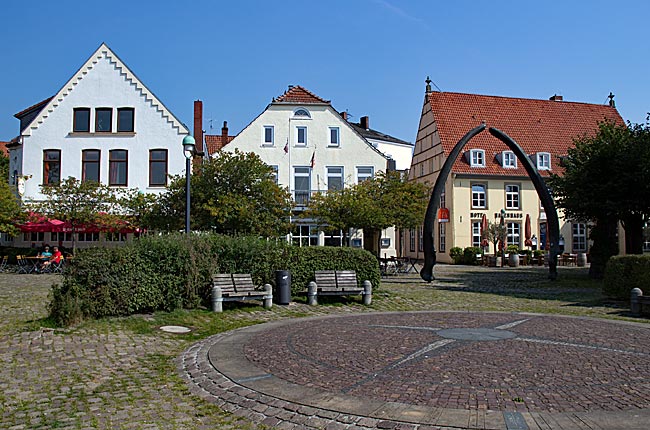
The most interesting area extends around the ferry terminal. From the seats of the nearby cafés and restaurants, you can almost watch the ferry operations. In front of the square stand the enormous lower jaws of a blue whale. Measuring 7.1 meters long, up to 1 meter wide, and weighing 1.2 tons, these bones belonged to a 26-meter-long animal that the port town received as a gift in 1961.
read more ...
DGzRS - The Maritime Rescuers
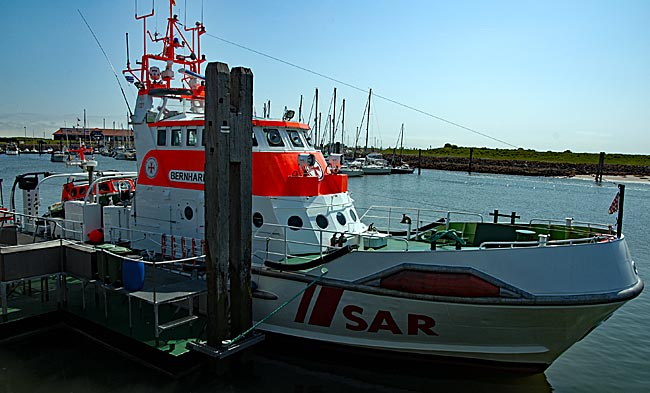
Anyone in distress at sea today has far better chances of receiving help, even out on the open water, thanks to modern technology and professionals who take care of it. Along Germany’s North and Baltic Sea coasts, these are primarily the approximately 1,000 full-time and volunteer men and women of the DGzRS (German Maritime Search and Rescue Service), also known as "The Maritime Rescuers." In 2020 alone, they conducted 1,720 operations and rescued 357 people. Since its founding, the organization has helped 86,000 individuals.
read more ...
Schlachte
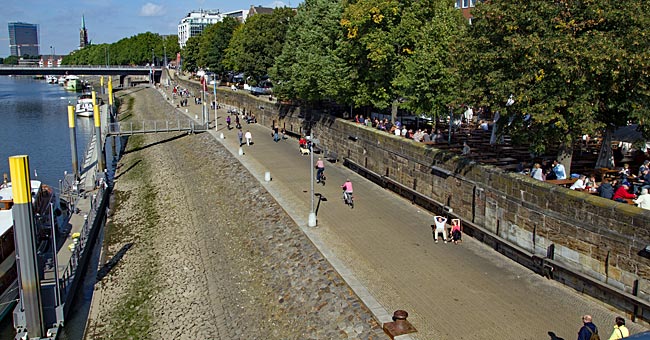
Between the Wilhelm-Kaisen Bridge and the Stephani Bridge, a promenade with a boulevard, ship docks, and numerous dining establishments offering something for every palate was created between 1993 (start of construction) and its grand opening on May 27, 2000. The project cost over €20 million, primarily funded by the EU, and features 60 trees and ample granite paving.
read more ...
Überseestadt (Overseas City)
When the Overseas Port required renovation, the decision was made in 1991 to simply close off the basin instead. In 1998, the Overseas Port was finally filled with sand obtained from dredging operations in the Outer Weser. Alongside the also decommissioned but still existing Europa Harbor basin, this formed the foundation for the conceptual development and creation of today's Überseestadt (Overseas City).
read more ...
Water-based activities in Bremen
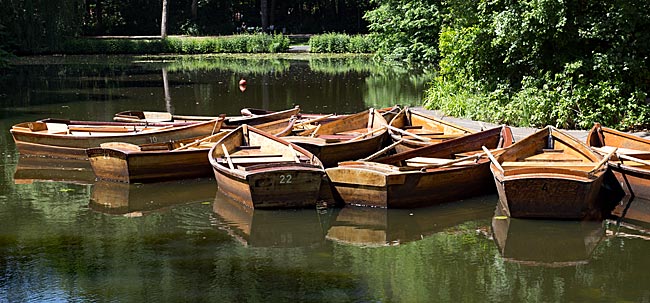
Given that Bremen is a city situated along a major river and surrounded by numerous lakes, it's only natural to extend sporting activities - or whatever one personally considers as such - from land to water. The most family-friendly activity on the water is undoubtedly taking a rowboat ride along the canals of the Citizens' Park (Bürgerpark).
read more ...
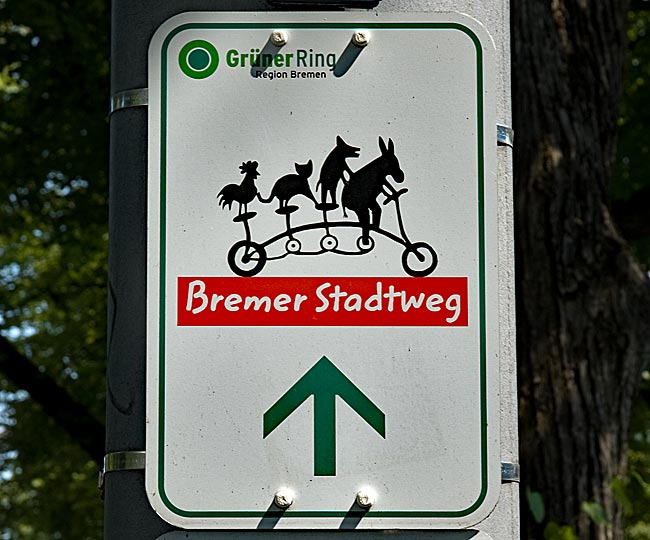
Cycling in Bremen and surroundings
The Free Hanseatic city of Bremen is connected to numerous neighboring towns via the Weser Bike Trail and the Unterweser Circular Route. On both sides of the Weser River, cycling routes lead, for example, to Brake with its Harriersand island or Bremerhaven and onward to Cuxhaven. In 2017, the Weser Bike Trail was named an ADFC-Quality Bicycle Route (4 stars) by the German Cyclists' Association (ADFC) at ITB. According to a travel analysis, it is the second most popular long-distance cycling route in Germany.
read more ...
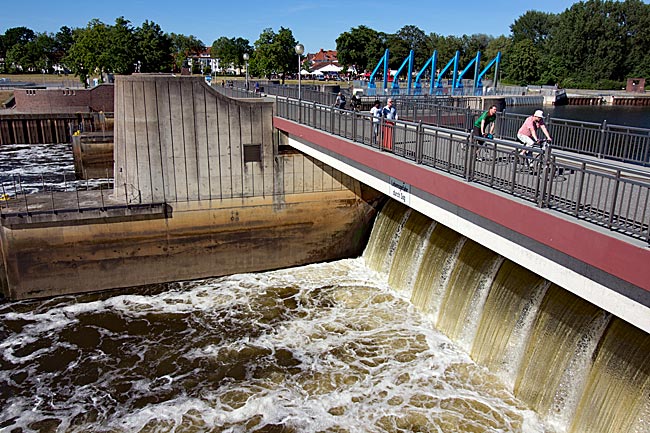
Round trip: from the City Center to the Weser weir and back
From Tiefer or Altenwall, the section of the Weser riverbank in front of Schnoor and diagonally opposite the DGzRS (German Maritime Search and Rescue Service), the planetarium, and the observatory on the other side of the river, a beautiful path for pedestrians and cyclists runs directly along the water upstream toward the Weser weir. After crossing the Weser weir, the return route of the tour leads via Stadtwerder.
read more ...
A stroll through the Neustadt
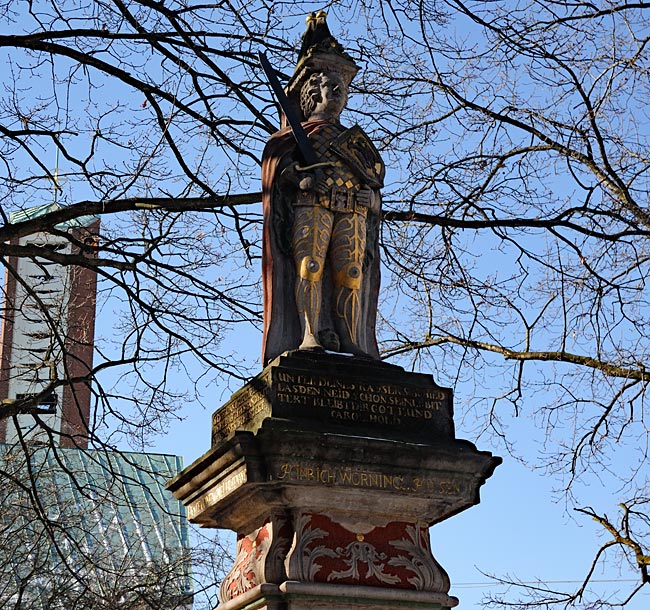
The Old Neustadt was only properly established as part of the district in the 17th century. One reason for this planned expansion of the city was the increasing threat posed by advancements in weaponry. Remnants of the defensive walls built at that time still exist today as parks, but there is much more to discover, such as the Little Roland.
read more ...