
 exploring Bremen & its surrounding areas
 You are here: worth seeing in the surroundings
 Oldenburg [Oldb] (4/5)
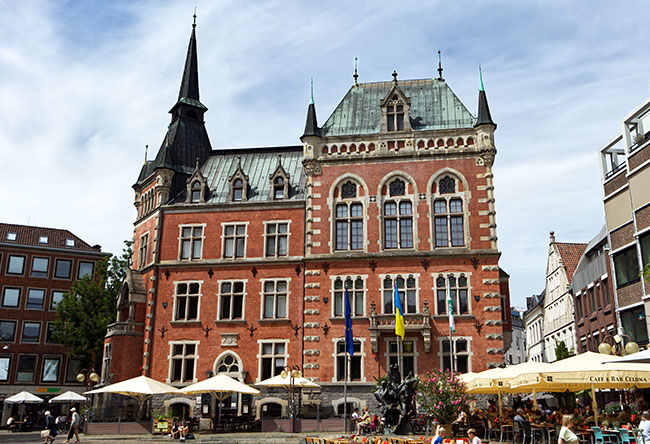
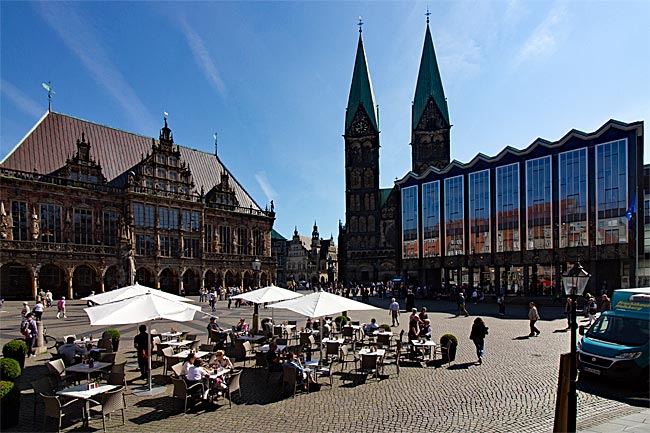
View of the town hall at Rathausmarkt
Well then, let's step into the heart of this civic city, where you'll more or less immediately find yourself on a square - the Rathausmarkt. If one of the weekly markets isn't taking place here, the atmosphere is more about relaxing than shopping. On sunny days, several restaurants set up their tables and chairs outside, making for an appealing setting given the architectural surroundings.
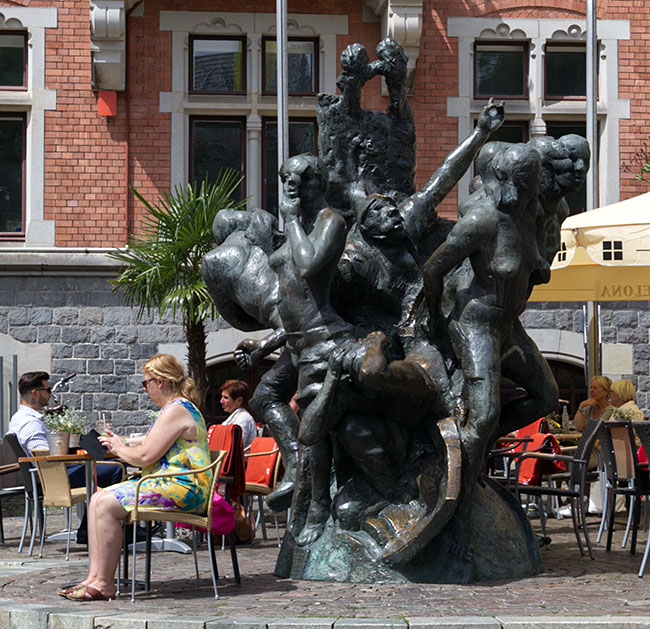
Fountain at Rathausmarkt
On one side stands - yes, it may be hard to believe - the Old Town Hall (Rathaus), and on the other, St. Lamberti Church. Construction of the town hall began in 1886, and by 1888, the political affairs of the city were being managed from here. The current building, featuring elements of Neo-Gothic and Renaissance architecture, is the third structure to occupy this site. A Renaissance-style building had already replaced the Gothic town hall (erected in 1355) around 1635 under the rule of Count Anton Günther, as the older structure had fallen into disrepair.
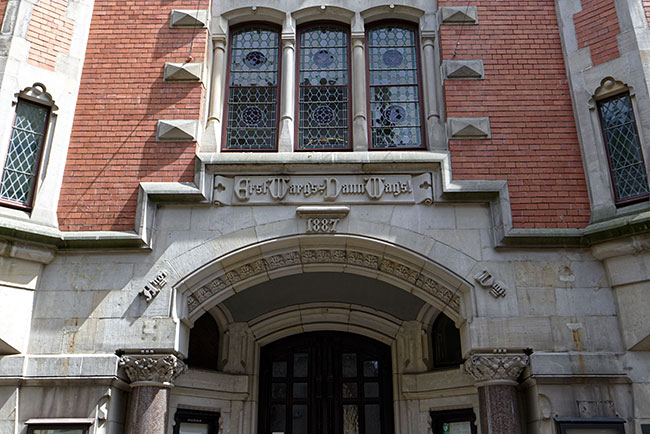
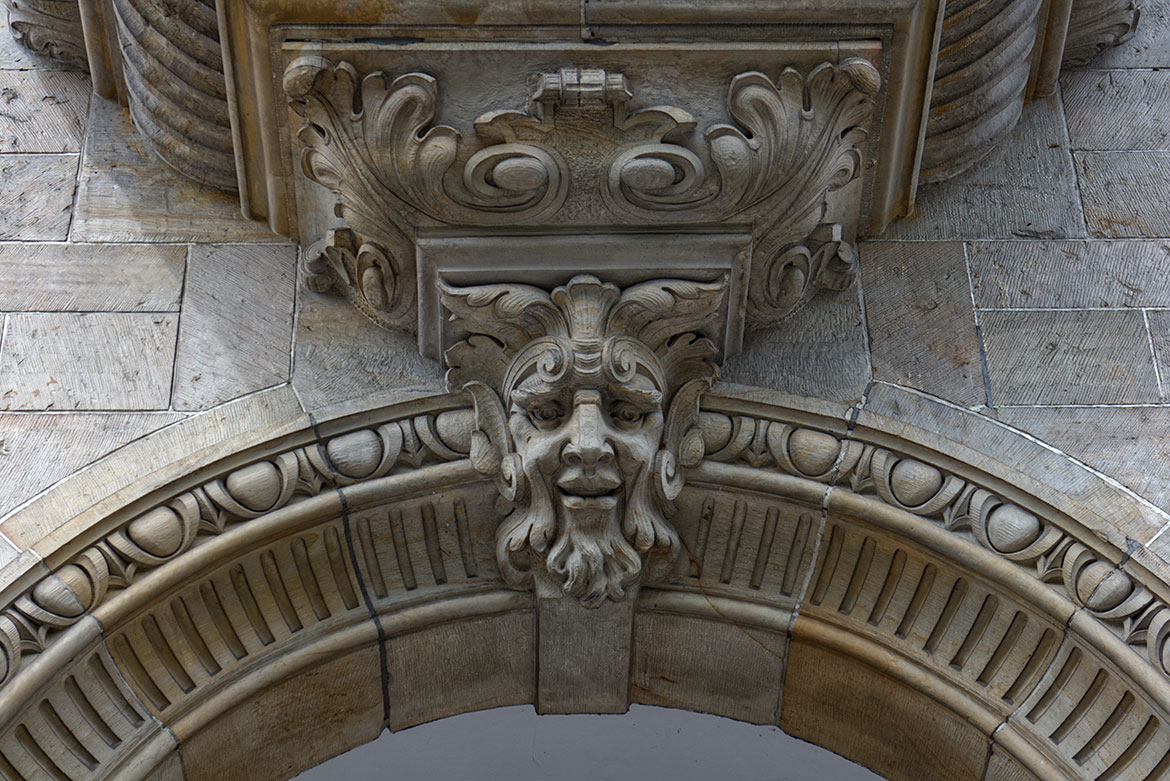
Entrance portal of the town hall
The demolition of the second town hall and construction of the current one posed challenges for the city due to increasing space requirements. After the demolition, citizens grew fond of the newly freed-up area, complicating decisions about where to rebuild. However, after lengthy deliberations, the council narrowly voted in favor of this location once again. The motto above the entrance - "First weigh it, then dare it" - is fittingly inscribed in stone.
Notable features include the historical murals from 1887 in the Great Council Chamber, which were restored during a 2005 reconstruction after being obscured by layers of paint applied over time.
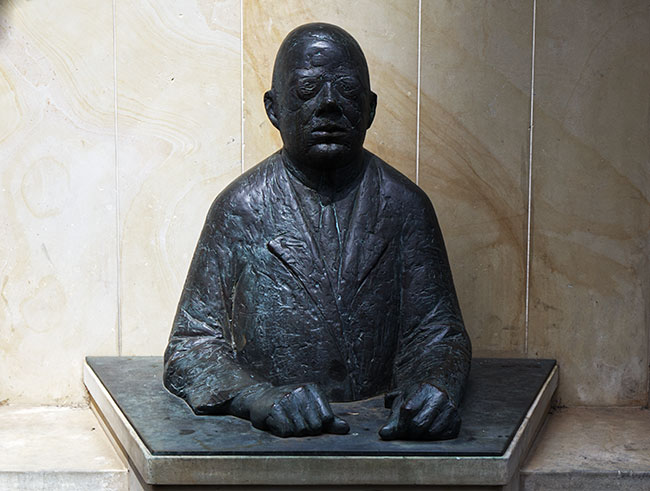
Bronze bust of Theodor Goerlitz
Upon circling the building, you'll notice that it is triangular - a rather unusual shape, likely due to pre-existing spatial constraints. During your walk around, you’ll also encounter a wise figure honored with a bronze monument for his contributions to the city. Theodor Goerlitz served as mayor from 1921 until the Nazis removed him from office in 1932. The tribute recognizes the jurist and professor for his efforts in expanding Oldenburg. He founded the GSG (Municipal Housing Association) in 1921 and co-founded EWE (1930), addressing critical urban issues such as affordable housing and basic utilities like electricity and gas.
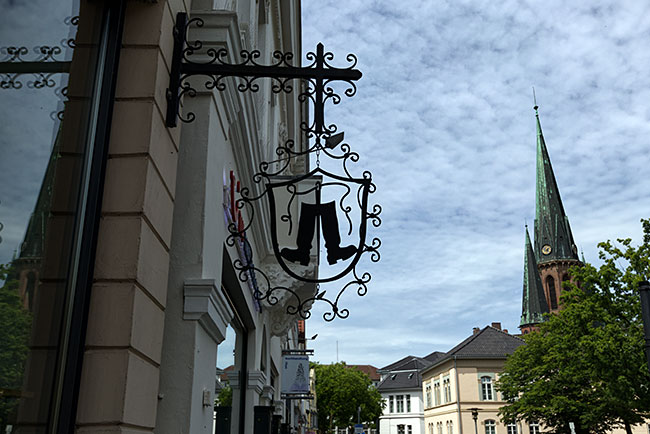
Although the towers of St. Lamberti Church are not among the tallest, they are often visible
The church stands at 86 meters, making it the tallest structure in the city. It is named after Saint Lambertus, who lived from the 7th to early 8th century and served as Bishop of Tongeren-Maastricht in present-day Belgium before being martyred. For reasons unknown, he held significant importance for the House of Oldenburg, which built an initial church dedicated to him. The current bishopric shares little with its predecessors up until the late 18th century. The oldest surviving mobile artifact is a late Romanesque chalice crafted by Westphalian goldsmiths around 1265.
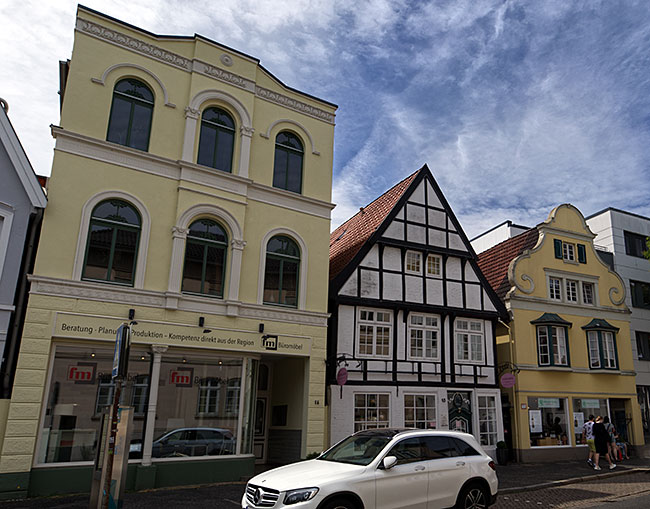
Houses on Schlossplatz Street near St. Lamberti Church
Over the centuries, the originally Late Gothic hall church underwent repeated modifications and expansions to meet new needs until it eventually fell into disrepair. It was Duke Peter Friedrich Ludwig who made a radical decision in 1795 to largely demolish the structure while preserving the outer walls. The interior underwent a stylistic shift to Classicism, resulting in the rotunda with its domed roof that remains today. During renovations between 2007 and 2009, the color scheme was brightened for a more inviting appearance.
Visitors entering the church expecting the typical eastward-facing altar and choir space will find something different. In 1795, the interior layout was rotated to face west, transforming that area into an entrance hall - a change that persisted even after the organ was installed later. Sometimes, you just have to do things differently. Incidentally, Oldenburg became Protestant not long after the Reformation began in 1517 (with Martin Luther’s 95 Theses and his actions in Wittenberg).
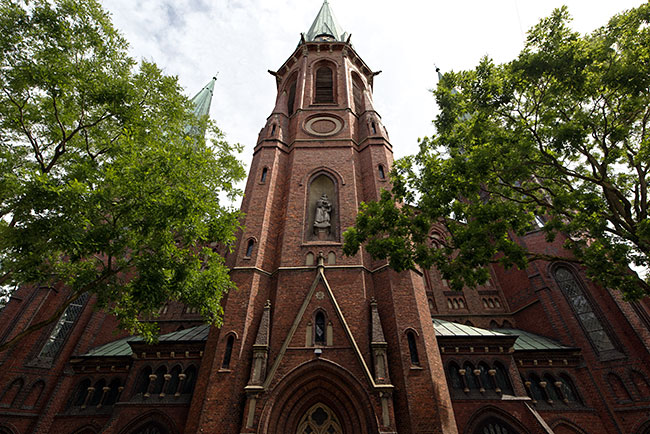
West tower of St. Lamberti Church with a statue of Martin Luther
Martin Luther himself, who sparked the Reformation, is commemorated at St. Lamberti Church with a statue in the Neo-Gothic west tower, completed in 1873. Wait, 1873? Yes, the freestanding bell tower had been demolished in 1813, leaving the church without towers for 60 years. Almost as if to make up for this, four smaller corner towers were added between 1885 and 1887 alongside the large west tower. Additionally, the structure was clad in red brick, giving it its current Neo-Gothic exterior.
The bells are relatively new; like many church bells, those of St. Lamberti were melted down during both World Wars as part of metal drives to support weapons production. Only the smallest bell - a borrowed one - dates back further and was cast in 1669.


Map
Further information
Oldenburg Tourism
Lange Straße 3
26122 Oldenburg
Phone: +49 (0)441 36161366
Email: info@oldenburg-tourist.de
Opening hours of Oldenburg-Info in Lappan: Monday - Friday 10 AM - 5 PM, Saturday 10 AM - 4 PM
www.oldenburg-tourismus.de
State Museum for Art and Cultural History
Damm 1
26135 Oldenburg
Phone: +49 (0)441 40570400
Email: info@landesmuseum-ol.de
www.landesmuseum-ol.de
Open: Tuesday - Sunday 10 AM - 6 PM, closed on Mondays, Holidays as per website
Locations:
Schloss (Castle), Schlossplatz 1, 26122 Oldenburg
Prinzenpalais, Damm 1, 26135 Oldenburg
Augusteum, Elisabethstr. 1, 26135 Oldenburg
State Museum of Nature and Man
Damm 38-46
26135 Oldenburg
Phone: +49 (0)441 40570300
Email: museum@naturundmensch.de
www.naturundmensch.de
Open: Tuesday - Friday 9 AM - 5 PM, Saturday and Sunday 10 AM - 6 PM, closed on Mondays
Oldenburg City Museum
Am Stadtmuseum 4-8
26121 Oldenburg
Phone: +49 (0)441 2352881
www.stadtmuseum-oldenburg.de
The museum is closed for demolition and reconstruction until further notice: www.museum-findet-stadt.de
Horst Janssen Museum
Am Stadtmuseum 4-8
26121 Oldenburg
Phone: +49 (0)441 2352885
Email: info@horst-janssen-museum.de
www.horst-janssen-museum.de
Open: Tuesday - Sunday from 10 AM - 6 PM, closed on Mondays
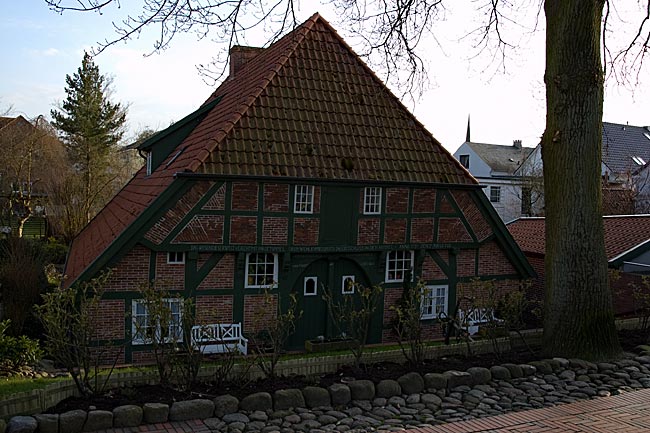
Dangast
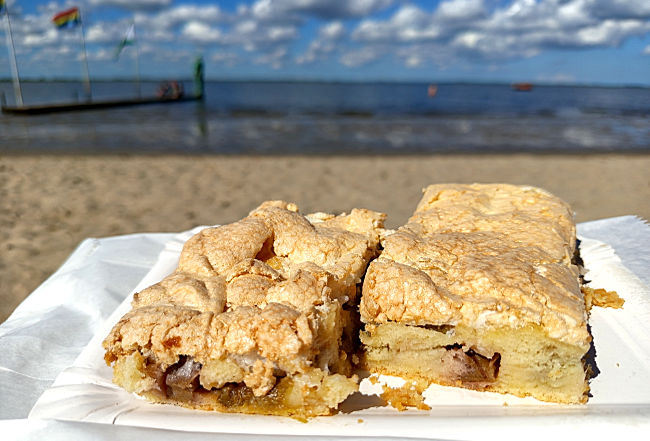
Dangast is located on the Jadebusen, a 190 km² sea bay at the North Sea created by storm surges. The town, which belongs to Varel, is a popular holiday and excursion destination. Campers will find two campsites right by the water here, and cyclists have excellent conditions for tours in the surrounding area. The rhubarb cake in the picture is a classic with a rich tradition at the old spa house, which has been run by a family business for several generations.
read more ...
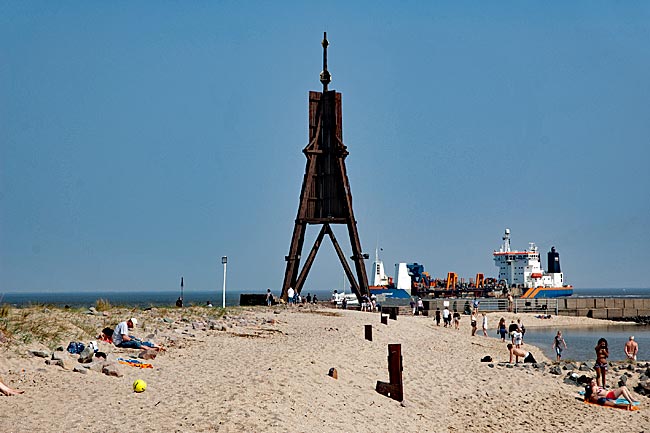
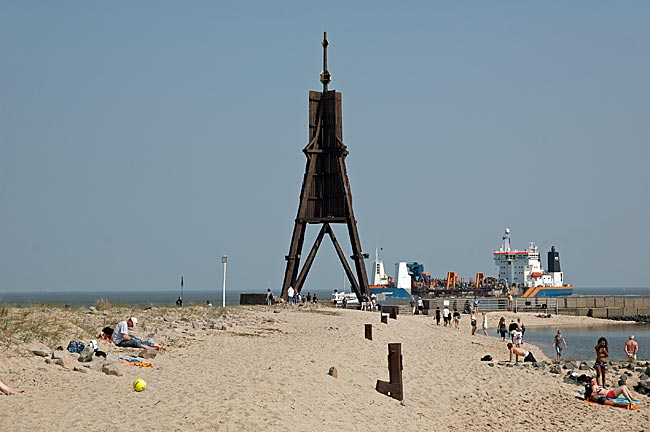
Cuxhaven - a day trip
Many people from Bremen consider the seaside resorts of Cuxhaven to be "their home beach." The coastal city at the mouth of the Elbe is easily accessible from Bremen by car via the A27, which passes by Bremen and Bremerhaven before ending in Cuxhaven. By train, the journey takes a bit longer with a transfer in Bremerhaven. However, even in the off-season, Cuxhaven with its seaside resorts is a great destination for an outing - for example, by bicycle.
read more ...
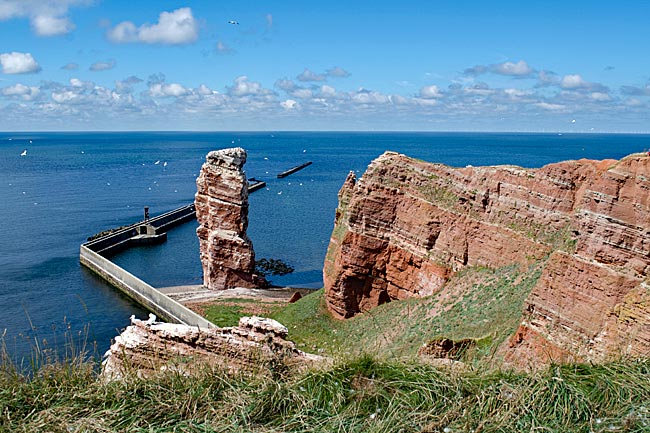
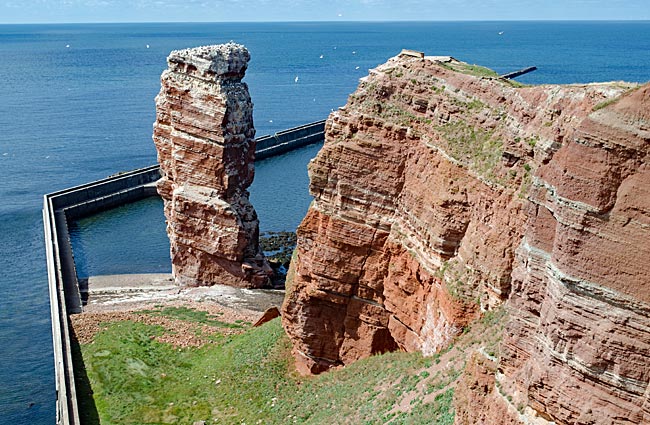
Heligoland - a day trip
Germany's only supposed high-seas island is visited each year by thousands of tourists, most of them day-trippers in the warmer months. And yes, admittedly, Heligoland isn't located right in the vicinity of Bremen. However, it can be reached as a day trip from Bremerhaven and Cuxhaven - which is why we decided to visit.
read more ...
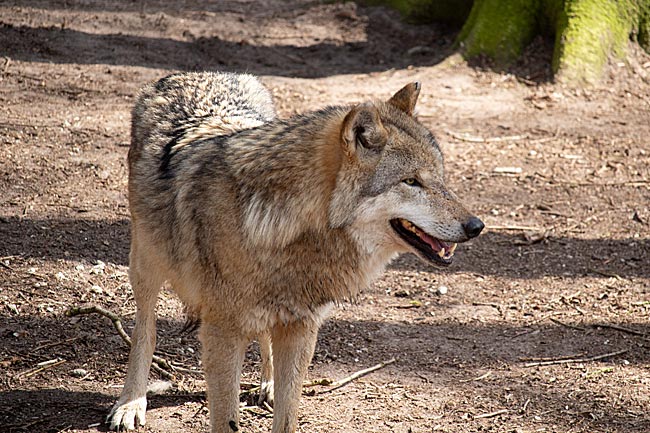
The East Frisian Island Wangerooge
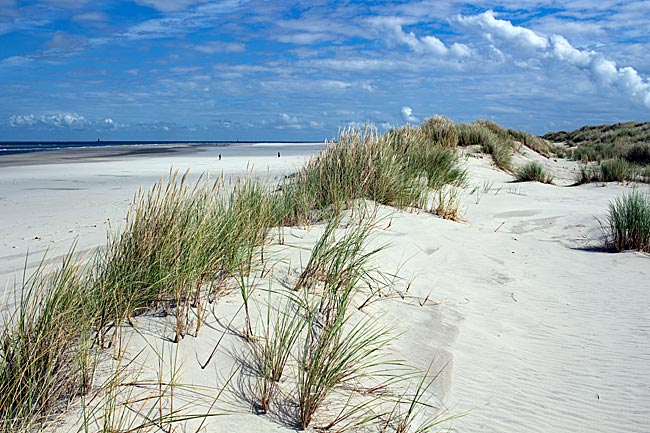
Among the inhabited East Frisian Islands, Wangerooge is the second smallest (7.94 km²) after Baltrum and car-free, making a stroll through town much more pleasant compared to other islands, especially since distances can easily be covered on foot. From the small train station, you're just a few steps away from the heart of the village, quickly finding yourself in front of the unmistakable Old Lighthouse, which now houses the island museum. From 1856 to 1969, this lighthouse served as a maritime navigation aid, guiding ships safely along their routes. Just how far its light could be seen becomes clear when you climb the 149 steps to the lantern room—from there, you can step out onto the surrounding gallery and enjoy a sweeping view of the island and the North Sea.
read more ...
Bremerhaven - Überseehafen (Overseas Port)
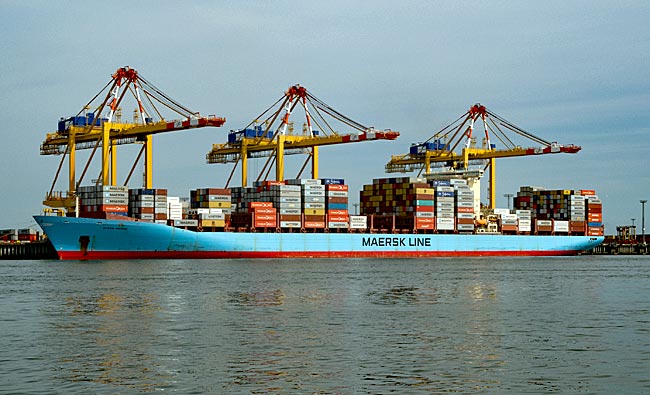
In addition to the Old Harbor (now the Museum Harbor), which was the first to be built, other ports were later added. Adjacent to the New Harbor lies Kaiserhafen I, the first in a series of additional harbor basins. Even a glance into this initial section of the expansive port area reveals a different world of maritime activity - one of large ships. And we will see even larger ones along the five-kilometer-long quay on the Weser.
read more ...
Wilhelmshaven – Seaside City on the Jadebusen
It's hard to imagine Wilhelmshaven without its naval presence, as the city only developed after a naval base was built in the 19th century. Even today, the German Armed Forces (Bundeswehr) maintain a large base here with several squadrons. Yet, there is much more to discover in this port city beyond its military significance.
read more ...