
 exploring Bremen & its surrounding areas
 You are here: worth seeing in the surroundings
 Oldenburg [Oldb] (3/5)
Where there is a castle garden, there must be a castle, right? Not necessarily, but since Oldenburg was almost entirely spared from Allied bombings during World War II, both residents and visitors to the city can still admire such a sight today.
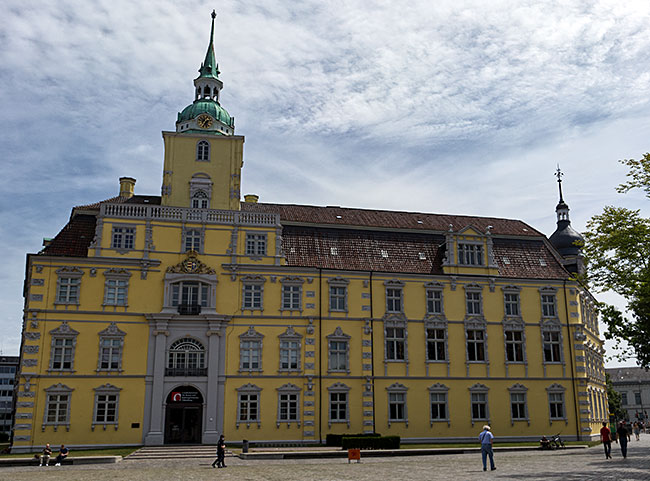
View from Schlossplatz to the castle
The construction of the castle and the surrounding buildings around Schlossplatz can certainly be considered a highlight of Oldenburg's city center, as is the adjacent Rathausplatz (Town Hall Square).
"Back then, there was more tinsel!" goes a line from Loriot’s 1976 sketch. For the castle, one could say: "Back then, there was more fortress." This is documented as early as around 1100, though confirmed in writing only in 1275. Just 48 years later, a defensive tower - the so-called bergfried - was mentioned. In the following century, the castle was further fortified and surrounded by a moat, turning it into a water castle. Over time, the structure underwent numerous modifications and renovations due to dilapidation. As a lowland castle, it also had to contend with marshy ground, common along riverbanks in such low-lying areas. By the early 17th century, the bergfried had to be demolished again because it had become crooked.
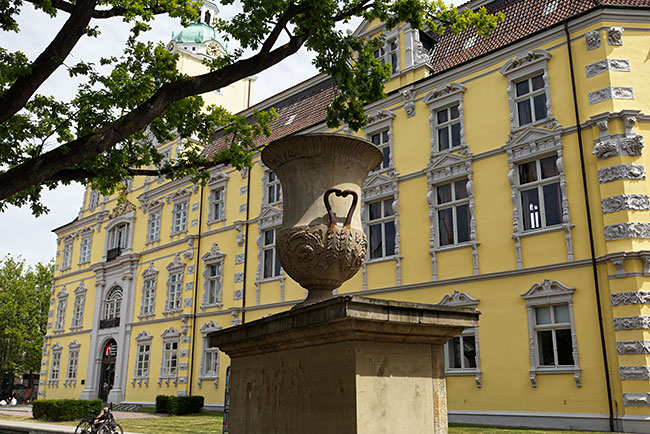
Franz Anton Högl designed not only the Schlosswache (Castle Guardhouse) but also this vase on Schlossplatz - quite dull without fresh flowers
Today, nothing remains of the former defensive walls. The oldest part of the current castle was home to Count Anton Günther von Oldenburg from 1607 until his death in 1667. During his reign, the ruler managed to keep his counties out of the devastating Thirty Years' War (1618–1648), which ravaged entire regions.
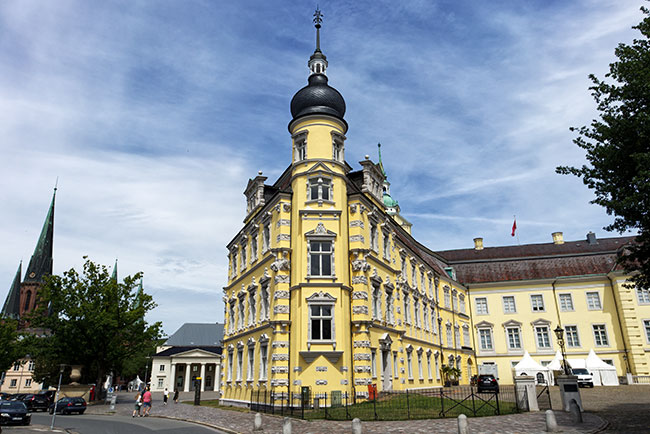
Architecturally, different parts of the castle stand out
One of his successors, Duke Peter Friedrich Ludwig, had a classicist wing built from 1817 onward, featuring spaces for the library and court kitchen, as well as two covered structures (remises) for carriages and coaches. The interior rooms of the castle were also modernized. After a 1744 annex - the "Kanzleiflügel" (Chancellery Wing), built under Danish rule for administrative purposes - was demolished in 1894, the castle took on its current shape and appearance. Following plans by architect Ludwig Klingenberg (who also designed Bremen’s Landgericht building at Domsheide), a new wing was added that stylistically complemented the existing Anton-Günther Wing. The grand Neorenaissance hall dominating the interior of this wing was enriched by several ceiling paintings from Arthur Fitger, an artist and poet who died in 1909 in Horn (now part of Bremen). His grave can still be found at Riensberg Cemetary.
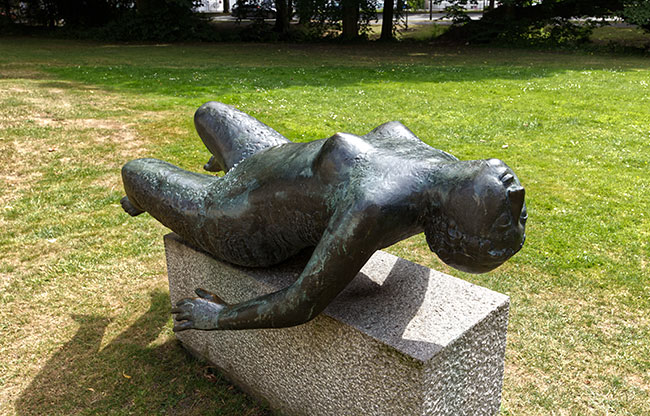
Art not inside but on the castle
The elegant exterior of the Renaissance-style castle, with its Rococo façade elements, continues inside. Not only are several representative rooms preserved in their historical furnishings with art objects and paintings, but since 1923, the castle has also housed the "Landesmuseum für Kunst und Kulturgeschichte Oldenburg" (State Museum for Art and Cultural History). In addition to the historic rooms, the museum displays around 800 cultural-historical exhibits and a collection of decorative arts at this location, including items from the former Kunstgewerbemuseum (Museum of Decorative Arts).
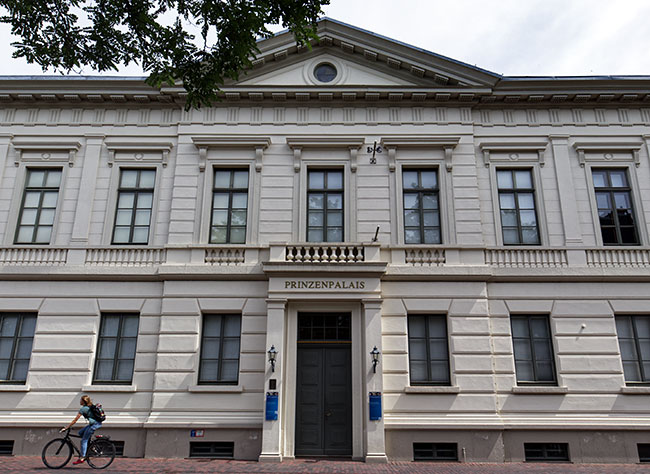
The Prinzenpalais, colloquially called a "feudal hut for some youngsters"
Other locations of the Landesmuseum include the nearby two-story classicist Prinzenpalais (Prince’s Palace), built between 1821 and 1826 by Duke Peter Friedrich Ludwig for his grandsons - hence its name. Also within sight is the Augusteum (1867) on Mühlenhunte, which today houses the "Galerie Alte Meister" (Old Masters Gallery), showcasing works by European painters from the 15th to 18th centuries.
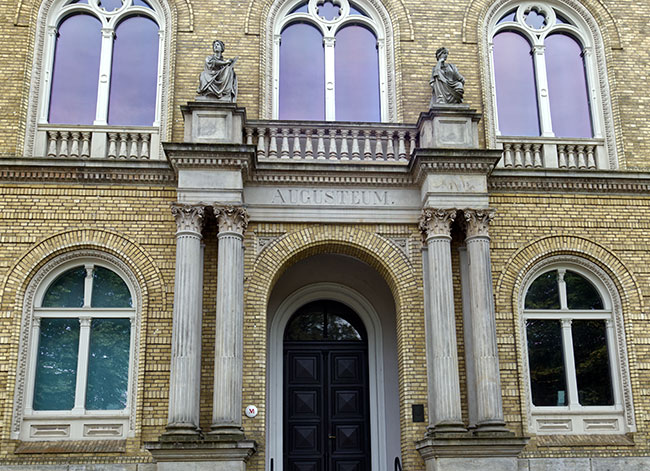
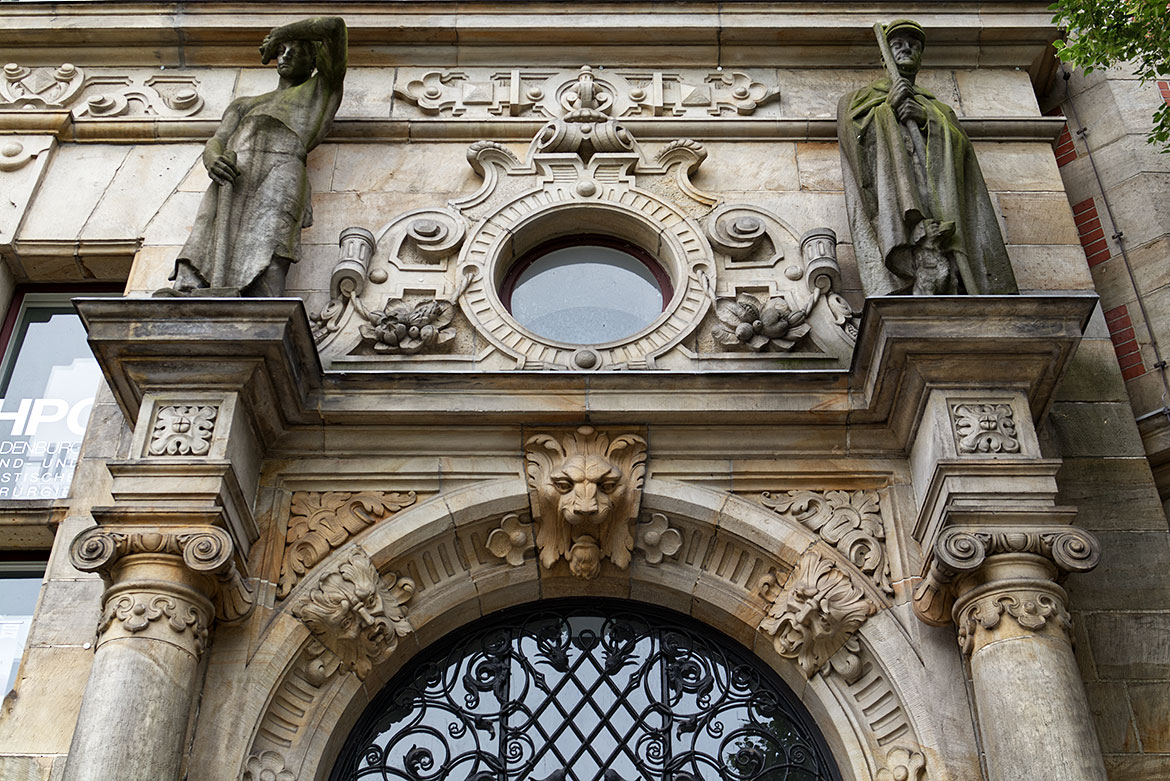
Entrance portal of the Augusteum. Is someone bored up there on their pedestal (right in the image)? Okay, "Old Masters" are probably not everyone's favorite
Three buildings for one state museum? That’s quite an opulent setup. Compared to this, Bremen’s Focke-Museum - its counterpart in the larger neighboring city - seems much more modest, at least in terms of space. But then again, Bremen never had art-loving dukes and grand dukes.
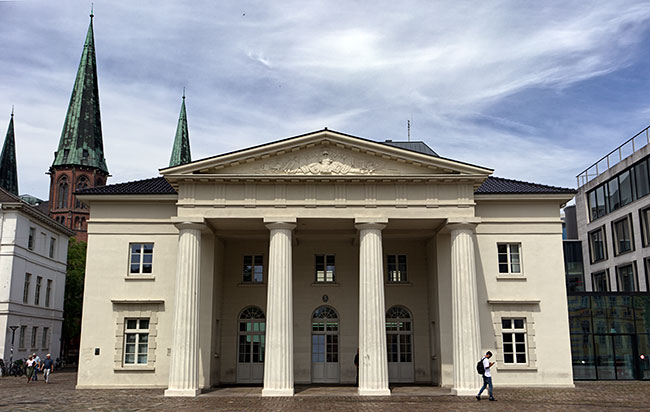
The Schlosswache (Castle Guardhouse) at the (former) border between Schlossfreiheit (Castle Freedom) and the bourgeois city, with St. Lamberti Church in the background
Of the three historic buildings on the opposite side of Schlossplatz from the castle, the Schlosswache stands out prominently. This two-story structure, built in 1839, served as a guardhouse for the castle and was also called the Hauptwache (Main Guardhouse). Like other guardhouses at city gates, it housed military personnel. Upon closer inspection, one can see a relief by Franz Anton Högl in the pediment of the portico with four Doric columns, reflecting its military use and commemorating Napoleon’s defeat.
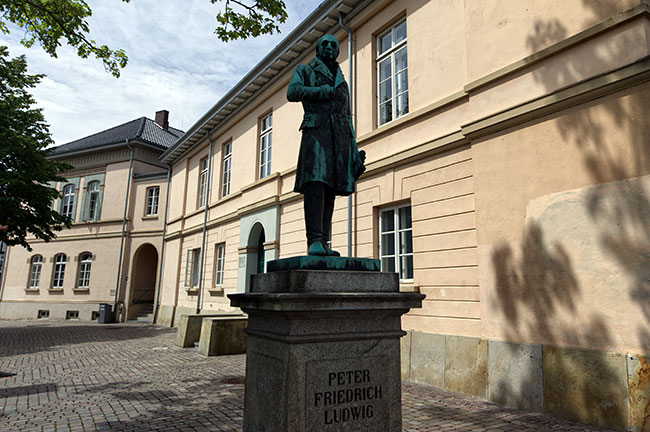
The statue of Duke Peter Friedrich Ludwig in front of classicist buildings
The two adjacent buildings are an 1817–1818 former government building and the former consistorial building of the princely church administration (1846–1847).
All these buildings stand at the boundary between Schlossfreiheit and the residential and commercial districts of the bourgeois city.


Map
Further information
Oldenburg Tourism
Lange Straße 3
26122 Oldenburg
Phone: +49 (0)441 36161366
Email: info@oldenburg-tourist.de
Opening hours of Oldenburg-Info in Lappan: Monday - Friday 10 AM - 5 PM, Saturday 10 AM - 4 PM
www.oldenburg-tourismus.de
State Museum for Art and Cultural History
Damm 1
26135 Oldenburg
Phone: +49 (0)441 40570400
Email: info@landesmuseum-ol.de
www.landesmuseum-ol.de
Open: Tuesday - Sunday 10 AM - 6 PM, closed on Mondays, Holidays as per website
Locations:
Schloss (Castle), Schlossplatz 1, 26122 Oldenburg
Prinzenpalais, Damm 1, 26135 Oldenburg
Augusteum, Elisabethstr. 1, 26135 Oldenburg
State Museum of Nature and Man
Damm 38-46
26135 Oldenburg
Phone: +49 (0)441 40570300
Email: museum@naturundmensch.de
www.naturundmensch.de
Open: Tuesday - Friday 9 AM - 5 PM, Saturday and Sunday 10 AM - 6 PM, closed on Mondays
Oldenburg City Museum
Am Stadtmuseum 4-8
26121 Oldenburg
Phone: +49 (0)441 2352881
www.stadtmuseum-oldenburg.de
The museum is closed for demolition and reconstruction until further notice: www.museum-findet-stadt.de
Horst Janssen Museum
Am Stadtmuseum 4-8
26121 Oldenburg
Phone: +49 (0)441 2352885
Email: info@horst-janssen-museum.de
www.horst-janssen-museum.de
Open: Tuesday - Sunday from 10 AM - 6 PM, closed on Mondays
Dangast
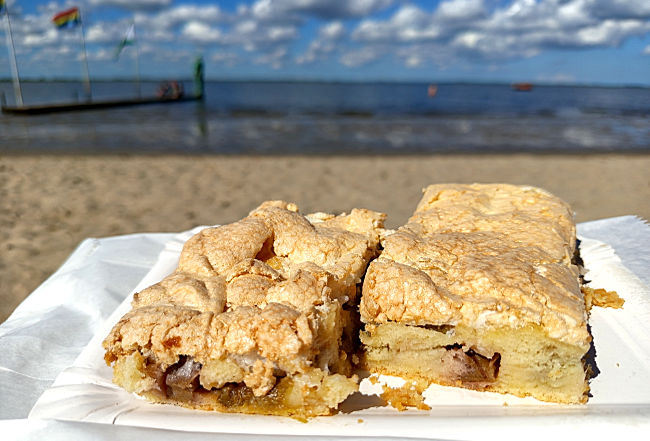
Dangast is located on the Jadebusen, a 190 km² sea bay at the North Sea created by storm surges. The town, which belongs to Varel, is a popular holiday and excursion destination. Campers will find two campsites right by the water here, and cyclists have excellent conditions for tours in the surrounding area. The rhubarb cake in the picture is a classic with a rich tradition at the old spa house, which has been run by a family business for several generations.
read more ...
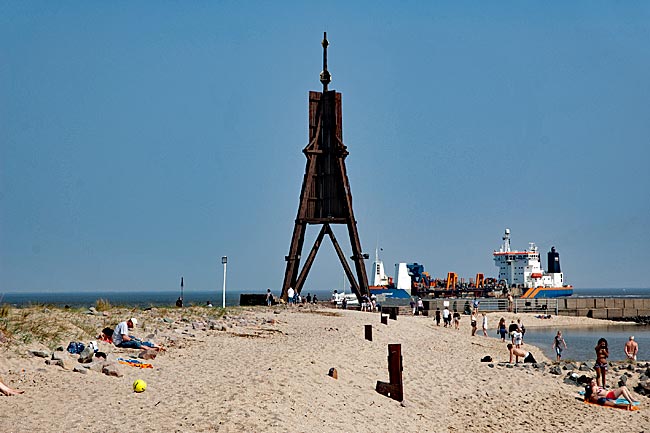
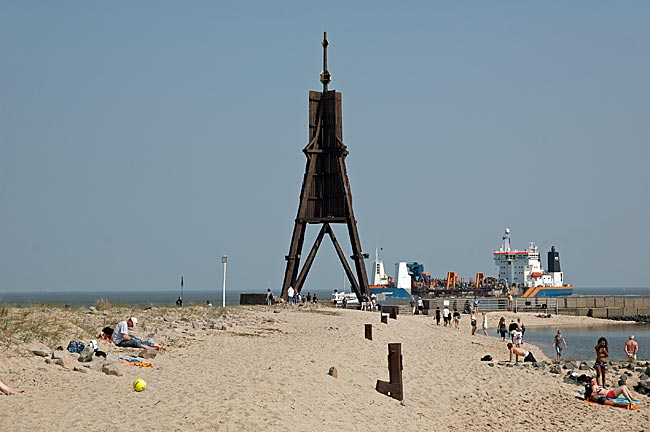
Cuxhaven - a day trip
Many people from Bremen consider the seaside resorts of Cuxhaven to be "their home beach." The coastal city at the mouth of the Elbe is easily accessible from Bremen by car via the A27, which passes by Bremen and Bremerhaven before ending in Cuxhaven. By train, the journey takes a bit longer with a transfer in Bremerhaven. However, even in the off-season, Cuxhaven with its seaside resorts is a great destination for an outing - for example, by bicycle.
read more ...
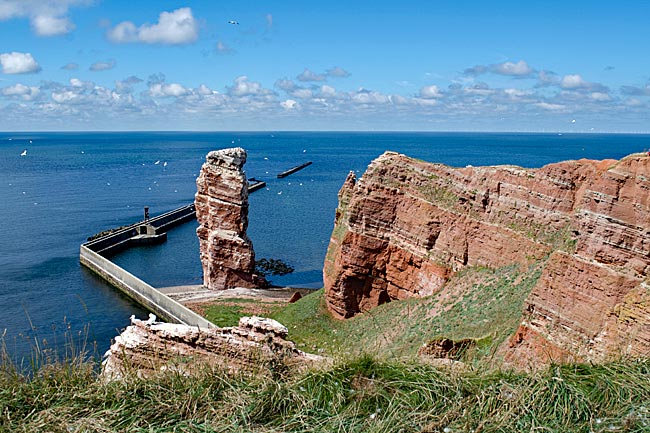
Heligoland - a day trip
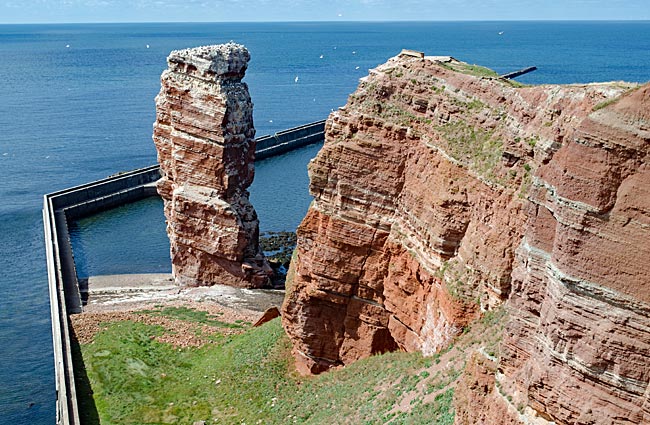
Germany's only supposed high-seas island is visited each year by thousands of tourists, most of them day-trippers in the warmer months. And yes, admittedly, Heligoland isn't located right in the vicinity of Bremen. However, it can be reached as a day trip from Bremerhaven and Cuxhaven - which is why we decided to visit.
read more ...
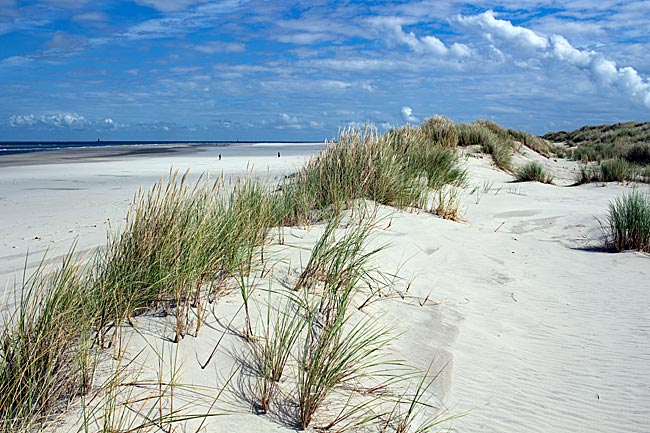
The East Frisian Island Wangerooge
Among the inhabited East Frisian Islands, Wangerooge is the second smallest (7.94 km²) after Baltrum and car-free, making a stroll through town much more pleasant compared to other islands, especially since distances can easily be covered on foot. From the small train station, you're just a few steps away from the heart of the village, quickly finding yourself in front of the unmistakable Old Lighthouse, which now houses the island museum. From 1856 to 1969, this lighthouse served as a maritime navigation aid, guiding ships safely along their routes. Just how far its light could be seen becomes clear when you climb the 149 steps to the lantern room—from there, you can step out onto the surrounding gallery and enjoy a sweeping view of the island and the North Sea.
read more ...
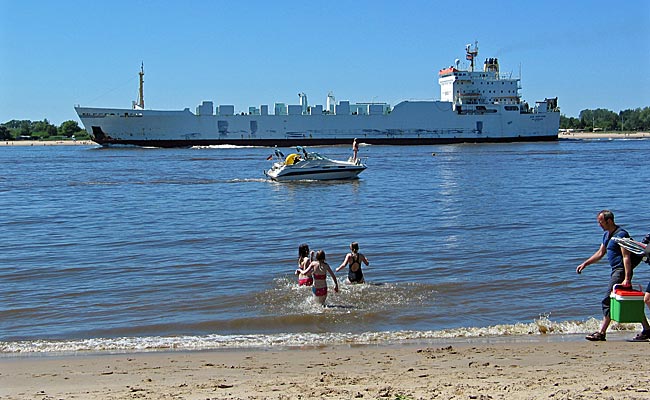
Brake & the River Island of Harriersand
As soon as the sun shines in spring and temperatures reach around 20 degrees, many Northern Germans are drawn to the North Sea coast for some water fun. The main thing is having a beach to lie on in the sun and sand for the kids to dig and build castles. That's why many people from Bremen also head north on warm weekends via the highway, packed with bags and picnic baskets ready for a day of beach vacation. But why travel far when the nearest beach is just around the corner - as a visit to Brake and Harriersand demonstrates.
read more ...
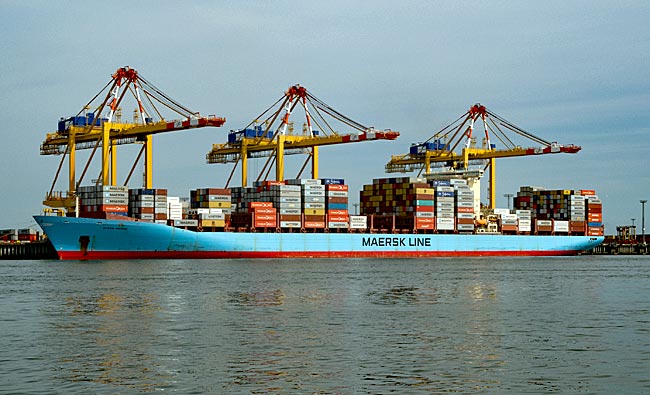
Bremerhaven - Überseehafen (Overseas Port)
In addition to the Old Harbor (now the Museum Harbor), which was the first to be built, other ports were later added. Adjacent to the New Harbor lies Kaiserhafen I, the first in a series of additional harbor basins. Even a glance into this initial section of the expansive port area reveals a different world of maritime activity - one of large ships. And we will see even larger ones along the five-kilometer-long quay on the Weser.
read more ...
Wilhelmshaven – Seaside City on the Jadebusen
It's hard to imagine Wilhelmshaven without its naval presence, as the city only developed after a naval base was built in the 19th century. Even today, the German Armed Forces (Bundeswehr) maintain a large base here with several squadrons. Yet, there is much more to discover in this port city beyond its military significance.
read more ...