
 exploring Bremen & its surrounding areas
 You are here: attractions in the city center
 The Schütting and beyond (1/2)
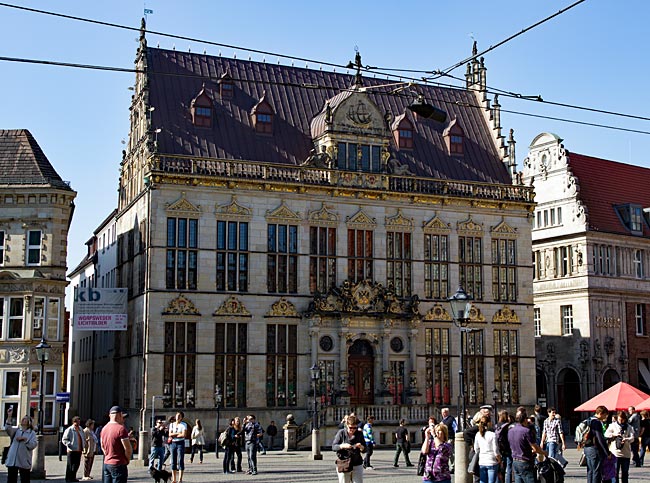
The Schütting at the market square; to the left, the path leads into Böttcherstraße, and to the right, into Bremen’s oldest merchant street, Langenstraße
On the edge of the market square stands the Schütting, the house of the merchants, formerly a guild and banquet hall. Built between 1537 and 1538 by an Antwerp architect in the style of Flemish Renaissance, this structure is the second Schütting to stand here. The east gable, created in 1565 by a Bremen stonemason, has remained almost entirely in its original form. A redesign of the market-facing facade in 1595 introduced stylistic changes toward Weser Renaissance.
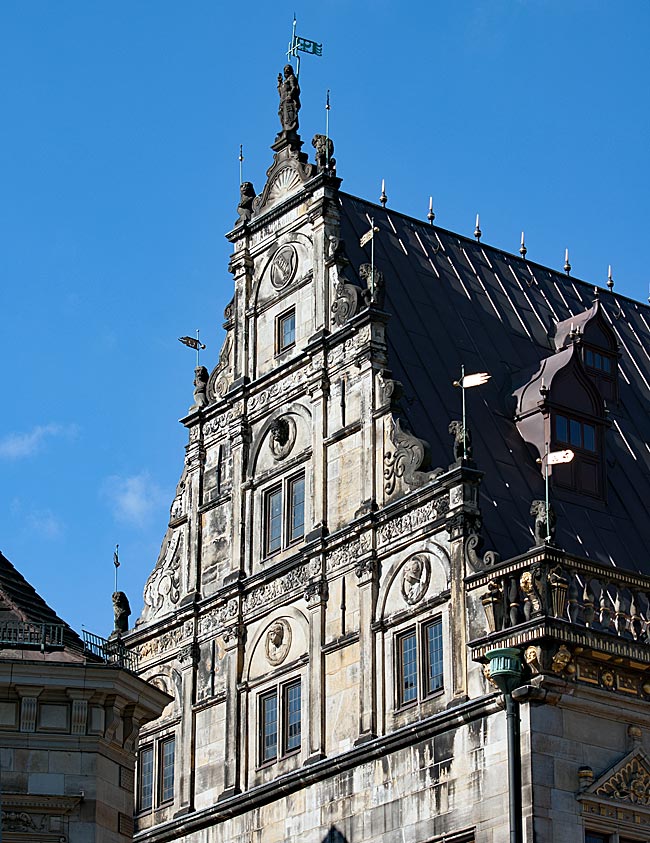
View of the east gable
The elegant appearance of this new building, with its decorative elements, surpassed the splendor of the still-Gothic town hall at the time - likely irritating the council members. The merchant guild and city council had long been embroiled in rivalries, so the Schütting’s deliberately chosen location, directly opposite the town hall, symbolized the merchants’ defiance toward the city council.
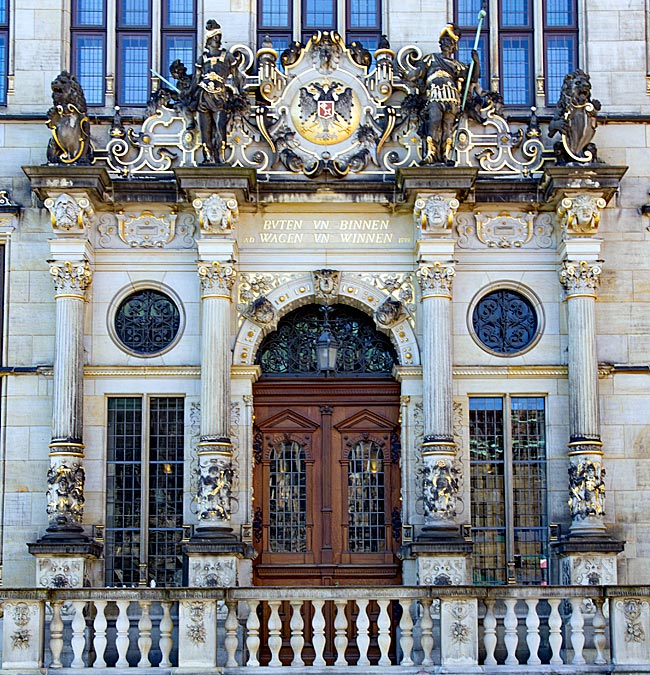
The grand portal of the Schütting on the market square
After multiple modifications to the market-facing facade, the entrance was moved to the center of the building between 1895 and 1899. In 1896, it was enhanced with a grand portal featuring a double staircase. Above the entrance portal stands the phrase attributed to Mayor Gildemeister: "Buten un Binnen, Wagen un Winnen" ("Outward and inward, dare and win"), a guiding motto of Bremen’s trade for centuries. Since 1849, the Chamber of Commerce has been headquartered in the Schütting, along with the "Club zu Bremen" on the ground floor. In 1944, the interior was completely destroyed by fire, leaving only the outer walls standing. During its reconstruction, completed in 1955, only minor changes were made to the market-facing facade compared to the original architecture.
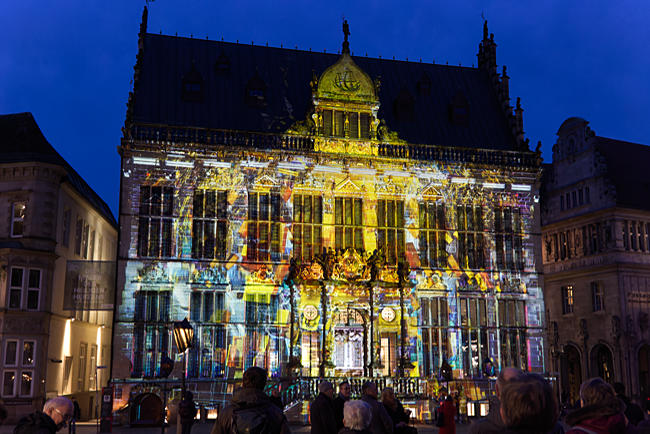
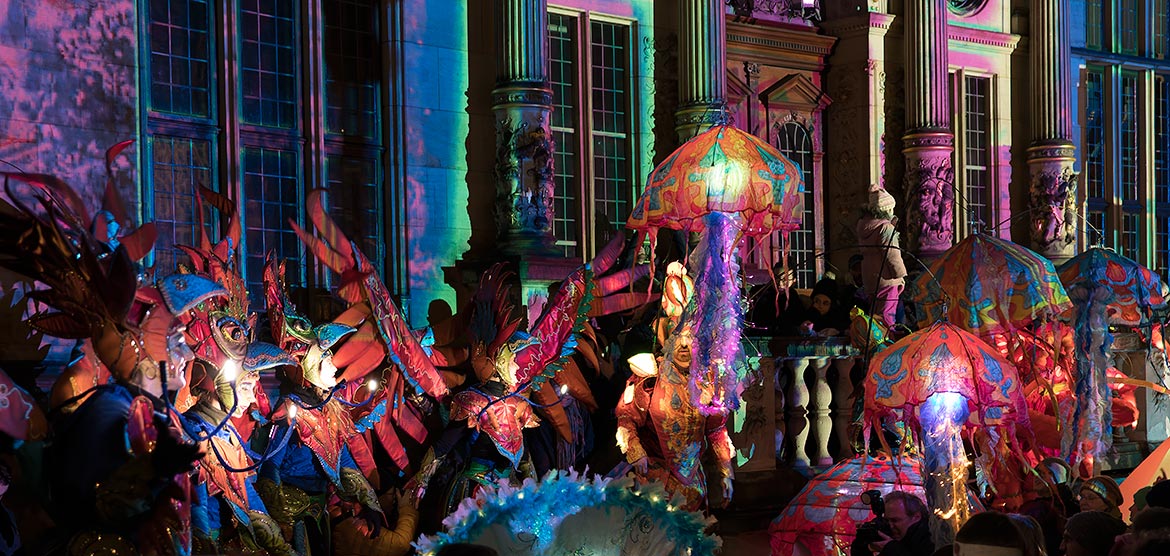
The Schütting as a projection surface for impressive video art with musical accompaniment as part of the "Lichter der City"(Lights of the city) project in January 2025. The building was one of ten historic structures showcased with artworks (mostly static images) for 15 days after dusk - well worth seeing.
The small, rather unassuming alleyway to the left of the Schütting (which has been under monument protection since 1973) leads to Böttcherstraße, one of Bremen’s most beautiful streets. However, before exploring Böttcherstraße, the street "Hinter dem Schütting" (behind the Schütting), which crosses the aforementioned alleyway, is worth a closer look - especially if you turn left behind the Schütting.
previous page
 next page
Map
Stadtwaage (City Weighhouse)
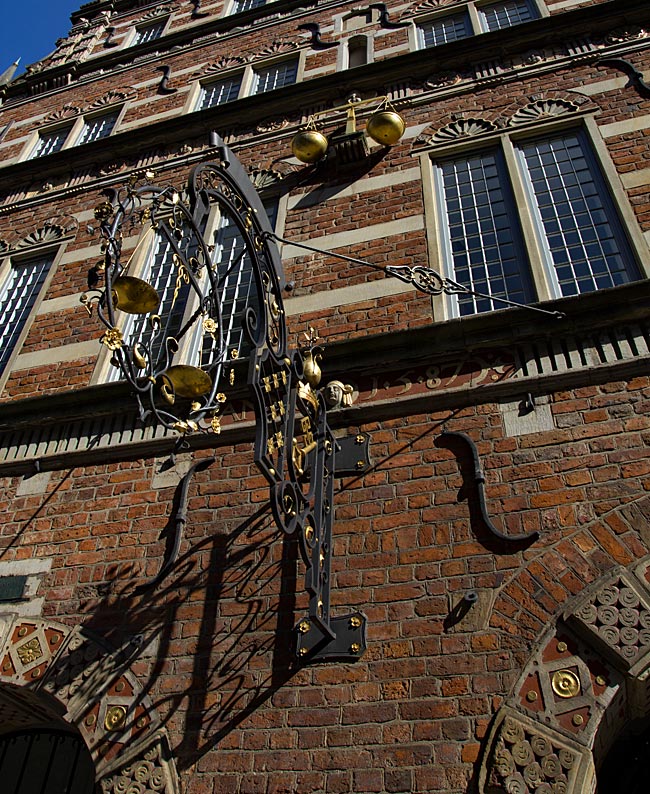
Located directly next to the market square and near the Schütting, the house of the merchant guild, stands the City Weighhouse on Langenstraße. During the Middle Ages, Langenstraße was one of Bremen's main thoroughfares and is considered the city's oldest merchants' street. The existence of a weighhouse in this street dates back to the year 1440. However, even before that, as documented since 1330, Bremen - like every major trading center in the Middle Ages - had a city weighhouse.
read more ...
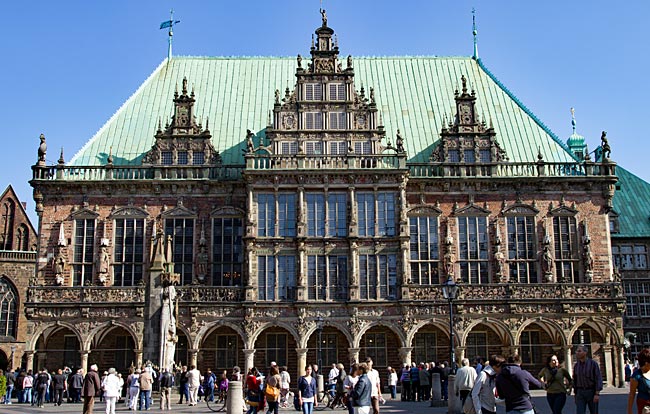
Town Hall
The original Old Town Hall on the market square was built between 1405 and 1412. Little remains of this rather plain late Gothic brick building today. The Renaissance façade that gives the UNESCO-protected structure its distinctive appearance was constructed between 1608 and 1614 by Lüder von Bentheim. Particularly above the arcades, it is lavishly adorned with various depictions from ancient mythology, which uniquely blend with Christian symbolism, Bremen city symbols, and other representations.
read more ...
Böttcherstraße
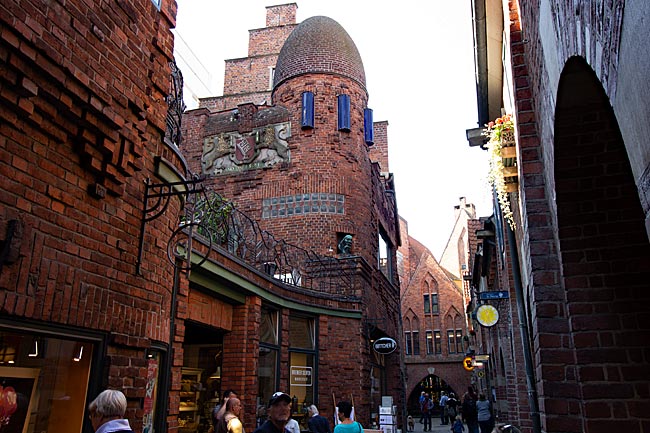
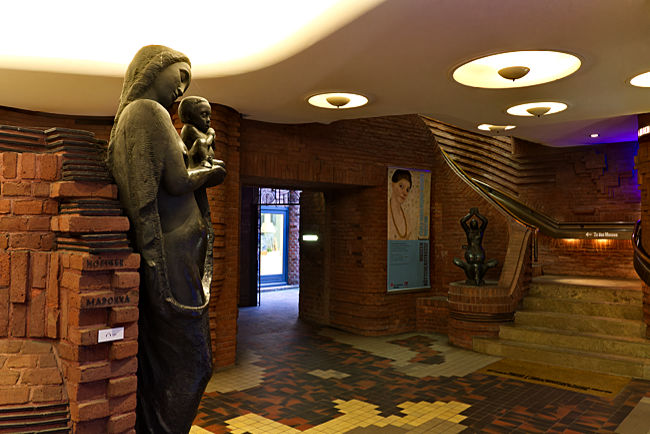
Since at least 1931, the name Böttcherstraße is no longer primarily associated with the scent of wood and the sound of coopers' hammers, but rather with a very special, almost enclosed ensemble of buildings. Over a length of just over one hundred meters, museums, open artist workshops, specialty retailers offering upscale goods, dining establishments, and a hotel create a unique atmosphere between brick and sandstone structures that is unparalleled in Bremen.
read more ...
Domshof
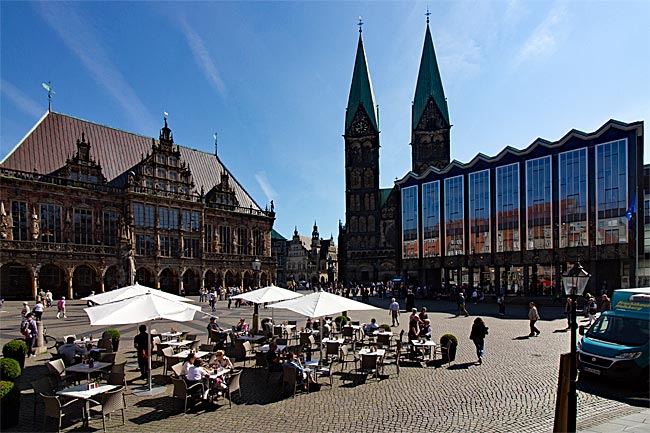
In the shadow of the cathedral (Dom) lies the Domshof. Until 1803, the cathedral precinct - and thus the large square - belonged to the respective bishops, then Sweden, and later the Electorate of Hanover, which ruled Bremen at times. The buildings, including merchant houses, along with the planting of numerous trees, made the Domshof one of the most beautiful squares in the Hanseatic city during the 18th and 19th centuries.
read more ...