
 exploring Bremen & its surrounding areas
 You are here: attractions in the city center
 Schlachte & Teerhof (2/2)
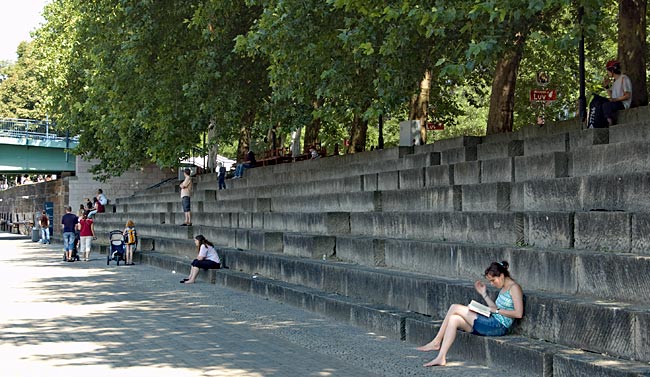
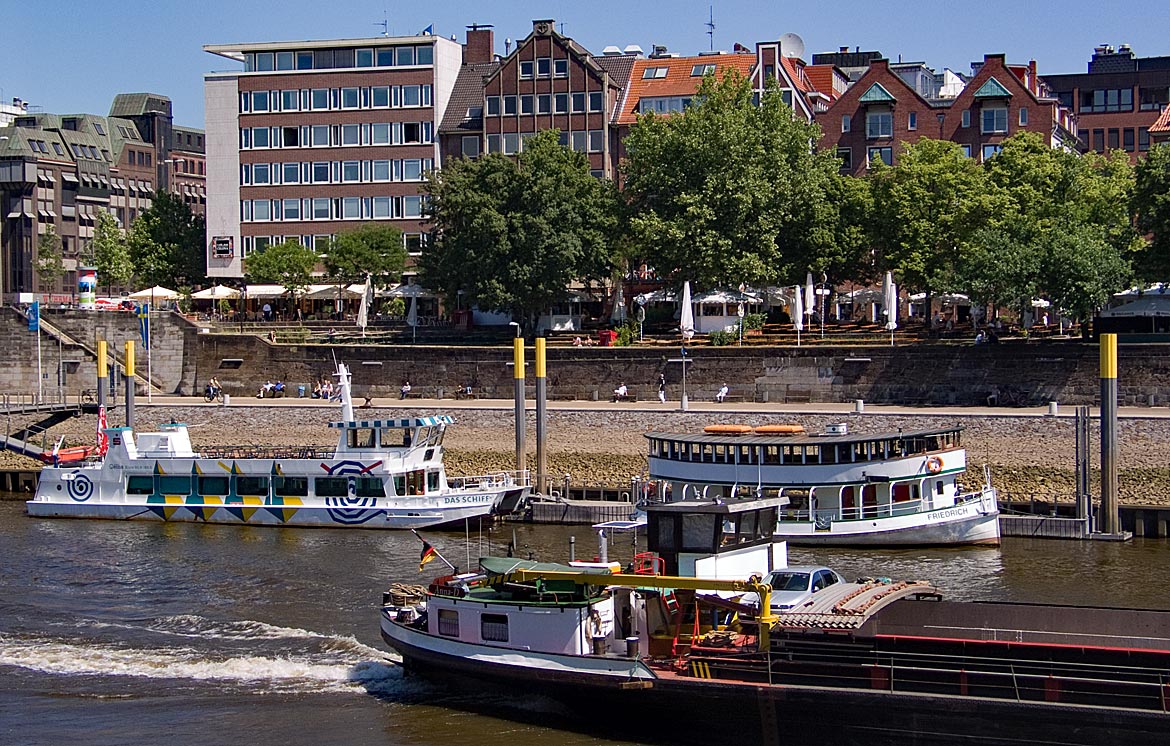
For a spontaneous relaxation at Schlachte
In late October 2016, the Martinianleger once again gained an addition. The bark "Alexander von Humboldt," which was launched in 1906 at the Bremer Weser shipyard (later "AG Weser"), permanently docked as a restaurant and hotel ship next to the Pannekoekschip Nelson on its own pontoon. The former lightship was decommissioned in 1986 and subsequently served, among other things, under green sails as an advertising ship for Bremen's traditional beer "Beck’s," which is brewed just across from Schlachte on the opposite bank of the Weser.
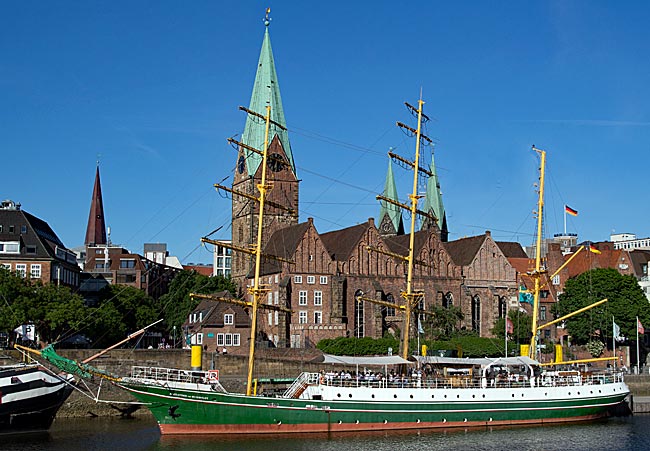
The Alexander von Humboldt at Martinianleger in front of St. Martini Church
Behind the landing stage stands St. Martini Church. This late Gothic brick building is one of the oldest churches in the Hanseatic city. The history of the parish dates back to the 13th century, and the oldest part of the church, located near the tower, also originates from this period. The 60-meter-long structure, which has been a protected monument since 1973, was almost completely destroyed by bomb hits on October 5, 1944. Fortunately, the outer walls remained standing, and new church life eventually resumed between them from 1952 to 1960.
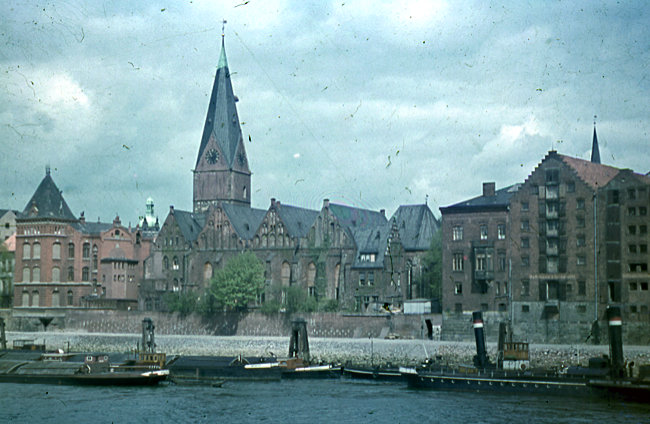
View of Schlachte with St. Martini Church and warehouses in May 1944. Archive image
Those who feel like crossing to the other side can walk across the scandalous - because exorbitantly expensive - Teerhof Bridge from Schlachte to the developed river peninsula Teerhof. Here, you will also find the Weserburg | Museum of Modern Art and the Society for Contemporary Art (GAK). For those interested in contemporary and modern art, this is one of the first addresses in Bremen.
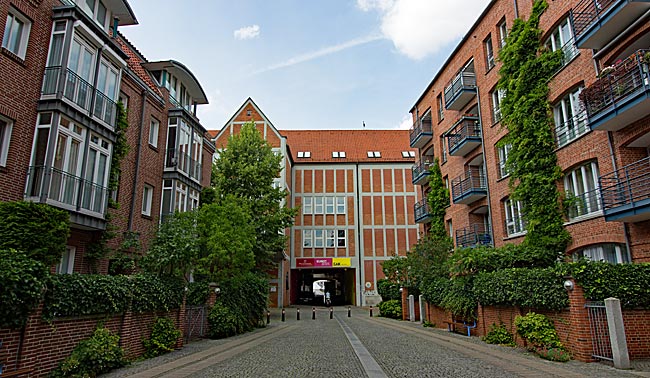
On Teerhof: In the concluding older building complex, art enthusiasts will find a good starting point
In the Middle Ages, the path to the city led past Teerhof because it was the only bridge over the river. In the 14th century, as maritime trade gained importance - Bremen had been a member of the Hanseatic League since 1260 with occasional interruptions - shipyards and craft businesses were established on Teerhof. The name "Teerhof" comes from the frequent use of tar (in german Teer) to seal cracks and planks in shipbuilding or repairs, as well as in the preservation of ropes and cables.
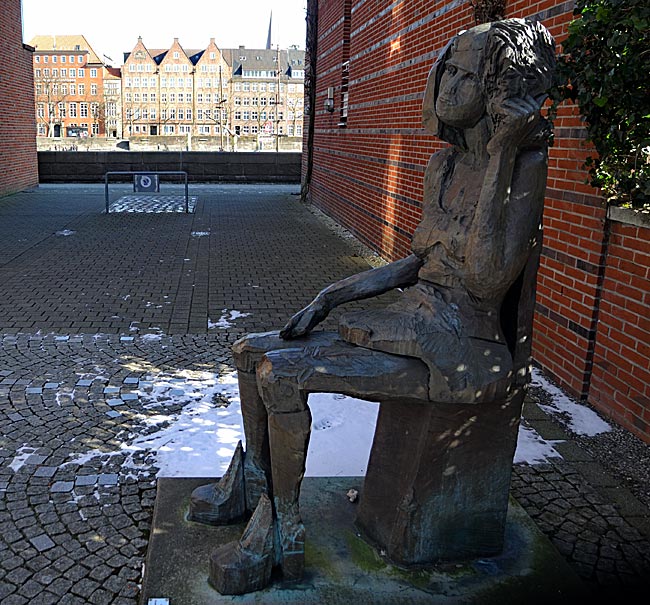
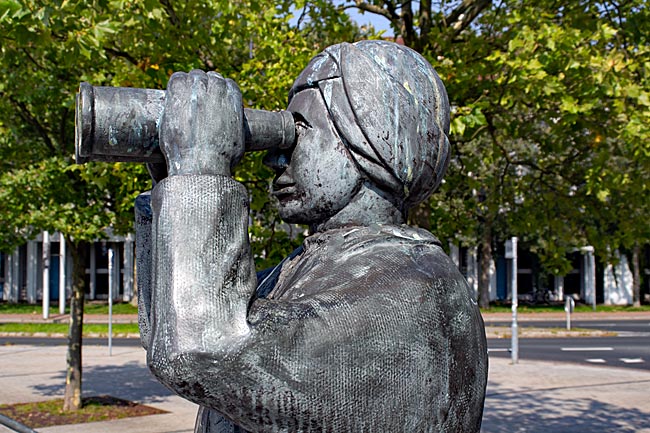
The bronze sculpture "Großes Mädchen" (1999) by Klaus Effern is just one of many artworks on Teerhof; in the background, you can see the houses along Schlachte
In 2007, during construction work on Teerhof opposite Martinianleger on the other side of the Weser, interesting historical artifacts from Bremen's past were uncovered. Remains of the "Braut" (Bride) and various everyday objects appeared in the excavation pit. The defensive tower was built between 1522 and 1531 as a bulwark against enemies who increasingly appeared at Bremen's gates. With a later added turret, the "Braut" measured 55 meters, making it the third-tallest tower and structure in the city after the towers of the Cathedral and Ansgari Church. When the defensive tower was no longer needed for its original purpose - since Bremen had expanded and the tower now stood far from the city limits - it was used as a storage facility for gunpowder and other explosive weapons until, on September 22, 1739, during a thunderstorm, lightning struck the turret. The explosion at half past one in the morning killed 32 people and sent burning debris flying across the Weser to the Cathedral, setting parts of the Old Town ablaze. When the fire was extinguished, a sixth of the city had been reduced to ashes. Of the 30-meter-wide "Herrlichkeitszwinger" (as it was actually called due to its location on Herrlichkeit - today Stadtwerder (a peninsula in the Weser with Teerhof as its tip), with its 4-meter-thick walls reinforced with iron bars, little remained, and it was never rebuilt. The "Braut" thus shared the fate of the "Bräutigam" (Groom), the Zwinger at Stephani Gate, which had also been blown up around 90 years earlier on August 4, 1647, following a lightning strike.
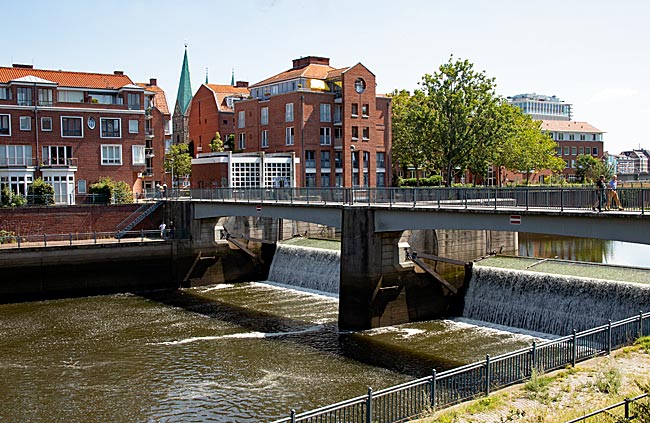
On the other side of Teerhof, a bridge spans the Kleine (small) Weser, which runs parallel to the Weser. A weir regulates the water level here, transitioning upstream into Werdersee
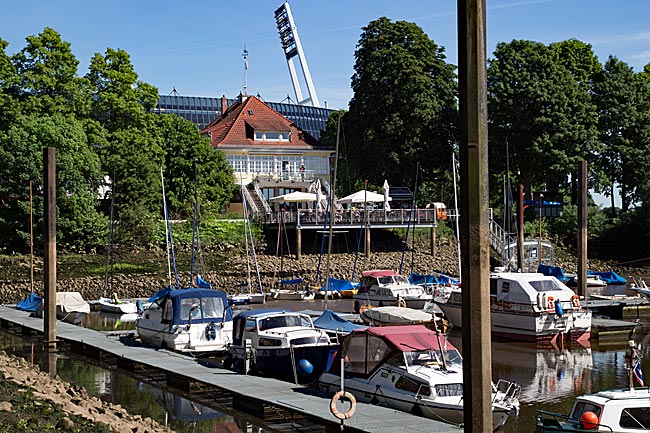
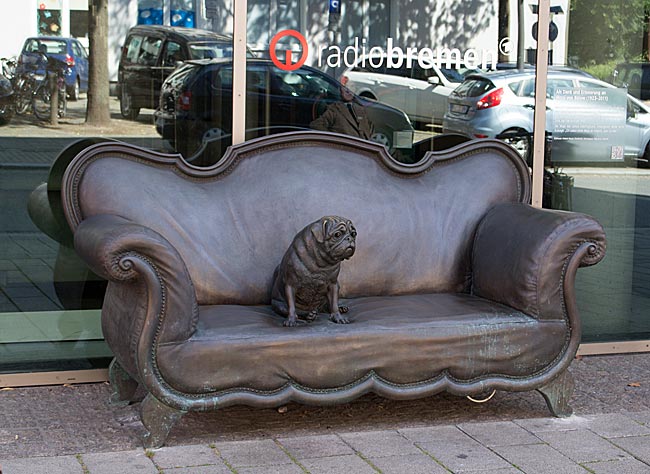
By the way, it is very pleasant to cycle or walk along the river upstream from Schlachte. The path leads past Weserstadion in Pauliner Marsch to the Weser weir in Hastedt; you can find a route description here. Downstream, on the promenade, the Untere Schlachte, you pass Bremen's youth hostel and can take a detour to the local radio station Radio Bremen in Stephani district to sit down with the pug on Loriot’s sofa.
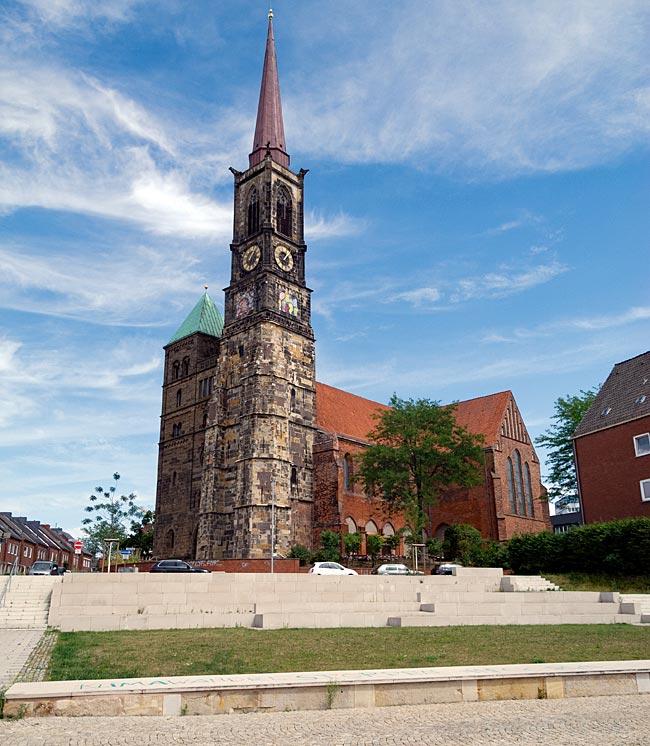
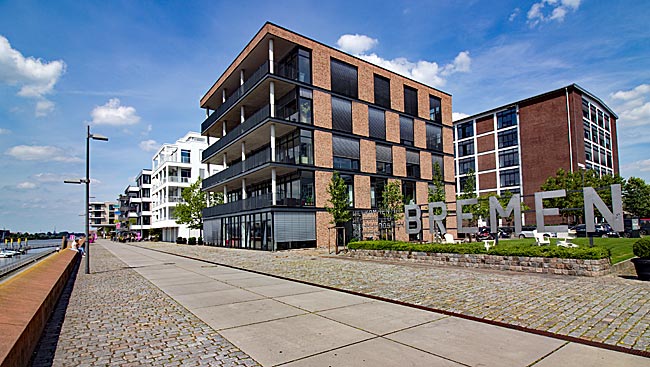
The Stephani church in Stephani district is one of Bremen's oldest churches and today serves as a cultural church. In 2018, directly along Untere Schlachte as part of a residential project, the Stephani terraces with views of the Weser were created. Here, remains of a 16th-century quay wall that were discovered were incorporated into the lower row of seats
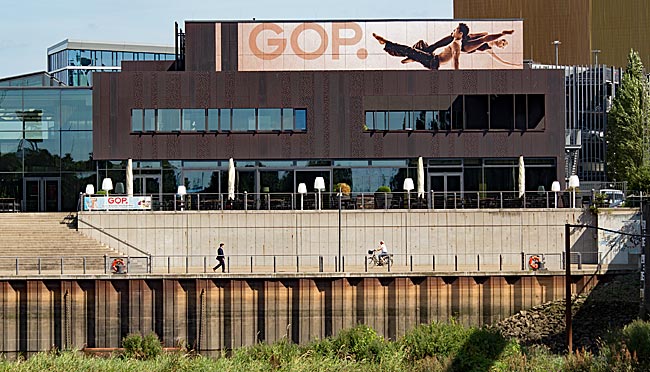
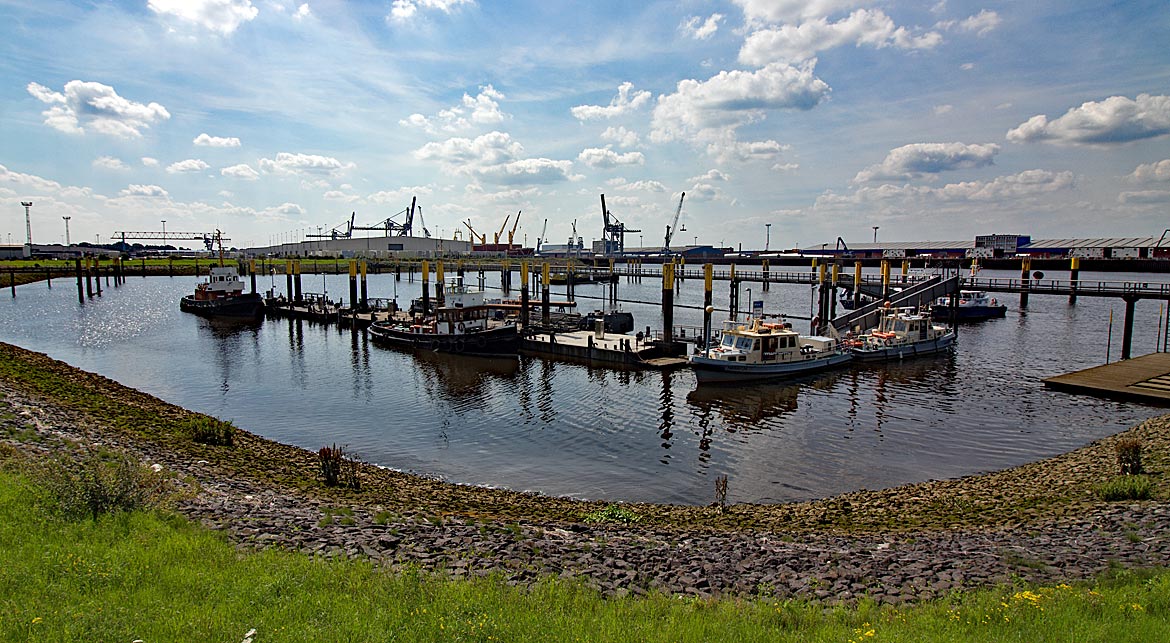
Not too far past the GOP Varieté Theater and the Steigenberger Hotel, the path currently ends somewhat abruptly at Übersee-Insel, a former industrial site in Überseestadt that is being redeveloped.
previous page
 next page
Map
Further information
www.schlachte.de
www.admiral-nelson.de
https://alex-das-schiff.de
www.weserburg.de
www.hal-oever.de
Round trip: from the city center to the Weser weir & back
Starting from Tiefer or Altenwall, the section of the Weser riverbank in front of Schnoor and diagonally opposite the DGzRS (German Maritime Search and Rescue Service), the Planetarium, and the Observatory on the other side of the river, a beautiful path for pedestrians and cyclists runs directly along the water upstream towards the Weser weir. After crossing the Weser weir, the return route takes you back via Stadtwerder.
read more ...
Stephani district
The Stephani district forms the western end of Bremen's Old Town and is considered the birthplace of the city, making it one of its oldest districts. As early as 1050, Archbishop Adalbert I founded a priory in honor of Saint Stephen. The priory, located on a dune, was called Steffensberg (mons sancti Stephani) in German translation. Adalbert's episcopal successors established a parish and built the first church in what was then also known as Steffensstadt (Stephen’s City).
read more ...
Überseestadt
When the overseas port (Überseehafen) needed to be renovated, it was decided in 1991 in the Hanseatic city to simply close the basin. In 1998, the overseas port was finally filled with sand that resulted from dredging operations in the outer Weser. Together with the also decommissioned but still existing Europa Harbor as a harbor basin, this formed the basis for the conceptual development and creation of today's Überseestadt.
read more ...
Through Woltmershausen to Lankenauer Höft
A truly maritime bike tour takes you from the Stephani Bridge through Hohentorshafen and Woltmershausen all the way to Lankenauer Höft, which is almost entirely surrounded by water. Behind the Höft, several ships, including the 1957-built tugboat Greif, are moored in an unrestricted section of Neustädter Harbor. This view of the harbor marks the end of this tour.
read more ...
A stroll through the Neustadt
The Old Neustadt was only properly established as part of the district in the 17th century. One reason for this planned expansion of the city was the increasing threat posed by advancements in weaponry. Remnants of the defensive walls built at that time still exist today as parks, but there is much more to discover, such as the Little Roland.
read more ...
Weser cruise from Bremen to Bremerhaven
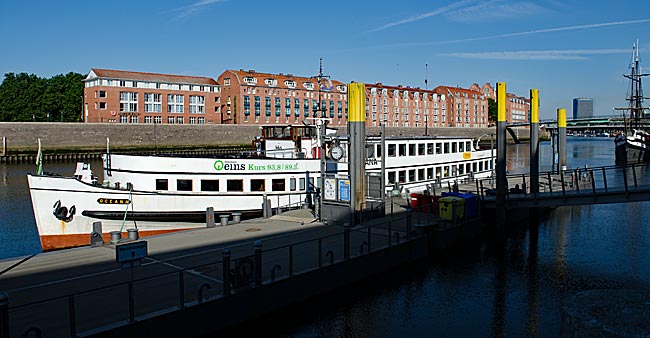
Of course, you can take a car for a visit to Bremerhaven from Bremen or board the regional train at the main station. However, with suitable weather and enough time, it is more interesting to cover the route on the Weser by ship. The shipping company "Hal över" operates the connection from May to September. The ship departs from the Martinianleger near the city center along the Schlachte. Those who wish can even take their bicycle with them; additionally, you can pre-book a breakfast onboard.
read more ...
Observatory & Planetarium
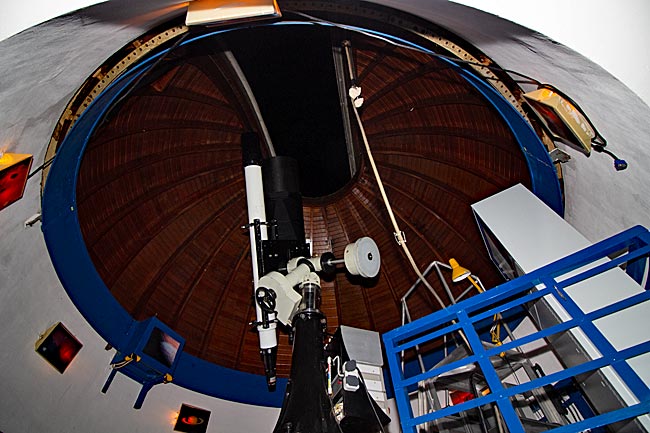
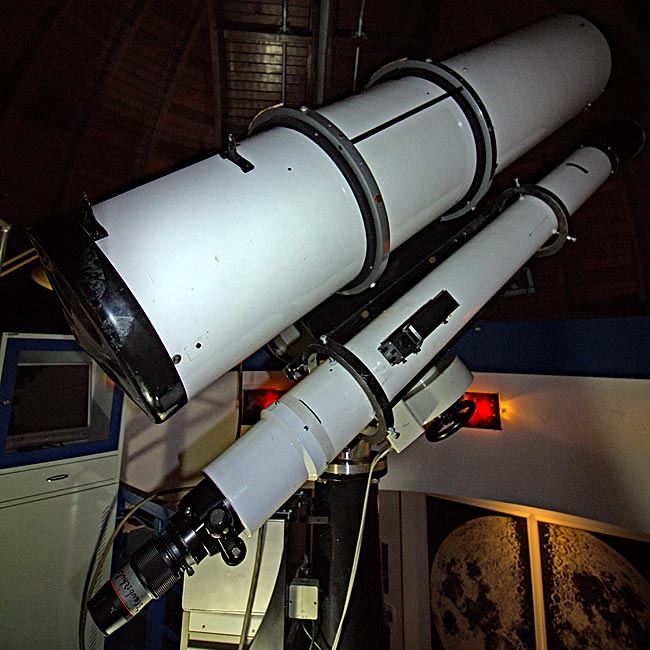
On selected days, visitors can also look through the large stationary and smaller mobile telescopes of Walter-Stein Observatory, which are set up on the terrace for the occasion. In the Olbers-Planetarium in the same building, members of the society give lectures on varying topics. Opened in 1952, the Olbers-Planetarium features a dome with a diameter of 6 meters, making it one of the smaller planetariums. It offers 35 seats (including wheelchair-accessible options) for visitors.
read more ...
DGzRS - The Maritime Rescuers
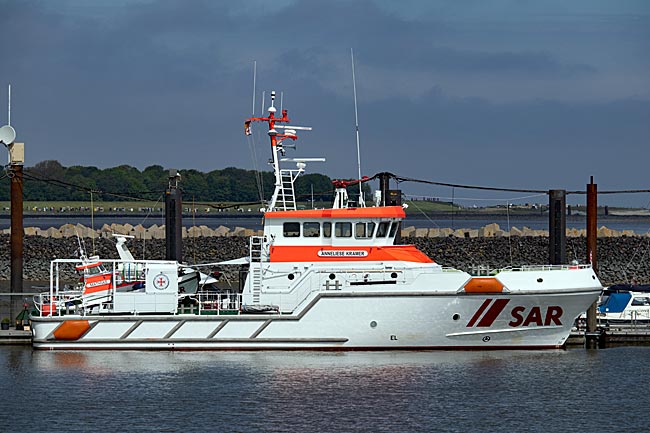
Anyone in distress at sea today has far better chances of receiving help, even out on the open water, thanks to modern technology and professionals who take care of it. Along Germany’s North and Baltic Sea coasts, these are primarily the approximately 1,000 full-time and volunteer men and women of the DGzRS (German Maritime Search and Rescue Service), also known as "The Maritime Rescuers." In 2020 alone, they conducted 1,720 operations and rescued 357 people. Since its founding, the organization has helped 86,000 individuals.
read more ...