

DISTANT PLACES
Travel tips by Bremen sehenswert far from the Hanseatic City of Bremen
Kos - The Greek Dodecanese Island
A Travel Guide
Fortress near Antimachia
Approaching from the city of Kos, the narrow road turns left just before reaching the village of Antimachia. The path leads through an almost deserted, hilly landscape where you can occasionally catch a glimpse of the nearby airport's runway, until the road finally ends at a dusty parking lot in front of the long, imposing outer wall of the fortress.
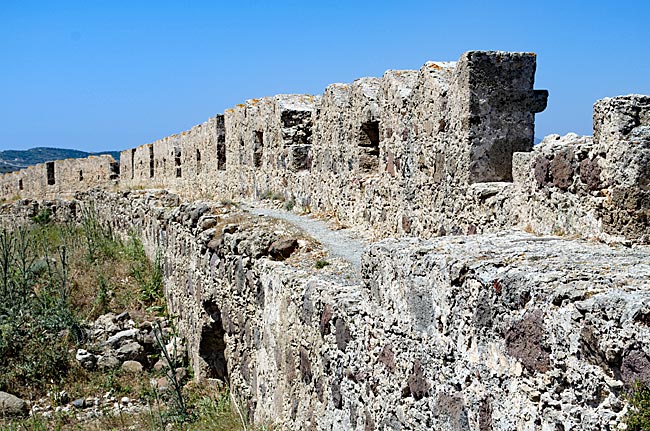
View of the outer wall with parapet
A fortress already existed at this strategically advantageous location - 170 meters above sea levelduring the Byzantine era; however, the current fortress was likely constructed by the Knights Hospitaller between 1337 and 1346 under Grand Master Helion de Villeneuve (similar to the Fortezza of Neratzia in Kos town). While it served as a defense against pirates, the far greater threat came from the Ottomans, who attacked the fortress several times and besieged it for 23 days in 1457. The walls held firm, but the structure was so badly damaged by an earthquake in 1493 that the then-Grand Master of the Hospitallers, Pierre d’Aubusson, considered building a new one elsewhere rather than repairing the existing one. Ultimately, however, he had the damage repaired within a year.
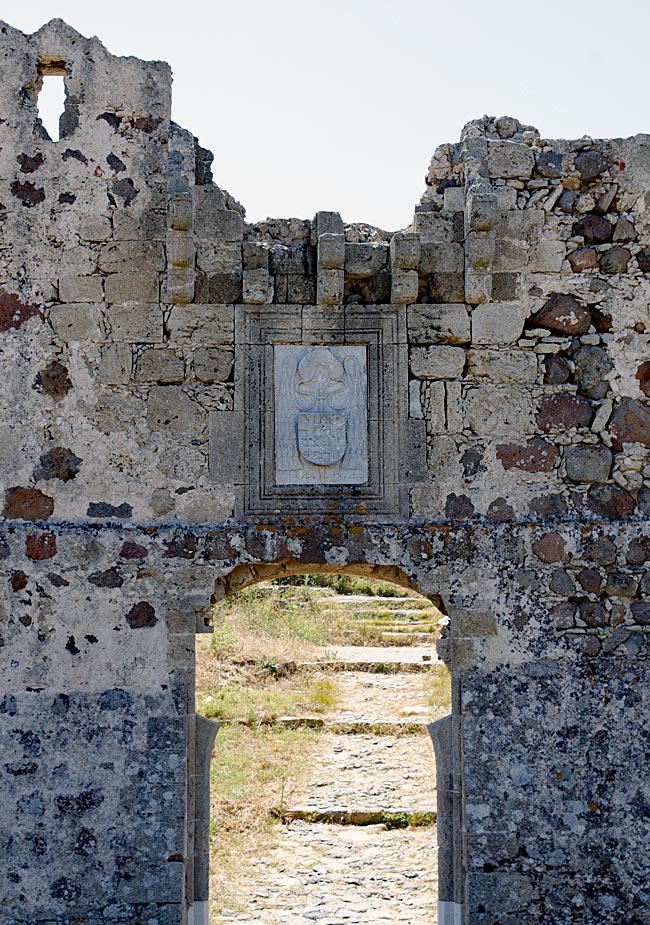
Entrance gate with the coat of arms of Grand Master Pierre d’Aubusson
Even today, the coat of arms of Grand Master d’Aubusson adorns the masonry above the inner gate, which is now accessible via a wooden staircase. Below it, the date 1494 marks the period of the former leader of the Knights. Recesses in the massive stone blocks in the passage still show traces of where the gates were hung and the locking mechanisms; however, no part of the original wooden gates remains.
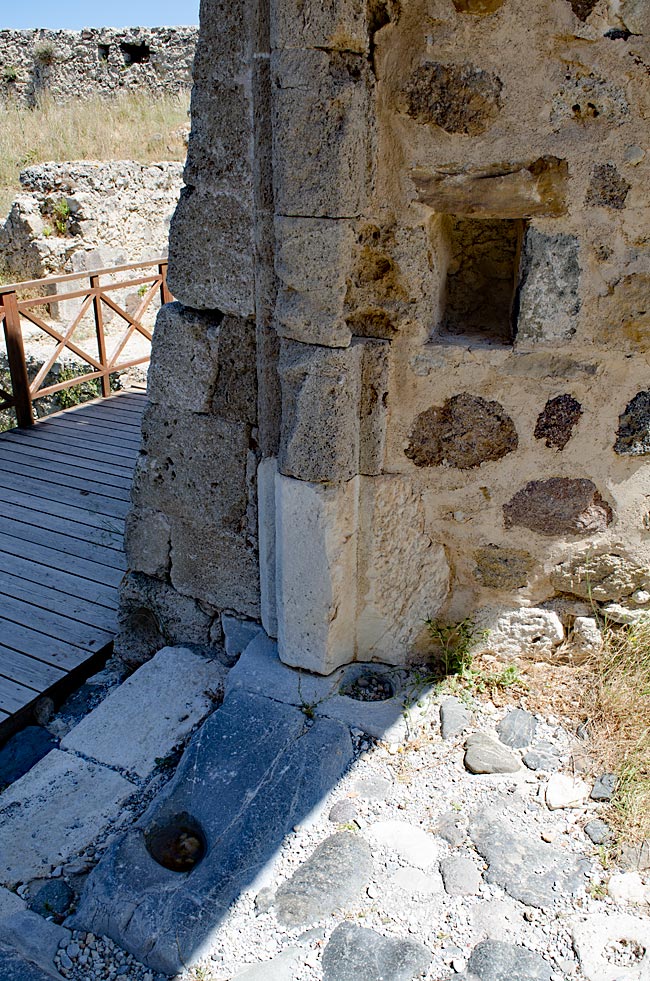
Traces of gate hanging and locking
The horseshoe-shaped bastion, which today serves as a protective wall around the gate, was constructed in the early 15th century by one of d’Aubusson's successors, Grand Master Fabrizio del Carretto.
After the surrender of the Hospitallers at their headquarters on Rhodes to Suleyman the Magnificent and the subsequent withdrawal of the Knights from Kos, Sultan Suleyman took power here in 1523. In the following years, the Ottomans continued to use the fortress as a stronghold.
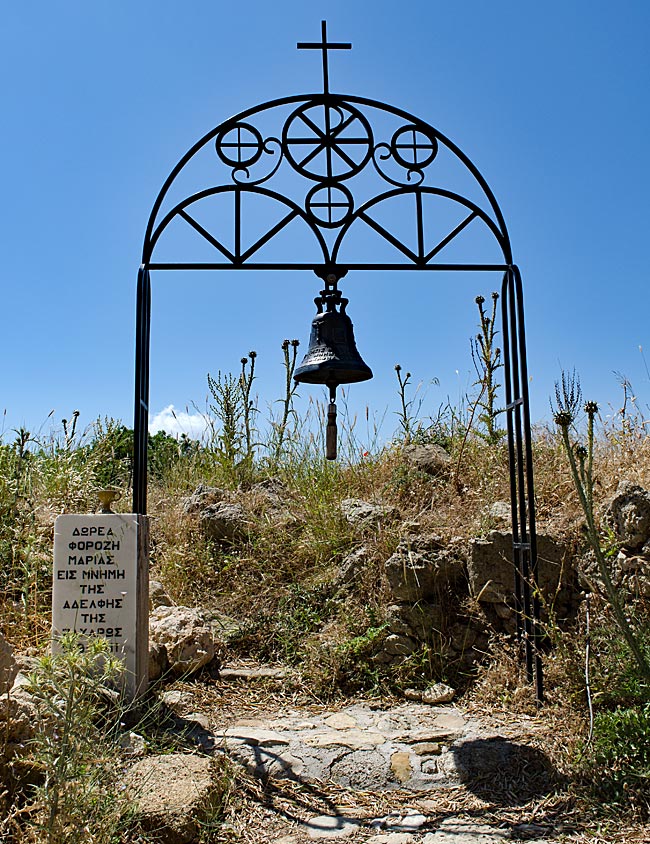
Bell
Beyond the well-preserved, crenelated outer wall, the inner complex appears more or less as a collection of ruins. Only a few structures remain, including two churches, such as the small one dedicated to Saint Nicholas. It is assumed that the date 1520 set into the masonry of this house of worship refers to its year of construction - completed just before the Muslim takeover.
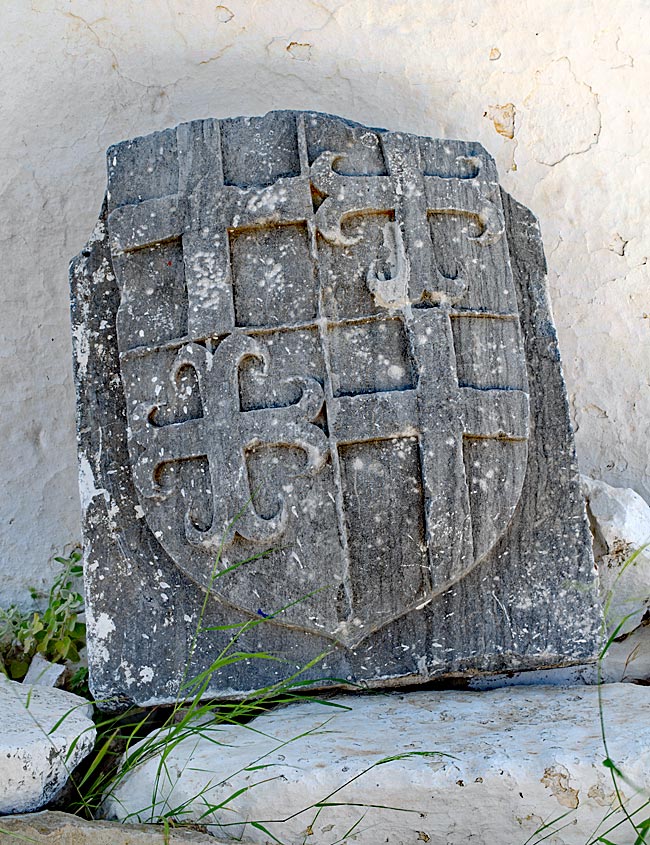
A stone coat of arms of the Hospitallers leaning against a church wall
After the fortress was completely abandoned in the 19th century, an earthquake in February 1926 destroyed all buildings behind the massive walls except for the churches.
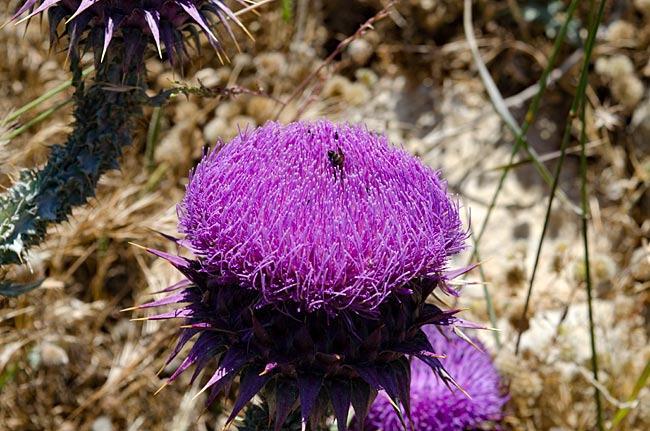
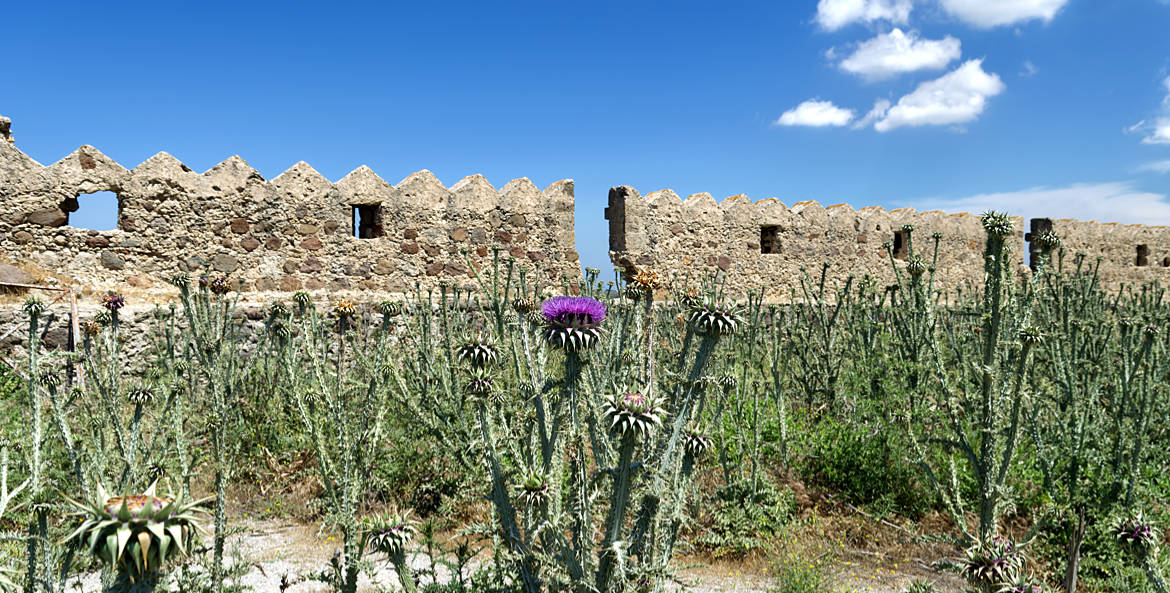
Blooming thistle
Today, vegetation thrives among the piles of stones and ruined walls, including extremely prickly thistles over a meter high. These bloom beautifully in violet in late May, providing a splash of color to an otherwise rather bleak area that is open to the public free of charge.
A true highlight is the view, especially of the south coast lying far below - including the larger port town of Kardamena and the islands rising from the sea, such as Nisyros. The visit to the old fortress is worth it for this view alone. However, visitors with children should keep a close eye on their little ones, as safety barriers are relatively sparse.
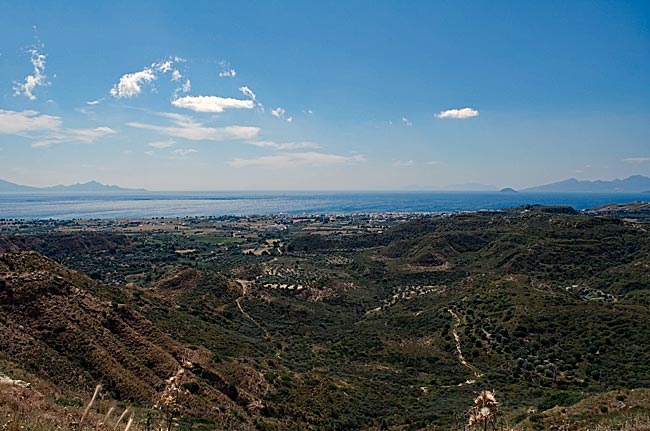
View of the south coast with the town of Kardamena and neighboring islands
previous page
 next page
Read more about Kos: The table of contents
Map
UNESCO World Heritage Site on Rhodes
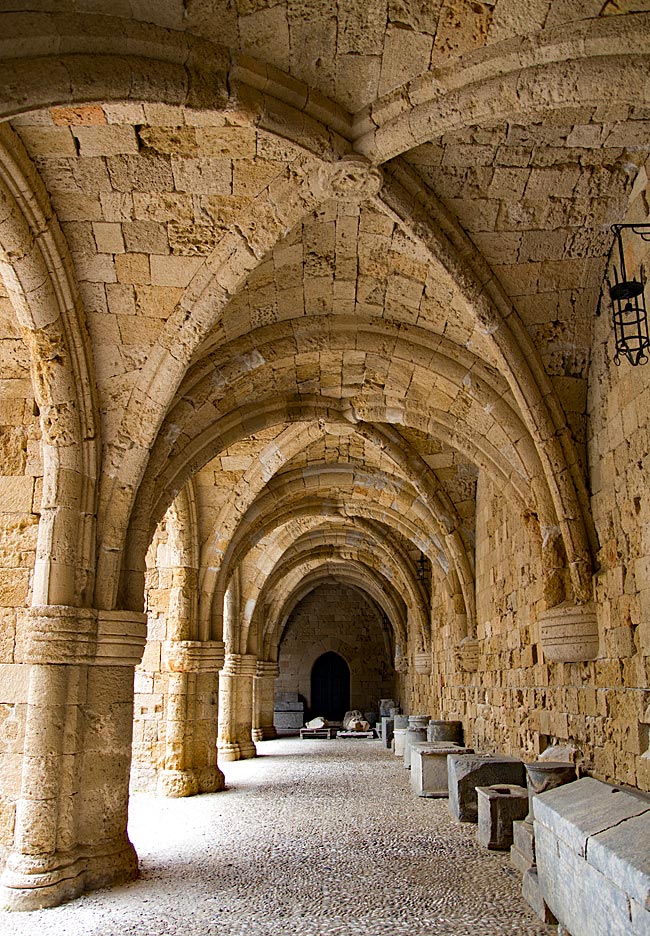
A journey through the historic Old Town of Rhodes
Relics from various eras - ranging from antiquity to the period of Italian occupation - can be found almost everywhere on the island. Many have left their mark; in some places, they must be sought out, while in others, they appear in clustered, fascinating density and variety. Yet, nowhere else on the island are these traces as prominent as they are in the city of Rhodes. It is not for nothing that the historic Old Town was declared a UNESCO World Heritage site in 1988.
read more about Rhodes Old Town ...
Symi
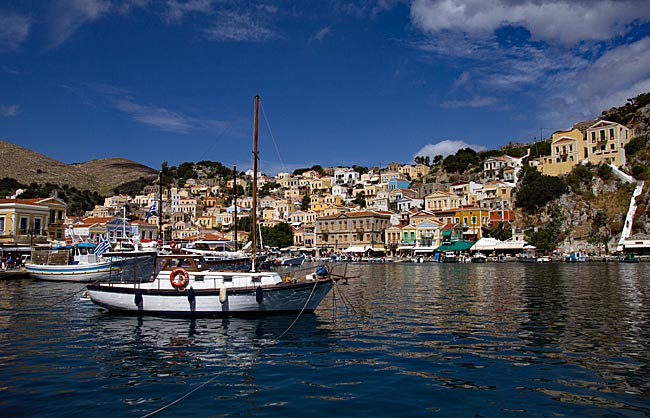
An excursion to the Greek Dodecanese island off the Turkish coast
A visit to this sparsely populated rocky island of about 60 square kilometers, with its namesake picturesque harbor town, is part of the standard tour itinerary offered in many locations on the Greek island of Rhodes. From the main island, it takes ships approximately two hours to reach the port of the small island located 23 kilometers north of Rhodes off the Turkish coast, which has belonged to Greece since 1947. As more of the Greek coast recedes into the distance to the port side, the ship draws closer to the Turkish shore; this part of the southern Aegean essentially connects Europe and Western Asia.
read more about Symi ...
The "Green" Island of Corfu
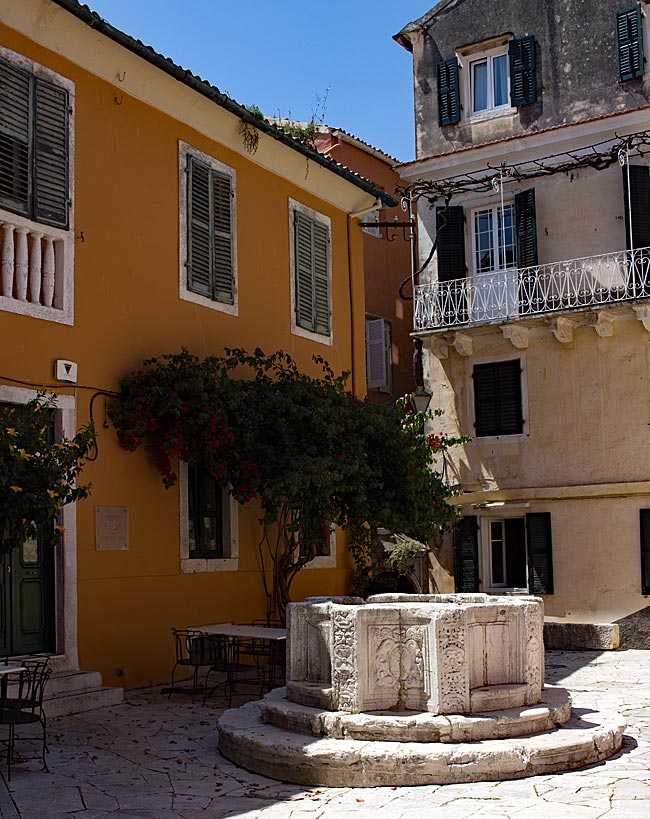
From the sights of the capital, Kerkyra, to the Corfu Trail
The Greeks call not only the city but the island itself Kerkyra. According to legend, it was named after the nymph Gorgyra (also known as Kerkyra), who was brought to the island by the sea god Poseidon. A legend, indeed. In fact, the name appears in a modified form, "Korkyra," on written records as early as 1200 BC. The current name, Corfu, dates back to the Byzantine era. Once an independent island and later the first Roman province of modern Greece, it became part of the Eastern Roman (Byzantine) Empire after the fall of the Western Roman Empire in 395 AD. On a rocky promontory jutting into the sea, the Byzantines built a fortress in the early 6th century and named the city emerging from this core "Koryfo."
read more about Kerkyra ...
Zakynthos
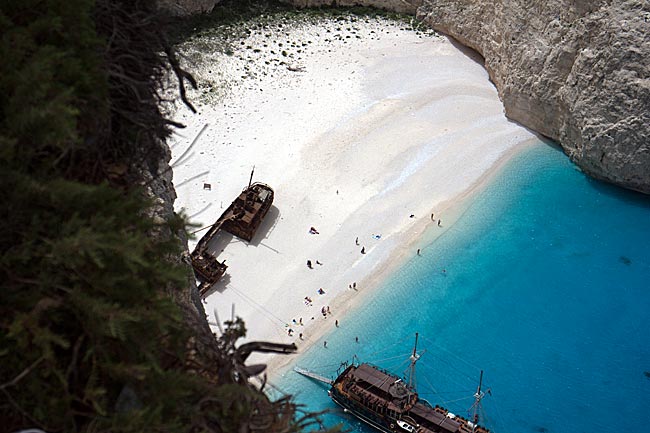
An island defined by the Caretta caretta
When searching for images of the 406 km² island online, one primarily encounters a very common recurring motif that has been captured from a similar angle by various photographers over the years: Navagio Bay on the northwestern coast. It's all junk, right? Well, that is a matter of perspective, and there are plenty of those during the season, whether they have a camera or not. The fact remains, however, that the rusting wreck of the motor vessel "Panagiotis" has become a landmark for Zakynthos.
read more about Zakynthos ...
More photos