exploring Bremen & its surrounding areas
 You are here: worth seeing in Schwachhausen district
 Schwachhausen district - "better to live strongly than house weakly (schwach hausen)" (2/2)
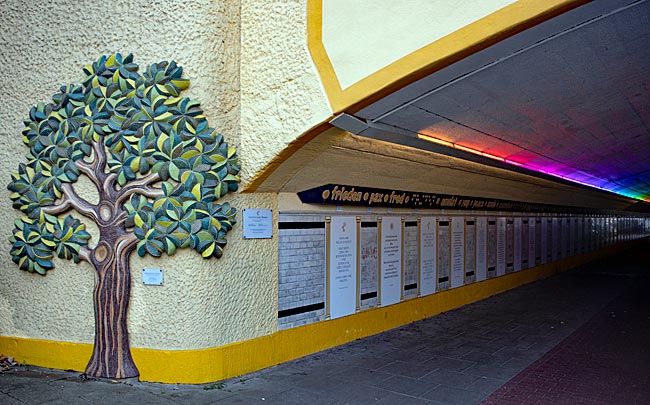
Left is the mosaic relief "Oak," Peace Tree from November 2, 2010, by Regina Heygster
"Never again war" should be the lesson learned from the two World Wars. In Bremen, the redesign of the Rembertitunnel at the end of Parkallee (near Slevogtstraße) into the "Friedenstunnel" (Peace Tunnel) set a symbolic mark - though according to the information board, it was specifically in response to the events of September 11, 2001, when the World Trade Center in New York became the target of a devastating attack. The initiator of the project was graphic designer and freelance artist Regina Heygster. From the "Interest Group Tunnel Project" initiated by her, the registered association "Friedenstunnel – Bremen Sets a Mark" was formed in 2003, which has managed the project ever since.
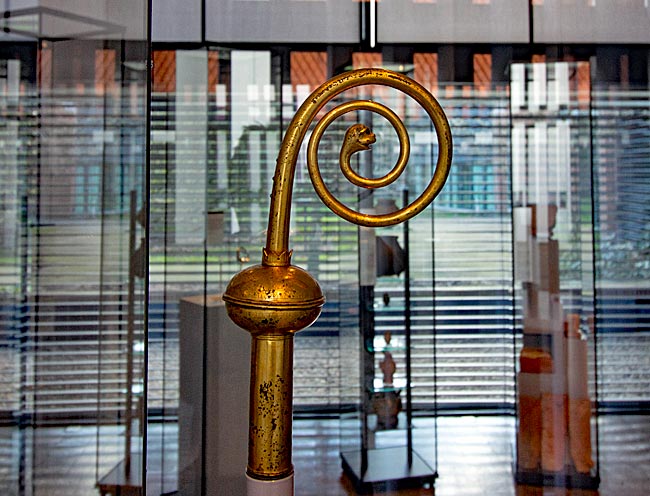
More art and culture can be found at the Focke Museum - the Bremen State Museum for Art and Cultural History in the Riensberg district of Schwachhausen - which is also mentioned earlier in the text. A curved bishop’s staff with a panther head from the 13th century, presumably found in the grave of Archbishop Gerhard II during excavations in St. Petri Cathedral, is now part of the Focke Museum's collection.
After years of preparation, also funded by donations, the Peace Tunnel was inaugurated in 2015. Several mosaics are embedded into the front sides of the tunnel, and 82 text panels featuring words from known and lesser-known people from many cultures and religions worldwide stretch along both walls of the vault, subtly lit and accented with multicolored LED lights. Since 2016, musical events have taken place regularly in the tunnel as part of the concert series "Peace Sounds in the Peace Tunnel," which is open and free to everyone. More about this art project at: www.friedenstunnel.de
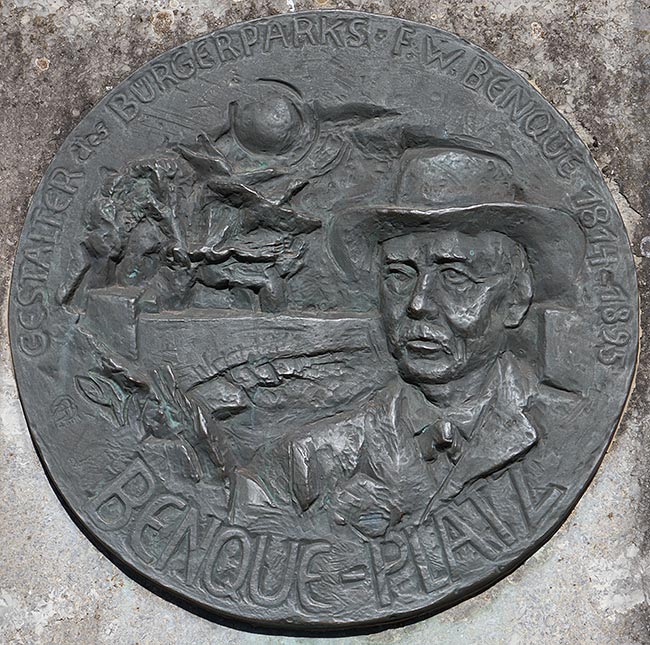
Memorial to garden architect Wilhelm Benque at Benque-Platz
Those who leave the Peace Tunnel - preferably by bicycle - at the Stern roundabout onto Wachmannstraße do not just end up in the district's most beautiful "shopping promenade" with many shops and dining options, but also on a busy premium cycling route between the train station and the university. The route passes by Benque-Platz, where a bronze monument was erected for the late garden architect Wilhelm Benque (who died at age 81) for his design of the nearby Bürgerpark - another "Benquestein" can be found in the Bürgerpark itself.
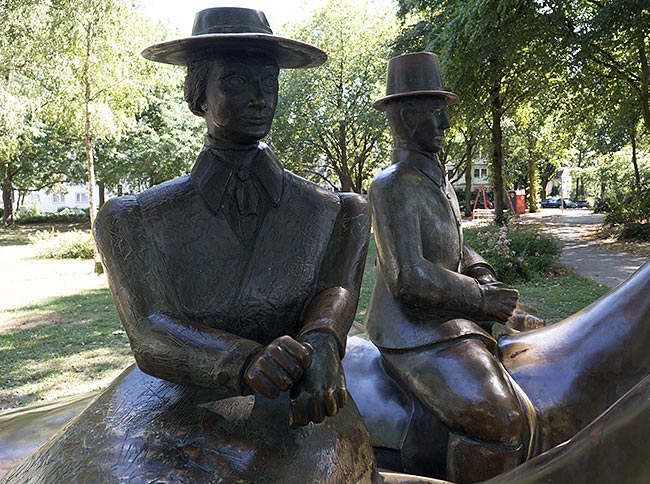
Monument to Countess Emma von Lesum, here with her brother-in-law
The subsequent section of the cycle route, several hundred meters long, often causes cyclists and drivers to break into a sweat due to the lack of space on the asphalt during peak times. Our destination is Emma-Platz, a small green area with a row of shops on Emmastraße (also a tram stop for line 6). From a tourist perspective, there isn't much to see here, but one encounters a piece of Bremen’s history symbolized by a bronze sculpture by the Bremen artist Thomas Recker, depicting Countess Emma von Lesum and her brother-in-law, Duke Benno.
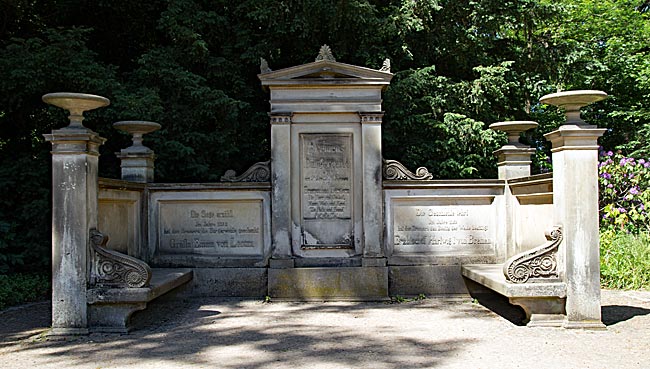
Emmabank at Lake Emma in the Bürgerpark
The Countess, who died on December 3, 1033, came from the Saxon noble family of Immedinger and married appropriately for her status. Thus, the estate of Lesum (today a district of Bremen) came into her possession. The wealthy noblewoman was regarded as a great benefactor of the church and was revered as a saint beyond her death. In the Bürgerpark, Lake Emma is named after her, and in 1868, architect Heinrich Müller erected a stone bench at the lake as a memorial to her. According to a legend that exists in various versions, Bremen's citizens owe her the gift of the "Bürgerweide" (citizens' pasture), a now-paved square at the north exit of the main station, where among other things, the "Freimarkt" takes place every October. Inscriptions on the bench (photo above) refer to the donation in 1032 and the confirmation of ownership by the citizens by Archbishop Hartwig I of Bremen in 1159. Read more about the Freimarkt and the legend here.
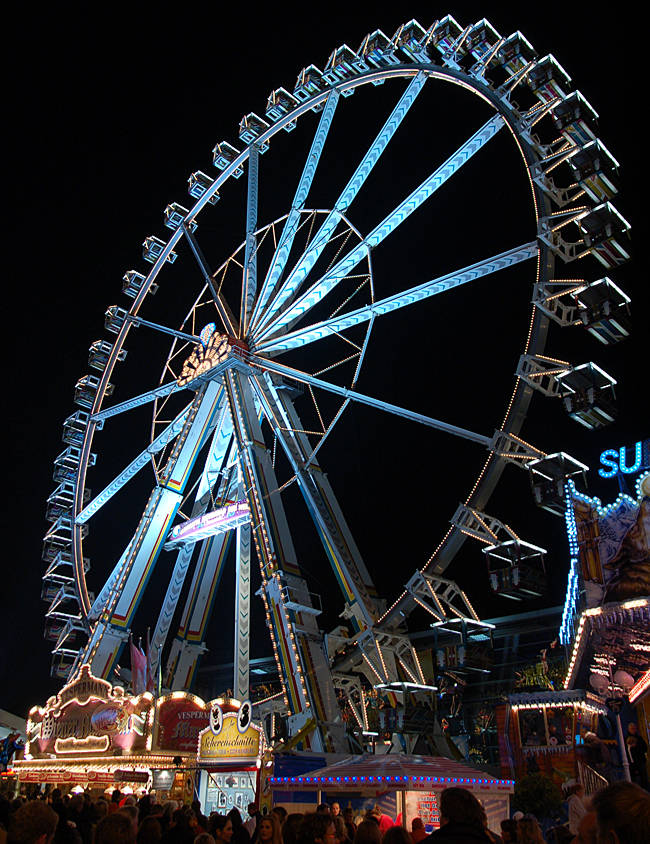
Ferris Wheel at the Freimarkt
When myths, legends, occultism, and superstitions lack facts and scientific explanations, they can drive people into delusional worlds; in reality, this can end fatally, as shown by the witch hunts fueled by the Catholic Church. It seems that quite a few people are still somewhat wary of Freemasonry today. This is despite the fact that the Freemasons do not try to remain invisible to the public, as evidenced by the two "Logenhäuser" (lodge houses) on Kurfürstenallee. It cannot be blamed on them if they are hardly noticed by many passers-by on the four-lane main road.
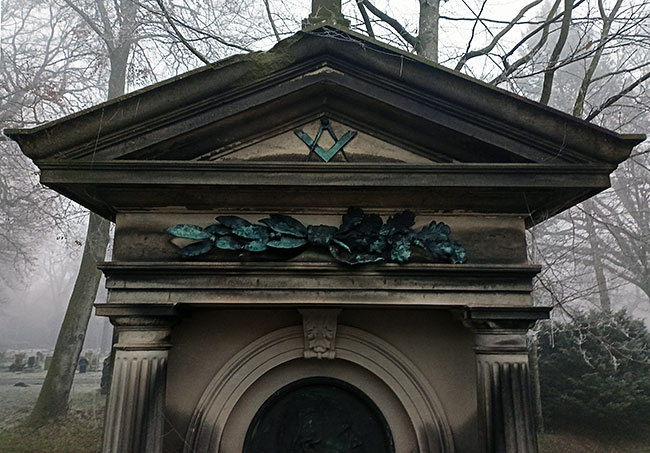
Compass and Square at First. Freemasons are not supernatural and are just as mortal as this burial site in the Riensberger Cemetery in Schwachhausen-Riensberg shows.
The symbolism on the facade of the larger lodge house already indicates who resides here. The compass and square are well-known symbols of Freemasonry and refer to the activities of, for example, master builders - in a manual sense, but also in the metaphorical sense as "masters" of all life (creation). In both cases, geometry plays an important role. In the Masonic lodges established starting in the 18th century, no subversive ideas from obscure secret societies were preached; on the contrary, through the cultivation of one's own being, they sought to positively develop society through their actions. This is evidenced by the basic ideals of Freemasonry: freedom, equality, fraternity, tolerance, and humanity. The fact that this initially takes place behind closed doors in a private circle is not a unique feature of Freemasonry today.
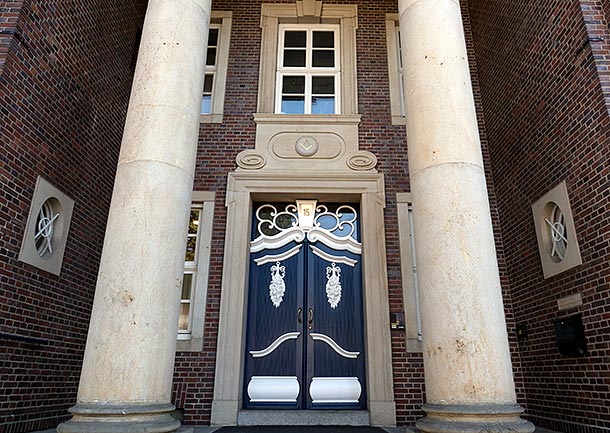
Lodge House on Kurfürstenallee, Number 15
People from all walks of life and different denominations have belonged to the Freemasons - and continue to do so today. Among them are well-known figures from science, such as Roald Amundsen and Alexander von Humboldt; artists like Goethe, Marc Chagall, or Peter Sellers; high-ranking politicians, such as former U.S. President Theodore Roosevelt and independence fighter and president Simón Bolívar. Are they all men? Yes!
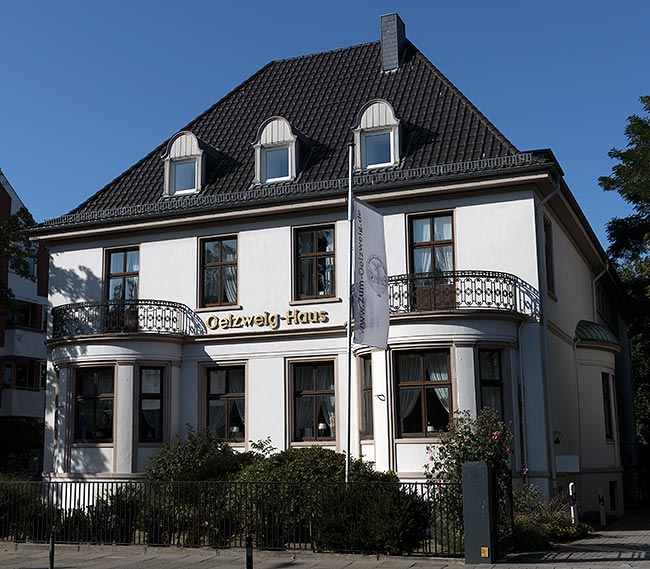
Oelzweig-Haus on Kurfürstenallee, Number 8
The Oelzweig-Haus on the opposite side of the street is the more visually striking one. The Bremen architects Hans and Heinrich Lassen were leading architects in the first half of the 20th century in the Hanseatic City; alongside many other buildings, they designed this grand bourgeois villa in 1911 for the manufacturer Gustav Louis Mundhenke (1869–1930).
However, the name of the house dates back to Bremen's oldest existing Masonic lodge, the "Zum Oelzweig" Johannis-Loge, founded in 1788. It has resided - along with several other lodges today - in these premises since 1965. During the Nazi era, however, lodges were banned and many dissolved.
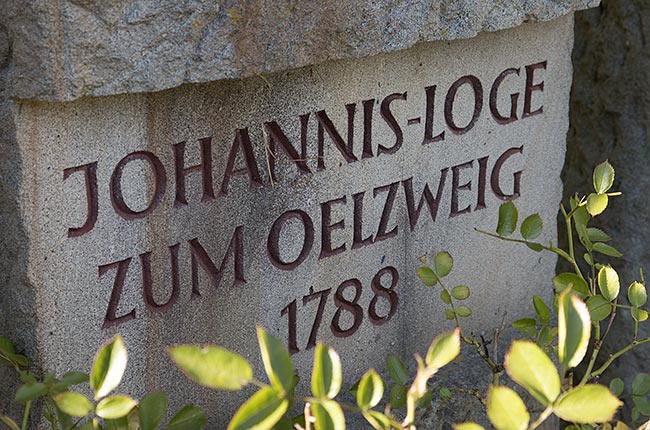
Bremen's oldest existing Masonic lodge
The interior of the lodge houses is not always closed to the public's eyes; there are frequently days when the doors are open for anyone to visit, often accompanied by guided tours and explanations. A visit is certainly worth it and may cause one or two prejudices to disappear where they belong - into the realm of imagination.
previous page
 next page
Map
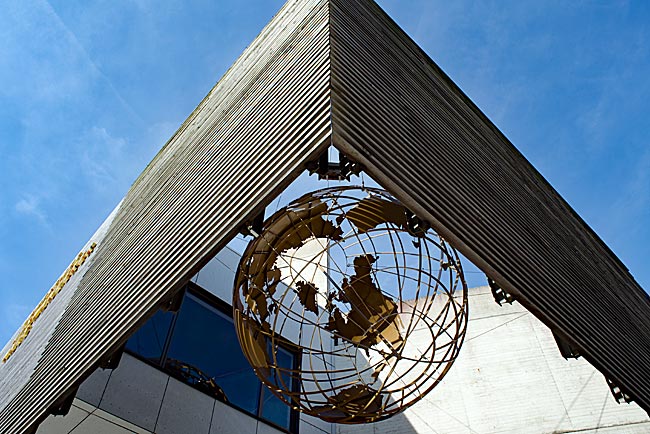
German Emigration Center Bremerhaven (Deutsches Auswandererhaus®)
Opened in 2005, the German Emigration Center® vividly and engagingly presents the history of emigration to America across five eras, spanning from 1830 to 1974. In total, 7.2 million people departed from Bremerhaven to seek a new home and build a new life beyond the Atlantic. For its emotionally compelling and historically grounded exhibition, the museum received the European Museum Award in 2007.
read more ...
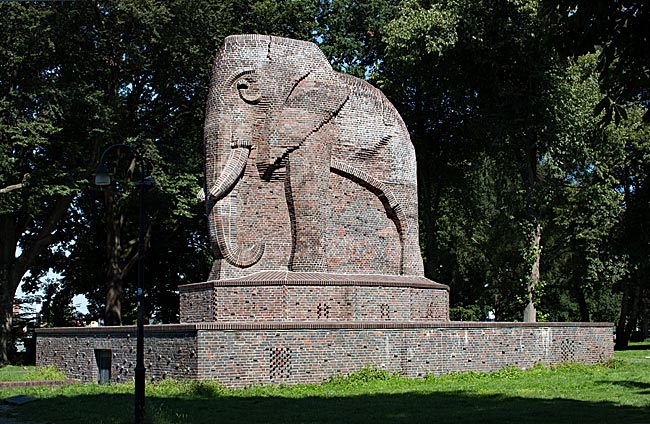
Anti-Colonial Elephant Monument
The commissioning of this brick structure was carried out by the German Colonial Society, which inaugurated the monument on July 6, 1932. However, even at that time, the construction was controversial in this traditionally more cosmopolitan Hanseatic city. The monument did not merely commemorate those who fell in the First World War in former German colonies but also symbolized the oppression and exploitation of the indigenous populations there. Since its restoration and repurposing in 1989, the Elephant has stood as an Anti-Colonial Monument representing equality and justice, serving as a warning against racism, oppression, and exploitation.
read more ...
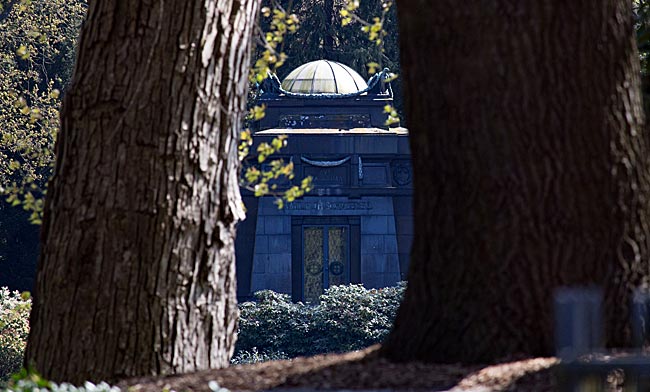
Riensberg Cemetary
Located near the Focke Museum, this cemetery was established between 1872 and 1875 as a replacement for two abandoned cemeteries elsewhere, simultaneously with Waller cemetery. Today, the well-maintained park cemetery spans approximately 28 hectares on the former estate of Riensberg. The landscape gardener and garden architect Wilhelm Benque was commissioned to design its horticultural layout. He had previously been responsible for the artistic landscaping of Bürgerpark and, among others, Knoops Park in Lesum.
read more ...
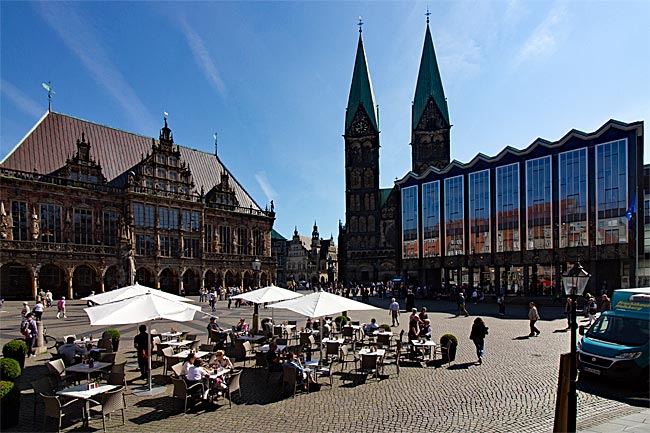
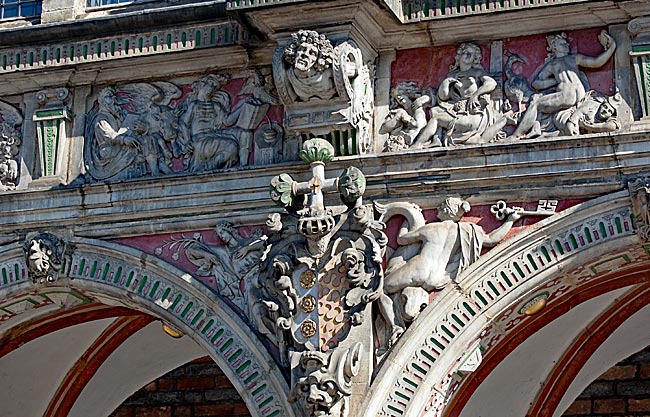
Town Hall
The original Old Town Hall on market square was built between 1405 and 1412. Little of this originally rather plain late Gothic brick structure remains today. The Renaissance façade, which gives the UNESCO-protected building its distinctive appearance, was constructed between 1608 and 1614 by Lüder von Bentheim. Above the arcades in particular, it is lavishly adorned with various depictions from ancient mythology, blending uniquely with Christian symbolism, Bremen city symbols, and other representations.
read more ...
Wallanlagen
Almost entirely surrounding the old town is a zigzagging park landscape with a moat. These are the last visible remnants of the fortifications that enclosed the old town and parts of the new town until the early 19th century. The transformation into a garden landscape began in 1802 with the first section between the Weser River and Herdentor Gate.
read more ...
Übersee-Museum (Overseas Museum)
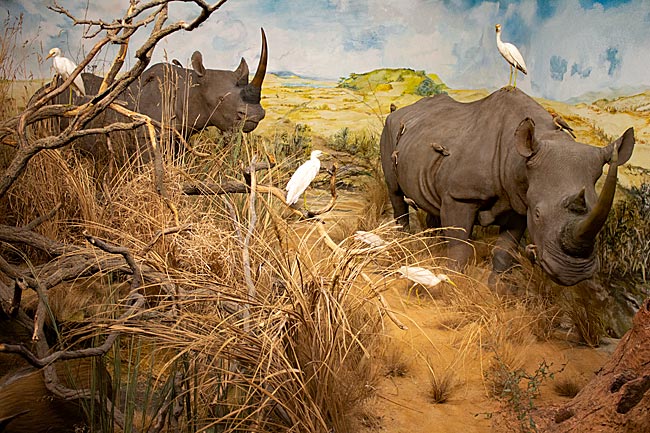
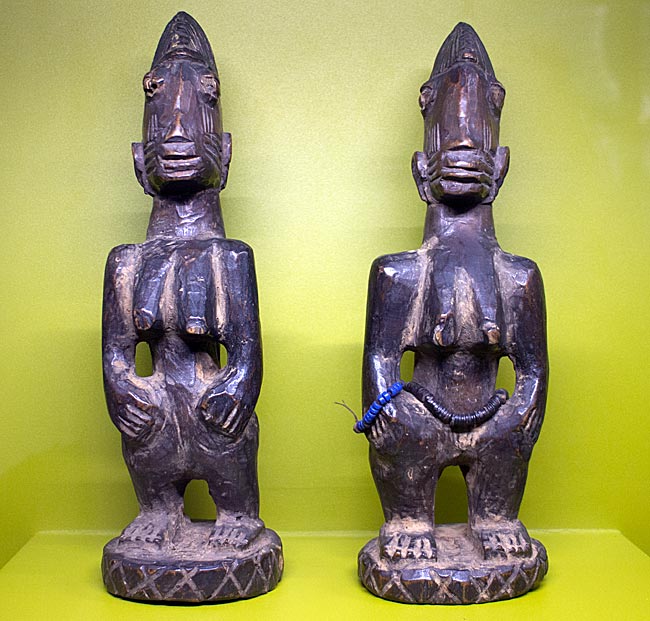
In 1896, what is now known as the Übersee-Museum first opened its doors under the name 'Municipal Museum for Natural History, Ethnology, and Commerce.' The exhibits initially came from the 'Municipal Collections of Natural History and Ethnography,' which were partly displayed as a 'Trade and Colonial Exhibition' at the 'Northwest German Trade and Industry Exhibition' in 1890 with great success. Since its founding, the museum's concepts have changed several times, evolving toward a stronger focus on museum education that continues to this day.
read more ...
Bürgerpark (Citizens' Park)
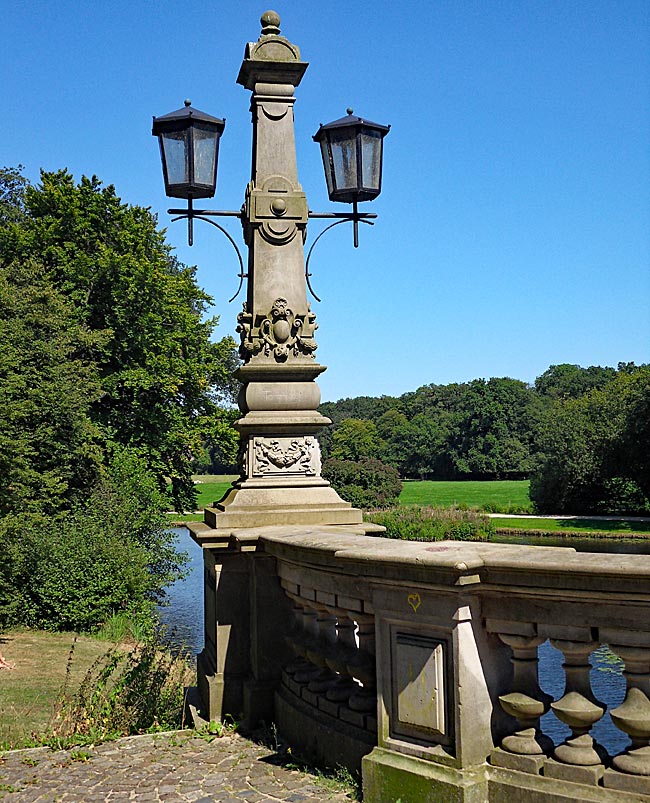
A green oasis near the city center and a popular recreational area is the Bürgerpark. This extensive park, which adjoins today's Bürgerweide behind the train station, was initiated by the citizens themselves. In the early 19th century, the old defensive structures of the city had already been dismantled, transforming the ramparts into a landscaped park. However, as the city rapidly expanded throughout the century, demands for more green spaces grew louder and louder.
read more ...
Focke-Museum
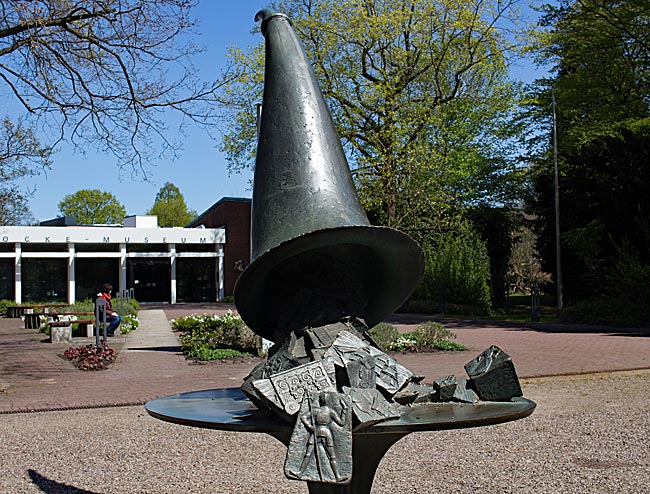
Every city has its history, and in many cities, there is a museum that tells this story. In the Hanseatic city, it is the Focke Museum in the Riensberg district, where urban history is presented most vividly. The "Bremer State Museum of Art and Cultural History" was established in 1924 by merging two collections: the Gewerbemuseum, founded in 1884, and the Historisches Museum für bremische Altertümer (Historical Museum for Bremen Antiquities), founded six years later. The museum's founder, who passed away in 1922, also gave it his name.
read more ...
Exploring Horn-Lehe district
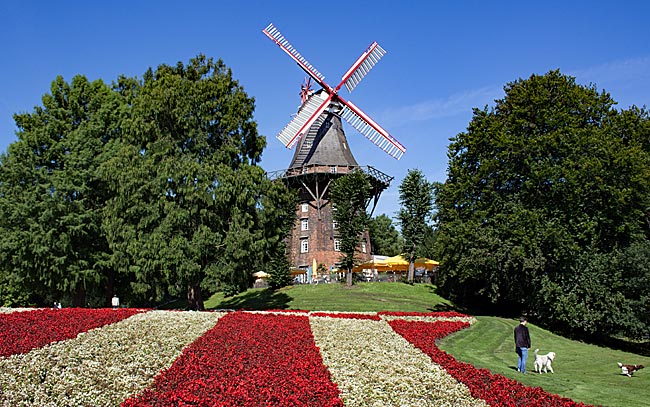
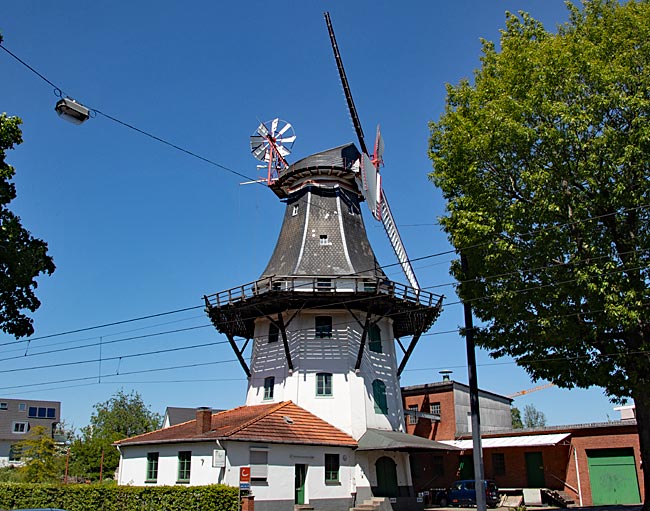
Some mills grind slowly, while others no longer operate at all - like the Horner Mill. Built in 1848 as a Dutch-style windmill, its preservation for passersby to enjoy today required significant effort and funding. It stands as the district's emblem.
read more ...
Water-based activities in Bremen
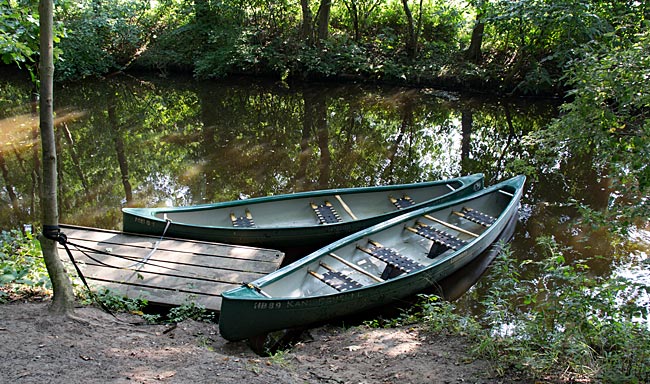
Since not everyone owns a boat, it's convenient that you can easily rent canoes and kayaks—for example, at Torfhafen in the Findorff district, which borders Bürgerpark, or just beyond the city limits at Kanu-Scheune in Lilienthal, accessible by tram line 4.
read more ...
Stadtwald & Stadtwaldsee (urban forest & lake)
Stadtwald & Stadtwaldsee. The design of the Bürgerpark is attributed to Wilhelm Benque, who served as its director from 1866–1870 and again from 1877–1884. Carl Orth succeeded him in this role, and under his plans, construction of the Stadtwald began in 1907. The 66.5-hectare site north of the railway tracks had been donated to the Bürgerpark Association by the Bremen merchant Franz E. Schütte one year earlier.
read more ...