
 exploring Bremen & its surrounding areas
 You are here: worth seeing in the surroundings
 Stade - on the banks of the Schwinge (2/6)
What remains today?
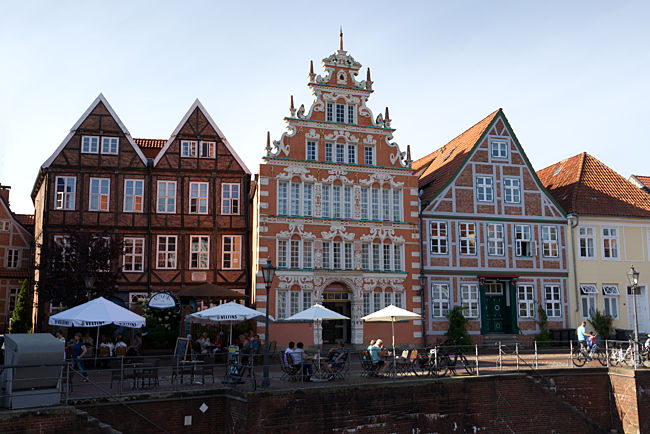
View from one side of the harbor to the other with the birthplace of General von Goeben (1816-80), today a café (left), next to it the Bürgermeister-Hintze House, built around 1500, which received its current magnificent façade in 1621.
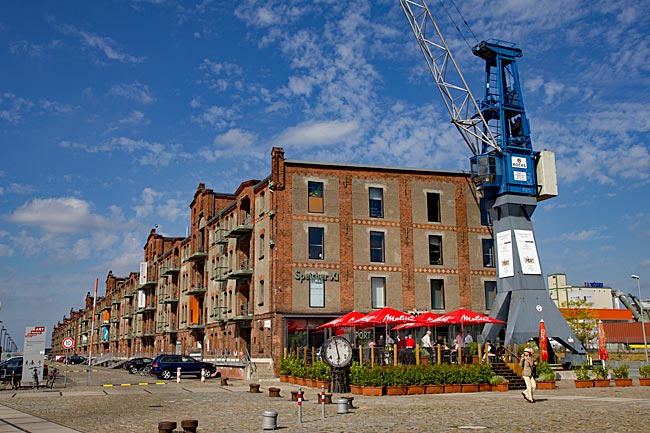
The most attractive area of the historic old town is undoubtedly the Hansehafen with its surroundings. Initially located outside the present-day city center, the harbor was moved around 1250 into the protective area of the castle and the city fortifications. Ships from the North Sea sailed up the Elbe River, turned into the tributary Schwinge, and finally docked at the harbor quay in the middle of the city, where about 4,000 people lived during the Middle Ages.
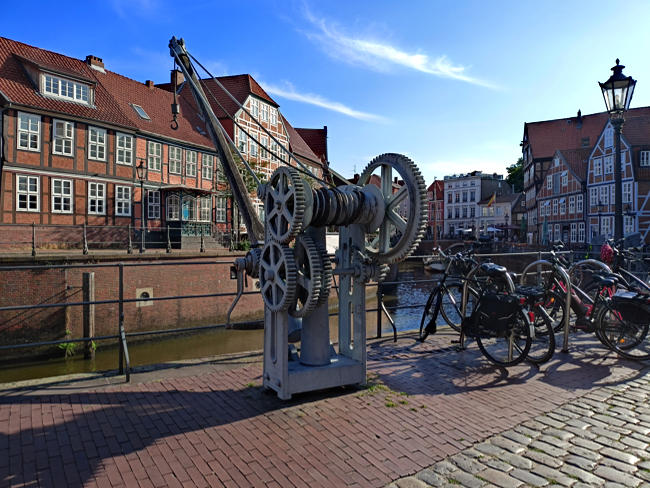
No more work for cranes
This has not been possible since 1967 because the heavily trafficked Hansestraße largely separates the harbor area from Schwinge and Stadthafen. Little more than a trickle of the Schwinge still flows through the harbor, continuing to merge on the other side of the old town with the part of the Schwinge located there.
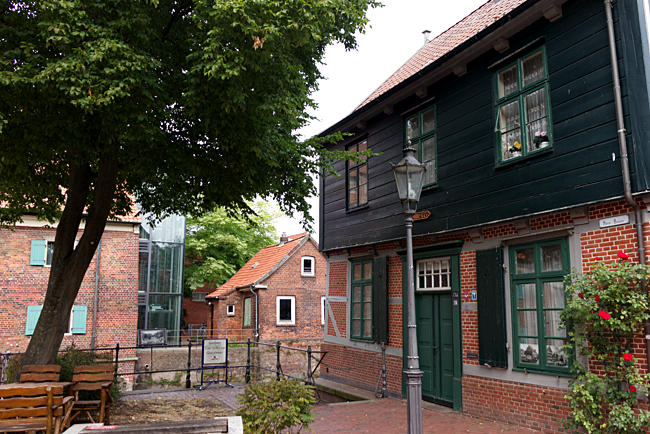
Front view of the Baumhaus
Unobstructed entry was also not easily possible in those days. Ships and cargo had to be registered, and fees had to be paid, which applied to both incoming and outgoing ships. Thus, the journey initially ended at the so-called Baumhaus - not a house on a tree, but one with a tree. This tree blocked the harbor entrance, secured by chains or ropes, and was only removed after authorized passage. The Baumhaus housed the harbor master for about 350 years (1609–1948), who was responsible for enforcing law and order in the harbor area and overseeing the loading and unloading of ships using cranes. The still-existing and restored Baumhaus was built in 1773 after its larger predecessor burned down. After the expansion of the Stadthafen in front of the Hansehafen, the tree lost its function and thus its significance.
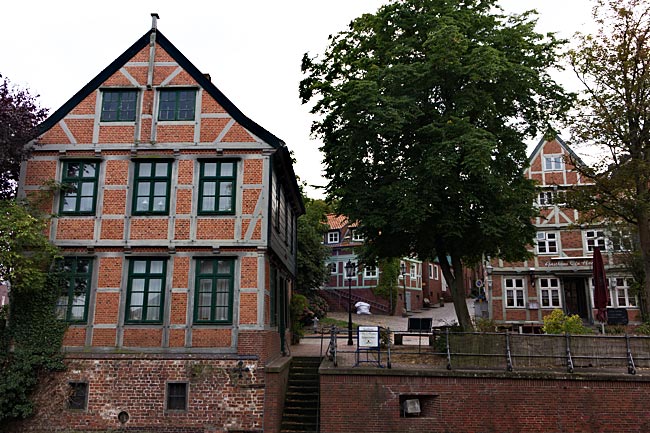
Change of perspective: The Baumhaus from the other side of the harbor with additional timber-framed buildings and the road to Spiegelberg
Opposite the Baumhaus, a small footpath leads to the Stadthafen viewing platform as well as up Baumhausstraße to Spiegelberg. Right next to the Baumhaus by the water is an outdoor terrace of a guesthouse. By the way, this is just one of many dining areas around the harbor, so you have plenty of choice to secure a nice spot.
Culture and art at Hansehafen
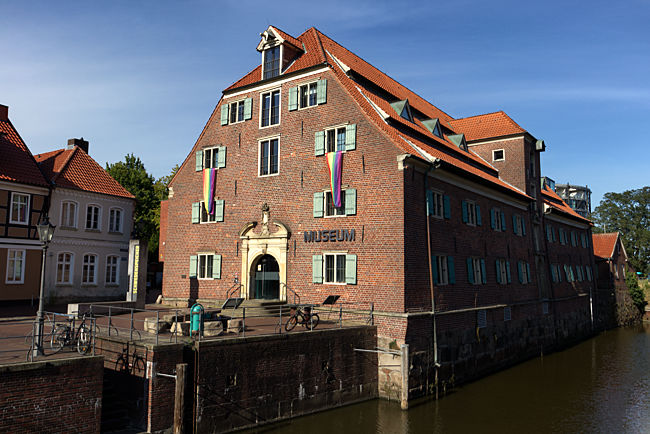
The Schwedenspeicher at Hansehafen
Directly opposite on the other side of the harbor stands the Schwedenspeicher. Like many parts of Northern Germany - the Hanseatic cities of Bremen and Wismar among them - Stade also came under Swedish rule for a time after Sweden's military intervention in the Thirty Years' War beginning in 1630. The storage building, restored in 1977, was originally the garrison’s provision house, constructed between 1701 and 1705 during the reign of Swedish King Carl XII.
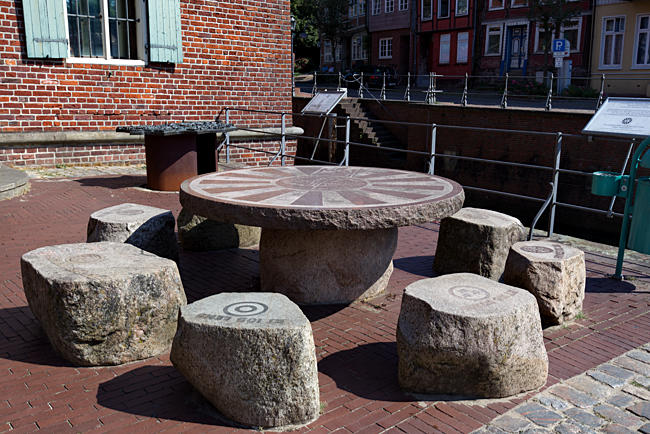
Seating from Viking Times? No. In 1997, Round Table 105 Stade celebrated its 20th anniversary, and on this occasion, the stone group consisting of a table and stools (symbolizing friendly partner tables) was donated in front of the storage building. The motto of these all-male societies is: adopt, adapt, improve.
The one-meter-thick wall foundations of this large secular building (41 by 16 meters in area) with its five stories - three of which are attic floors - rest on oak piles driven into the ground. In the mid-1970s, the demolition of the dilapidated structure was prevented by the efforts of a citizens' initiative and an association. A good thing, because today visitors to the museum can learn about the city's history in the renovated premises, covering 1,650 square meters of exhibition space, as well as about the Hanseatic League era and even further back into the prehistoric times of the Elbe-Weser region.
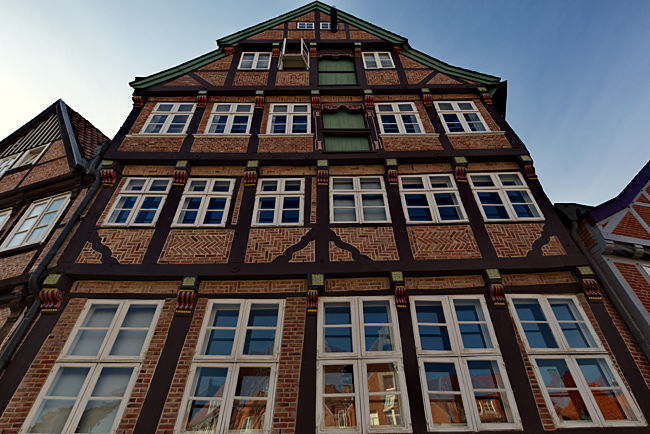
Wood works; over the centuries, the beams of the timber-framed house have warped, yet the Kunsthaus stands securely nonetheless
Those interested in art and culture will find another option just a few meters from the storage building in the tallest timber-framed house with its three floors on this side of the harbor. The Kunsthaus has its premises in a former merchant's house dating back to 1667. Floor-length windowless wooden doors and a crane beam in the gable area, which was once used to pull goods into the upper floors using a pulley system, indicate that the building also served as a storage facility. Since 1987, classics of fine art have been displayed here alongside works by young artists up to the present day. Regularly changing exhibitions make frequent visits worthwhile.
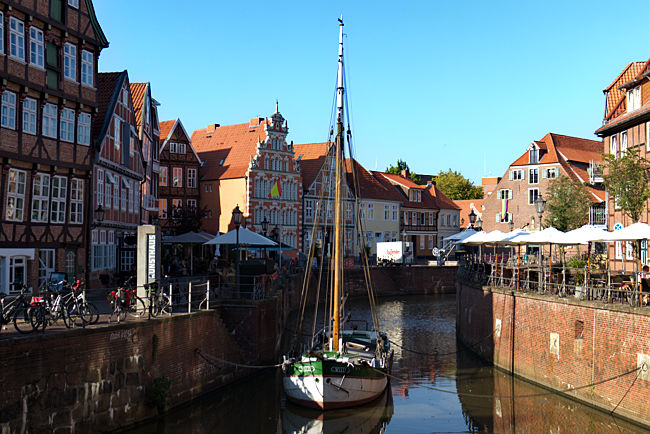
Oh, he's not bigger, is he, Willi? Well, just a ship for narrow inland waters, but fitting for the historic Hansehafen
Approaching the head of the Hansehafen from the storage building to the Kunsthaus, only the Giek-Ewer "Willi" permanently lies in the water of the Schwinge. The designation of Stade's maritime landmark refers to a type of sailing ship equipped with a flat keel (flat bottom), originally from Friesland and presumably operated by a single crew member (ewer, derived from the Dutch term for a one-man vessel). Giek here denotes a wooden mast with corresponding rigging for a gaff sail. The small motorized cargo ship built in 1926 was active for about 40 years on the waters of the Haseldorfer Marsh, an area east of the Elbe opposite the Schwinge estuary.
At the Fish Market
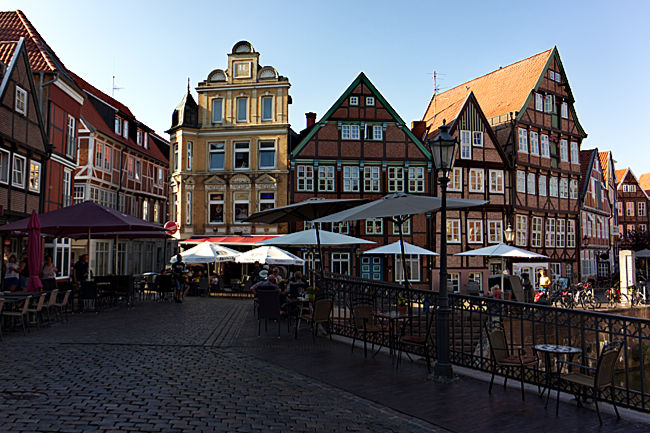
Dining at the harbor head
The fish market once took place around the harbor head. This is evidenced not only by street names but also by a bronze sculpture of a market vendor with her basket and a cat vying for a bite near the Kunsthaus. While fish was once considered poor people's food - simply because rivers like the Elbe were abundant with it, making it inexpensive to obtain - the strong odor made it unappealing to the increasingly refined noses of wealthy citizens. Today, aquatic inhabitants are a high-priced delicacy, as the menus of restaurants at the square impressively demonstrate.
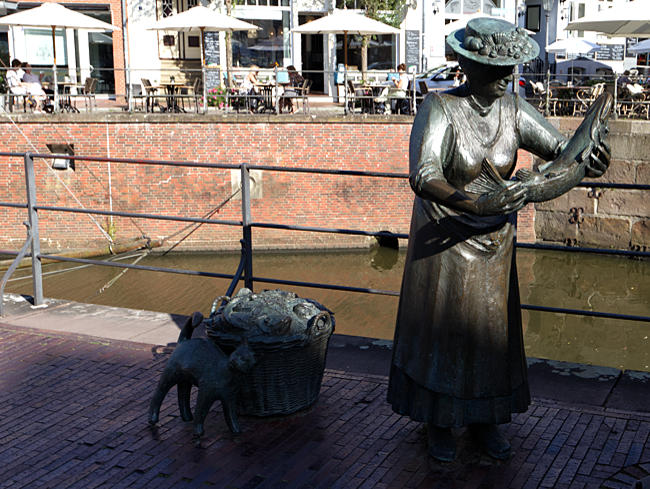
Bronze Sculpture "Fishwoman" by Sculptor Frijo Müller-Belecke
The most unusual object in the fish market and harbor head area is unmistakably a massive wooden tread crane. However, this specimen never served any other purpose than to function as an exhibition space inside with information about Stade's harbor and shipbuilding history, the history of the Hanseatic League, and the operation of the crane. The construction in 1977 was made possible by donations from citizens, businesses, and the Rotary Club of the city. Meanwhile, this crane, a replica based on a model from Lüneburg (built in 1661), has become a much-photographed and visited architectural monument. The last original crane at the harbor was dismantled at the end of the 19th century; it was simply no longer needed and stood in the way of other plans.
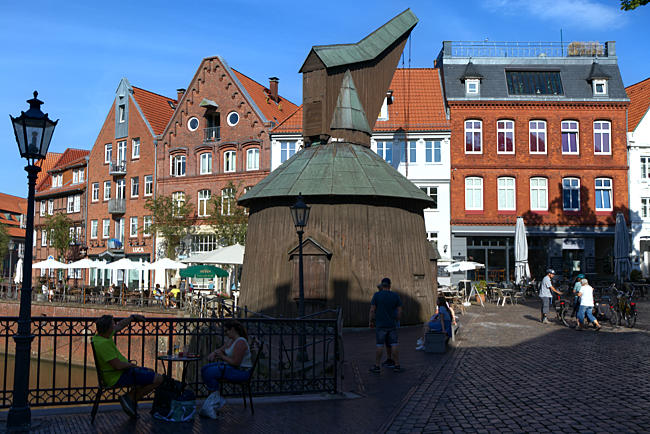
Tread Crane
The operation of such a pre-industrial working tool for unloading ship cargo, which was used for several centuries, is fascinating. Approximately 10-12 men were required to set the lifting device in motion using a treadwheel, turn the crane, or perform other tasks. Initially, the treadwheels in which the men ran were mounted externally on the crane; later, in the construction of larger cranes, they migrated inward, and one wheel became two to enable the lifting of even larger and heavier loads.
Although the entire harbor area is architecturally appealing thanks to extensive restoration, the crane with the old city weighhouse next to it forms a unique ensemble. While the two-story timber-framed house from 1753, unlike the city weighhouse in the Hanseatic city of Bremen with its magnificent Renaissance facade and volute gable, is far less of an eye-catcher or, in modern terms, an "eye-catcher."
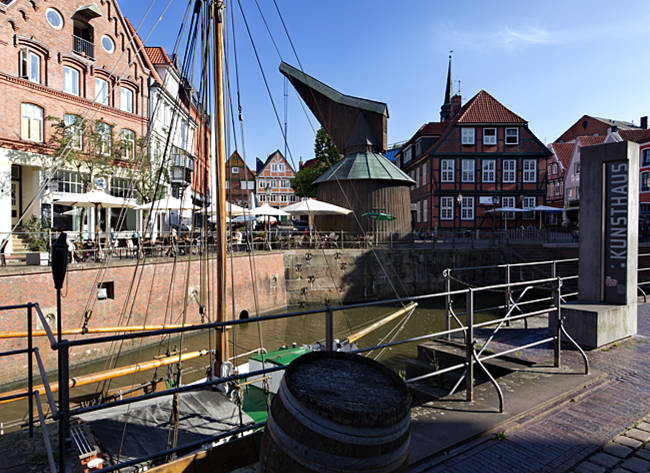
Crane with the city weighhouse (right) seen from the west quay
Weighing has not taken place in the building since 1853. After the relocation of the (Hanse) harbor to its current location and the increase in regional trade, the site of the city weighhouse was moved from the area of the horse market to here in the 14th century. Short distances, quick money, one might almost say, because before the landed goods could be delivered to the warehouses or shops of the recipients, they were recorded in writing and weighed, then taxed/import duties were assessed according to fixed rates. Only after payment of the amount was the goods released. A principle that still functions in global trade today. Additionally, merchants could have goods weighed in trade with others at the city weighhouse to prevent potential fraud.
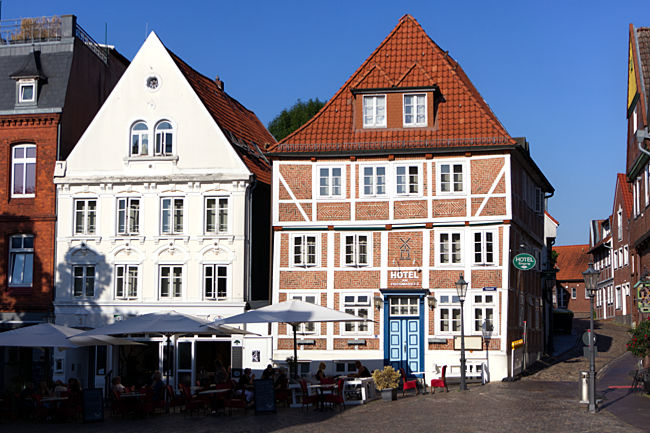
Next to the fish market by the city weighhouse


Map
Further information
STADE Marketing and Tourism GmbH
Hansestraße 16
D-21682 Stade
Email: info@stade-tourismus.de
Website: www.stade-tourismus.de
Phone: +049 (0) 4141 77698-0
Tourist Information at the Harbor
Opening Hours: April to October: Mon–Fri 10 AM – 6 PM; Sat, Sun & Holidays 10 AM – 3 PM, November to March: Mon–Fri 10 AM – 5 PM, Sat 10 AM – 3 PM, Sun & Holidays closed
Schwedenspeicher
Wasser West 39
D-21682 Stade
Phone: +49 (0) 4141 79 773 0
Email: info@museen-stade.de
Website: www.museen-stade.de
Opening Hours: Tue–Fri 10 AM – 5 PM, Sat & Sun 10 AM – 6 PM
Kunsthaus
Wasser West 7
D-21682 Stade
Phone: +49 (0) 4141 79 773 20
Email: info@museen-stade.de
Website: www.museen-stade.de
Opening Hours: Tue, Thu, Fri 10 AM – 5 PM, Wed 10 AM – 7 PM, Sat & Sun 10 AM – 6 PM, closed during exhibition changes!
Verein Alter Hafen Stade e.V.
Phone: Gerd Becker +49 (0) 4141 4123255 or +49 (0)151 10974508
Email: becker1959@gmail.com
Website: www.greundiek.de
Kunstverein Stade e. V.
Website: www.kunstvereinstade.de
Heimatmuseum
Inselstraße 12
D-21682 Stade
Phone: +49 (0) 4141 79 773 40
Email:
info@museen-stade.de
Website:
www.museen-stade.de/heimatmuseum
Opening Hours: closed for renovation
SUP CLUB Stade: Rentals, courses, canoe, kayak, pedal boat, BBQ
Salztorswall 8
D-21682 Stade
Phone: +49 (0)1514 2898283
Arrival
The advantages of traveling by car from Bremen are limited. While there are several parking garages to park your vehicle near the city center, the train station is also just a five-minute walk from the city center. At the station, you need to change trains in Hamburg. The regional trains run more frequently, so you don't have to rely on specific connections. With a Niedersachsenticket (valid from 9 AM until 3 AM the next day), you can freely choose your connections for an entire day (round trip excluded IC and ICE). Buses and trams operated by Bremer Straßenbahn AG (BSAG) are also freely usable with the Niedersachsenticket.
Bremerhaven in general
Bremerhaven was only founded in 1827. To secure its status as a port city amid the threat of the Weser - Bremen's lifeline - silting up, Bremen purchased 342 acres of land at the mouth of the Weser from the Kingdom of Hanover for 74,000 talers under then-mayor Johann Smidt. About 60 kilometers downstream from Bremen, this became the site of the first urgently needed seaport built by Bremen, known as the Alter Hafen (Old Harbor), completed by 1830.
read more ...
Bremerhaven - Zoo am Meer (Zoo by the Sea)
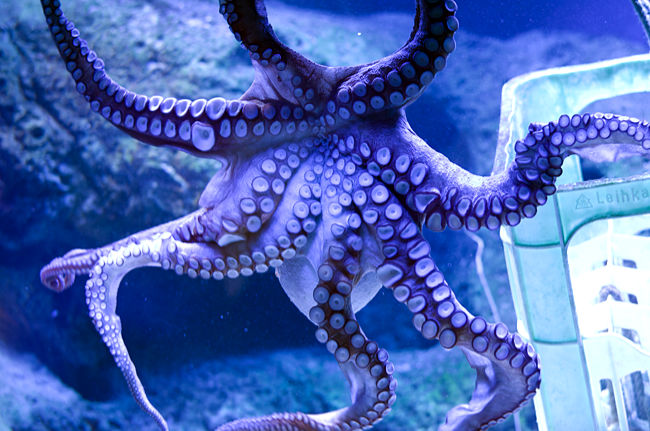
In addition to the 19th-century harbor facilities, the Zoo am Meer is the oldest attraction on the site between the Weser River and the pedestrian zone. It opened in 1928 under the name "Tiergrotten." The enclosures house polar bears, seals, penguins, various bird species such as gannets and keas, reptiles like turtles, raccoons, Arctic foxes, pumas, monkeys, and others - almost 50 animal species in total.
read more ...
Bremerhaven Havenwelten
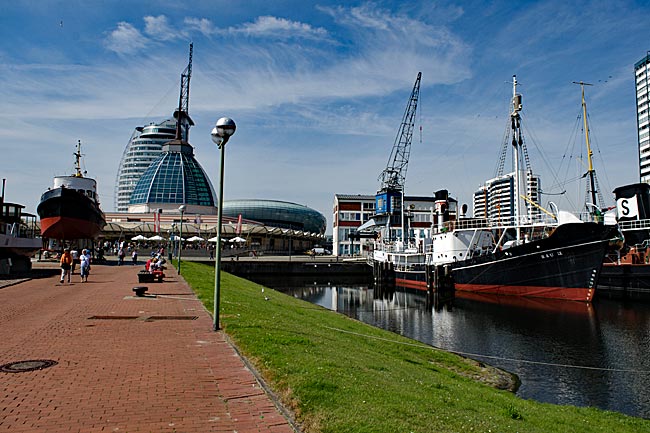
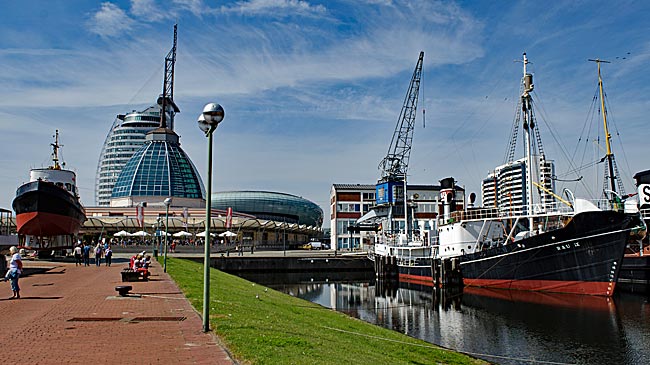
Since early 2008, Bremerhaven has not only had a new tallest building but also a new landmark in its Weser-side skyline with the ATLANTIC Hotel SAIL City, which rises 147 meters directly behind the Weserdeich. Architecturally, the structure perfectly embodies a maritime city - it stands like a powerful, rounded ship's superstructure. On the 20th floor, at a height of 77 meters, there is an observation deck (SAIL City) that is also accessible to non-guests.
read more ...
German Emigration Center Bremerhaven (Deutsches Auswandererhaus®)
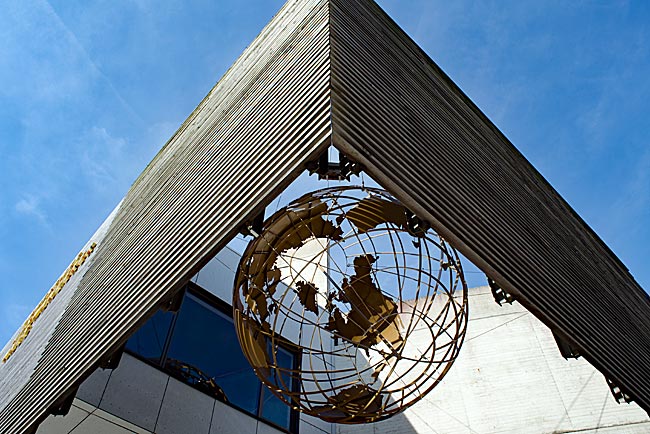
Opened in 2005, the German Emigration Center® vividly and engagingly presents the history of emigration to America across five eras, spanning from 1830 to 1974. In total, 7.2 million people departed from Bremerhaven to seek a new home and build a new life beyond the Atlantic. For its emotionally compelling and historically grounded exhibition, the museum received the European Museum Award in 2007.
read more ...
Bremerhaven - Überseehafen (Overseas Port)
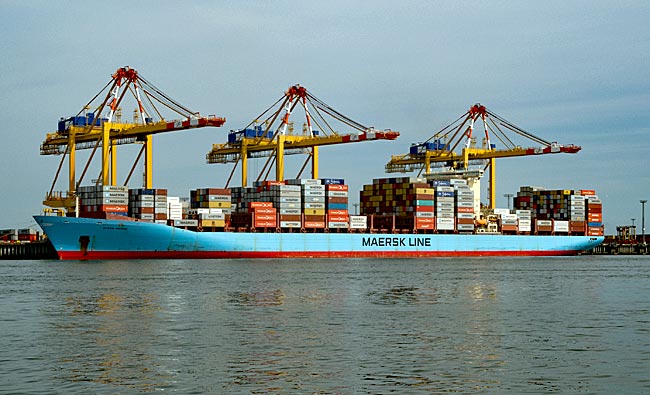
In addition to the Old Harbor (now the Museum Harbor), which was the first to be built, other ports were later added. Adjacent to the New Harbor lies Kaiserhafen I, the first in a series of additional harbor basins. Even a glance into this initial section of the expansive port area reveals a different world of maritime activity - one of large ships. And we will see even larger ones along the five-kilometer-long quay on the Weser.
read more ...
Bremerhaven - Schaufenster Fischereihafen (Fishery Harbor Showcase)
Away from the Havenwelten and older than both the Emigration Center and Klimahaus is the "Fishery Harbor Showcase." In fact, the Fishery Harbor was originally Geestemünde's deep-sea fishing harbor, built between 1891 and 1896. After a period of decline and decay - including partial demolitions - the idea emerged to transform the area into a maritime experience world. In 1990, efforts began to restore Fish Packing Hall IV, the oldest surviving hall, which had been slated for demolition just shortly before.
read more ...
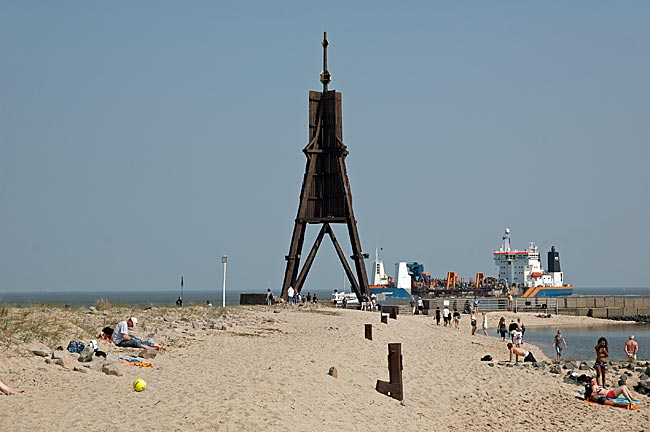
Cuxhaven - a day trip
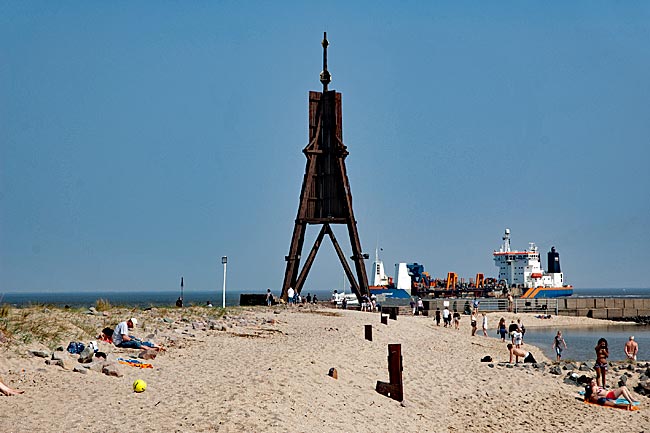
Many people from Bremen consider the seaside resorts of Cuxhaven to be "their home beach." The coastal city at the mouth of the Elbe is easily accessible from Bremen by car via the A27, which passes by Bremen and Bremerhaven before ending in Cuxhaven. By train, the journey takes a bit longer with a transfer in Bremerhaven. However, even in the off-season, Cuxhaven with its seaside resorts is a great destination for an outing - for example, by bicycle.
read more ...
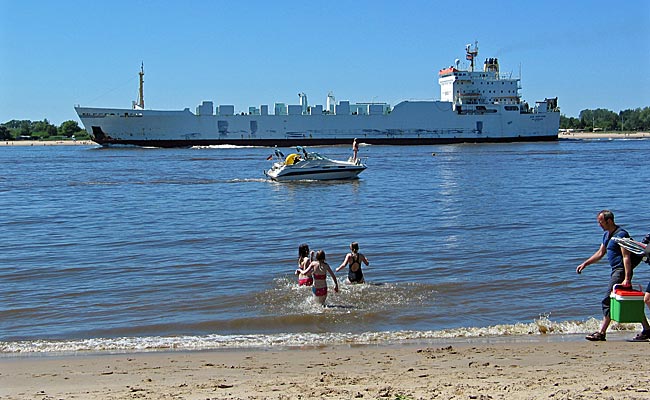
Brake & the River Island of Harriersand
As soon as spring arrives and the temperatures reach around 20 degrees, many Northern Germans are drawn to the North Sea coast. The main attraction? A beach to lie in the sun and sand for children to dig and build castles. This also draws many people from Bremen to the highways heading north on warm weekends, equipped with bags packed and picnic baskets ready for a day of seaside relaxation. But why travel far when the nearest beach is just around the corner? A visit to Brake and Harriersand proves that.
read more ...
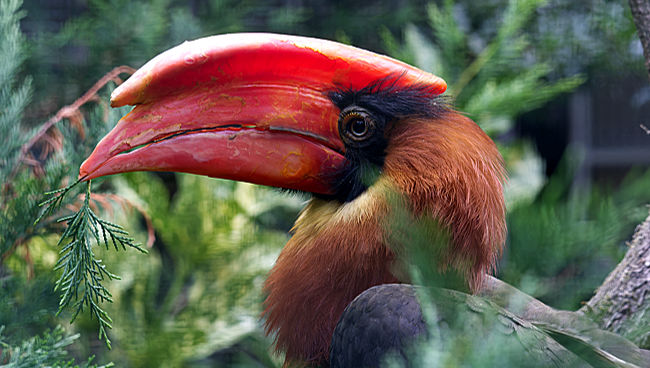
Walsrode World Bird Park
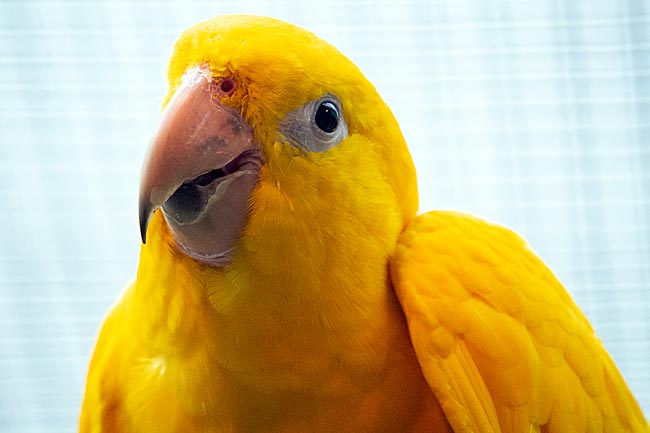
The name "Weltvogelpark" (World Bird Park) sounds ambitious, but in fact, the park in the Lüneburg Heath is the largest of its kind worldwide and has only carried the addition "Welt" ("World") since 2010. Over 4,000 birds, including many rare species, live on the 24-hectare site, representing around 650 different bird species from all continents. The bird park was founded in 1962 as a private breeding station and later expanded into a full-fledged park. It is highly recommended as a family-friendly day trip.
read more
...
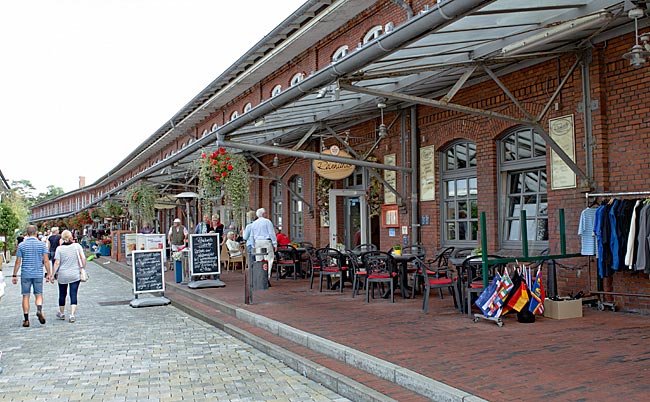
Artists' colony & peasant village: Fischerhude
Signposts make it clear to every previously unaware visitor that this place differs significantly from many other traditionally agricultural villages. Fischerhude is hip. Numerous cafés and restaurants, ceramics studios, art galleries, a local history museum, the Modersohn Museum, and more vie for the favor of an audience that is sometimes more and sometimes less interested in art but regularly strolls through Fischerhude in large numbers.
read more ...