
 exploring Bremen & its surrounding areas
 You are here: worth seeing in Bremerhaven
 Bremerhaven Overseas Port (2/3)
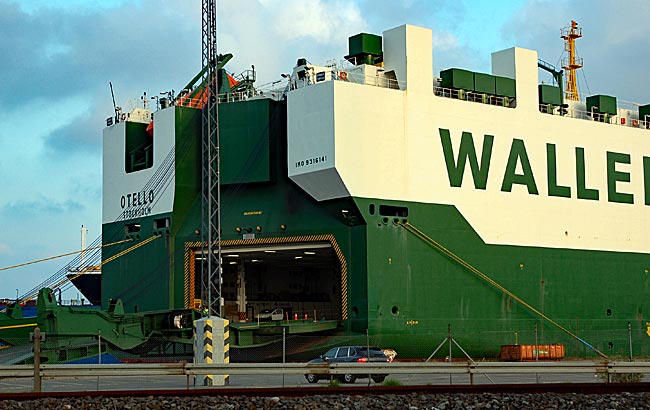
Self-propelled barge with open rear hatch and loading ramp in northern habor
Since the wreck posed a navigation hazard in the narrow, heavily trafficked shipping lane, having already caused three collisions, the vessel was cut into segments underwater over several months until October 2004, then raised and scrapped (including the cars). Images of the accident can be found online if interested.
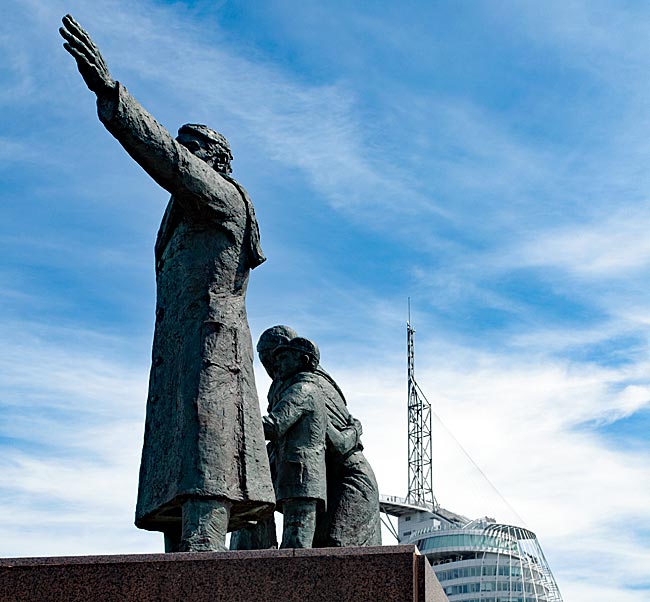
The emigrants are commemorated not at Columbuskaje but at Willy-Brandt-Platz near Zoo am Meer
By contrast, those arriving today near Kaiserschleuse at the 1927-completed Columbuskaje live in relative luxury. The name "Columbus" refers to the passenger ship of Norddeutscher Lloyd (NDL) launched in 1924, which made its maiden voyage to New York and docked here, as well as Christopher Columbus as a symbol of connection with the New World, America. As early as June 1847, the first American ship of a regular postal steamship service between the two continents arrived in Bremerhaven. Once a place of farewells for emigrants boarding NDL ships to face an uncertain but promising future, today it is a modern, frequently used cruise terminal (Columbus Cruise Center) and docking point for floating hotels of the world’s oceans. The cruise terminal also has a viewing platform, accessible only when a ship arrives.
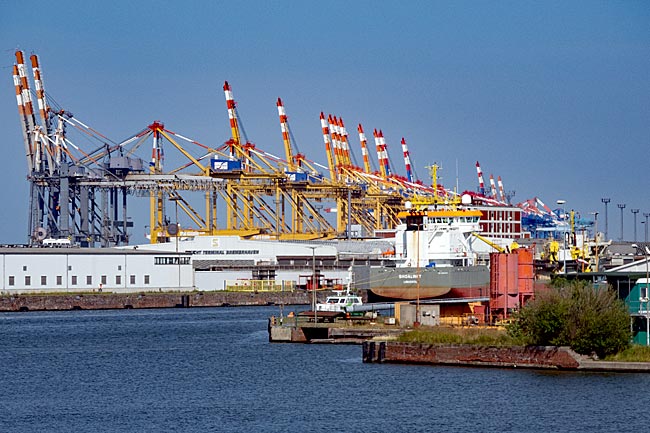
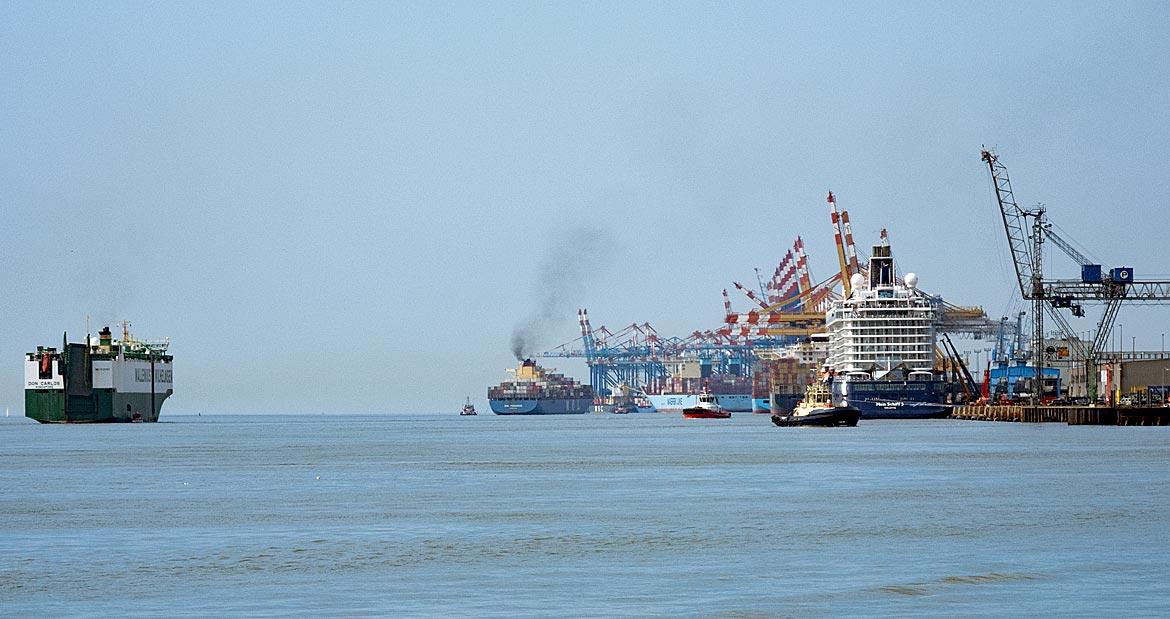
View from Kaiserschleuse to container cranes along the 5 km-long Stromkaje
Beyond the terminal stretches the Container-Kaje to Bremerhaven’s city limits, a five-kilometer restricted zone. To see anything from this side, one must visit the observation tower near Nordschleuse at Steubenstraße, where stacked containers allow a proper view from a distance. But why observe from afar when you can almost reach out and experience the action on the river live—and there’s plenty happening, including seals during low tide. Incidentally, the first container arrived in Bremerhaven in 1966 aboard a ship from the USA, becoming a true success story.
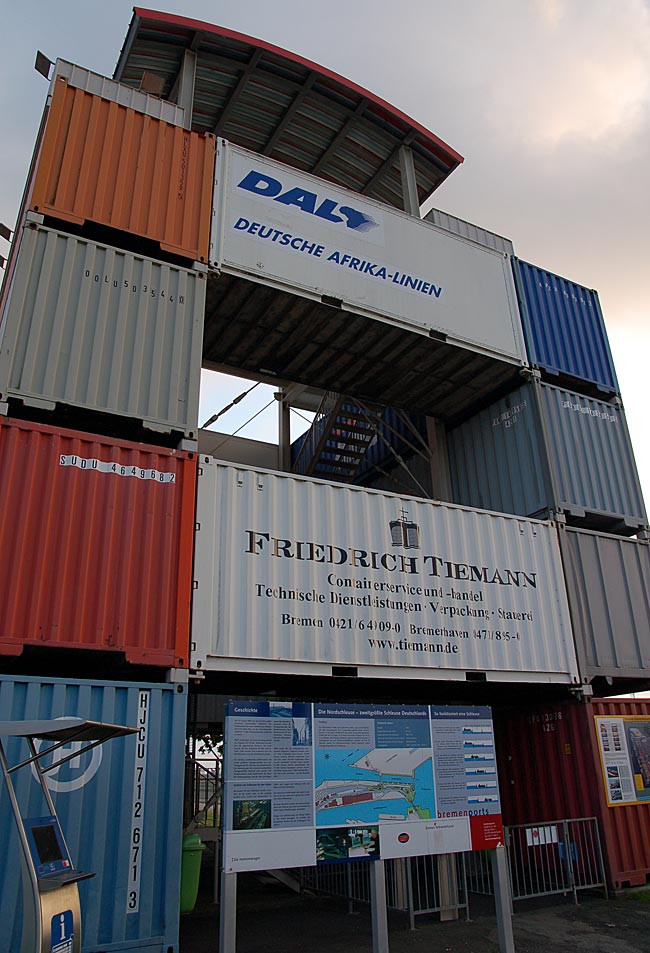
Observation tower
The „Dicke Pötte Tour“ (Big Ships Tour)
Literally translating to "big pots", " Dicke Pötte" refers colloquially in Low German simply to big ships. Tickets for the boat tour can be purchased at the brick building at the head of Neuer Hafen (House No. 6) or directly aboard the excursion ship *MS Geestemünde*, which departs near Zoo am Meer. Passengers may board half an hour before departure, but arriving earlier is advisable to secure one of the limited spots on the partially open upper deck, the view from there is simply better.
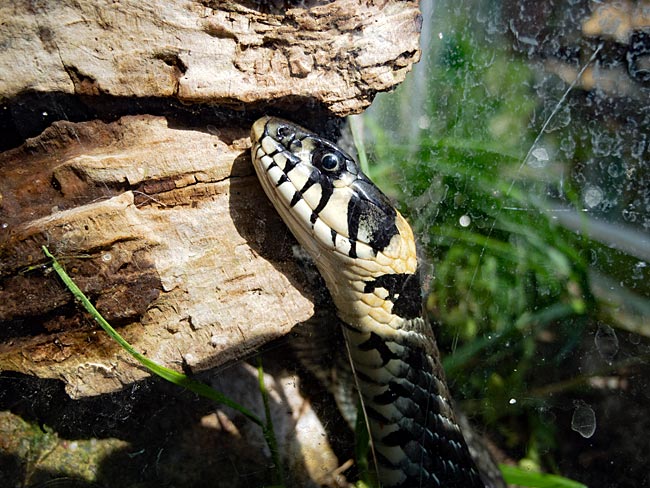
Snake (grass snake) in a terrarium at Zoo am Meer
The water route to the large ships first passes through the lock near Simon-Loschen Lighthouse, which compensates for the tidal height difference between the Weser and Neuer Hafen. Unintentionally becoming part of a small attraction for other city visitors, who may wish to cross one of the two bridges during the lock passage (which is restricted or impossible when one of the gate pairs opens). Human ability to straddle is limited by leg length; beyond that, it becomes very wet and dangerous, hence barriers, red lights, and a warning announcement, even in Plattdeutsch. So, it’s wait-and-watch.
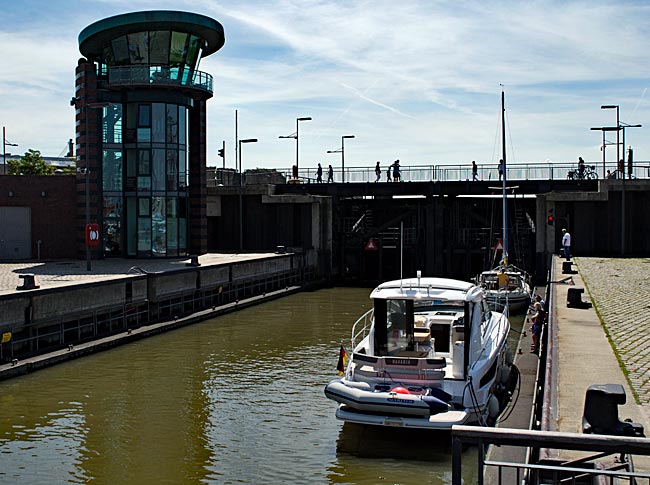
When the lock gates open to the Weser, the path above also splits
In the open waters of the Weser, the tour proceeds, always mindful of ship traffic and right-of-way rules, toward the North Sea. Even before departure from the harbor, the crew provides competent and entertaining commentary via loudspeaker about what we see along the previously mentioned tugboat pier to the cruise terminal. There, we spot *Mein Schiff 3* from TUI Cruises (headquartered in Hamburg). The Finland-built, approximately 293-meter-long cruise liner has been sailing the world’s oceans since 2014 and can accommodate 2,506 passengers.
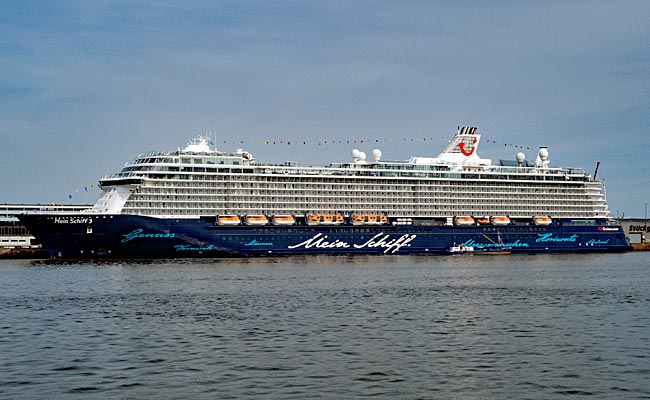
The cruise ship "Mein Schiff 3" at Columbuskaje is being refueled
"Mein Schiff 3" sails under a so-called flag of convenience (Malta), a widespread practice among cruise and container shipping companies. Registering in countries like Liberia, Panama, Cyprus, or Malta means adhering to their tax rates for shipowners, regulations on crew status, pay, working hours, and safety standards. As a result, sailors often work for half their wages or less with fewer labor protections than under German flag regulations. Shipping companies argue that this is necessary due to the cutthroat international competition.
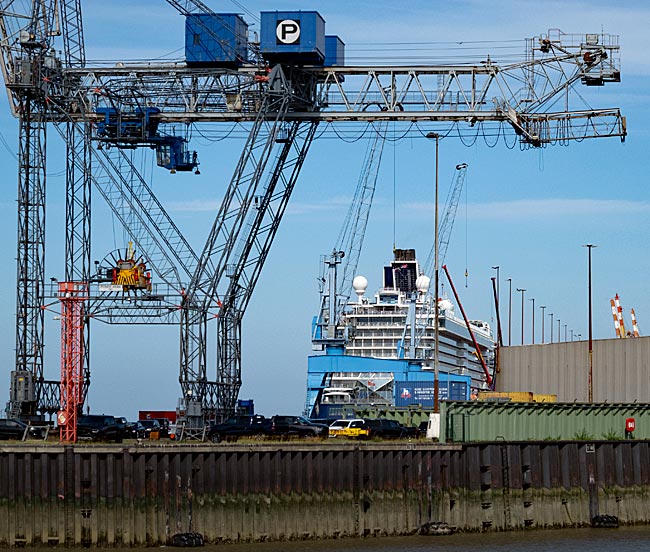
From afar, one can already see the towering deck superstructures rising high above the house
If German cruise operators like TUI Cruises or Rostock-based AIDA Cruises were legally required to pay crews according to German labor laws, mandate shore power during docking, and enforce environmentally friendly propulsion systems or more efficient exhaust filtration, passengers might have to double their current cruise fares. Likely fewer cruise ships would then dock in Bremerhaven, a financial blow for the city.
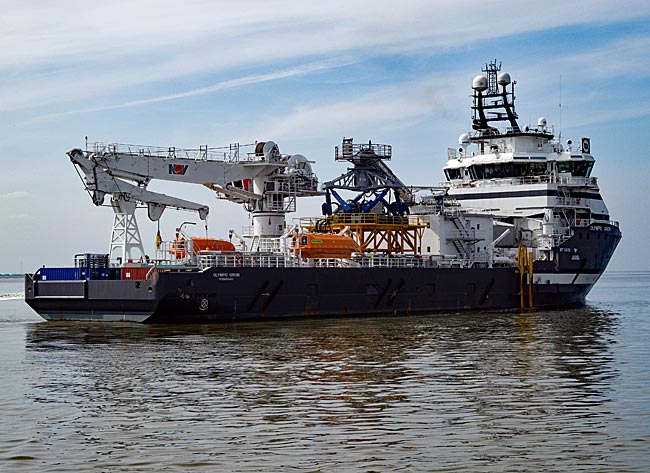
Under Norwegian flag serving wind energy, which may soon generate shore power: the offshore vessel Olympic Orion (built 2012)
Incidentally, Albert Ballin of Hamburg is credited with inventing cruising. The managing director of HAPAG (Hamburg-Amerikanische Packetfahrt-Actien-Gesellschaft), founded in 1847 and active alongside Norddeutscher Lloyd in the emigration business, had an idea in 1891: since ships were underutilized in winter, he organized an "educational and pleasure cruise." Critics predicted failure, but contrary to expectations, the "Augusta Victoria", Germany’s largest passenger steamship at the time, was fully booked for its Mediterranean voyage.
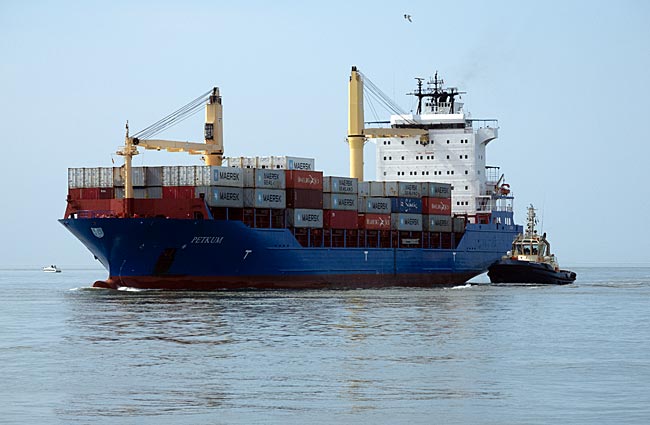
Named after a district of Emden (East Frisia) and registered in Antigua Barbuda: the Petkum (1,304 TEU) is a feeder ship, i.e., a supply vessel for larger seagoing ships and ports, equipped with its own cranes if local infrastructure is lacking
If the world’s largest container ship in 2019 is fully booked, it carries 23,756 standard containers (TEU), including up to 2,000 refrigerated units. TEU stands for "Twenty Foot Equivalent Unit," equivalent to a container length of 6.058 meters; however, there are also 30- and 40-foot containers. All steel boxes share the same width (2.438 meters) and height (2.591 meters), ideal for international trade. Typically, two TEU or one 40-foot container fits on a three-axle truck trailer for practical comparison. The "MSC Gülsün" of Swiss shipping company Mediterranean Shipping Company has a 12-meter draft and made a brief stop in Bremerhaven during its maiden voyage in August 2019.


Map
Further information
Dicke Pötte Tour (Big ships tour)
Reederei Weserfähre GmbH
Zur Hexenbrücke 11
27570 Bremerhaven
Phone: +49 (0)471 3003-600
Email: info@weserfaehre.de
www.ms-geestemuende.de
Travel time: 2 to 2¼ hours, daily 1–2 trips depending on the schedule
Hafenrundfahrten (Harbor Tours)
HaRuFa Maritime Tourismus GmbH
H.-H.-Meier-Straße 4
27568 Bremerhaven
Phone: +49 (0)471 415850
Email: kontor@hafenrundfahrt-bremerhaven.de
https://hafenrundfahrt-bremerhaven.de
Bremerhaven in general
Bremerhaven was founded only in 1827. To secure its importance as a port city amid the threat of silting up of the Weser River - the lifeline of Bremen - Bremen acquired 342 morgen (approximately 850 acres) of land at the mouth of the Weser from the Kingdom of Hanover for 74,000 talers in 1827 under then-mayor Johann Smidt. About 60 km downstream from Bremen, the first urgently needed seaport for Bremen, known as the Alte Hafen (Old Harbor), was established there by 1830.
read more ...
Bremerhaven - Deutsches Auswandererhaus® (German Emigration Center)
Opened in 2005, the German Emigration Center vividly and engagingly presents the history of emigration to America across five eras spanning from 1830 to 1974. In total, 7.2 million people departed from Bremerhaven to seek a new home and build a new life beyond the Atlantic. The emotionally compelling exhibition, backed by historically accurate research, earned the museum the European Museum Award in 2007.
read more ...
Bremerhaven - Zoo am Meer (Zoo by the Sea)
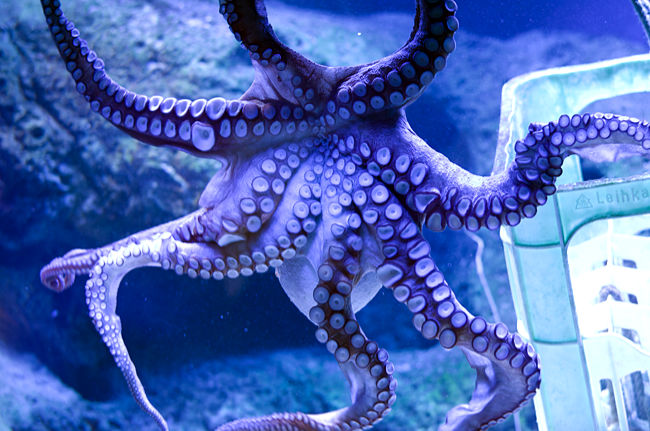
In addition to the 19th-century harbor facilities, the Zoo am Meer is the oldest attraction on the site between the Weser River and the pedestrian zone. It opened in 1928 under the name "Tiergrotten." The enclosures house polar bears, seals, penguins, various bird species such as gannets and keas, reptiles like turtles, raccoons, Arctic foxes, pumas, monkeys, and others - almost 50 animal species in total.
read more ...
Bremerhaven Havenwelten
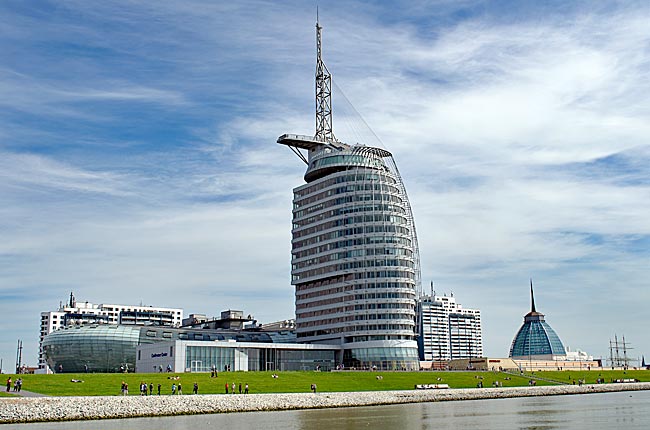
Since early 2008, Bremerhaven has not only had a new tallest building but also a new landmark in its Weser-side skyline with the ATLANTIC Hotel SAIL City, which rises 147 meters directly behind the Weserdeich. Architecturally, the structure perfectly embodies a maritime city - it stands like a powerful, rounded ship's superstructure. On the 20th floor, at a height of 77 meters, there is an observation deck (SAIL City) that is also accessible to non-guests.
read more ...
Bremerhaven - Schaufenster Fischereihafen (Fishery Harbor Showcase)
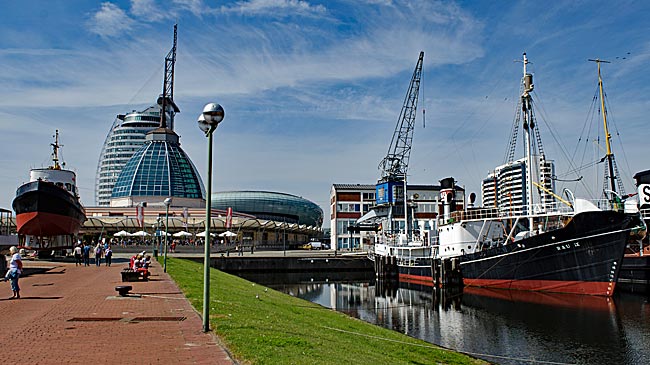
Away from the Havenwelten and older than both the Emigration Center and Klimahaus is the "Fishery Harbor Showcase." In fact, the Fishery Harbor was originally Geestemünde's deep-sea fishing harbor, built between 1891 and 1896. After a period of decline and decay - including partial demolitions - the idea emerged to transform the area into a maritime experience world. In 1990, efforts began to restore Fish Packing Hall IV, the oldest surviving hall, which had been slated for demolition just shortly before.
read more ...
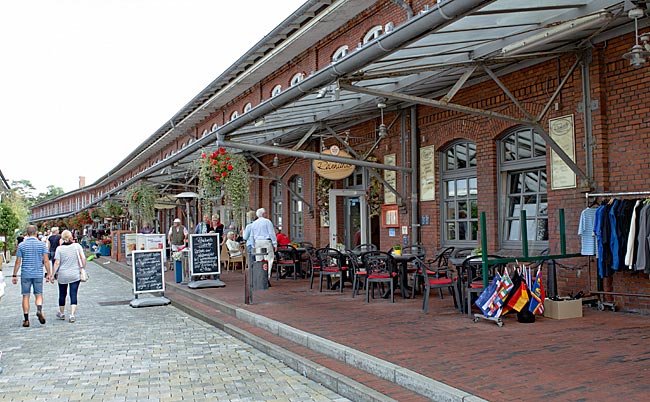
Cuxhaven - a day trip
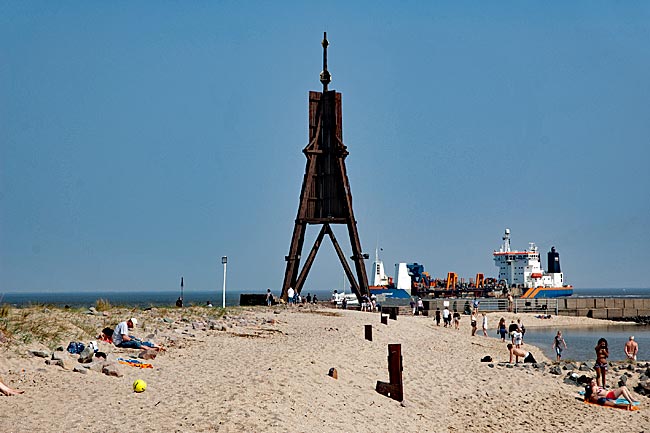
Many people from Bremen consider the seaside resorts of Cuxhaven to be "their home beach." The coastal city at the mouth of the Elbe is easily accessible from Bremen by car via the A27, which passes by Bremen and Bremerhaven before ending in Cuxhaven. By train, the journey takes a bit longer with a transfer in Bremerhaven. However, even in the off-season, Cuxhaven with its seaside resorts is a great destination for an outing - for example, by bicycle.
read more ...
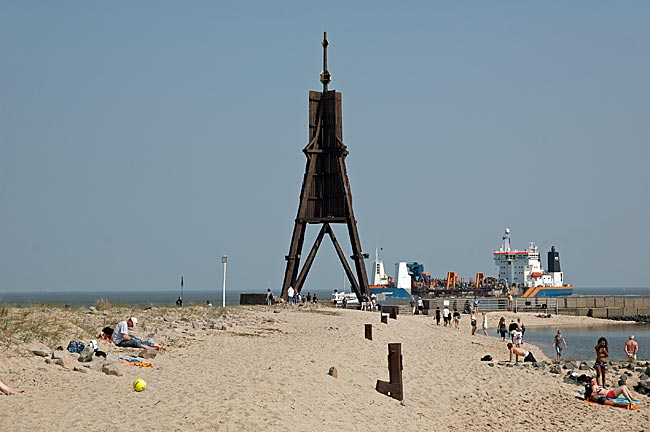
Heligoland - a day trip
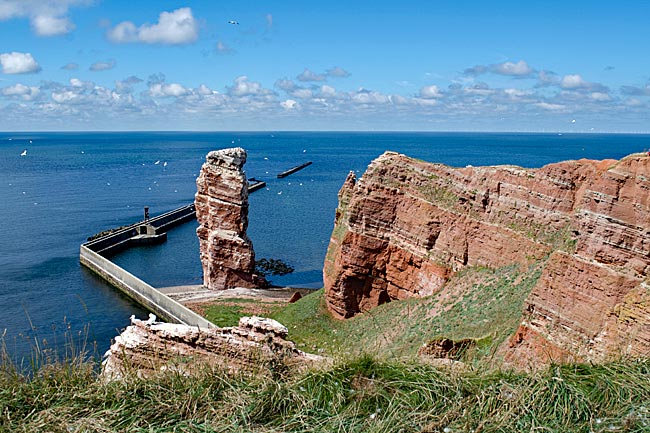
Germany's only supposed high-seas island is visited each year by thousands of tourists, most of them day-trippers in the warmer months. And yes, admittedly, Heligoland isn't located right in the vicinity of Bremen. However, it can be reached as a day trip from Bremerhaven and Cuxhaven - which is why we decided to visit.
read more ...
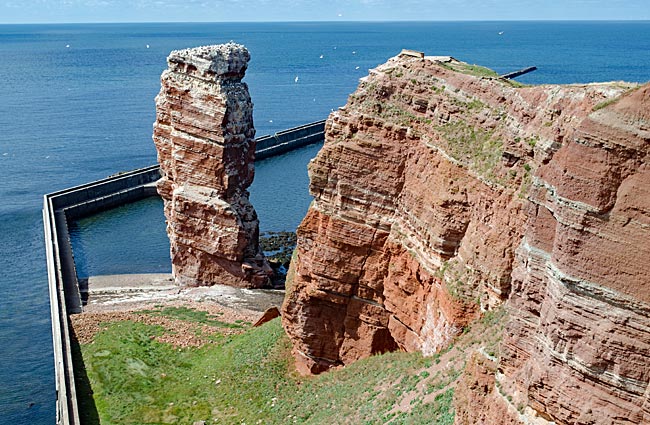
Brake & the River Island of Harriersand
As soon as spring arrives and the temperatures reach around 20 degrees, many Northern Germans are drawn to the North Sea coast. The main attraction? A beach to lie in the sun and sand for children to dig and build castles. This also draws many people from Bremen to the highways heading north on warm weekends, equipped with bags packed and picnic baskets ready for a day of seaside relaxation. But why travel far when the nearest beach is just around the corner? A visit to Brake and Harriersand proves that.
read more ...
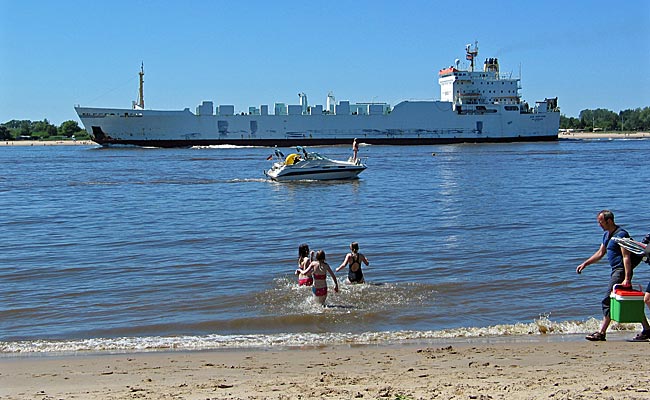
Wilhelmshaven – Seaside City on the Jadebusen
It's hard to imagine Wilhelmshaven without its naval presence, as the city only developed after a naval base was built in the 19th century. Even today, the German Armed Forces (Bundeswehr) maintain a large base here with several squadrons. Yet, there is much more to discover in this port city beyond its military significance.
read more ...
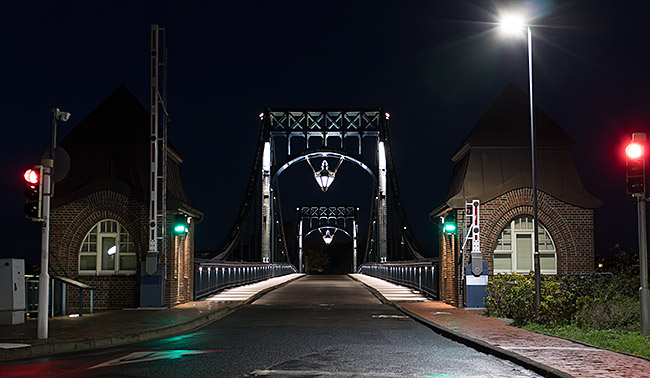
Vegesack
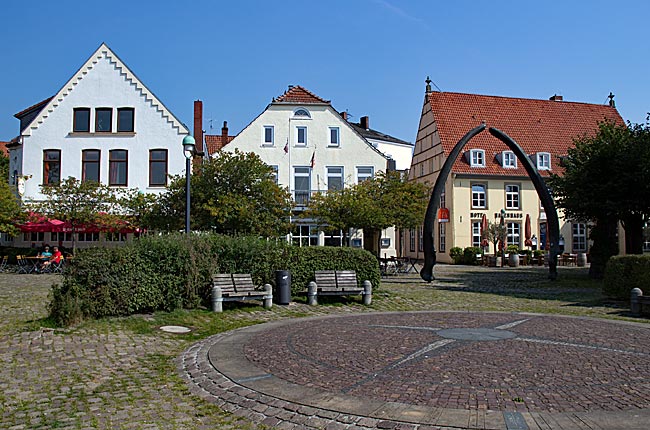
The most interesting area extends around the ferry terminal. From the seats of the nearby cafés and restaurants, you can almost watch the ferry operations. In front of the square stand the enormous lower jaws of a blue whale. Measuring 7.1 meters long, up to 1 meter wide, and weighing 1.2 tons, these bones belonged to a 26-meter-long animal that the port town received as a gift in 1961.
read more ...
SAiL Bremerhaven
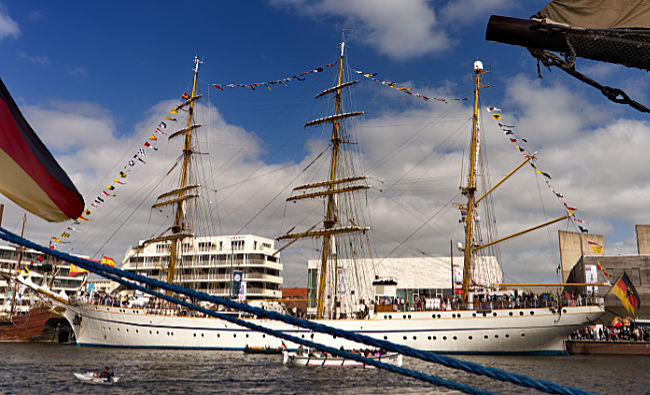
When SAiL Bremerhaven takes place, the port city becomes an even more international stage than it already is, both in terms of participants and visitors, who exceed ten million over the five days of the event. Unlike the usual focus on cargo ships at the container terminal and cruise ships at the cruise terminal, this time - true to its name - the spotlight shifts primarily to sailing ships. In total, 250 vessels were attracted or involved in the SAiL, which returned for the first time in ten years in 2025.
read more ...