

DISTANT PLACES
Travel tips by Bremen sehenswert far from the Hanseatic City of Bremen
Kos - The Greek Dodecanese Island
A Travel Guide
Kos Town - Asclepieion
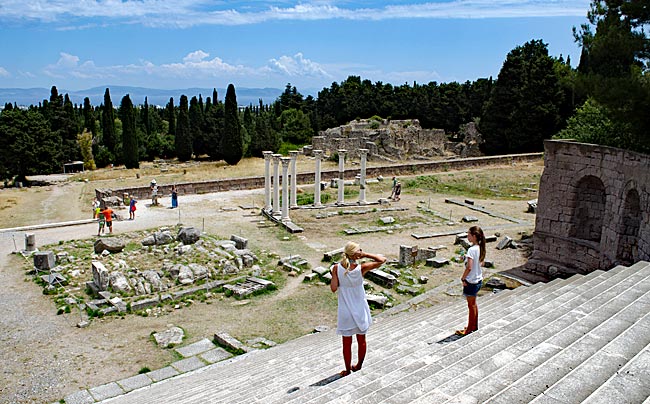
A wide view from the top terrace
While there is plenty to see for archaeology enthusiasts in the island’s capital, the most significant site is located behind the village of Platani, four kilometers outside the city: the Asclepieion of Kos. A regularly scheduled bus on Line 3 transports visitors from the harbor to the entrance of the expansive, tree-lined area situated at an elevation of about 100 meters at the foot of the Dikeos Mountains. From the highest point of the site, one has a beautiful view of part of the city and the coast, as well as the nearby Anatolian mainland - Turkey - which is within easy reach.
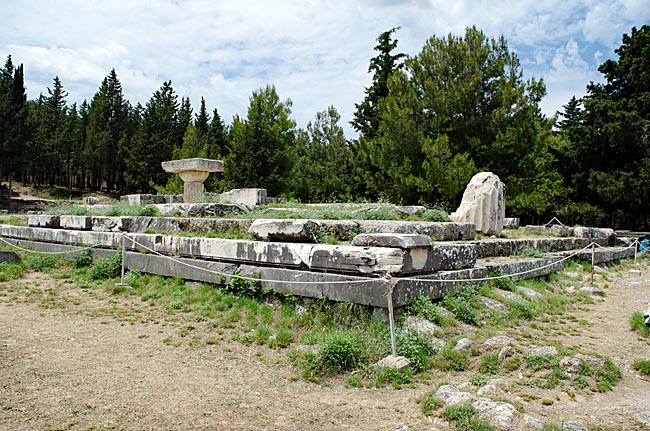
Fragments of a Doric temple on the top level of the complex
Asclepieia, such as the site here, were sanctuaries dedicated to the god of healing, Asclepius (referred to by the Romans as Aesculapius), in Greek antiquity starting from the 5th century BC and for two centuries later by the Romans. At this location on Kos, patients were examined, treated, and cured, primarily following the teachings of the famous physician Hippocrates, who was born on the island.
It was the discoveries of historian Iakovos Zaraftis that eventually allowed German archaeologist Rudolf Herzog to excavate the cult site between 1902 and 1904. What emerged was a complex spanning several terraces. A wide open staircase connects the three levels. The site was expanded repeatedly over several centuries. The oldest structures of the temple complex are dated back to the 3rd century BC.
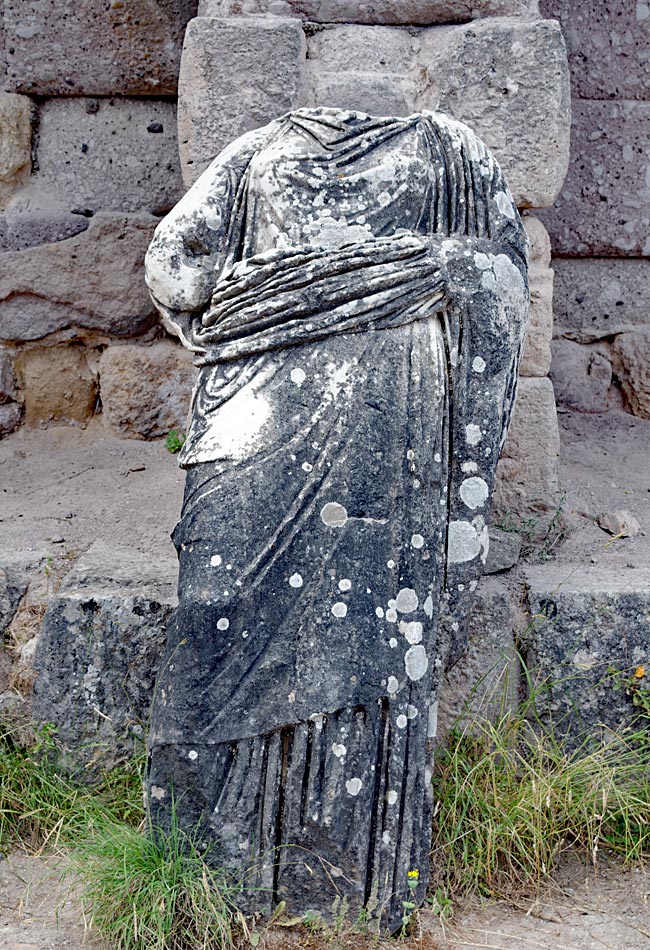
One of the few remaining statues
In the region where Kos is located, the Earth's crust is still in motion; here, the African Plate steadily moves beneath the Aegean Plate, causing frequent earthquakes to this day. In the years 142 BC and 554 AD, two powerful earthquakes destroyed large parts of the structures on the island, including the temple complex, which was subsequently used as a quarry for new constructions such as the Neratzia Knights' Fortress.
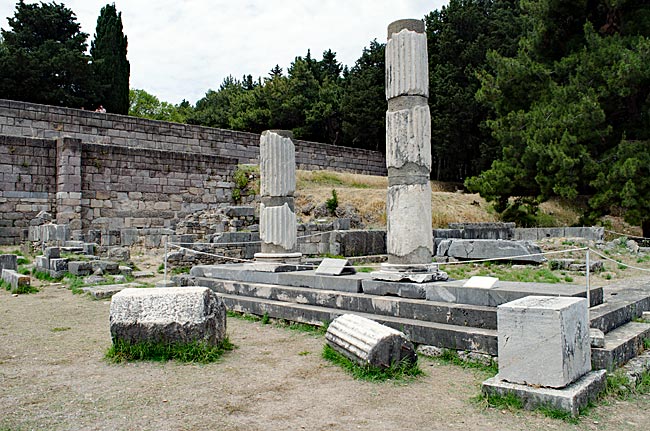
Remains of the Ionic Temple of Asclepius from the 3rd century BC
The second level is the oldest part of the sanctuary; here stands the Ionic Temple of Asclepius from the 3rd century BC, with the Asclepius altar nearby. Formerly, living quarters for the priests were located next to the temple, the outlines of which can still be clearly identified.
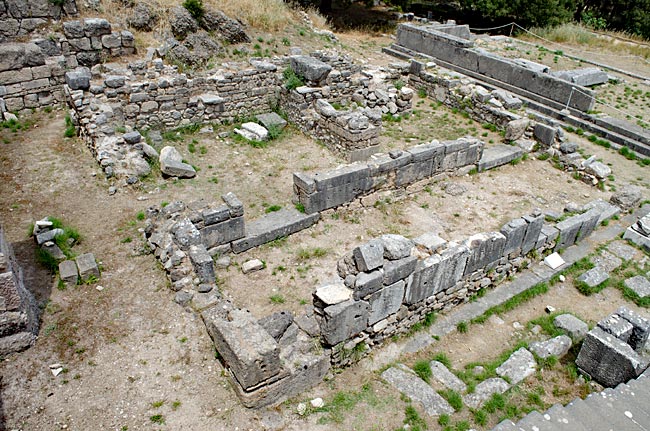
Living quarters for the priests
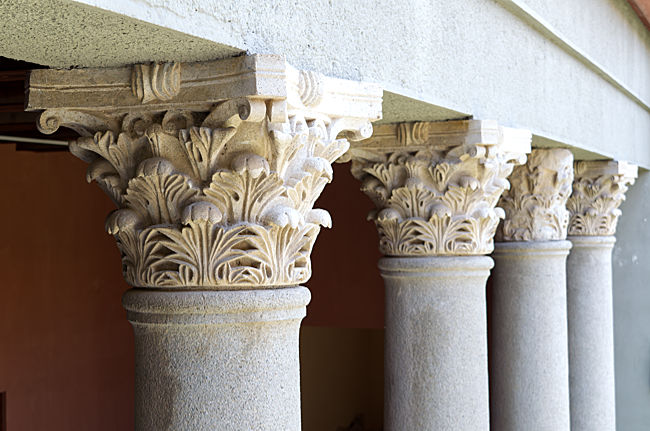
In front of a semicircular exedra bordering the open staircase -which features niches built into the wall and seating areas - parts of a temple to Apollo can still be seen; it was later constructed in the Corinthian order. Seven columns have been erected upon its foundations. The fact that two temples dedicated to Asclepius and Apollo stand close together is no coincidence, as Asclepius is considered the son of Apollo in Greek mythology.
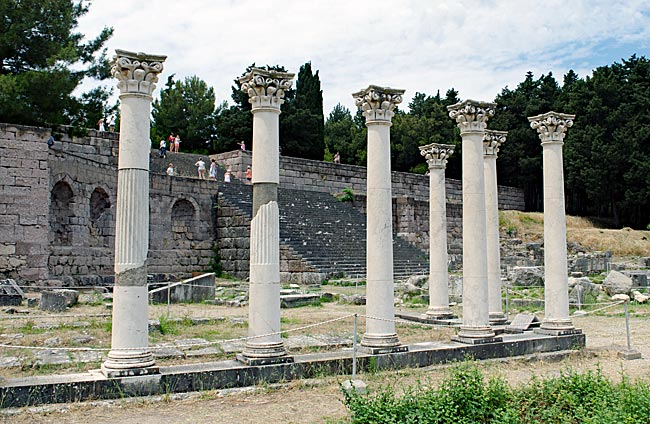
The columns of the Temple of Apollo; behind them, the exedra next to the open staircase
Another structure was located on this level, which served as an assembly room in antiquity.
The first level of the complex was enclosed on three sides by a colonnade, as evidenced by the remaining foundations and fragments of columns. This area also contained the rooms that served as accommodation for patients during their medical treatment period, as well as the treatment rooms themselves. There were even underground rooms where patients with leprosy and venereal diseases were housed separately. However, the walls rising on the left side when viewed from the entrance date from the Roman period and housed bathhouses (thermae).
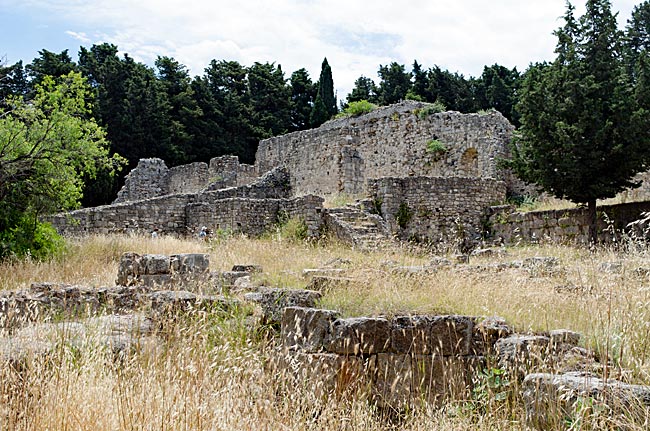
Remains of Roman structures on the site
Another indication of the Romans is found in a niche to the right of the open staircase. The physician from Kos, Gaius Stertinius Xenophon, donated what is known as the "Altar of Xenophon" (according to an inscription on its base), in front of which a small temple once stood. The man was the personal physician of the Roman Emperor Claudius, who was born in 10 BC and reigned for 13 years until his death in 54 AD.
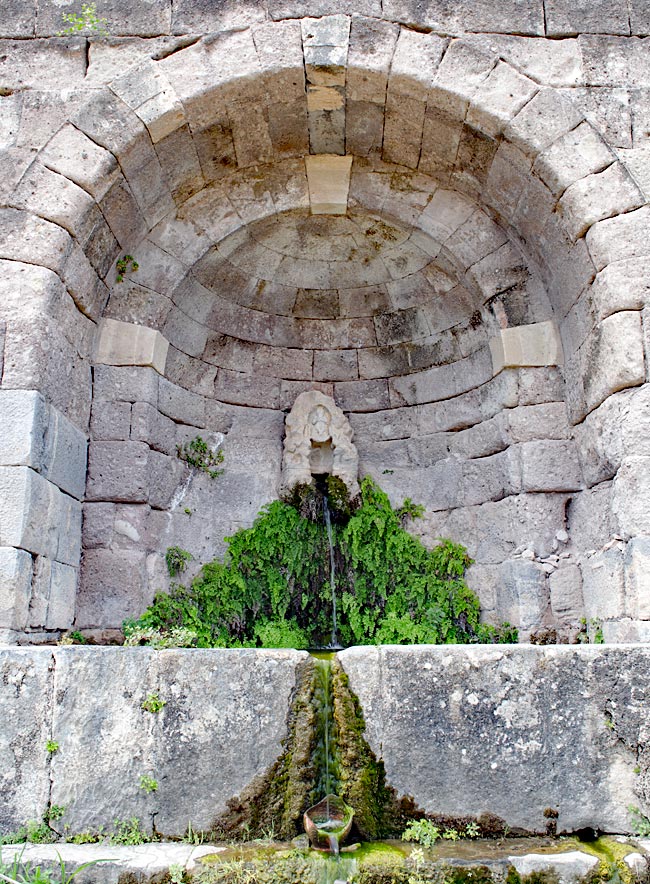
Some water still flows: the Pan Fountain
In the third of many niches on the left side of the open staircase, one can find the small Pan Fountain. It takes its name from a small relief above the water outlet depicting the shepherd god from Greek mythology. Statues are believed to have once stood in the neighboring niches.
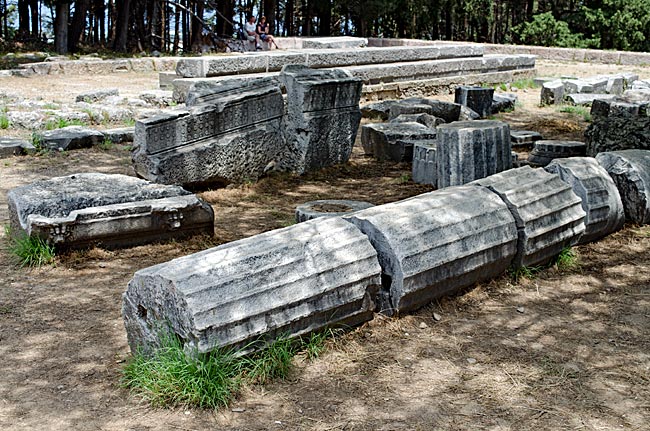
Fragments of the Doric temple
Climbing the steps to the top level provides a good overview of the partially reconstructed Asclepieion and places you where the largest temple on the site once stood. The builders created a marble copy of the Doric Temple at Epidaurus here - the most significant ancient sanctuary on the Peloponnese dedicated to the god of healing, Asclepius. Evidence shows that Christians used the temple as a church during the later Byzantine period.
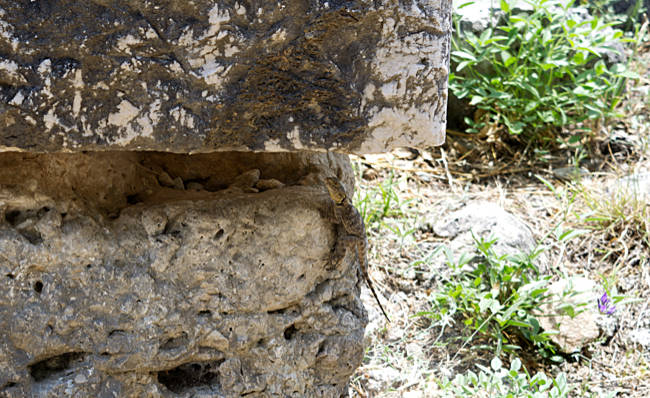
Fragment with small lizard
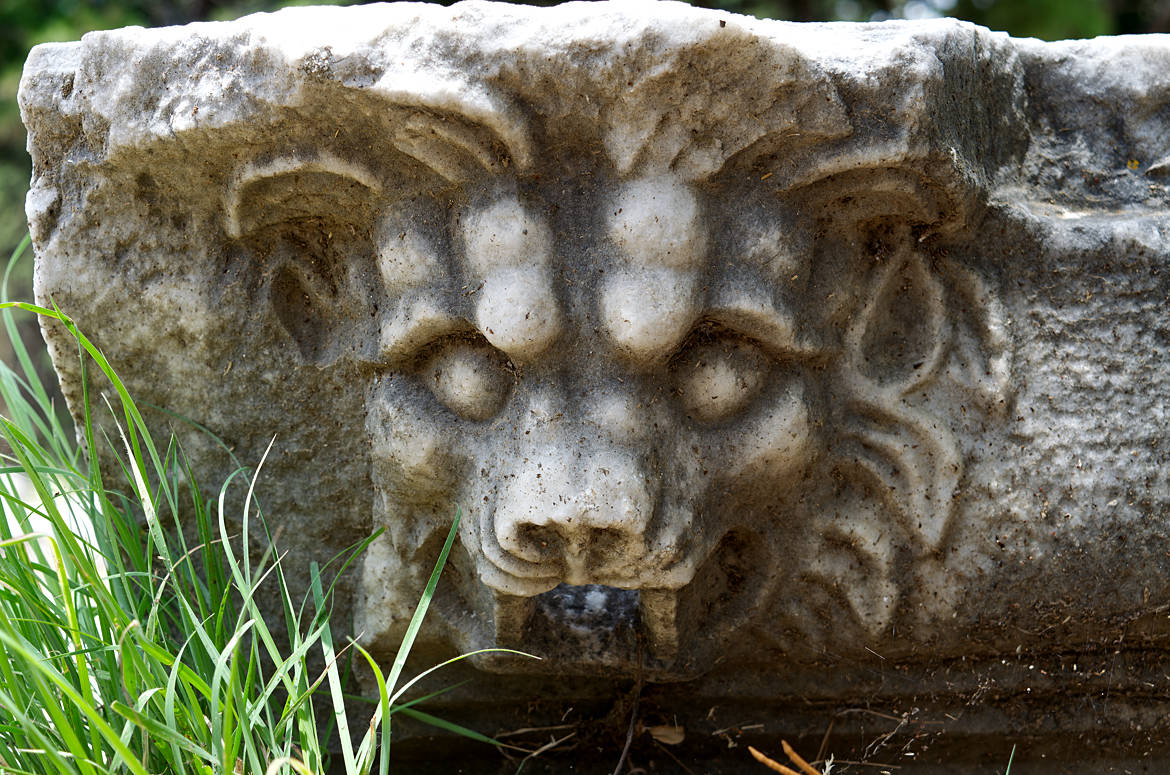
Today, wall fragments and foundation bases still bear witness to the building's former size. Fragments of columns and other worked stones, some featuring animal heads or geometric patterns, lie scattered across the site. In between them, small lizards scurry about, and greenery thrives wherever it can find a foothold.
The town of Kos — it's worth seeing
Introduction
Freedom Square with Market Hall, Defterdar Mosque & Archaeological Museum
Agora and Gate of Taxes
Hadji-Hassan Mosque, Plane Tree of Hippocrates & Palace of Justice
Knights of Rhodes Fortress Neratzia
Dionysus Sanctuary, Casa Romana, Odeon
Western Excavation Site
Asclepieion (slightly outside town)
previous page
 next page
Read more about Kos: The table of contents
Map
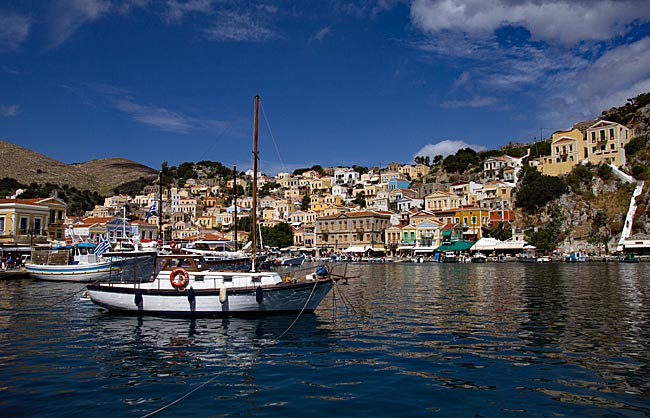
UNESCO World Heritage Site on Rhodes
A journey through the historic Old Town of Rhodes
Relics from various eras - ranging from antiquity to the period of Italian occupation - can be found almost everywhere on the island. Many have left their mark; in some places, they must be sought out, while in others, they appear in clustered, fascinating density and variety. Yet, nowhere else on the island are these traces as prominent as they are in the city of Rhodes. It is not for nothing that the historic Old Town was declared a UNESCO World Heritage site in 1988.
read more about Rhodes Old Town ...
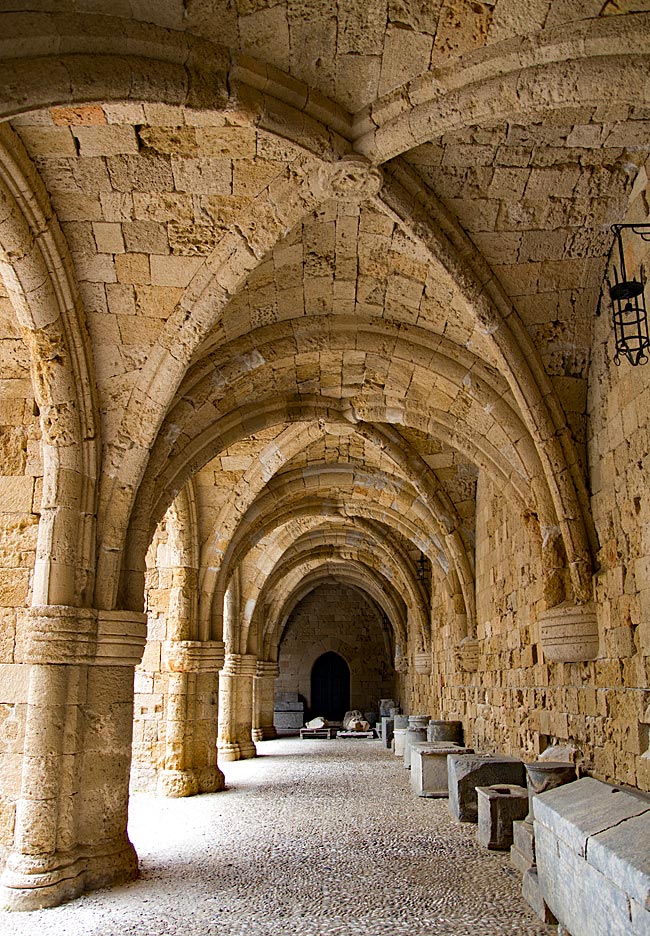
Symi
An excursion to the Greek Dodecanese island off the Turkish coast
A visit to this sparsely populated rocky island of about 60 square kilometers, with its namesake picturesque harbor town, is part of the standard tour itinerary offered in many locations on the Greek island of Rhodes. From the main island, it takes ships approximately two hours to reach the port of the small island located 23 kilometers north of Rhodes off the Turkish coast, which has belonged to Greece since 1947. As more of the Greek coast recedes into the distance to the port side, the ship draws closer to the Turkish shore; this part of the southern Aegean essentially connects Europe and Western Asia.
read more about Symi ...
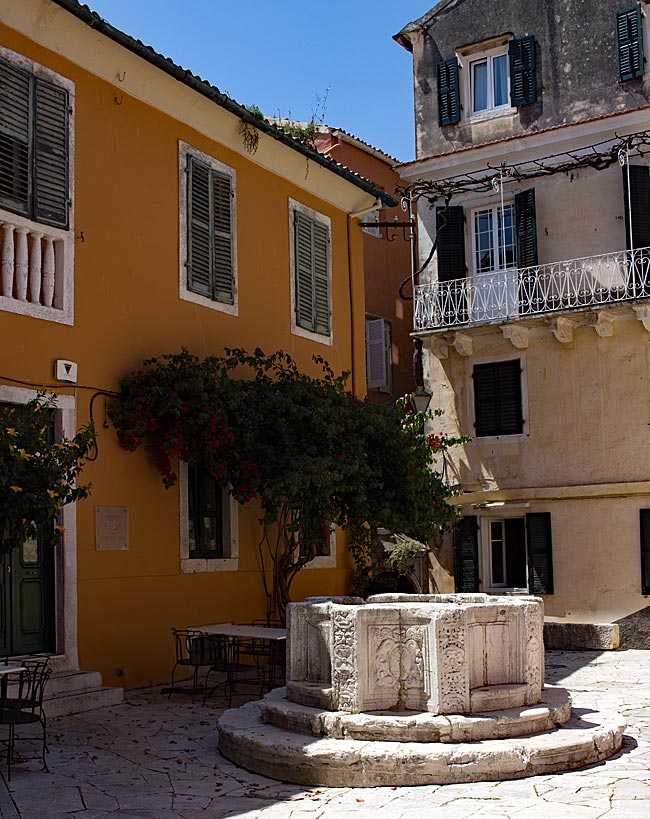
The "Green" Island of Corfu
From the sights of the capital, Kerkyra, to the Corfu Trail
The Greeks call not only the city but the island itself Kerkyra. According to legend, it was named after the nymph Gorgyra (also known as Kerkyra), who was brought to the island by the sea god Poseidon. A legend, indeed. In fact, the name appears in a modified form, "Korkyra," on written records as early as 1200 BC. The current name, Corfu, dates back to the Byzantine era. Once an independent island and later the first Roman province of modern Greece, it became part of the Eastern Roman (Byzantine) Empire after the fall of the Western Roman Empire in 395 AD. On a rocky promontory jutting into the sea, the Byzantines built a fortress in the early 6th century and named the city emerging from this core "Koryfo."
read more about Kerkyra ...
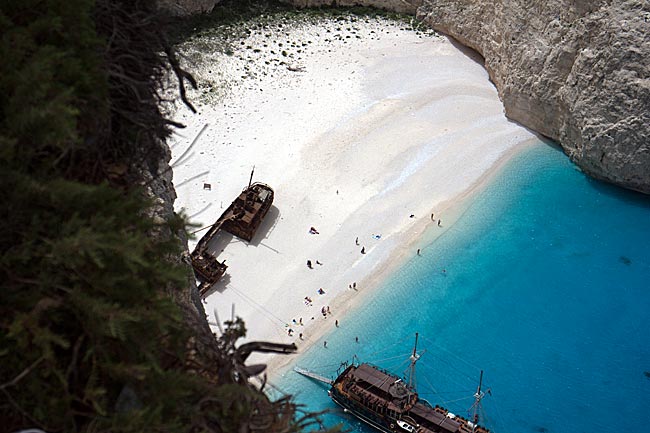
Zakynthos
An island defined by the Caretta caretta
When searching for images of the 406 km² island online, one primarily encounters a very common recurring motif that has been captured from a similar angle by various photographers over the years: Navagio Bay on the northwestern coast. It's all junk, right? Well, that is a matter of perspective, and there are plenty of those during the season, whether they have a camera or not. The fact remains, however, that the rusting wreck of the motor vessel "Panagiotis" has become a landmark for Zakynthos.
read more about Zakynthos ...
More photos