

DISTANT PLACES
Travel tips by Bremen sehenswert far from the Hanseatic City of Bremen
Kos - The Greek Dodecanese Island
A Travel Guide
Kos Town – Hadji-Hassan Mosque, Plane Tree of Hippocrates, and Palazzo di Giustizia
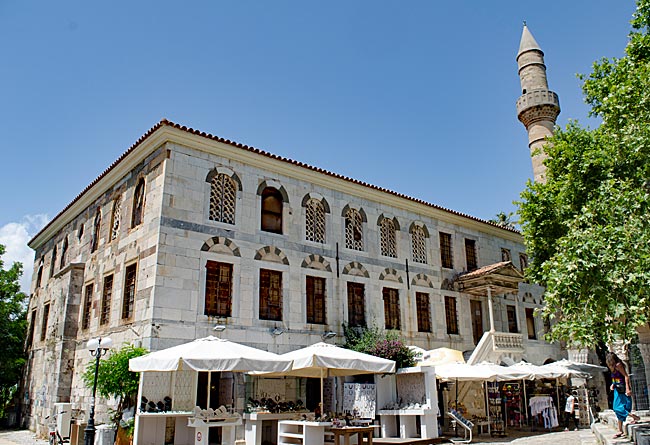
Hadji-Hassan Mosque surrounded by mobile vendors
Following this path past the eateries on Odós Nafklírou, you will find the second mosque of Kos Town at Platía Platanoú. The Hadji-Hassan Mosque was completed in 1786 during the Ottoman period, and like its neighbor, it no longer hosts Friday prayers. Looking up at its towering minaret and the purification well located in the square -whose dome rests on Corinthian columns, an unusual combination - the building does not give the impression of a traditional Islamic house of worship; instead, it bears the characteristics of a secular palace. Known as the "Arcaded Mosque" due to its use of portico-style architecture, this three-story structure is topped with a tiled hipped roof rather than a dome like the Defterdar Mosque.
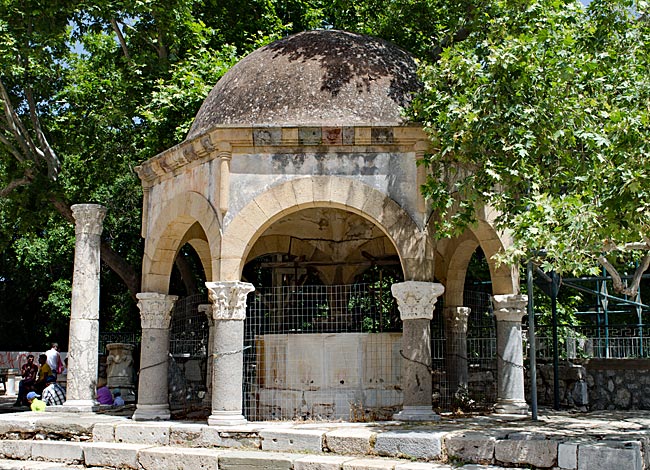
Under renovation: the purification well in front of the mighty Plane Tree of Hippocrates
While the entrance portal appears inviting, the rooms on the upper floors are inaccessible to the public due to structural defects. However, the ground-floor rooms have been taken over by shops that set up stalls and racks with their wares on the square during business hours.
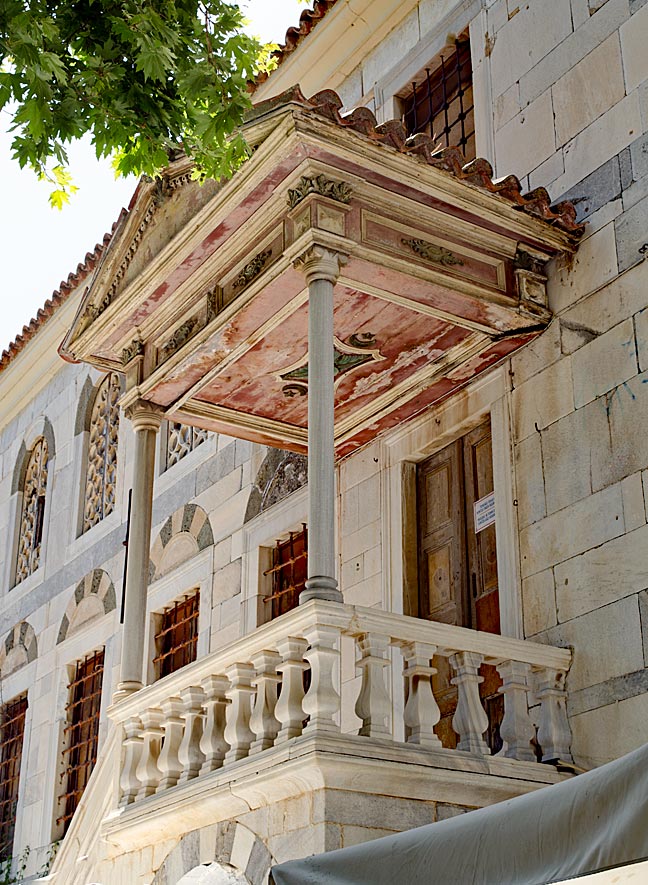
The entrance of the Hadji-Hassan Mosque
The area is called Platía Platanoú because of the massive Plane Tree of Hippocrates standing in its center. Legend has it that the famous forefather of modern medicine planted it over 2,500 years ago and taught under its sprawling branches. However, research indicates that this legend - as well as the one concerning the preaching of the Apostle Paul under its boughs - is indeed just a legend, as the tree is estimated to be only about 500 years old.
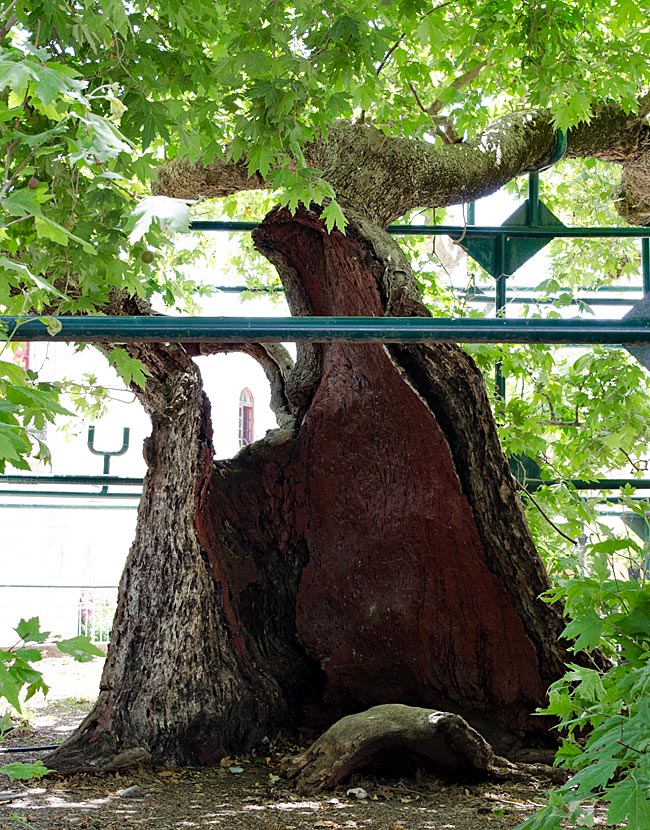
The Plane Tree of Hippocrates
Today, the massive trunk of the tree is hollow and lined with a red protective coating; nevertheless, it still bears leaves on its branches every year. These branches, however, must be supported by an extensive frame of steel pipes; otherwise, they would break off and crush the ancient stone sarcophagus beneath them, which the Ottomans repurposed as a well.
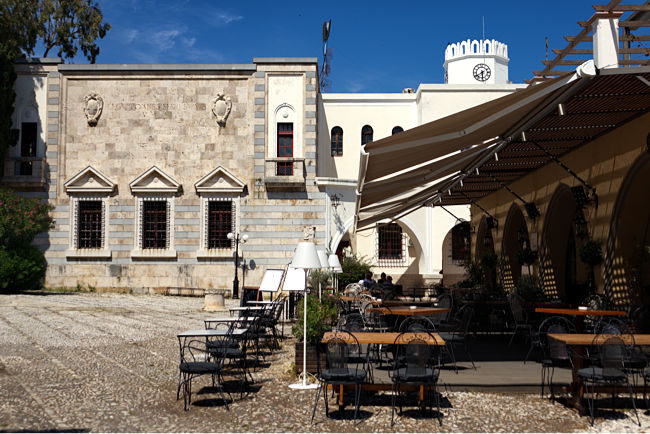
The back of the Palazzo di Giustizia featuring a restaurant adjacent to the Agorá
Facing the plane tree and mosque, the Italians built a small "palace" in 1928. Although the white-washed Palazzo di Giustizia may look like it, it is not one. It is an active courthouse where trials are still held today, and administrative offices also occupy its rooms. From Platía Platanoú, however, you can only see the rear of the palace; the true splendor of its ornate facade can only be seen from the waterfront road. With a little imagination, one can notice a slight architectural resemblance to the nearby Neratzia Fortress.
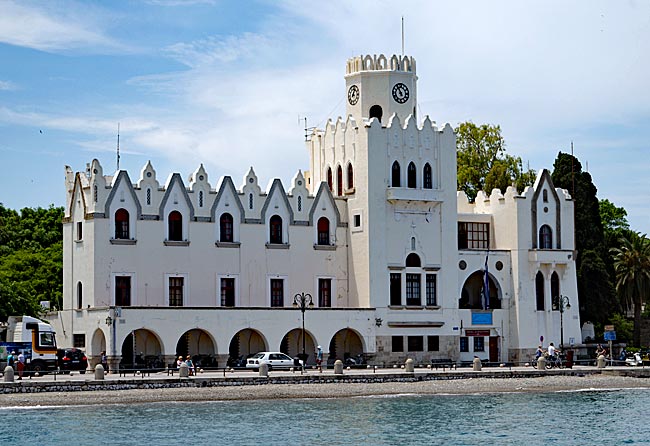
The front view of the Palazzo di Giustizia
Beyond the Palazzo di Giustizia on the other side of the waterfront road lies a narrow, somewhat stony beach by the water. However, relaxing here is only moderately pleasant, as a busy bus stop is located right behind it and the waterfront road is heavily trafficked.
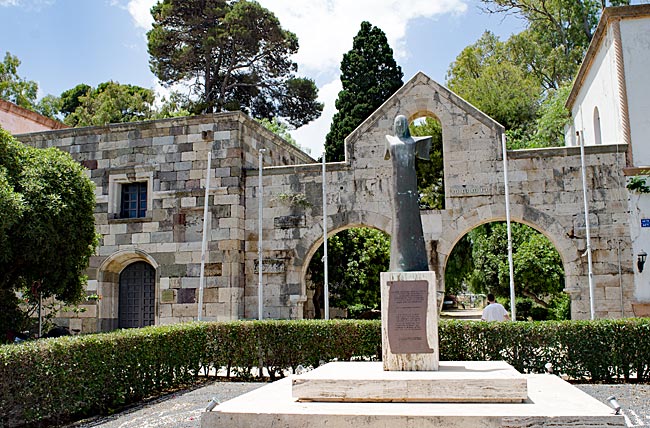
The stately manor of former Governor Francesco Sans
Just a few steps further, past the palace, you will find the stately manor house of former Governor Francesco Sans, which he had built here in 1514. It sits directly against the medieval city wall and owes its excellent condition to restoration after being used for various purposes over the centuries, including as a café.
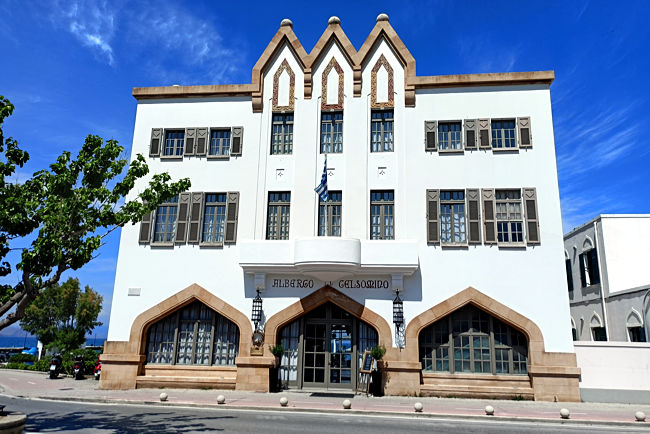
Albergo Gelsomino
Diagonally across on the other side of the street lies the former governor's palace, though it was intended for a different governor than Francesco Sans. The "Albergo Gelsomino" was built by the Italians in 1929, one year after they completed the courthouse building. Today, it houses the Tourist Office.
The town of Kos — it's worth seeing
Introduction
Freedom Square with Market Hall, Defterdar Mosque & Archaeological Museum
Agora and Gate of Taxes
Hadji-Hassan Mosque, Plane Tree of Hippocrates & Palace of Justice
Knights of Rhodes Fortress Neratzia
Dionysus Sanctuary, Casa Romana, Odeon
Western Excavation Site
Asclepieion (slightly outside town)
previous page
 next page
Read more about Kos: The table of contents
Map
UNESCO World Heritage Site on Rhodes
A journey through the historic Old Town of Rhodes
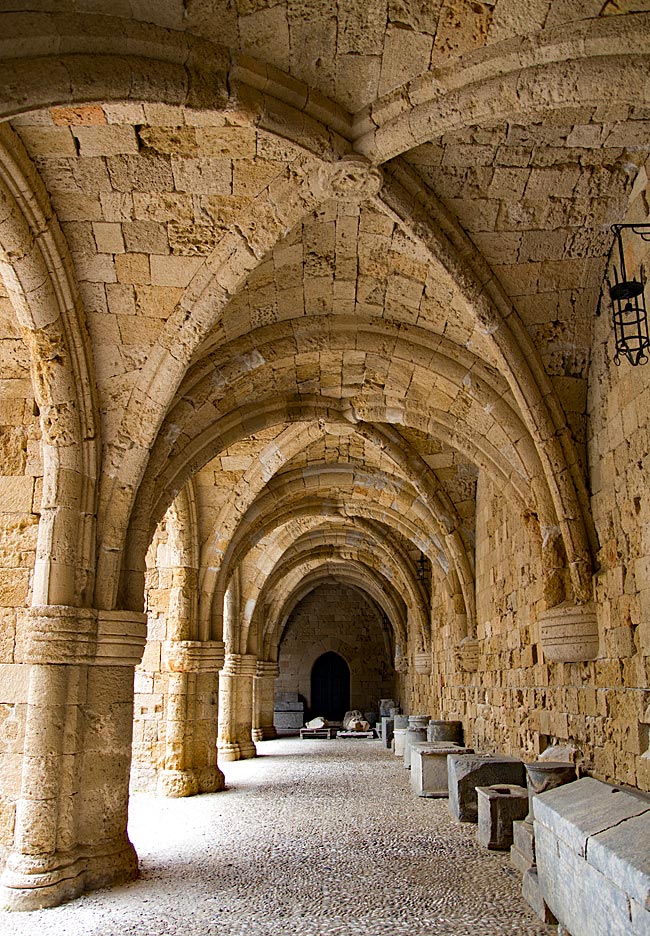
Relics from various eras - ranging from antiquity to the period of Italian occupation - can be found almost everywhere on the island. Many have left their mark; in some places, they must be sought out, while in others, they appear in clustered, fascinating density and variety. Yet, nowhere else on the island are these traces as prominent as they are in the city of Rhodes. It is not for nothing that the historic Old Town was declared a UNESCO World Heritage site in 1988.
read more about Rhodes Old Town ...
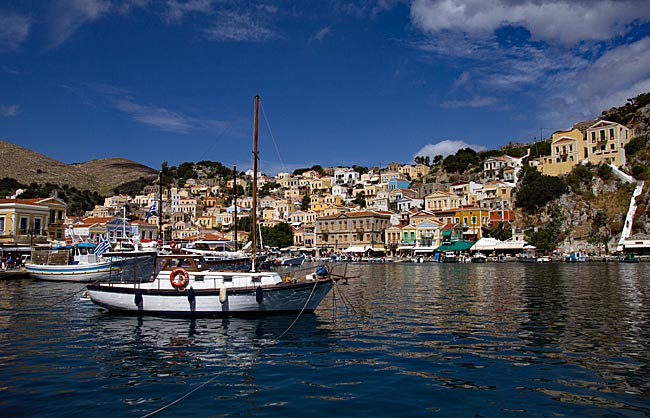
Symi
An excursion to the Greek Dodecanese island off the Turkish coast
A visit to this sparsely populated rocky island of about 60 square kilometers, with its namesake picturesque harbor town, is part of the standard tour itinerary offered in many locations on the Greek island of Rhodes. From the main island, it takes ships approximately two hours to reach the port of the small island located 23 kilometers north of Rhodes off the Turkish coast, which has belonged to Greece since 1947. As more of the Greek coast recedes into the distance to the port side, the ship draws closer to the Turkish shore; this part of the southern Aegean essentially connects Europe and Western Asia.
read more about Symi ...
The "Green" Island of Corfu
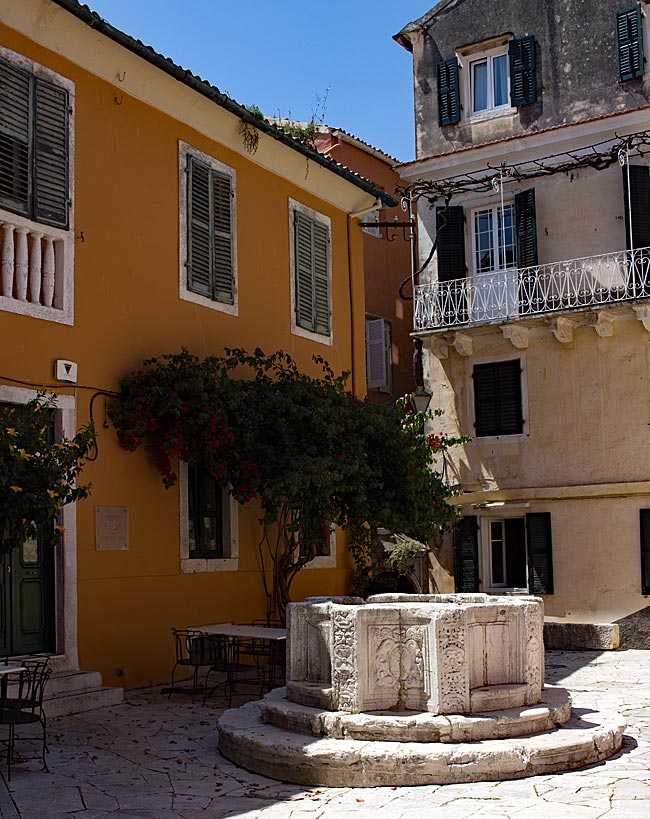
From the sights of the capital, Kerkyra, to the Corfu Trail
The Greeks call not only the city but the island itself Kerkyra. According to legend, it was named after the nymph Gorgyra (also known as Kerkyra), who was brought to the island by the sea god Poseidon. A legend, indeed. In fact, the name appears in a modified form, "Korkyra," on written records as early as 1200 BC. The current name, Corfu, dates back to the Byzantine era. Once an independent island and later the first Roman province of modern Greece, it became part of the Eastern Roman (Byzantine) Empire after the fall of the Western Roman Empire in 395 AD. On a rocky promontory jutting into the sea, the Byzantines built a fortress in the early 6th century and named the city emerging from this core "Koryfo."
read more about Kerkyra ...
Zakynthos
An island defined by the Caretta caretta
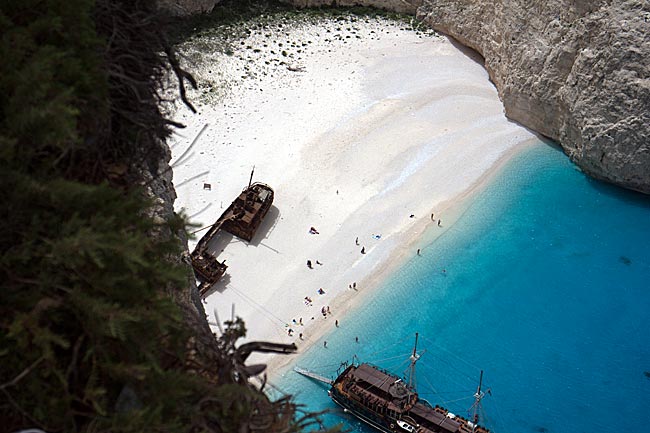
When searching for images of the 406 km² island online, one primarily encounters a very common recurring motif that has been captured from a similar angle by various photographers over the years: Navagio Bay on the northwestern coast. It's all junk, right? Well, that is a matter of perspective, and there are plenty of those during the season, whether they have a camera or not. The fact remains, however, that the rusting wreck of the motor vessel "Panagiotis" has become a landmark for Zakynthos.
read more about Zakynthos ...
More photos