

DISTANT PLACES
Travel tips by Bremen sehenswert far from the Hanseatic City of Bremen
Kos - The Greek Dodecanese Island
A Travel Guide
Kos Town - Dionysus Sanctuary, Casa Romana, Odeon
On the busy Odós Grigóriou E, which leads toward the west of the island, there is an open-access excavation site located below street level, where two ancient ruins situated diagonally opposite each other have been unearthed. Not much more than the outlines of the foundations, a few stones, and some paving can be seen from either. However, since the site lies on the way to the truly impressive Casa Romana, it doesn't hurt to take a look.
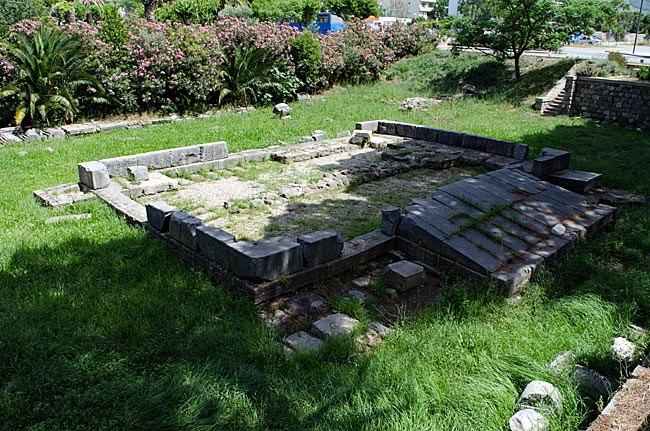
Remains of the Dionysus Altar
The Dionysus Sanctuary consisted of a Doric temple and the Dionysus altar. Dionysus was the god of wine, who also appears in history under the Latin name Bacchus - a reference to his prominent retinue. These Hellenistic structures date back to the 2nd century BC. The altar structure, built in a typical style for that era, features a sort of flat ramp on one of its long sides. The reason the sanctuary was associated with Dionysus is likely due to the discovery of a frieze featuring corresponding depictions.
The Casa Romana
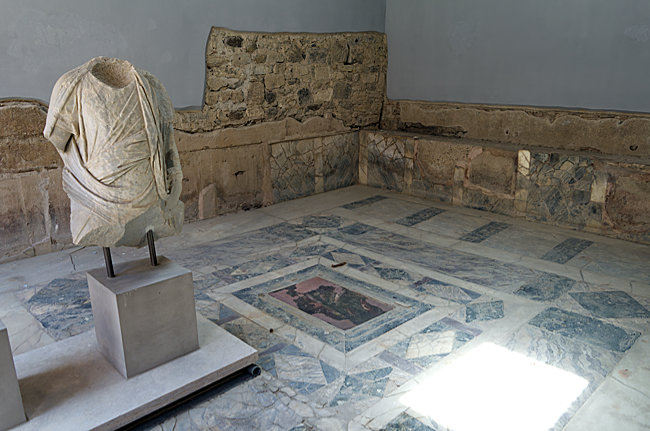
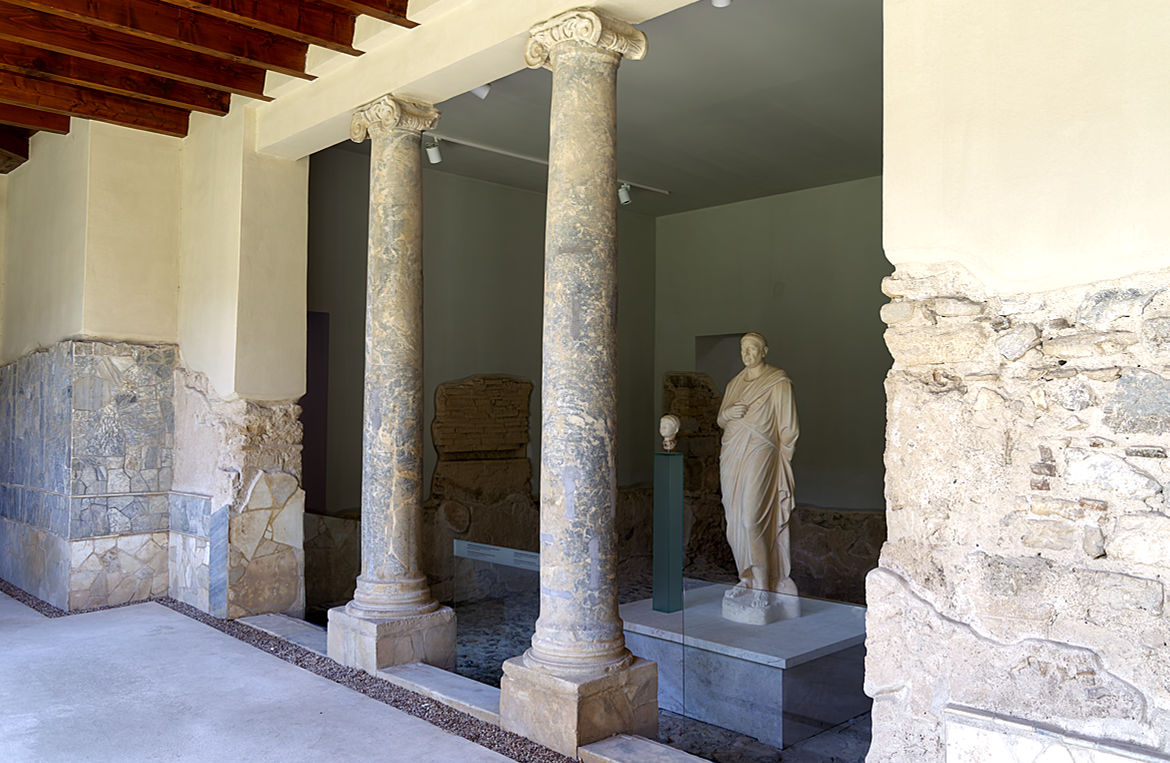
Inside the Casa Romana
Diagonally opposite is the Casa Romana, which is absolutely worth a visit. While it cannot be recognized as such from the outside, the interior is the residence of an upper-class elite during late antiquity in the 2nd/3rd century AD, when the island was part of the Roman Empire.
Once again, it was Italian archaeologists who unearthed the ruins in 1933/34 following the earthquake of '33; the work was completed by 1936. The once-magnificent Roman-style villa was reconstructed between 1938 and 1940 using the ancient finds found on-site, providing an impression of the luxury in which many people of that social class lived.
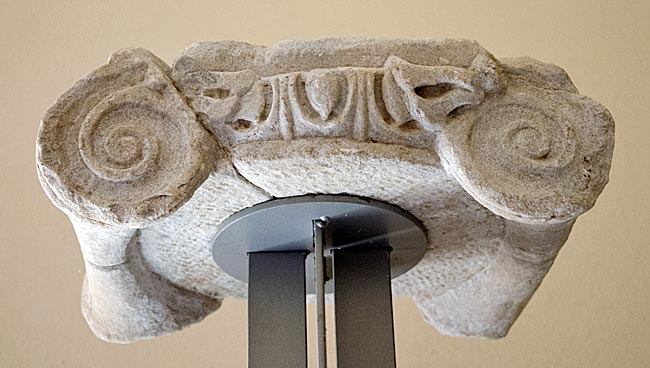
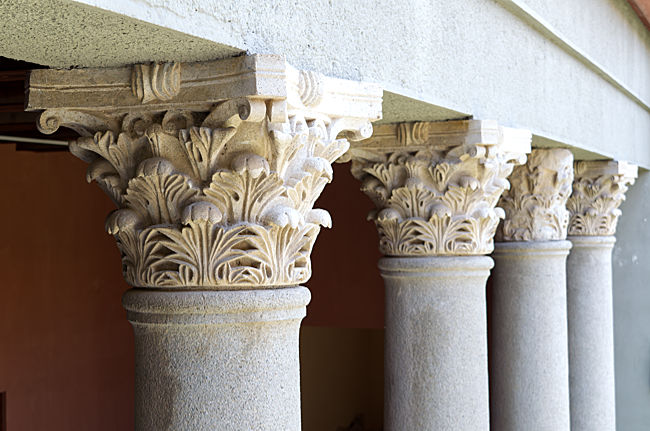
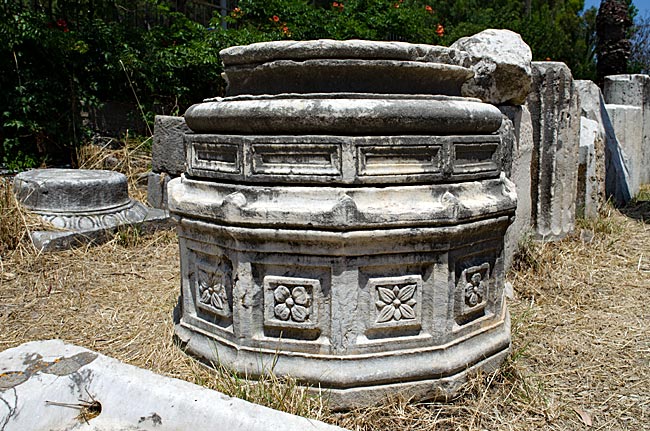
The ceilings of the partially two-story building are supported in some areas by Ionic and Corinthian columns; while most are replicas created for display purposes, original fragments are still incorporated into the structure and displayed as exhibits.
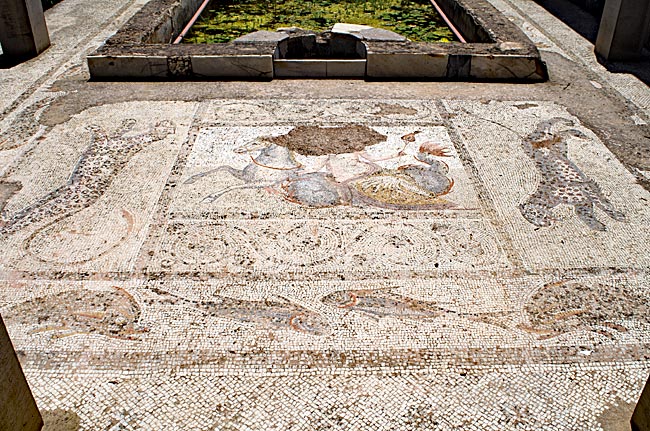
The house features three inner courtyards of different sizes, each with a well or at least a water basin. The ground surrounding the second-largest courtyard and its basin features a magnificent mosaic depicting, among other things, predators, fish, and a central horseman.
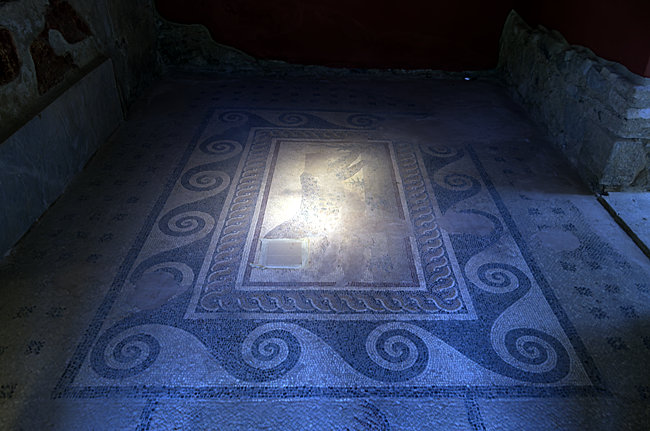
Further floor mosaics made of marble can be found in parts of the former living quarters adjacent to the courtyards. The walls of these rooms are only partially preserved, showing marble paneling and masonry, but they provide an impression of how it might have looked during antiquity while the residents were still alive.
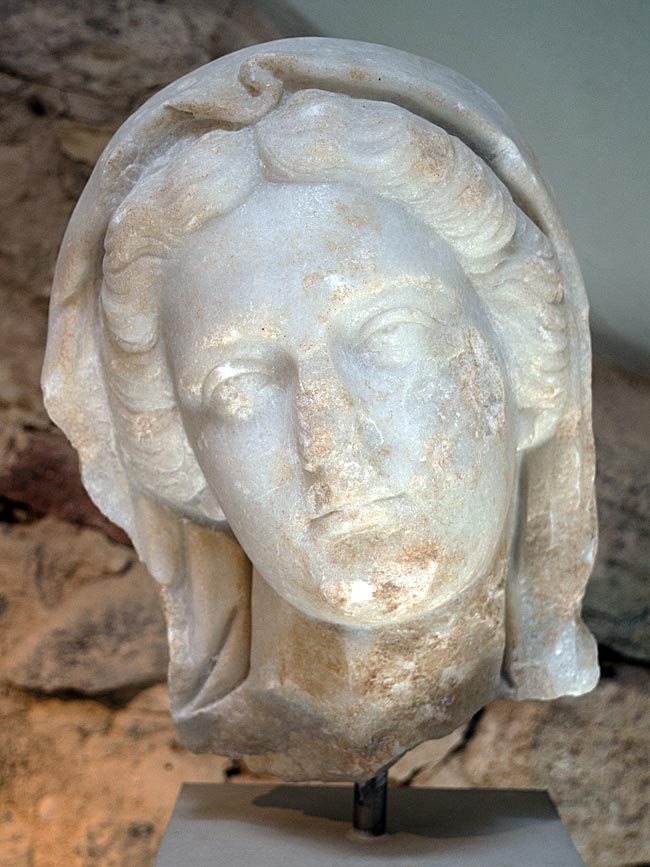
Statues - some life-sized, some merely torsos or small busts, and some as replicas - uniquely "animate" the rooms, which are laid out much like a modern home: living and sleeping quarters, a dining room, laundry and storage areas, a kitchen with an oven, stove, and grill all in one, and a latrine (toilet). In such houses, there was often even underfloor heating powered by hot water.
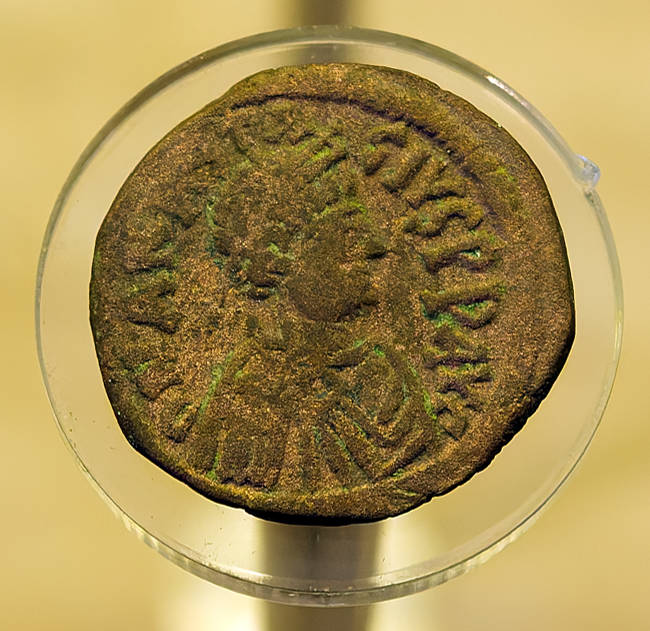
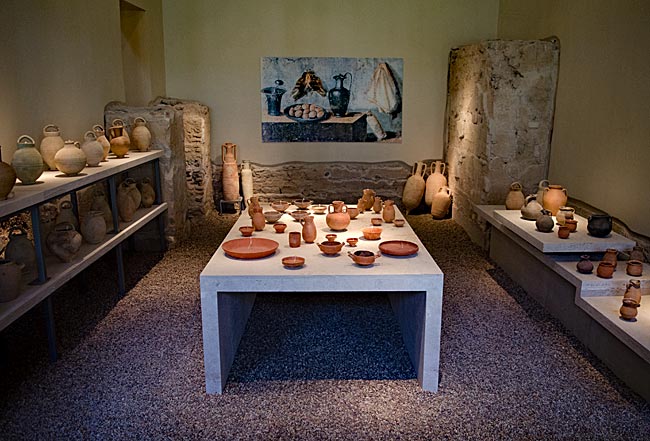
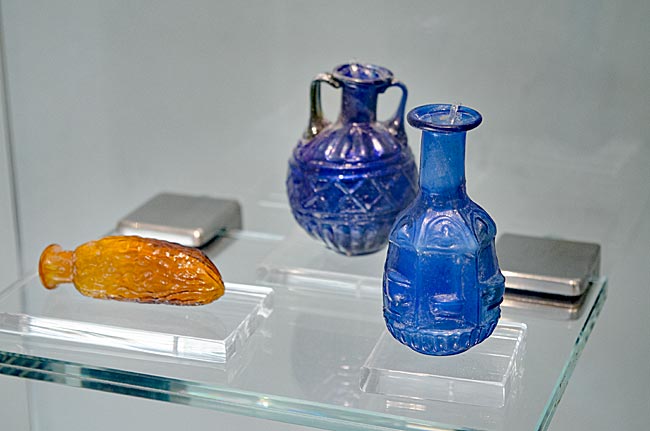
Jars and pitchers, bowls and plates, as well as clay candleholders, vessels made of colored glass, stone construction fragments (e.g., featuring depictions of animals), jewelry, and coins - all these elements in the exhibition attempt to convey a picture of the wealth of the upper class of that era.
The central baths, which lie as ruins in the outdoor area, are little more than remains from which a layperson can extract very little without explanatory signage.
The Odeon
A few meters further, heading toward the outskirts of the city on the same side, you encounter a Roman theater from the 2nd century AD: the Odeon. This also open-access site is not visible from the road; therefore, a signpost guides visitors along an alley lined with large cypresses through a small park before the Odeon reveals itself to those arriving, with its 14 rows of seating for approximately 750 spectators.
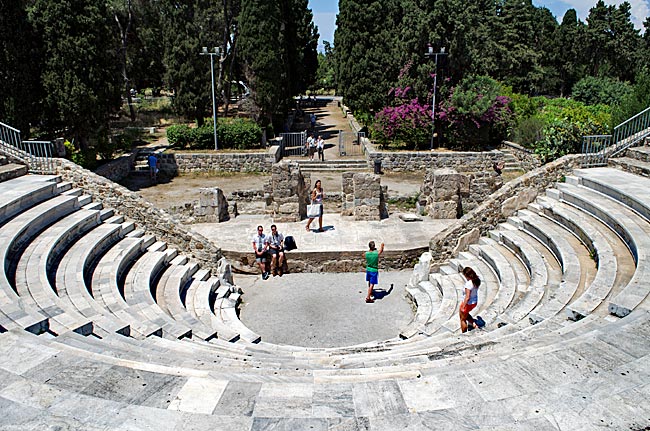
After the theater was discovered by Italian archaeologists in 1929 - prior to the unearthing of the Casa Romana - a restoration took place. While this shows how concerts and plays functioned at the time, it also created a visible discrepancy between old and new, as only fragments of masonry remain from the stage house; the rooms beneath the theater are not accessible to the public. The Italians found one of the oldest objects currently admired in the Archaeological Museum there: the statue of Hippocrates.
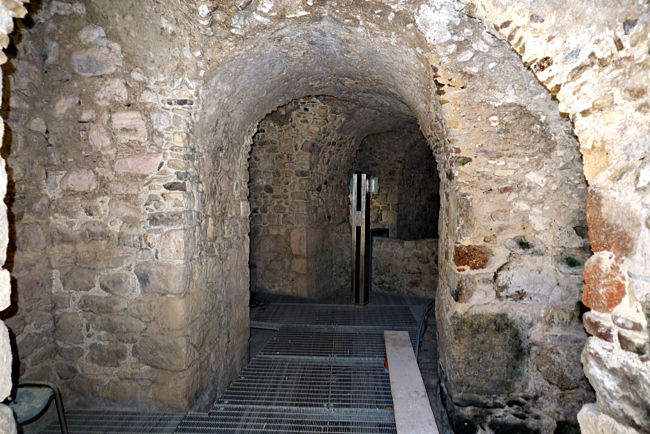
Although the catacombs are not accessible today, they were used for exhibition purposes once and were previously restored; at the very least, one can catch a glimpse through the barred doors and imagine how, during cultural performances, actors would have stepped out of their everyday clothes into their costumes, perhaps reciting their stage lines one last time before props were brought out and put back.
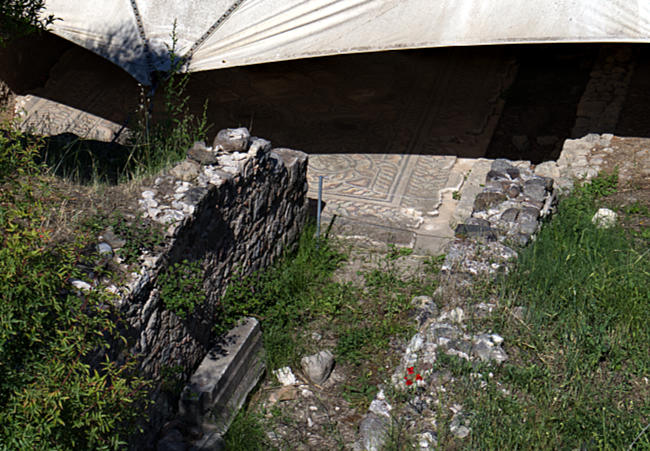
A floor mosaic next to the Odeon is also not accessible today
To this day, the Odeon is still used for events and, when it hosts tourists who wish to stand on the stage at least once in front of their cameras, one might think: "To be, or not to be" - but that was another time and a different place.
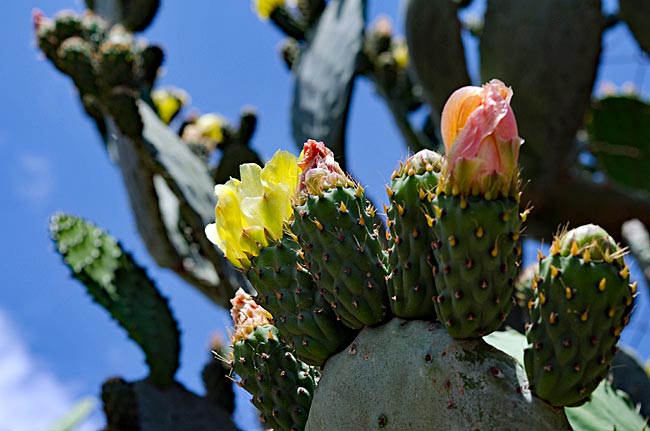
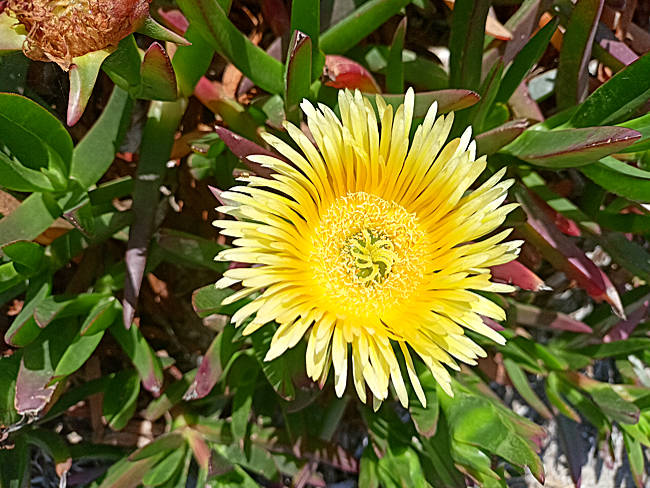
Blooming cacti right next to the Odeon
On the other side of the main road (Odós Grigóriou E), however, lies the expansive Western excavation site with several notable floor mosaics.
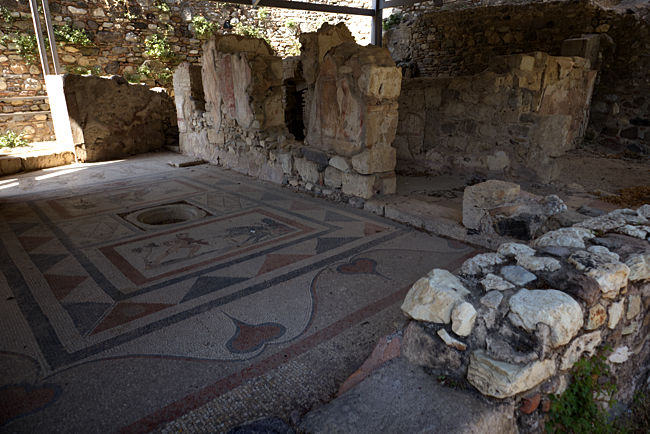
Floor mosaic at the Western excavation site
The town of Kos — it's worth seeing
Introduction
Freedom Square with Market Hall, Defterdar Mosque & Archaeological Museum
Agora and Gate of Taxes
Hadji-Hassan Mosque, Plane Tree of Hippocrates & Palace of Justice
Knights of Rhodes Fortress Neratzia
Dionysus Sanctuary, Casa Romana, Odeon
Western Excavation Site
Asclepieion (slightly outside town)
previous page
 next page
Read more about Kos: The table of contents
Map
UNESCO World Heritage Site on Rhodes
A journey through the historic Old Town of Rhodes
Relics from various eras - ranging from antiquity to the period of Italian occupation - can be found almost everywhere on the island. Many have left their mark; in some places, they must be sought out, while in others, they appear in clustered, fascinating density and variety. Yet, nowhere else on the island are these traces as prominent as they are in the city of Rhodes. It is not for nothing that the historic Old Town was declared a UNESCO World Heritage site in 1988.
read more about Rhodes Old Town ...
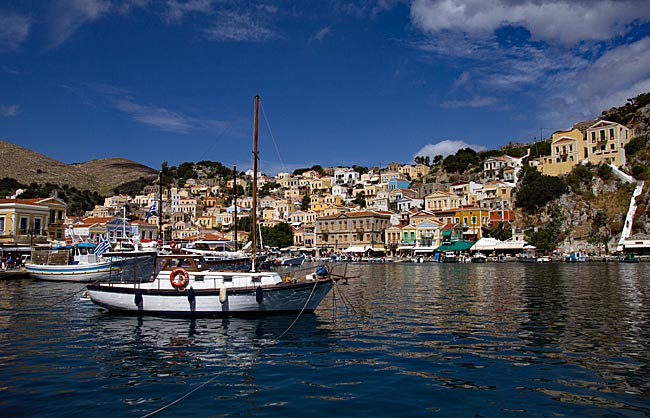
Symi
An excursion to the Greek Dodecanese island off the Turkish coast
A visit to this sparsely populated rocky island of about 60 square kilometers, with its namesake picturesque harbor town, is part of the standard tour itinerary offered in many locations on the Greek island of Rhodes. From the main island, it takes ships approximately two hours to reach the port of the small island located 23 kilometers north of Rhodes off the Turkish coast, which has belonged to Greece since 1947. As more of the Greek coast recedes into the distance to the port side, the ship draws closer to the Turkish shore; this part of the southern Aegean essentially connects Europe and Western Asia.
read more about Symi ...
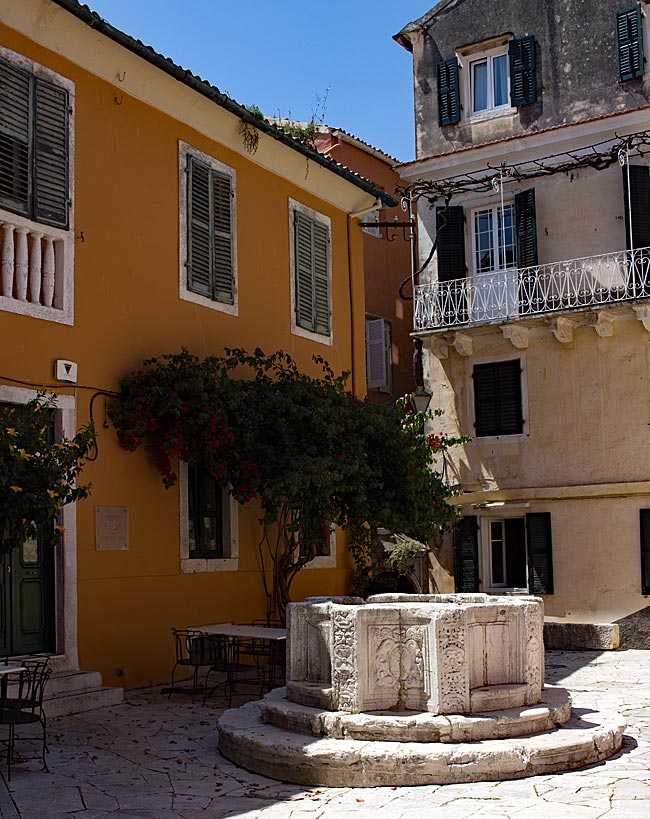
The "Green" Island of Corfu
From the sights of the capital, Kerkyra, to the Corfu Trail
The Greeks call not only the city but the island itself Kerkyra. According to legend, it was named after the nymph Gorgyra (also known as Kerkyra), who was brought to the island by the sea god Poseidon. A legend, indeed. In fact, the name appears in a modified form, "Korkyra," on written records as early as 1200 BC. The current name, Corfu, dates back to the Byzantine era. Once an independent island and later the first Roman province of modern Greece, it became part of the Eastern Roman (Byzantine) Empire after the fall of the Western Roman Empire in 395 AD. On a rocky promontory jutting into the sea, the Byzantines built a fortress in the early 6th century and named the city emerging from this core "Koryfo."
read more about Kerkyra ...
Zakynthos
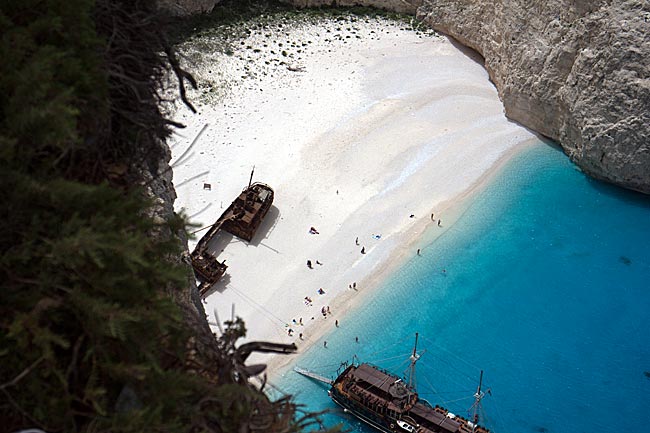
An island defined by the Caretta caretta
When searching for images of the 406 km² island online, one primarily encounters a very common recurring motif that has been captured from a similar angle by various photographers over the years: Navagio Bay on the northwestern coast. It's all junk, right? Well, that is a matter of perspective, and there are plenty of those during the season, whether they have a camera or not. The fact remains, however, that the rusting wreck of the motor vessel "Panagiotis" has become a landmark for Zakynthos.
read more about Zakynthos ...
More photos